Northeast
Hunter Biden trial enters day 4 after wild testimony from exes on rampant drug use, trashed hotel rooms

WILMINGTON, DEL. — Details about Hunter Biden’s relationship with a 24-year-old stripper, his need for crack cocaine every 20 minutes and how his spiraling addiction torpedoed his first marriage were on full display for the jury as it considers the first son’s three felony charges related to the purchase of a revolver in 2018.
“He would want to smoke the second he woke up,” Biden’s ex-girlfriend, Zoe Kestan, testified Wednesday. She met Biden when she worked at a gentleman’s club in New York City when she was 24 and he was 48.
The court heard continued testimony from FBI Special Agent Erika Jensen on Wednesday, as well as from Biden’s ex-wife Kathleen Buhle, Kestan and gun shop employee Gordon Cleveland, as prosecutors worked to prove to the jury Biden lied about his drug addiction when he filled out a federal form to buy a Colt revolver gun in 2018.
Biden is facing charges of making a false statement in the purchase of a gun, making a false statement related to information required to be kept by a federally-licensed gun dealer and possession of a gun by a person who is an unlawful user of or addicted to a controlled substance.
HUNTER BIDEN TRIAL ENTERS 3RD DAY WITH CROSS-EXAMINATION OF FBI AGENT
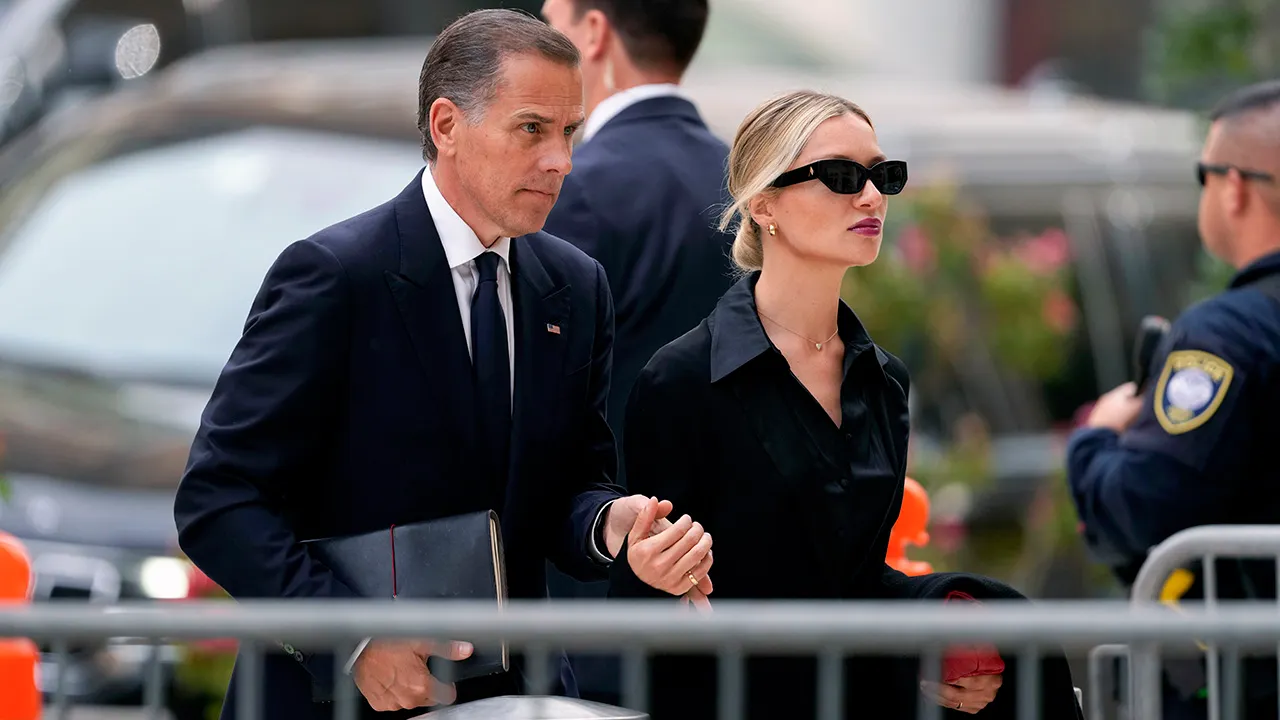
Hunter Biden arrives to federal court with his wife, Melissa Cohen Biden, on June 5, 2024, in Wilmington, Delaware. (AP Photo/Matt Slocum)
Biden pleaded not guilty in the case.
The total maximum prison time for the three charges could be up to 25 years. Each count also carries a maximum fine of $250,000 and three years of supervised release.
Kestan detailed in her testimony that she met Biden in December 2017 after he booked a private room for 30 minutes at the strip club where she worked, ultimately sparking a relationship with the man she described as “charming and charismatic.” Kestan, who testified under immunity, walked the jury through Biden’s rampant drug abuse throughout their relationship, including him smoking crack in hotel rooms, stealing away to public bathrooms to smoke crack and how she helped pick up drugs for him. She said the crack cocaine he purchased often was the size of a “ping pong ball,” which he broke into pieces and lit up in glass pipes.
‘LIKE A SON’: FORMER TOP BIDEN ADVISER WITH DEEP BUSINESS TIES TO CHINA SPOTTED INSIDE HUNTER BIDEN GUN TRIAL
Kestan described that Biden was a “super charming” man when she first met him and that she was “confused” about how he was able to appear coherent and cognizant after smoking the hard drug.
“I didn’t notice it. Sometimes I think that’s because I was catching feelings for him,” she told the court.
Kestan said their whirlwind relationship was a “distraction” for Biden, as he allegedly smoked less when they were hidden away, sometimes for days at a time, in ritzy hotel rooms such as New York City’s Four Seasons or in a bungalow at Los Angeles’ Chateau Marmont.
Kestan detailed the rise and fall of their relationship, including how he called on her to clean up one of the trashed hotel rooms that was littered with crack residue, pipes, snacks and alcohol. He also asked her to pick up his car after it was towed in Los Angeles in 2018.
HUNTER BIDEN’S WIFE LASHES OUT AT FORMER TRUMP AIDE DURING COURT APPEARANCE: ‘PIECE OF S—‘
A court sketch depicts Hunter Biden’s ex-girlfriend, Zoe Kestan, in federal court in Wilmington, Delaware, on Wednesday, June 5, 2024. (William J. Hennessy Jr.)
Accompanying Kestan’s testimony were photos depicting crack pipes in hotel rooms often sitting next to bottles of liquor or beer, a photo of a bare-chested Biden in a bubble bath with Kestan and a screenshot of a FaceTime video showing Biden’s back tattoo that resembled claw marks. The jurors were told amid Kestan’s remarks that Biden learned how to cook crack cocaine, and they were shown a photo of baking soda in one hotel room used to cook cocaine into crack.
Kestan said Biden often spoke about how he was an addict and wished to get sober, including his attempt to purge his body of drugs with frog venom called “kambo.”
HUNTER BIDEN’S DRUG USE: WHAT THE PROSECUTION NEEDS TO PROVE AND WHAT WE ALREADY KNOW
Though Kestan knew Biden before and after purchasing the Colt revolver in October 2018, the pair did not speak the month of the purchase, rekindling their relationship in November 2018 before it officially ended.
A court sketch depicts Hunter Biden’s trial in federal court in Wilmington, Delaware, on Wednesday, June 5, 2024. (William J. Hennessy Jr.)
Buhle, Biden’s ex-wife of more than 20 years with whom she shares three daughters, also took the stand Wednesday. Buhle and Biden divorced in 2017 after Buhle found a crack pipe on the side porch of their home in Washington, D.C., in 2015, she told the court.
Buhle was soft-spoken and appeared emotional during her testimony as she detailed her suspicions of his rampant drug use after he was discharged from the Navy Reserves for testing positive for cocaine and the subsequent death of their marriage. “I was definitely worried, scared,” she said, describing how she would scour his car for drugs and drug paraphernalia to ensure their daughters would not drive the vehicle around with the substances.
Buhle said following the discovery of a crack pipe at their home in 2015, they participated in couple’s therapy before the marriage ended. Buhle said she does not remember the date they officially terminated their marriage, only saying it occurred on Good Friday of 2017.
HUNTER BIDEN TRIAL: 9 KEY FIGURES WHO MAY TESTIFY
Hunter Biden’s former wife, Kathleen Buhle, departs the federal courthouse after taking the stand during Biden’s trial on criminal gun charges in Wilmington, Delaware, June 5, 2024. (Reuters/Kevin Lamarque)
Buhle was on the stand the shortest amount of time among witnesses and deeply exhaled as she quickly left the courtroom Wednesday morning.
Jurors were apparently rapt by Buhle’s presence in the court following relatively dry continued testimony from Special Agent Jensen, who discussed Wells Fargo bank records early Wednesday morning. Nearly all the jurors were jotting down notes or at least holding their notepads and pens when Buhle first took the stand.
Following testimony from Hunter’s ex-wife and ex-girlfriend, prosecutors next called on Cleveland, the gun shop employee who sold Biden the revolver in October 2018.
US V HUNTER BIDEN: OPENING STATEMENTS TO BEGIN IN FIRST SON’S FEDERAL GUN TRIAL AFTER JURY SEATED
Cleveland, who previously worked as a salesman at StarQuest Shooters & Survival Supply in Wilmington, detailed the sequence of events on Oct. 12, 2018, down to the detail of Biden driving a black Cadillac the day of the purchase.
“I like guns, and I like cars,” Cleveland told the court when asked how he remembers what Biden was driving. The comment elicited chuckles among the jury, members of the media and others in the courtroom.
Gordon Cleveland departs federal court Wednesday, June 5, 2024, in Wilmington, Delaware. (AP Photo/Matt Slocum)
Cleveland said Biden entered the store late in the afternoon in 2018 with the intention of buying a gun. Biden bought a Cobra Colt .38, a box of ammunition, a speed loader for the gun and a BB gun.
Cleveland said he gave Biden a federal gun form to fill out, explaining he instructed him to take his time and answer the form “truthfully.” Cleveland said he was about two feet from Biden as he filled out the form, including question 11 E, which asked whether he was an unlawful user of or addicted to drugs. Biden checked the box that said he was not addicted to drugs.
A court sketch depicts Hunter Biden’s trial in federal court in Wilmington, Delaware, on Wednesday, June 5, 2024. (William J. Hennessy Jr.)
Cleveland laughed when defense attorney Abbe Lowell asked if he was “familiar with the phrase whale hunter?”
“Yes,” he responded, chuckling before arguing that although he “didn’t do up-sales,” he was able to sell expensive guns to customers, such as two Desert Eagles, in a single day.
When asked if Cleveland often sold ammunition along with a gun sale, the court again broke into laughter over the former salesman’s response.
HUNTER BIDEN’S CRIMINAL TRIAL ON FEDERAL GUN CHARGES BEGINS WITH JURY SELECTION
”What are you gonna do? Throw [a gun] at somebody?” he quipped, noting ammo was often sold alongside a gun.
In opening statements on Tuesday, the defense team argued Biden’s gun purchase was hurried by gun shop employees seeking to make a sale. Cleveland, however, was confident in his responses to Lowell on Wednesday that Biden was the one to ultimately choose the Colt revolver, the ammo and speed loader. The purchase of the BB gun, he said, was a decision solely made by Biden. The BB gun is one that had the appearance of an actual handgun, lacking the traditional orange tip found on most other BB guns.
Jurors were shown the gun, box of ammunition and speed loader in court Wednesday.
Biden was joined by stepmother Jill Biden for the third day. She again took a front-row seat behind the first son. She wore a bright pink suit and matching heels, casually chatting with family members and allies throughout the day, but she sat quietly with her legs crossed and hands clasped over her knees. She was again seated next to Biden’s second wife, Melissa Cohen Biden.
Hunter Biden, left, departs federal court with his wife, Melissa Cohen Biden, on Wednesday, June 5, 2024, in Wilmington, Delaware. (AP Photo/Matt Slocum)
Court resumes Thursday at 9 a.m. with continued cross-examination of Cleveland. Prosecutors announced late Wednesday they have six additional witnesses who will take the stand and could rest their case as soon as Thursday afternoon.
Biden’s former romantic partner and sister-in-law, Hallie Biden, Beau Biden’s widow, could be among witnesses who take the stand Thursday.
The defense team’s witnesses will take the stand after prosecutors rest their case.
Read the full article from Here


The 24-year-old forward had a career-high 68 points (27 goals, 41 assists) in 2024-25 with the Sabres before getting traded to Utah in June, 2025. Peterka posted 47 points (25 goals, 22 assists) through 82 games in his first year with the Mammoth.
“He’s got an elite shot. Probably gives us another look on the elbows in a power play situation. His power play minutes dipped a little bit last year; his 5-on-5 production has been really good, plays both wings, can probably play with a couple different types of centers,” Sweeney said.
Peterka had a similar assessment for himself.
“I think a pretty fast game, likes to score goals,” he said. “Just overall, exciting player that loves to make plays.”
Sweeney also sees a versatility in Peterka’s game that can benefit his new teammates up and down the lineup.
“I think he fits into a good group age-wise because he’s able to have played in the league with all the experience he’s had, the success he’s had, so he can ride shotgun with David because he has had scoring,” Sweeney said. “He can go down and drive a line, which he has done.”
The prospect of him playing with someone like David Pastrnak is something that excites both Sweeney and Peterka.
“That would be pretty sick, not going to lie,” Peterka said. “If you have that caliber of a player, I think everyone wants to play with him. From the past, playing against him, even watching him, was always super special. I would be super honored, for sure.”
While Peterka has already played four full seasons in the NHL, he still has his whole career in front of him. He joins a young new wave of Bruins players – alongside the likes of Reichel, Fraser Minten, Marat Khusnutdinov and James Hagens – who will carve the future identity of the team. The ceiling is high for Peterka.
“In JJ’s case, he has had success. We have to come in and put him in the right situations so he continues to score at the level we think he can. Morgan [Geekie] is a great example,” Sweeney said. “Did we think he was going to score 39 goals when we first acquired him? No. But that’s always the hope – that a player will take advantage of a new opportunity and playing with different types of players than what they were in their other environment.”
Peterka is ready for the challenge and to prove that he has another gear to his game to help the Bruins win.
“I think it’s always nice to have a fresh start. I think especially after the year I had last year where I wasn’t really happy with the performance I put on the ice,” Peterka said. “For me, I feel like it’s a fresh start. And for a team like Boston, it couldn’t be any better.”

The Pittsburgh Penguins got what they wanted.
Friday night was life-changing for Pittsburgh Penguins’ first-round pick Liam Ruck of the Medicine Hat Tigers. The organization selected him with the 22nd overall pick. Saturday morning was life-changing for his identical twin brother Markus Ruck as the Penguins used the first of their second-round picks to select him.
And the twins and teammates in Medicine Hat, who have spent only four days apart in their first 18 years, got what they wanted, too. They’re both Pittsburgh Penguins.
Penguins general manager Kyle Dubas told reporters Friday night, following the conclusion of Round One, that it appeared more likely in the days leading to the draft that the team would not be able to trade up and that Liam Ruck would be available to them.
There were credible rumors emanating from the league side that some teams considered taking Markus to spur trade talks with the Penguins, but eventually, the other half of the WHL’s high-scoring duo was available Saturday morning with the 39th overall pick.
While Liam had 45 goals and 104 points in 68 games, Markus was the slick playmaking center who kept him fed. Markus Ruck had 108 points with 87 assists. Both brothers need to both add bulk but also improve their skating, which scouts consider a weakness.
Liam is the slightly larger twin, at 6-foot, 177 pounds. Markus weighs in at 6-foot, 167 pounds.
The story is developing, and Pittsburgh Hockey Now will update the story after Markus Ruck speaks with the media.
Categorized:2026 NHL Draft Pittsburgh Penguins

A person who was reported missing late Friday night in Brookfield has been found dead.
Police received a report of a missing person around 11 p.m. As officers were searching the area, they said they found an ATV off of the roadway and in the woods on Candlewood Shores Road.
According to investigators, the sole occupant of the ATV was found dead at the scene. The person’s identity has not yet been released.
The investigation is active and ongoing. Anyone with information is asked to contact Officer Brian Flanagan at (203) 740-4169.
-
 Entertainment54 seconds ago
Review: A mesmerizingly vulnerable Angelina Jolie fails to fully redeem ‘Couture’
-
 Lifestyle8 minutes ago
He turned his one-bedroom West Hollywood apartment into an entertainer’s paradise
-
 Politics11 minutes ago
Quicker count, bigger turnout: L.A. County certifies 2026 primary election ballots
-
 Science16 minutes ago
Water from Boyle Heights warehouse fire carries foam into L.A. River, sparks testing
-
 Sports23 minutes ago
Cameron Carr on Lakers acquiring him draft night: ‘It didn’t feel real’
-

 World31 minutes ago
Why is Crimea critical to the Russia–Ukraine war?
-
 News56 minutes ago
As Supreme Court expands Trump’s immigration power, experts warn of steeper U.S. population decline
-

 Los Angeles, Ca2 hours ago
About 20 detained after armed suspect call sparks LAPD response in Koreatown

