West
Ex-criminology professor jailed for 5 years for 'arson spree' during Dixie Fires

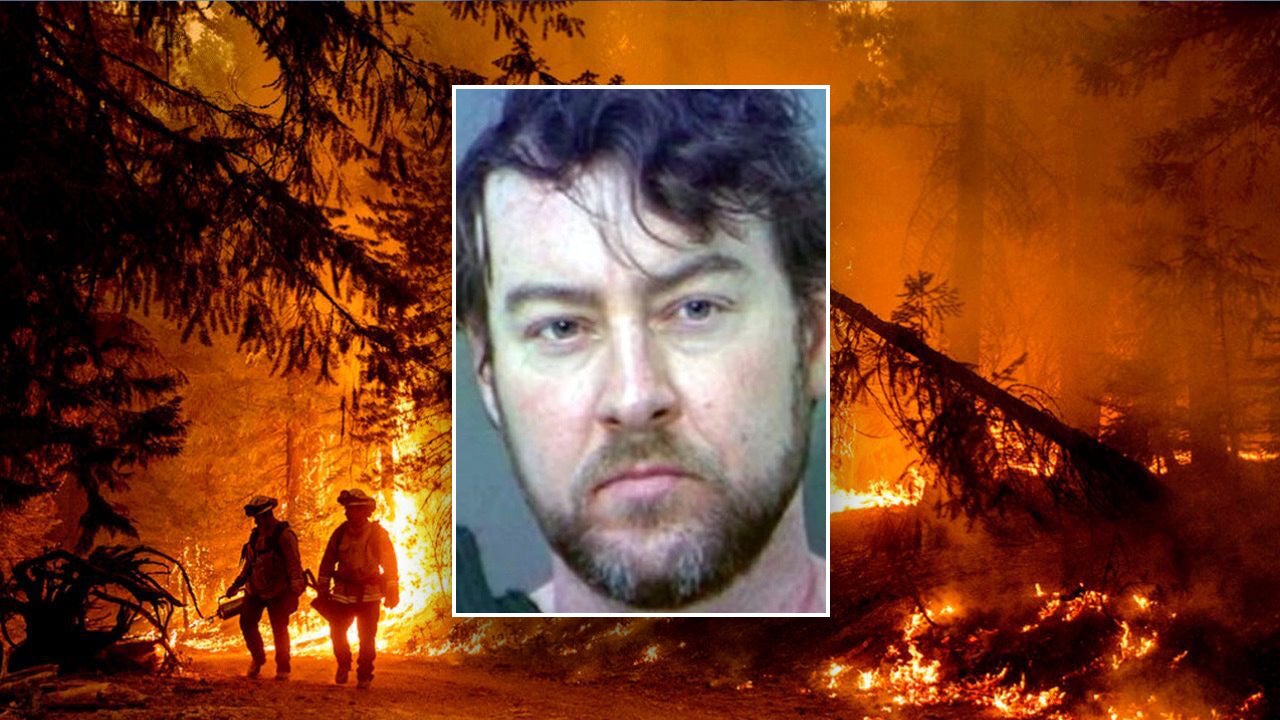
A former college professor who specialized in social deviancy was sentenced on Thursday to more than five years in prison for starting four fires in 2021, some of which threatened to trap firefighters as they responded to one of the largest wildfires in California history, the U.S. Attorney’s Office for the Eastern District of California said.
Gary Stephen Maynard, 49, pleaded guilty in February to three counts of arson on federal property after he set fires behind crews battling the Dixie Fire, which became the second-biggest wildfire in California history, scorching more than 1,500 square miles and destroying more than 1,000 structures.
Maynard, of San Jose, admitted to starting four fires: the Cascade and Everitt fires on July 20 and 21, and the Ranch and Conard Fires on Aug. 7. He pleaded guilty to three as part of a plea deal and was jailed for 63 months in total. The fires were extinguished before they could destroy any buildings, according to prosecutors.
DIXIE FIRE BECOMES LARGEST SINGLE WILDFIRE IN CALIFORNIA HISTORY
Gary Stephen Maynard was sentenced on Thursday to five years and three months in prison for starting four California wildfires in 2021, (Gary Stephen Maynard )
“Maynard went on an arson spree on federal land while California faced one of the worst fire seasons in history,” U.S. Attorney Phillip Talbert announced.
“He intentionally made a dangerous situation more perilous by setting some of his fires behind the men and women fighting the Dixie fire, potentially cutting off any chance of escape. It is only because of the quick response by the U.S. Forest Service — and the actions of civilian witnesses — that those fires were extinguished as quickly as they were.”
Forest Service agents started investigating Maynard on July 20 after the Cascade Fire was reported on the western slopes of Mount Shasta.
An investigator found Maynard underneath his black Kia Soul that had its front wheels stuck in a ditch and its undercarriage centered on a boulder, court papers said. He was living out of his vehicle at the time.
EX-PROFESSOR CHARGED WITH STARTING FOUR CALIFORNIA WILDFIRES
A firefighter sprays water along Highway 89 near South Lake Tahoe, in California on Sept. 2, 2021. (AP Photo/Jae C. Hong)
A second fire erupted the next day on Mount Shasta, and investigators later found tire tracks similar to those made by the Kia.
They eventually placed a tracking device under Maynard’s car which confirmed he had traveled to the area where the Ranch and Conard Fires erupted in the Lassen National Forest.
Assistant U.S. Attorney Michael Anderson wrote in a detention memo that Maynard had entered the evacuation zone and “began setting fires behind the first responders fighting the Dixie Fire.”
In sentencing memorandums, Maynard’s attorney said her client was suffering from untreated and significant mental health issues when he set the fires and has sought treatment since then.
Maynard was an adjunct faculty member at Santa Clara University from September 2019 to December 2020 and he had also taught criminology and sociology at Chapman and Sonoma State Universities, the New York Times reports, citing prosecutors. He specialized in criminal justice, cults and deviant behavior.
A Santa Clara University colleague of Maynard’s told the police in October 2020 that Maynard was struggling with anxiety, depression, split personality and wanted to kill himself, the complaint said, per the New York Times.
Scorched cars and trees after a wildfire in Plumas County, California, in 2021. (AP Photo/Noah Berger)
Maynard was also sentenced to three years of supervised release and ordered to pay $13,081 in restitution as part of the plea agreement.
The Dixie Fire began on July 13, 2021, with fire eventually scorching the Plumas National Forest, Lassen National Forest and Butte, Lassen, Plumas and Tehama counties.
The fire cost more than $610 million over three months to bring it under control, the most expensive in California history, according to the head of Cal Fire.
The Associated Press contributed to this report.
Read the full article from Here


Baker County was 1st official jurisdiction in Eastern Oregon
Published 9:00 pm Monday, June 29, 2026
Although Native Americans had lived in what became Northeastern Oregon for millennia, when the Declaration of Independence was signed on July 4, 1776, the better part of a century would pass before settlers began to start towns in the region.
Tens of thousands of immigrants rolled through the area, following the Oregon Trail, starting in the 1840s.
Although their destination was the trail’s end at Oregon City, and ultimately a farm in the Willamette Valley, eventually some retraced the ruts to the northeast corner of Oregon, which became the nation’s 33rd state on Feb. 14, 1859, while others halted their wagons in the valley of the Powder or Grande Ronde river, or in the Columbia Basin on the west side of the Blue Mountains.
The first post office in Eastern Oregon actually predates the state. The Umatilla post office was established on Sept. 26, 1851, although it was closer to present-day Echo than to the city of Umatilla. The post office closed just a year later.
The region’s first official jurisdiction was Baker County, which the Oregon Legislature carved out of Wasco County on Sept. 22, 1862.
That was prompted by the region’s first gold rush, which followed Henry Griffin’s discovery of gold in a gulch, a few miles southwest of what would become Baker City, on Oct. 23, 1861.
Just five days after designating Baker County, on Sept. 27, 1862, lawmakers shrunk Wasco County even more by creating Umatilla County.
Two years later, on Oct. 14, 1864 — apparently a busy day in Salem — the legislature added two more counties in Grant and Union.
Grant County was made of parts of Umatilla and Wasco counties, while Union County was originally part of Baker County.
On Oct. 14, 1887 — it’s not clear why Oct. 14 seems to have been 19th century lawmakers’ favorite day to create counties — the legislature designated a chunk of eastern Union County as Wallowa County.
In many cases, such as Umatilla, post offices were started before towns were incorporated.
And most cities in the region were settled years, or even decades, before they were incorporated.
People were living in what became Baker City, for instance, in 1863, but the city was platted in 1865 and incorporated in 1874, eight years after the post office was established.
La Grande was already a town when it was incorporated in 1865.
And two cities — Umatilla and Canyon City — were incorporated even earlier, in 1864.
Incorporation dates for other cities in the region:
Pendleton: 1880
Hermiston: 1907
Heppner: 1887
Boardman: 1921
Milton-Freewater: 1950 (Milton, 1873; Freewater, 1890)
Enterprise: 1889
Elgin: 1891
Echo: 1904
Haines: 1909
Halfway: 1909
Huntington: 1891
Imbler: 1922
Ione: 1903
Irrigon: 1957
Island City: 1904
John Day: 1901
Joseph: 1887
La Grande: 1865
Lexington: 1903
Long Creek: 1891
Mount Vernon: 1948
North Powder: 1903
Pilot Rock: 1911
Prairie City: 1891
Richland: 1917
Stanfield: 1910
Sumpter: 1901
Summerville: 1885
Union: 1878
Unity: 1972
Wallowa: 1899
Weston: 1878
Athena: 1904

Three firefighters were killed Saturday while battling two wildfires near the Colorado-Utah border, the U.S. Wildland Fire Service announced.
Emily Barker, 38, was from Michigan; Nick Hutcherson, 27, was from Arizona; and Sydney Watson, 26, was from Alabama.
Loved ones and friends started sharing tributes on social media, and FOX 13 News spoke to the loved ones of Emily Barker.
It all started when Sarah Brubeck was looking for a roommate in Colorado.
“Emily answered a random Craigslist ad,” Brubeck said. “We didn’t even know we had so much in common, so we had multiple hockey bags in our garage and multiple snowboards.”
Little did Brubeck know, she was getting a lot more than just a roommate.
“Grew to be more sisters than friends,” she said.
3 firefighters killed in wildfires
Just a couple of states over, Barker had touched the life of Kayla Lindsey.
“I met her when I was doing my interagency fire season with USFS and BLM Idaho,” she said. “You cannot see Emily and not want to talk to her.”
However, both friends’ worlds came crashing down when they heard the news that three firefighters did not make it while responding to the Knowles Fire along the Colorado-Utah border.
“One of our teammates was like, ‘Hey, Emily, let us know you’re safe,’ and she didn’t respond,” Brubeck said. “I just assumed she was out of service, and she would respond when she could, but she couldn’t.”
“I saw it first on Facebook,” Lindsey said. “I just kept reading it over and over, like, ‘That’s not the Emily Barker, I know that’s not my Emily.’”
Barker had died during a burn-over incident, something that hits close to home for Lindsey.
“I remember my first state fire, we pulled our shelters, and that’s never a good feeling. You never want to have to hear the words, ‘Get to your safety zone,’” she said. “I couldn’t imagine as strong as Emily was, how scared she must have felt when that happened, because that’s a terrible way to go.”
“She was more than life itself,” Lindsey added through tears. “She took so much interest in every person she met. She loved her job.”
While the world is getting to know Barker as a hero, her friends said it’s who she’s been all along.
“Showing up to house sit for free while we’re on our honeymoon or offering to carry someone’s hockey bag — she just gave of herself constantly,” Brubeck said.
“Didn’t matter how much she didn’t have in her cup, she always tried to fill everyone else’s,” Lindsey added. “I just wish we had more Emilys in the fire service.”
A wildland firefighter who knew the victims in Utah released the following statement:
“It’s times like these we’re reminded how truly dangerous our jobs are. Fire is the only natural disaster we ask men and women to stand in front of and stop. While we are often successful, sometimes the power of fire overtakes us, despite our best efforts and safest decision making. As we see so much criticism online about how we do our jobs, please remember our ultimate goal is to get every firefighter home safely. Saturday, we failed. The loss of Emily, Nick, and Sydney is burned in our souls. Our agencies and firefighters are hurting. We appreciate the public support now. And we hope that continues long after this has been forgotten for most of you. Because, for us, it is never forgotten. Every decision“It’s times like these we’re reminded how truly dangerous our jobs are. Fire is the only natural disaster we ask men and women to stand in front of and stop. While we are often successful, sometimes the power of fire overtakes us, despite our best efforts and safest decision making. As we see so much criticism online about how we do our jobs, please remember our ultimate goal is to get every firefighter home safely. Saturday, we failed. The loss of Emily, Nick, and Sydney is burned in our souls. Our agencies and firefighters are hurting. We appreciate the public support now. And we hope that continues long after this has been forgotten for most of you. Because, for us, it is never forgotten. Every decision, every pause in action, is because of a lost firefighter. To our fallen comrades… we’ll take it from here.”

WASHINGTON (7News) — D.C. is looking forward to an economic boost from added tourists this summer.
Tourism numbers for the America 250 celebration are looking positive. Hotel bookings are up, as D.C. prepares to celebrate America’s birthday.
The National Mall is ground zero for the 4th of July festivities, with the Folklife Festival, the 4th of July Parade, fireworks and free museums. Plus, this year, there is an extra emphasis on historic and cultural exhibits. 50 million visitors are estimated to inject millions into the local economy.
SEE ALSO | ‘Packed to the brim’: Trump says 45K guests attend Great American State Fair rally
“It’s very hard right now for us to tell you exactly what the economic impact is. overall, events like this, we typically don’t know the impact until after the event has taken place,” said Elliott Ferguson, Destination DC CEO.
According to Destination DC, 27.2 million people visited D.C. in 2025, up 20,000 visitors from the year before. They spent almost $12 billion, bringing in $2.5 billion in tax revenue and creating more than 114 thousand jobs.
SEE ALSO | World Cup delivers win for America’s economy, image
International visitation declined by 4%.
This summer of 2026, hotel bookings are up. More than two dozen hotels have DC250 packages, hoping to attract overnight guests. Luxury hotels are reporting record packages.
Visitors to the District pump billions directly into the local economy, accounting for over $11.4 billion in recent annual visitor spending and generating $2.3 billion in local tax revenue. And there’s a strong demand for the July 4 period.
D.C. has also secured 18 conventions for 2026, estimated to bring in $317(m) according to Exhibitor Online. This influx saves the average D.C. household more than $3,600 in taxes.
“As we look at the events with America’s 250 and the events that this Trump administration is bringing to the city, it has been positive for the industry,” Ferguson added.
Major openings are adding to the expected summer tourism boom, including the National Geographic Museum, renovations to the Air and Space Museum, and the new Lincoln Memorial Undercroft exhibit. The Freedom 250 Grand Prix of Washington, D.C., will take place Aug.22 to 23, 2026, marking the firstever IndyCar series race on the National Mall.
These tourism dollars are critical, saving the average D.C. household more than $3,600 in taxes, as D.C. is facing headwinds from reductions to the federal workforce and commercial real estate challenges.
-

 Oregon3 minutes ago
Baker County was 1st official jurisdiction in Eastern Oregon – La Grande Observer
-

 Pennsylvania8 minutes ago
Editorial: Classrooms reflect Pennsylvania’s demographic reality
-

 Rhode Island15 minutes ago
Rhode Island wins 5 gold medals at 2026 Special Olympics
-

 South-Carolina18 minutes ago
Hricik launches no-money pledge campaign for SC attorney general
-
South Dakota23 minutes ago
SD Lottery Powerball, Lotto America winning numbers for June 29, 2026
-

 Tennessee30 minutes ago
PHOTOS: The Strawberry Moon lights up Middle Tennessee Monday night
-

 Texas33 minutes ago
Hot, muggy and breezy conditions continue for North Texas ahead of Fourth of July
-
Utah38 minutes ago
‘She gave of herself constantly’: Loved ones remember woman killed in Utah-Colorado wildfire

