Washington, D.C
Parents tote toddlers to D.C. to press for expanded child tax credit, child care funds • Michigan Advance


WASHINGTON — Families gathered outside the U.S. Capitol Tuesday to “make a fuss for babies,” who they believe are being left behind by lawmakers who direct only a fraction of U.S. resources to young children.
Parents and kids representing 50 states and the District of Columbia convened for the eighth annual “Strolling Thunder.” Moms and dads pushing strollers decked out in state license plates rallied on the Capitol’s East Lawn to lobby lawmakers to fund child care, establish national paid family leave, and permanently expand the child tax credit.
Matthew Melmed, executive director of ZERO TO THREE, the organization behind the event, rallied parents to tell their representatives that the 11 million babies in the U.S. “make up 3.4% of our population, but 100% of our future.”
“You’re here with the pork producers and the insurance lobby and the pharmaceutical industry. Members of Congress don’t normally see real people, and they rarely see babies and toddlers, particularly babies and toddlers who need to have their diapers changed on their desks. And that’s what I encourage you to do if you need to have that happen,” Melmed told the crowd.
The nonprofit ZERO TO THREE bases its advocacy on health and developmental research findings in infants up to age 3, the years the group describes as “the most important for lifelong mental health and well-being.”
Melmed praised top Democratic appropriators Sen. Patty Murray of Washington and Rep. Rosa DeLauro of Connecticut for achieving a $1 billion increase for child care block grants and Head Start in this year’s government funding bills.
DeLauro, who spoke to the crowd, said “families deserve better.”
“The cost of living has increased year after year, and more and more Americans simply do not get paid enough to live on, let alone to raise a family,” the Connecticut lawmaker said, promising to advocate for the reinstatement of a fully refundable child tax credit.
‘Diapers, child care, formula’
Candace Winkler, a former Alaska resident and current ZERO TO THREE leader, sat on the Capitol lawn next to Sabrina Donnellan who traveled to D.C. from Girdwood, Alaska, with her 13-month-old Blakely to advocate for lower child care costs and paid family leave.
Winkler, the organization’s chief development and strategy officer, said the group of families would divide up in the halls of Congress Tuesday to meet with their representatives about six key policy issues, including permanently expanding the child tax credit to pandemic levels.
“We’ve seen that time and time again that families are using those resources for diapers, child care, formula and things their babies and their family needs. And it’s really critical for their success,” WInkler said.
The current child tax credit is $2,000 a year after tax liability, but the amount a parent could receive per child under 17 in a refund check is capped at $1,600 in 2023. The credit phases in at 15% on every dollar after earnings of $2,500.
As the U.S. was digging out from under the COVID-19 economic crisis, Congress approved a one-year expansion of the tax credit to $3,000 per child under age 18, and $3,600 for those under age 6 — including for families who made $0 in income. Lawmakers made the entire amount refundable, and a portion of it was sent to families in monthly installments.
Advocates hailed the research findings that showed the temporary move was a game changer for lifting children from poverty in the U.S.
A current bipartisan proposal, widely supported by U.S. House lawmakers, to temporarily expand the child tax credit until 2025 — though not to pandemic levels — is currently stalled by U.S. Senate Republicans who liken aspects of the bill to a welfare program.
The proposal, as passed by the House, would increase the credit’s refundable portion to $1,800 in 2023, $1,900 in 2024 and $2,000 in 2025. The legislation would also increase the phase-in rate to 15% per child, simultaneously — in other words, 30% for a family with two children, 45% for a family with three, and so on.
Credit card debt for child care
Cruz Bueno, a parent from Rhode Island, shared her story of racking up credit card debt to enroll her 11-month-old Rosie in child care, along with her 2-year-old sister Amalia.
“Putting Rosie into daycare means that we must put a halt to our dream of buying a home,” said Bueno, an economist who lives in Warwick with her husband, Xhuljan Meta.
“One of the stipulations of our mortgage pre-approval was to keep our credit card balances low. Even so, we remain hopeful that one day in the not-so-distant future we will be able to buy a home to raise our girls and pass on wealth to them,” she said.
When asked about the Strolling Thunder event at Tuesday morning’s regularly scheduled House Republican press conference, House Speaker Mike Johnson of Louisiana said, “There’s lots of ideas out there. What we stand for, what our party stands for, is support of families. We support infants and children, and there’s an appropriate role to play in that.”
“The devil’s always in the details on legislation, so I’m not sure exactly what they’re proposing, but all of us are looking at those avenues. We want to support families. That’s good public policy,” Johnson said. “In our view, the best way often for the government to do that is to step back and allow the local and state officials to handle their business at that local level.”
Rep. Elise Stefanik, House Republican Conference Chair, said the GOP is “proud to be a pro-family conference.”
“There are many of our members who have proposed innovative solutions — one is rural child care. Home-based child care, that’s an issue I’ve worked with many of my colleagues on the Education and Workforce Committee,” Stefanik, of New York, said. “But the economy, the border, crime, these issues, these crises caused by Joe Biden, they impact every family.”



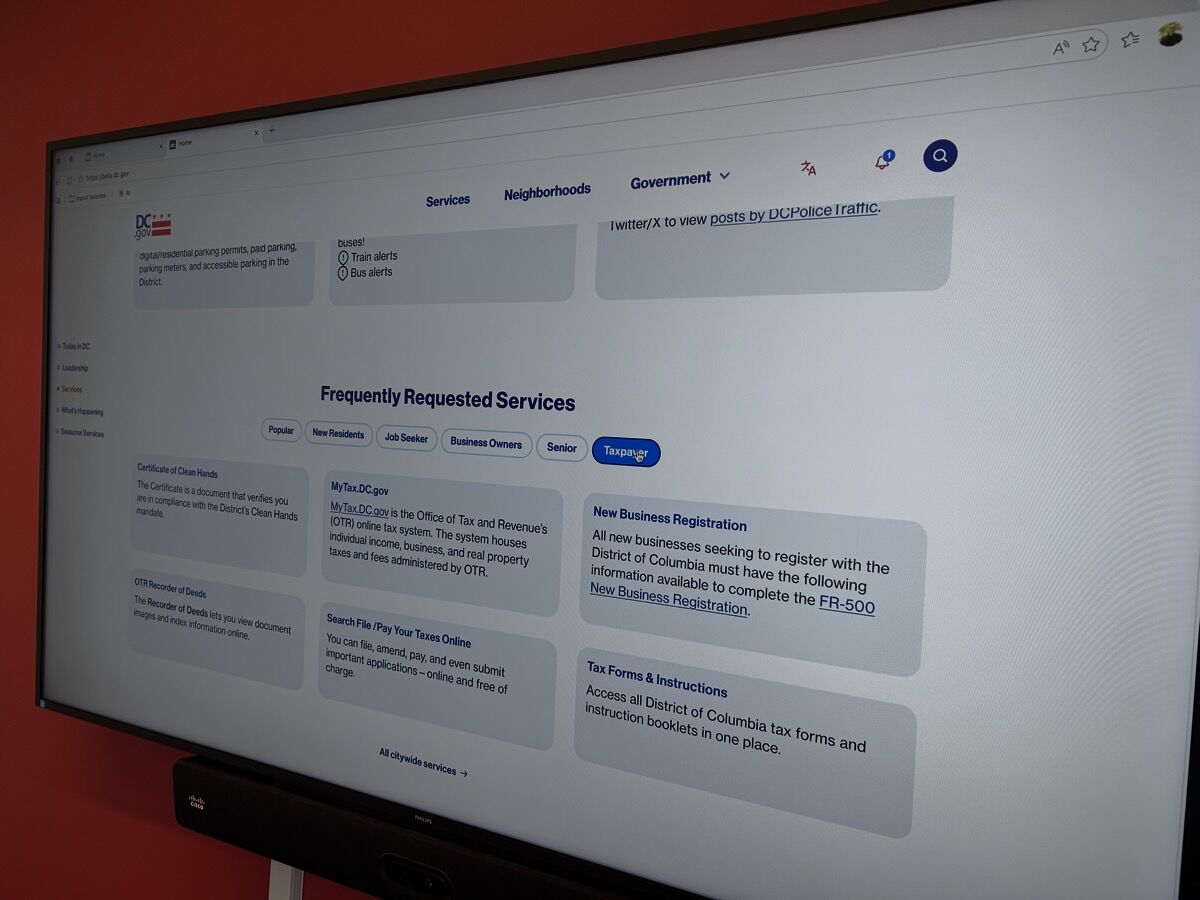
The overhaul is the first in more than a decade and comes in response to feedback that it’s hard to find information on the current site without being efficient at using Google or other search tools.

The D.C. government’s website is getting a complete revamp, a step city leaders hope will make it easier for residents, visitors and business owners to access the help they need.
The District unveiled a beta version of the new DC.gov — beta.dc.gov — and plans to have the redesigned site ready to launch before the end of the year.
The website’s overhaul is the first in more than a decade. It comes in response to feedback that it’s hard to find information on the current site without being efficient at using Google or other search tools.
“This website, it’s really going to eliminate the alphabet soup that you have to remember every day,” said Stephen Miller, the District’s chief technology officer. “So, do you need to know that it’s DPW that’s picking up your trash, or you just need to know that it’s dc.gov?”
The site is built on Drupal 11, which the city said has stronger built-in security features. It includes an integrated calendar and sections for seasonal government services.
Popular searches, based on site traffic data, will also be featured prominently on the main page.
“It’s going to show you, here’s popular services today, based on being a resident, based on being a new resident, based on being a job seeker, based on being a business owner, or based on just being a general resident of the city,” Miller said.
The project cost about $500,000 in dedicated funds.
“We’re setting this up so that you can just go in, say, ‘My trash was missed,’ and it’s going to tell you exactly how to fix that problem,” Miller said.
D.C.’s Office of the Chief Technology Officer is collecting feedback. Residents can leave comments on the beta site and at events at Haynes Senior Wellness Center and Eastern Market, among others, in the coming weeks.
An artificial intelligence-powered search tool, built using Google’s AI technology, will be included on the new DC.gov site after its official launch.
The District, Miller said, is “trying to clean up our content, because what we want to make sure is when we put AI into this site, it’s giving you the right information.”
“We see a lot of future use with AI,” Miller said. “I’d love to get to a point where it’s, ‘Hey Siri, renew my driver’s license,’ and we’ve laid out the foundation for something like that to happen in the future.”
Get breaking news and daily headlines delivered to your email inbox by signing up here.
© 2026 WTOP. All Rights Reserved. This website is not intended for users located within the European Economic Area.

A 16-day state fair is among the biggest attractions of the country’s 250th celebration in Washington DC. The Great American State Fair, which features attractions from each of the 50 states, runs from 25 June to 10 July across the National Mall from the US Capitol to the Washington Monument.
The BBC asked visitors why it was important for them to attend the fair.
Video by Meiying Wu
Produced by Madeline Gerber
Washington, D.C
Great American State Fair opens Thursday on National Mall. See hours and security info

The Great American State Fair, celebrating the United States’ 250th birthday, opens Thursday, bringing a Ferris wheel, special exhibits and road closures to the National Mall.
D.C. residents and visitors may have seen a Ferris wheel towering 110 feet over the fairgrounds. It’s free to ride, and it’s the first-ever Ferris wheel to be on the National Mall, a Talley Amusements spokesperson said on social media.
Visitors will also find exhibits representing all 56 states and territories, fair organizers Freedom 250 said, although some states decided not to sponsor programming, several media outlets reported. Metro will showcase its newest and oldest railcars at the fair.
Expect road closures and Metrobus detours into July.
Great American State Fair hours
The Great American State Fair is free and opens to the public at 10 a.m. Thursday. It runs daily through July 10. Each day has a theme, including Make America Health Again (MAHA) Mondays and Military & Veterans Appreciation Day on Sunday, June 28.
Fair hours will be 10 a.m. to 9 p.m. Sunday to Wednesday, 10 a.m. to 11 p.m. Thursday to Saturday.
Fairgrounds will be open 10 a.m. to midnight on July 4, when President Donald Trump promised “the largest pyrotechnics display in the history of the world.”
Great American State Fair security: bag policy and prohibited items
Visitors must go through security at the gates on either 12th or 7th street.
“To enhance security screening and expedite entry into the event venue, all attendees will be required to follow the Clear Bag Policy,” the event’s website says. Bags are subject to inspection.
Bag policy: Each guest may bring one clear, see-through bag that does not exceed 12″ x 6″ x 12″. A small clutch purse not exceeding 10″ x 6″ x 2″ is also permitted. Anyone accompanying a child 6 or under can bring one diaper bag.
Prohibited items: Aerosols (including bug spray and sunscreen), animals, backpacks, food, water bottles, umbrellas, balls, drink tumblers, drones, glass and metal containers, packages, selfie sticks, sign supports, toy guns and weapons of any kind, including firearms, are among prohibited items. See a full list on the event’s website.
Driving and walking anywhere near the National Mall is drastically different as it’s being transformed for the state fair. News4’s Mauricio Casillas reports.
How to get to the Great American State Fair
Organizers recommend you take public transit or ride share. Nearby Metro stations include Federal Triangle and Smithsonian on the Blue, Orange and Silver lines; Archives on the Green and Yellow Lines; and Gallery Places on the Green, Yellow and Red lines.
You can use Metro’s Trip Planner tool or apps like Google Maps to get directions.
“All ride-share services (Uber, Lyft, taxi, etc.) must use the designated Ride-Share Pick-Up & Drop-Off areas. Locations will be updated and communicated at a later time,” the event’s website said on Thursday morning.
President Trump kicked off fair after artists dropped out
Trump formally kicked off the celebrations on Wednesday night with a rally that included a series of flyovers by stealth bombers, military bands and Lee Greenwood singing “God Bless the USA.”
“There has never been anything like the United States of America, and together we are making it bigger and better and stronger and far more exceptional than ever before,” Trump said.
Trump announced he would headline the event after several musicians pulled out of the event’s concert series. Some artists have said they were misled about the event’s theme and want to avoid political controversy.
The event is organized by Freedom 250, a public-private partnership created by Trump that labels itself as a nonpartisan nonprofit organization, NBC News reported.
The fair is just the latest event drawing crowds downtown, prompting extra security and road closures. It follows the UFC fight, problems with the Reflecting Pool and the debut of a FIFA World Cup fan zone.
In August, the Freedom 250 Grand Prix will send cars speeding at 190 mph through D.C.
Subscribe to The Weekend Scene, our free newsletter about events, experiences and adventures for you and for your family around the DMV.
-

 Technology7 minutes ago
World Cup ticket scams target desperate fans
-
Business9 minutes ago
Snap sued by parents of girl who was raped by man she met on Snapchat
-
 Entertainment15 minutes ago
‘The Bear’ at closing time: Ayo Edebiri and Jeremy Allen White reflect on five seasons
-
 Lifestyle22 minutes ago
L.A. Affairs: After decades of near-misses, I finally told him: ‘I’m not leaving here without you’
-
 Politics24 minutes ago
Trump budget request omits funds for L.A. fire relief, prompting criticism from senators
-
 Science30 minutes ago
EPA touts crackdown on smuggled pesticides in L.A. visit
-
 Sports37 minutes ago
Commentary: Did Padres curse themselves by messing with that anti-Dodgers FTD burger?
-

 World44 minutes ago
Copernicus lead warns extreme heat measures needed or deaths to ensue


