Connect with us

Alaska

Alaska Senate passes draft budget, confirming $175M in bonus public-school funding

Published

on

Alaska Senate passes draft budget, confirming 5M in bonus public-school funding


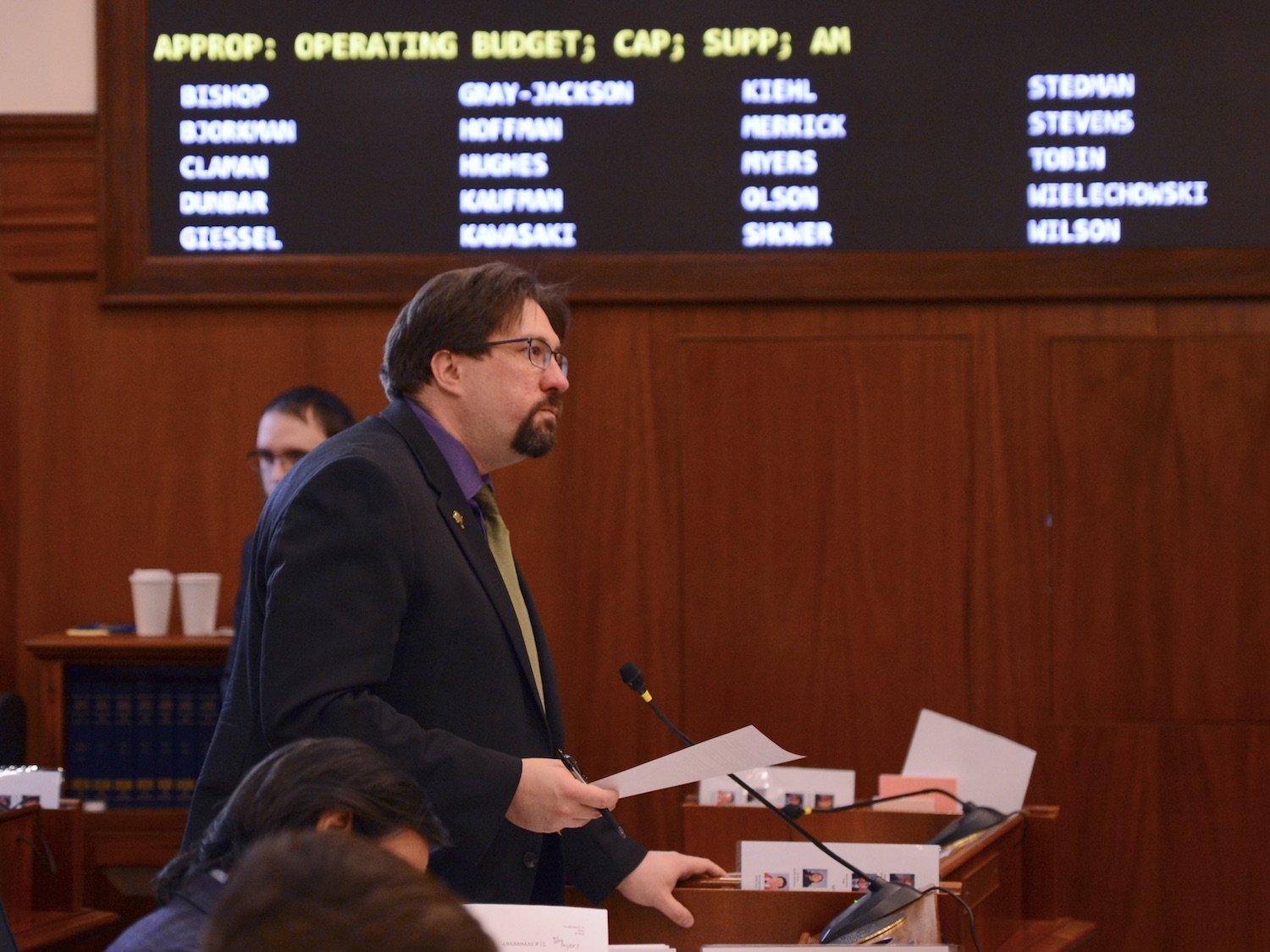
Sen. Bert Stedman, R-Sitka, puts away his notes after debate on the state operating budget, Wednesday, May 1, 2024, as the Senate’s tally board displays the vote on the budget’s effective date. (Photo by James Brooks/Alaska Beacon)

The Alaska Senate on Wednesday approved a draft $12.25 billion state operating budget and in the process, finalized legislative plans to offer public schools a one-time, $175 million funding bonus.

The Senate’s proposed Permanent Fund dividend is about $1,580 per recipient, including an estimated $222 energy relief payment. That’s below the $2,270 figure included in a competing draft passed by the House, and the final figure will be subject to further debate. 

The smaller amount reduces the risk of the state spending down savings.

Advertisement

“We’re living within our means. This is what it looks like,” said Sen. Bert Stedman, R-Sitka and co-chair of the Senate Finance Committee.

lawmakers
Sen. Bert Stedman, R-Sitka, speaks on the floor of the Alaska Senate, Wednesday, May 1, 2024. (Photo by James Brooks/Alaska Beacon)

Stedman said the budget balances if the state’s oil production hits estimates and if North Slope oil prices average $78 per barrel between July 1, 2024, and June 30, 2025.

Oil and other sources of revenue would be enough to pay for state operations, as well as new legislation and the state’s capital budget, which pays for construction and renovation projects statewide. 

Wednesday’s 17-3 vote, which follows the state House’s passage of its own draft operating budget, triggers the final phase of the Alaska Legislature’s annual budget process, where legislators negotiate a compromise between the two drafts.

In places where the drafts match, the relevant item is final, except that Gov. Mike Dunleavy has the ability to reduce or eliminate final items with his line-item veto power. He cannot increase them or add new ones.

On education, the Senate included a $680 one-time boost to the state’s Base Student Allocation, the core of Alaska’s per-student funding formula. 

Advertisement

That’s worth about $175 million statewide, and the same language is in the House’s draft budget, making the item final, except for the governor.

Last year, Dunleavy vetoed half of an identical one-time boost, but in a news conference with reporters on Wednesday, the governor signaled that he may not repeat his veto.

“I’ve told people I’m open to the increase,” Dunleavy said, “an increase in one-time funding, especially to help with the inflationary issues.”

The Senate budget also includes a House-adopted plan to spend $5.2 million more on reading programs for students in kindergarten through third grade.  

Senators included additional money for student transportation, something that will have to be negotiated with the House, which did not include it.

Advertisement

Also subject to further negotiation is $11.9 million in education money added after the federal Department of Education warned that the state underfunded some school districts during the COVID-19 pandemic.

lawmakers
Senate President Gary Stevens, R-Kodiak (center), listens to Sen. Bert Stedman, R-Sitka (left) and Senate Majority Leader Cathy Giessel, R-Anchorage (right) during a break from debates Wednesday, May 1, 2024. (Photo by James Brooks/Alaska Beacon)

The Senate is led by a supermajority of nine Democrats and eight Republicans, and Wednesday’s draft budget was crafted by that supermajority. 

Before the final vote, the three Republicans outside the majority offered 21 amendments containing a variety of priorities, but all failed.

The most contentious amendments dealt with the amount of this year’s Permanent Fund dividend, which Stedman labeled “the focal point of most budgets.”

Sen. Mike Shower, R-Wasilla, proposed taking extra money from the Alaska Permanent Fund to increase the Senate’s proposed dividend to a figure above the House’s amount, once the energy relief payment is included. 

While much of the fund is constitutionally protected, lawmakers need only a simple majority to break a law that limits spending from the fund’s earnings reserve, which contains money accumulated from the fund’s investments.

Advertisement
lawmakers
Sen. Robert Myers, R-North Pole, speaks Wednesday, May 1, 2024, during debates on the state operating budget. (Photo by James Brooks/Alaska Beacon)

Shower said his proposed dividend is what was recommended by a bipartisan, bicameral working group and implied that passage could encourage work on a plan to bring the state’s long-term finances into balance.

He had support from Sen. Shelley Hughes, R-Palmer, who said, “If we were to pass this, we would start on the road toward a fiscal plan.”

But a majority of other senators opposed the idea. Stedman said he believed the amendment would instantly create a billion-dollar deficit.

“I don’t think this is a prudent amendment,” he said.

Sen. Forrest Dunbar, D-Anchorage, said he’d like to see larger dividends, but thus far, the Legislature hasn’t advanced other needed components of the financial plan, including new state revenue.

Shower’s amendment failed, 6-14. 

Advertisement

The House and Senate are expected to appoint lawmakers to a budgetary conference committee on Monday, starting work on a final budget draft.

The budget is typically the final item passed before the Legislature adjourns for the summer.

lawmakers
From left to right, Sens. Loki Tobin, D-Anchorage; Bert Stedman, R-Sitka; and David Wilson, R-Wasilla, discuss a proposed budget amendment on Wednesday, May 1, 2024. (Photo by James Brooks/Alaska Beacon)


Advertisement

Alaska Beacon is part of States Newsroom, a network of news bureaus supported by grants and a coalition of donors as a 501c(3) public charity. Alaska Beacon maintains editorial independence. Contact Editor Andrew Kitchenman for questions: info@alaskabeacon.com. Follow Alaska Beacon on Facebook and X.

Advertisement


Source link

Advertisement

Alaska

Editorial: Decision time in Juneau: Discipline or make it rain?

Published

on

Editorial: Decision time in Juneau: Discipline or make it rain?


The trans-Alaska pipeline and pump station north of Fairbanks. (AP Photo / File)

Alaska has seen this movie before: oil prices spike, politicians celebrate and Juneau starts figuring out how fast it can spend the money.

The U.S. attack on Iran has pushed global oil prices higher, rattling energy markets and sending crude prices upward as supply fears ripple through the global economy. Energy markets surged as tanker disruptions and facility shutdowns across the Middle East threatened supply — a reminder that geopolitical shocks can move oil prices overnight.

For Alaska, that means something very specific: more money. But before Gov. Dunleavy and the Alaska Legislature start eyeing a fresh pile of cash like kids staring at a cookie jar, let’s get something straight. This is not prosperity. This is a temporary windfall driven by war.

And if the past is any guide, Juneau has a good chance to screw it up.

Advertisement

[Related news coverage: Spike in oil prices will boost Alaska revenue, but not enough to cover projected deficit]

Oil prices jumped sharply after the U.S. and Israel attacked Iran on Feb. 28, and analysts say prices could climb even higher if the conflict drags on. Some forecasts suggest oil could exceed $100 per barrel, which could mean roughly $1.5 billion more in revenue for Alaska in the coming year, according to reporting by the Juneau Empire.

That kind of money would erase much of the state’s budget deficit and could even fund a dividend north of $3,000.

Cue the political stampede.

In an election year especially, there will be lawmakers eager to promise giant Permanent Fund dividends fueled by this sudden surge in oil revenue. Expect campaign ads. Expect grandstanding. Expect speeches about “returning the wealth to the people.” And even before the attack on Iran, Gov. Dunleavy was already pushing an unsustainable full dividend for each Alaskan.

Advertisement

It’s a stupid idea — not because Alaskans don’t deserve dividends but because temporary revenue should never be used to make permanent promises. War-driven oil money is the worst possible revenue on which to build promises.

Alaska should know better by now

Alaska’s finances remain wildly exposed to oil price swings. A single dollar change in oil prices can move the state budget by roughly $25 million to $35 million, according to Alaska Public Media.

That volatility is exactly why treating a war-driven price spike as stable revenue is fiscal stupidity.

Even lawmakers watching the markets closely say the state should not assume the spike will last. As legislative leaders told Alaska Public Media, Alaska cannot build its spending plans around overly optimistic oil prices. Yet history tells us that when oil money shows up unexpectedly, discipline in Juneau disappears faster than reindeer sausage at the Tanana Valley State Fair.

The last time a global conflict sent prices soaring was after Russia invaded Ukraine in 2022. Oil shot above $100 a barrel for months. What did Alaska do? The Legislature and governor approved a massive dividend and energy payments totaling more than $2 billion. The state spent the money almost as fast as it arrived — don’t we wish we had those billions today?

Advertisement

Like any temporary high, it felt good at the time, and politically, it was wildly popular. It also did absolutely nothing to solve Alaska’s long-term fiscal problems.

The temptation is coming

The state’s spring revenue forecast arrives in about two weeks. If oil prices remain elevated, the numbers will suddenly look far healthier than they did a month ago.

That’s when it gets tempting. Lawmakers will start talking about “surplus revenue.” Candidates for public office will promise bigger dividends. The governor’s allies will argue the state can suddenly afford everything. Don’t fall for it.

As longtime Alaska fiscal analyst Larry Persily recently wrote in the Alaska Beacon, rising oil prices quickly create a long list of spending ideas in Juneau. But the real question isn’t how much money might arrive — it’s how long it will last. And nobody knows the answer to that. War-driven oil spikes can disappear just as quickly as they arrive.

If Alaska receives a revenue windfall from this conflict, the state should treat it for what it is: a one-time shot in the arm.

Advertisement

That means save it, invest it and strengthen the state’s fiscal stability.

Deposits into reserves like the Constitutional Budget Reserve — or even better, the Permanent Fund — would help rebuild the savings Alaska burned through during the last decade of deficits. Strategic investments in infrastructure, education and economic development would strengthen the state long after oil prices fall again.

What Alaska should not do is hand the entire windfall to voters as a massive dividend. That’s not fiscal policy. That’s a sugar rush.

A simple message for Juneau

There is nothing wrong with Alaskans benefiting when oil prices rise. Oil built this state, and its revenues still help pay for essential services. But relying on war-driven price spikes to fund giant dividends is reckless.

This moment will test the discipline of Alaska’s leaders. The attack on Iran may deliver Alaska a sudden burst of revenue. But the state’s long-term problems — structural deficits, unstable revenue and growing needs — will still be there long after oil prices settle down.

Advertisement

So here’s the message the governor and the Legislature need to hear: If this windfall arrives, don’t blow it the way you did last time.

Save it. Invest it. And for once, resist the urge to torch the cash in the middle of an election year.


Source link

Continue Reading

Alaska

Here’s how some Alaska lawmakers are trying to get rid of daylight saving time

Published

on

Here’s how some Alaska lawmakers are trying to get rid of daylight saving time


Morning sun reaches the peaks near Turnagain Arm as fog hovers above the water on March 20, 2024. (Marc Lester / ADN)

Alaskans, like millions of Americans in other parts of the country, will move their clocks one hour ahead on Sunday for daylight saving time.

Many see the twice-a-year clock shift as an irksome practice that should be eliminated. Research has shown that the clock changes disrupt circadian rhythm, leading to negative health effects.

So what, if anything, are Alaska lawmakers doing to change the situation?

The Senate voted in May to advance a bill that would permanently eliminate daylight saving time in Alaska — but only if the federal government agreed to move Alaska to Pacific Standard Time, the same time zone used by Washington state, Oregon, California, Nevada and parts of Idaho.

Advertisement

Sen. Kelly Merrick, an Eagle River Republican who sponsored the bill, said her proposal aims to address concerns that arise from past proposals to eliminate daylight saving time while keeping Alaska in its current time zone. Effectively, that would mean Alaska is offset from Seattle by two hours for part of the year, creating challenges for Alaskans who are dependent on Lower 48 time zones — including bankers, broadcasters and tourism operators.

The House has yet to take up Merrick’s bill. There are also two dueling House bills introduced last year — neither of which has advanced — to either permanently remain in daylight saving time or permanently remain in standard time.

Federal law allows states to exempt themselves from observing daylight saving time, which generally begins in March and ends in November. However, states are not allowed to move permanently to daylight saving time without congressional authorization.

The U.S. Senate voted in 2022 in favor of moving to permanently adopt daylight saving time. The legislation has not been voted on in the U.S. House.

Hawaii and Arizona are the two states to exempt themselves from observing daylight saving time so far.

Advertisement

Alaska has long considered various proposals for eliminating the twice-a-year clock changes, with more than a dozen bills proposed in three decades. None have passed both bodies.

But there is relatively recent precedent for changing the way Alaskans set their clocks.

Until the 1980s, Alaska had four time zones. Before the change, the Southeast Panhandle, including Juneau, operated in Pacific Standard Time — the same as the West Coast of the Lower 48. Clocks in most of the state were set two hours earlier — the same time zone as Hawaii. Kotzebue, Nome and much of the Aleutian Chain were on Bering Standard Time, an hour behind Hawaii.

Moving most of the state to a single time zone was meant to create simplicity for both residents and visitors alike.

What would it mean for Alaska to permanently move to Pacific Standard Time? On the shortest days of the year, the sun would rise in Anchorage around 11 a.m. and set around 5 p.m. On the longest days of the year, the sun would rise in Anchorage shortly after 5 a.m. and set well past midnight.

Advertisement

For proponents of after-work outdoor recreation, the idea may seem appealing. For longer stretches of the year, Alaskans will be able to enjoy sunlight after leaving the office or school. The price to pay? More mornings waking in the dark.


Source link

Continue Reading

Alaska

Alaska 2025 summer tourism was ‘soft’ amid economic jitters and reduced marketing money

Published

on

Alaska 2025 summer tourism was ‘soft’ amid economic jitters and reduced marketing money


Tourists cross Fifth Avenue in downtown Anchorage during the rainfall on Monday, June 9, 2025. (Bill Roth / ADN)

Visitor numbers to Alaska were nearly flat last summer following a dip in cruise ship traffic, an unusual plateau for an industry that typically sees solid growth.

The state saw just 4,000 more tourists last summer, compared to the previous year, according to a new report commissioned by the Alaska Travel Industry Association.

That’s a bump of 0.1% percent, in a total of 2.7 million visitors.

“A flat season is OK, I guess,” Jillian Simpson, president of the Alaska Travel Industry Association, said in an interview this week.

Advertisement

“It’s not great,” she said. “Certainly it feels like there’s an opportunity for tourism to be growing in Alaska. But it wasn’t a decline. And so that feels like a win.”

Early season last June, some operators reported slightly slower bookings in some sectors, such as international visitors, amid geopolitical and economic concerns caused by President Donald Trump’s global trade wars and rhetoric.

The leveling off in visitor numbers is unusual for the industry, she said.

“We’ve been on a steady trend of growth for several years,” she said, not counting the COVID-related downturn in 2020 when cruise ships to Alaska were canceled.

Also potentially affecting the summer tourism numbers: The group had less marketing funding to reach potential visitors, she said.

Advertisement

That money dropped after the group had used a COVID-related $5 million federal grant the previous year.

Alaska saw about 1.8 million travelers arrive by cruise ship last year, a decrease of 0.4% from the year earlier, the report said.

About 900,000 travelers arrived by air, an increase of 0.8%.

Less than 100,000 people arrived by highway or ferry.

Anchorage snapshot

While most cruise guests visit Southeast communities, about a quarter of them travel to Seward and Whittier, delivering visitors to Anchorage.

Advertisement

That cross-gulf cruise traffic fell 5% from the year before, the report said.

That likely had to do with how cruise lines allocated their ships last year, Simpson said.

The cross-gulf numbers are expected to rise this summer, in part because a new dock in Seward will be available to handle larger ships, she said.

Anchorage bed tax revenues, a tourism indicator, were down last summer, compared to a year earlier, the report said.

The annual income fell to $45 million, falling more than $4 million from the year before, an 8% drop.

Advertisement

Hotel demand for Anchorage last summer was a bit softer compared to the year before, said Jack Bonney with Visit Anchorage, the city’s tourism bureau.

But that trend has recently reversed, with growth in January up from the year before.

Hotel supply was tight last year, with some renovations underway and some hotels in recent years coming off the tourism market.

But the situation for hotel supply has started to shift, too, with growth in that area, he said.

For example, a 141-room Courtyard by Marriott Hotel has planned to open its doors in spring in Midtown, at 4960 A St.

Advertisement

Cross-gulf cruise ship capacity is also expected to grow this summer by 10% to 15%, he said.

That should also help boost visitor numbers, Bonney said.

Advance hotel bookings for so far this year are showing positive signs, he said.

“It appears that, at least for advanced bookings, at the same time last year, we’re ahead of the game,” he said.


Source link

Advertisement
Continue Reading
Advertisement

Trending