Science
A total eclipse is more than a spectacle. So I'm on the road to see it — again

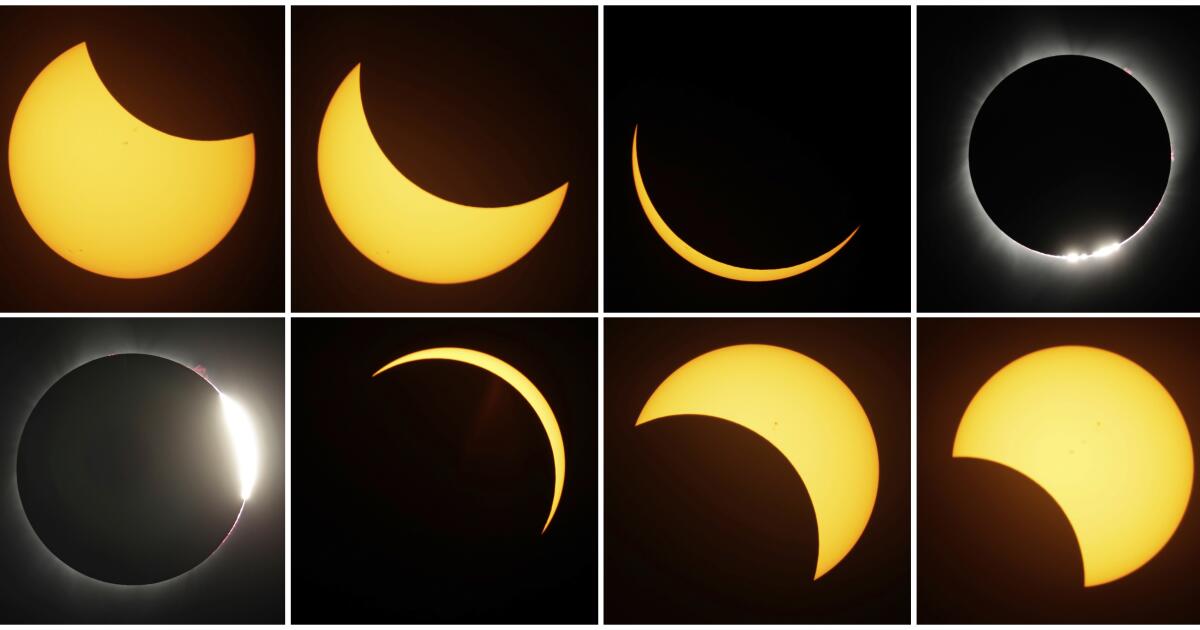
With the probable exception of glimpsing Earthrise out the window of Apollo 8, a total solar eclipse may be the best show in the universe accessible to human eyes.
I didn’t quite understand this seven years ago when I drove 900 miles all night and into morning from L.A. to Idaho the last time a total eclipse visited North America.
But what I saw then has set me on the road again, by plane and car to St. Louis, with plans to venture southeast for Monday’s eclipse.
The allure is not just the spectacle of this astronomical rarity. A partial solar eclipse, as will be visible Monday from Los Angeles and the rest of the contiguous United States — weather permitting — is a marvel not to be missed. But I am not traveling halfway across the country just to see a partial eclipse gone total.
I am going to watch the sun turn into a platypus.
At the instant the lunar disk slips entirely over the solar disk, the sun is abruptly transfigured into a foreign object. As if you looked at your watch and it suddenly turned into a flower.
Those lovely eclipse photos of a brilliant white halo (the solar corona, visible only during an eclipse) surrounding the deep black lunar sphere are poor preparation for the event. As I looked up from an Idaho Falls roadside lot in August 2017, at the moment of total eclipse the sun was no longer the sun.
This combination of photos shows the progression of the eclipse of Aug. 21, 2017, near Redmond, Ore.
(Ted S. Warren / Associated Press)
I felt as I imagine the bemused European naturalists must have when, in 1799, they beheld for the first time a platypus specimen, a creature they found so peculiar they initially declared it an Australian hoax. What I saw above Idaho was neither fish nor fowl, and I could not quite convince myself it was real.
“In the sky was something that should not be there,” Annie Dillard wrote in her essay on seeing the moon obliterate the sun near Yakima, Wash., in 1979. In her view, this was not a good thing. “I pray you will never see anything more awful in the sky.”
In the sky was something that should not be there
— Annie Dillard, on the 1979 eclipse
When 38 years later I witnessed the next total solar eclipse viewable from the United States, I too was shaken, though in a very different way.
The moment of “totality,” as it’s called in astronomy lingo, issues a shock to the system, as if one were plunged into an ice cold pond. Day fades and then suddenly — snap! — flips to night, or twilight at least. Temperature falls, the wind rises. Stars and planets alight on their evening perches. Twilight too is total — 360 degrees: On any horizon can be seen the familiar orange glow we associate with sunrise or sunset.
I was literally breathless. I gasped to recover my lungs’ normal function. Voices around me exclaimed, with variations of “oh-my-God” or “holy” punctuated with swear words of choice.
In my usual job as a copy editor for this newspaper, I tend to cast a skeptical eye on a writer’s use of the word “ecstatic.” I can confirm that when it comes to watching a total eclipse, the word is warranted.
Though we moderns stand on the terra firma of scientific rigor — since at least the 1st century BC, astronomers have been able to predict eclipses roughly, and with ever-greater precision since Edmond Halley in the 18th century — we can appreciate how a total eclipse must’ve scared the devil out of the ancients.
Mythology is filled with apocalyptic visions associated with eclipses. They appear as ill omens in Shakespeare and, of course, the Bible. Milton summed it up in “Samson Agonistes”: “Oh dark, dark, dark, amid the blaze of noon, / Irrecoverably dark, total Eclipse / Without all hope of day!”
Christopher Columbus used his foreknowledge of a lunar eclipse to force the Arawak residents of present-day Jamaica to heel in fear in 1504.
(Frederic Lewis / Getty Images)
So terrified were the warring Lydians and Medes at the arrival of an eclipse in 585 BC, Herodotus tells us, they immediately made peace. Columbus used his foreknowledge of a lunar eclipse to force the Arawak residents of present-day Jamaica to heel in fear. As late as the 19th century, a solar eclipse over Virginia inspired Nat Turner to launch his violent uprising. The 1878 eclipse in the U.S. aroused fears of Armageddon, moving one man to kill his young son with an ax and slit his own throat. The acclaimed essay by Dillard, a fellow modern, is a doomscape of terror and death.
I find a total solar eclipse to be an affirmation of humanity, both as experience and as a triumph of knowledge over the glare of ignorance. Eclipses were once crucial in producing more accurate land and sea maps, and they inform solar science to this day. English astronomer Arthur Eddington’s eclipse expedition of 1919 proved Einstein’s theory of general relativity beyond a shadow of a doubt.
At the instant of totality, planetary motion as described by Newton and Kepler is not a matter only for scientists and our imaginations. It is something to be seen and felt by anyone in the right place at the right time. Our moon is orbiting us; the sphere on which we stand is also in motion, on its daily axis and annually lapping the sun. It is one thing to know and understand this; it is another to experience it.
Our everyday illusions are exposed as counterfeit: of a sky above, when in fact sky is all around us; of the sun rising and setting, when it does no such thing; of a moon waxing and waning, when it is continuously circling us with its same face forward. “We are an impossibility in an impossible universe,” author Ray Bradbury said.
And just what is this cosmic platypus, this something in the sky that should not be there? Similes abound.
A total eclipse of the sun is said to look like a black dahlia or a monochrome sunflower. Or a hole punched in the sky.
I prefer to think of it as a Louise Nevelson sculpture suspended above.
Many of Nevelson’s well-known works of the 1950s to 1970s were monochromatic black. Influenced by the space exploration of her time, the artist suggested celestial objects in her sculptures and chose titles featuring “night,” “sky,” “lunar,” “moon.” On at least one occasion, she took inspiration from astronaut Bill Anders’ “Earthrise” photo of 1968.
Her sculptures were, perhaps most of all, a meditation on the color black.
During a total eclipse, the sun’s blazing corona and “diamond ring” of light oozing outside the lunar disk just before and after totality are the main spectacle. But I was just as transfixed by the absolute blackness of the moon within. It is almost certainly the blackest black possible.
“I fell in love with black; it contained all color,” Nevelson once explained. “It wasn’t a negation of color. It was an acceptance. Because black encompasses all colors.” Black, for Nevelson, was “the total color. It means totality. It means: contain all.”
That is the lunar black I saw over Idaho Falls and which draws me now to Missouri. The title of a celebrated series of Nevelson works, “Sky Cathedral,” would do well as a name for nature’s occasional exhibition of lunar-solar art.
The 2024 eclipse arrives at a grim time in our history. We have witnessed the worst pandemic in a century. Gun violence at home and excruciating wars abroad seem impossibly intractable. Climate denial imperils our existence and a pernicious relativism our democracy. My profession and my newspaper, proudly committed to separating facts from fabrication, are at a crossroads of sustainability.
So a few minutes of astronomical truth seem all the more necessary for me to revisit at this time, though now with better preparation.
In 2017 I embarked on my all-night drive to see the eclipse out of last-minute inspiration. As an avid sky-watcher, I had an obvious interest. Not yet knowing what I was in for, though, I dawdled, thinking the journey too far and impractical, until I finally relented about 20 hours before totality over Idaho. I arrived with hours to spare under propitious skies.
I regretted my lack of planning on the way back, when I endured a traffic doomsday on Interstate 15 and could find no hotel vacancy along the route south before I finally gave up and slept in my car.
My eclipse preparations this time have been more considered and considerable, though complicated.
An early plan for an eclipse viewing in Rochester, N.Y., fell through. In the meantime, I have assembled a small library of eclipse books and magazines, including a road atlas that superimposes the 2024 path of totality onto a detailed map of the U.S., Mexico and Canada.
I considered joining the eclipse crowds in Carbondale, Ill., where a news report on Atlas Obscura said that old-time apocalyptic fever — also known as modern-day conspiracy theorist hokum — had taken hold.
Bob Baer of Southern Illinois University in Carbondale, co-chair of the Southern Illinois Eclipse 2017-2024 Steering Committee, will be leading a comprehensive monitoring effort to capture Monday’s solar eclipse moment by moment.
(Carlos Javier Ortiz / Getty Images)
Because Carbondale happened to be in the path of totality in 2017 and is so again in 2024, it seems many believed Monday’s eclipse encore would trigger a calamitous seismic event in town. This disturbing local opinion suggested to me an intriguing juxtaposition of setting for my notion of affirming the reality of our shared universe under the shadow of the moon.
The prime spot seemed to be southern Texas. Historical weather records indicate that the path through Texas had a much greater likelihood of cloud-free skies than farther northeast. And the duration of totality near the path’s center line was due to be almost 4½ minutes. As this eclipse moves northeast, its duration will get shorter, its path narrower.
Monday’s total eclipse will arrive on Mexico’s Pacific coast, climb through Texas and Arkansas, then cross the Midwest and New England before exiting over eastern Canada into the Atlantic.
(Associated Press)
In Idaho Falls, totality lasted about 1 minute and 40 seconds. Four and a half minutes over Texas? I could hardly fathom it. I made plans for San Antonio.
Until the actual meteorological forecast defied historical prediction. As eclipse day drew near, “weather permitting” turned more ominous. Less than a week out, the April 8 forecast for Texas — nearly the entire state, apparently — called for overcast skies all day, maybe even thunderstorms.
I studied my alternatives. Flights were still reasonable to Chicago, from where I could drive a few hours to reach several cities along the path: Indianapolis, Cleveland, even Buffalo. I also considered Mexico, but the forecast for the whole of its eclipse path, from Mazatlán to the border town of Piedras Negras, was likewise dire.
I added 16 cities to my phone’s weather app, from Mazatlán to Buffalo, which I monitored as the 8th drew near. Days before my planned departure, I booked accommodations in St. Louis, two hours from the center line.
The weather may yet conspire against me, and 3 or 4 minutes of totality will be lost under a ceiling of clouds. If so, I will see something I never have before. The midday gray blackening, then brightening, on account of a remote and veiled disk of sun and moon.
Astronaut Bill Anders snapped his “Earthrise” photo from the window of Apollo 8 on Dec. 24, 1968.
(NASA)
Either way, Bradbury advised, we are obliged to keep watch:
Why have we been put here? … There’s no use having a universe … there’s no use having a billion stars, there’s no use having a planet Earth if there isn’t someone here to see it. You are the audience. You are here to witness and celebrate. And you’ve got a lot to see and a lot to celebrate.


new video loaded: NASA Announces Artemis III Crew
transcript
transcript
NASA Announces Artemis III Crew
NASA announced the crew of Artemis III mission, which will fly to low-Earth orbit to test rendezvous and docking maneuvers with one or two lunar landers.
-
“I am excited to welcome you as the next crew in the Artemis journey to successfully return to the moon — this time to stay.” “I’m honored by the role that I’ve been given. I’m also very humbled by the task in front of us. But first and foremost, I’m grateful.” “So with that, the Artemis II crew, comrade, hands you the baton. You got the controls.” “As you know, we had a significant anomaly at our Launch Complex 36A on May 28. We’ve redoubled our efforts and are moving forward.”
By Alisa Shodiyev Kaff
June 9, 2026
Science
Santa Monica Mountains’ last steelhead trout survived the Palisades fire — and even had babies

Scientists feared the Santa Monica Mountains’ last remaining steelhead trout were dead, smothered by debris flows unleashed by the Palisades fire.
But the endangered fish surprised them: A team of biologists recently spotted 30 of the rare trout — and 21 babies — in Topanga Creek.
“There was a lot of happy dancing in the creek,” said Rosi Dagit, principal conservation biologist for the Resource Conservation District of the Santa Monica Mountains, which works with public and private landowners to conserve natural resources.
That’s because the steelhead here are endangered, at both the state and federal levels. Once, they swam in most streams of the Santa Monicas, but their numbers plummeted amid overfishing and coastal development. Increasingly frequent wildfire has further stressed their habitat. Topanga Creek, a biodiversity hot spot, is home to their last known population in the mountains that stretch from the Hollywood Hills to Point Mugu in Ventura County.
The trout that were spotted, including this one, are part of a distinct Southern California population that’s listed as endangered at the state and federal levels.
(RCDSMM Stream Team)
The California Department of Fish and Wildlife spearheaded a complex mission to rescue trout threatened by the Palisades fire that sparked in January 2025.
Time was of the essence. The fire hadn’t yet been fully contained. But rain was on the way, which would sweep massive amounts of sediment from the denuded hillsides into the water. Fish are often killed this way.
Crews stunned the fish with electricity, scooped them up in buckets, trucked them to a hatchery and ultimately moved them to Arroyo Hondo Creek in Santa Barbara County.
Within days, Topanga Creek was choked with mud. Some assumed the fish left behind were goners.
But in March, the conservation district’s team found four. The following month, when water conditions were clearer, they saw more.
“These fish continue to amaze me,” said Kyle Evans, environmental program manager for the state Department of Fish and Wildlife, who had seen the damage to the creek. “I had seen populations get wiped out in similar situations. So when I heard, I was thrilled.”
Evans surmises the fish that survived were in an area of the creek where less charred material and sediment were swept in.
“These fish likely hunkered down, were hiding under some rocks or places to try to get away from the main concentration of flow,” he said. “And luckily they weren’t buried.”
The ones that were spotted were fairly small, around 6 to 14 inches. Rainbow trout and steelhead trout are the same species, but with different lifestyles. If the fish remain in freshwater, they’ll be considered rainbows. However, they can migrate to the ocean and become steelhead, where they typically grow larger before returning to their natal waters to spawn.
Topanga Creek hasn’t fully recovered from the damage it sustained, but scientists say it’s looking better. Surveys last year were “so depressing,” Dagit said, with very few animals, and stretches that were essentially transformed into flat roads from all the sediment buildup. Some of the riparian canopy burned right down to the creek.
Then came 32 inches of rain over the last nine months, scouring out and moving sediment, creating deeper pools. Dagit said they recently found newt egg masses for the first time in years, as well as a few adult newts and many frogs. Plants that provide cover are starting to recover.
She provided photos comparing certain pools last year and this year, some dramatically transformed. In September 2025, the Shrine Pool could have been an overgrown hiking trail. This April, it was filled with shallow water.

The Shrine Pool in September 2025, left, and the same location in April 2026, right, with RCDSMM’s Isaac Yelchin donning a wetsuit.
(RCDSMM Stream Team)
Topanga Creek is home to another endangered fish, the small but hardy northern tidewater goby, often described as cute. Not long before the trout operation, Dagit led a rescue of hundreds of these fish too. Many were repatriated to the lagoon at the mouth of the creek in a moving ceremony last June.
There’s still the matter of what to do with the trout that were moved to Santa Barbara County last year. Evans would like to bring them home to the Santa Monicas at some point, but isn’t sure if it will happen. On one hand, they could bolster the small, genetically isolated surviving population. On the other, they might inadvertently bring in a disease or bacteria. There is some time to decide. Evans estimates the creek still needs to recover for two to three more years.
For now, the fish are functioning fine in their adopted creek. Experts worried the trauma wrought by the move would disrupt their spawning process, but they had babies that spring. This year, they spawned again.

The Pacifica Municipal Pier was shut down and taped off Thursday after city workers noticed cracks running through the landmark structure and concrete chunks falling into the ocean.
It’s just one of many coastal California structures that have recently crumbled under pressure from a rising and relentless ocean.
Officials from the small, beach city south of San Francisco said the pier was closed due to “cracking, separation, and displacement of the concrete walkway and structural elements.”
It will stay closed while structural engineers asses its safety.
Photos taken by city employees show a wide crack that runs from top to bottom and across the structure as well. Other photos show a large horizontal crack under the foundation of a small restaurant on the pier, the Chit Chat Cafe.
The cafe was also shut down.
This is not the first time the 53-year-old pier has shown signs of stress. In 2021, part of it was shut down after handrails along the edge collapsed. And in 2023, after a series of storms pummeled the Central California coast, damaging parts of the pier, the structure was partially closed for more than year.
Those same storms caused extensive damage in Aptos and Capitola, 70 miles south, where piers and waterfront infrastructure were swept away or damaged.
In 2024, a 150- to 180- foot section of the Santa Cruz wharf was ripped off by powerful waves.
At least 10 of the state’s dozens of coastal public piers were closed for part or all of 2024 due to structural damage sustained in winter storms since 2022. At least five others have longer-term upgrades planned to address structural issues.
“These things are costly to maintain,” said Zach Plopper, senior environmental director at Surfrider. “They are a part of our California coastal culture in many ways, but we’re going to need to reckon with, one, the state that they’re in, and two, the continuous and worsening threats they’re going to experience,”
He said most of the piers were constructed in the early 1900s, and they weren’t built to withstand decades of rough seas, storms and rising sea level.
“With this incoming El Niño, which is forecasted to be significant, and this marine heat wave we’re in the midst of, we’re kind of in uncharted waters as far as what this winter could bring in terms of storms and swells to the California coast, and we’re likely going to see a lot more damage,” he said. “Not just piers, but roads and other coastal infrastructure up and down the state.”
There was no storm in Pacifica earlier this week, so no single event could be blamed for the destruction.
However, a 2025 report from an outside engineering firm, GHD, found that several sections of the pier were in “poor” or “serious” condition, and they recommended closure before anticipated storms or events that could “subject the piles to high winds, swells and large waves.”
The firm found several areas of the pier where concrete was missing and rebar was exposed and corroding.
“The pier has continued to experience high winds and large waves in a harsh marine environment,” the engineers wrote in the report, noting that continuous exposure to seawater or marine spray was “detrimental” to the structure.
A 2023 city report estimated it would cost $19 million to repair.
That same year, a state law was enacted to require local governments along the California coast to plan for sea level rise in the coming decades.
Sea level has risen some 8 inches, on average, along the coast in the past 150 years, Plopper said, and researchers anticipate another foot in the next 25 years.
“We’re going to see profound shifts on our coastline, none that we have ever experienced before, and building static structures on the coast just doesn’t work all that well,” he said. “We’re going to have to make some really hard decisions.”
-

 New York53 minutes ago
This Parking Spot Is Free. Should It Be?
-

 Los Angeles, Ca59 minutes ago
O.C. Uber customer says driver asleep in Tesla on 405 Freeway
-

 Detroit, MI1 hour ago
One person dead, another in custody following shooting in Detroit, police say
-

 San Francisco, CA2 hours ago
Bay Area artists celebrate Wong Kim Ark’s legacy in San Francisco’s Chinatown
-

 Dallas, TX2 hours ago
Plano’s new tax increment reinvestment zone could allocate $700M for Dallas Stars arena
-

 Miami, FL2 hours ago
Home intruder shot and killed in Miami Gardens
-

 Boston, MA2 hours ago
Rays hold on to beat Tolle, Red Sox 4-3
-

 Denver, CO2 hours ago
The steep price the Denver Nuggets must pay to get off Zeke Nnaji’s contract

