Virginia
Virginia Credit Union to merge with $1B Roanoke-based Member One FCU – Richmond BizSense


Virginia Credit Union will continue to use its brand and keep its headquarters in Chesterfield following the merger with Member One. (BizSense file photo)
The Richmond region’s biggest credit union has yet another initiative in the works to increase its size and stature in the state.
Virginia Credit Union announced on Thursday its plans to merge with Roanoke-based Member One Federal Credit Union.
The deal, which is subject to certain approvals and could close later this year, would create the third-largest credit union in Virginia with $6.8 billion in assets, nearly 500,000 members, 37 branches and 1,100 employees.

The credit unions said the merger is expected to close in mid-2024.
VACU is the larger of the two with $5.2 billion in assets, 320,000 members and 22 branches mostly around Richmond.
Member One has $1.6 billion in assets and 150,000 members. Its 15 branches are clustered in Roanoke, Lynchburg and the Blacksburg area.
The credit unions said the merger would create one of the 50 largest credit unions in the U.S.
“This merger is between two financially healthy, future-focused credit unions committed to providing unparalleled branch and digital access, along with amazing service for the members and the communities they serve,” the credit unions said in a joint press release. “In a highly competitive financial services industry, where consumers want things easier and more seamless than ever, this merger positions VACU and Member One to be a leading credit union to do just that.”
The credit unions say they don’t have plans to close any branches or lay off any employees from either side.

Chris Shockley (right) and Frank Carter.
VACU CEO Chris Shockley would lead the combined organization. Member One CEO Frank Carter would remain in an executive role.
“Becoming a larger organization with more locations, more talent, and more resources will ultimately result in greater economies of scale which is a good thing,” Shockley said in an prepared statement. “What becoming larger does not mean, however, is that we sacrifice our mission and our purpose. We would continue to invest in our members, our people, and our communities.”
The deal has already been approved by the boards of both sides. It awaits a vote from Member One members and approval from the National Credit Union Administration. If both of those are obtained, the merger is expected to close sometime this year.
The Member One brand would stick around at list in the interim as a division of Virginia Credit Union. VACU’s name will not change. The two sides said they would eventually conduct “a thoughtful, independent, and expert analysis of brand… to determine the name of the combined organization.”
Each side expects to maintain its respective headquarters: VACU’s in Chesterfield and Member One in Roanoke.
Member One was created in 1940 to serve employees of Norfolk and Western Railway. It was called Norfolk & Western Credit Union at the time, eventually changing its name in 1996.
VACU was created as State Employees’ Credit Union in 1928.
The Member One deal comes on the heels of a much smaller merger recently consummated by VACU in Charlottesville, where it absorbed the tiny Virginia Trailways FCU.
It also comes as VACU is attempting to convert from a state charter into a federally chartered credit union – the same designation held by Member One.
A VACU spokesperson said the merger with Member One is unrelated to VACU’s ongoing effort to obtain a federal charter, which awaits approval from the NCUA.
VACU said it expects that process to be completed prior to the closing of the Member One deal.


RICHMOND, Va. — Jerrod Buford first picked up a paintbrush as a kid, never imagining that same creative outlet would carry him through his darkest days in prison.
Buford, who grew up in Williamsburg, was convicted and arrested as a young man and spent almost a decade behind bars. During that time, he struggled deeply.
“Turning to drugs and alcohol to kind of shadow over emotions,” Buford said. “Looking for acceptance, approval. Not just from my parents, but from friends, from, you name it. I mean, I tried to commit suicide, I don’t even know how many times,” Buford said.
WTVR
It was inside prison walls that art became more than a hobby.
“Throughout my prison time, I learned, the freedom that I desired, I’ve always had it. I got, I found it, in a box,” Buford said.
More than three years after his release, Buford continues to advocate for art as a tool for healing. He describes his work as a gift he feels called to share.
“I received a blessing from God that just allowed me to display what he’s given me,” Buford said.
For Buford, creating art is also a way of processing his past.
“That’s what art has done for me. It’s given me the ability to look at parts of my life, all parts of my life, and find the good and the negative, learn from the negative,” Buford said.
He shares his story and artwork with a wide audience through social media, including live sessions on TikTok, and holds art classes with new communities.
The Story Cafe
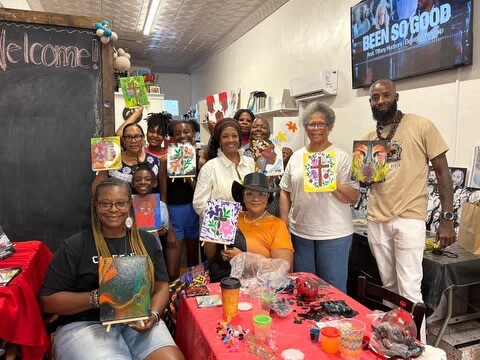
Buford said his mission is to help others find their own path toward healing — whatever form that takes.
“What I strive to do is guide this person to just create, man. Don’t care what people think about your creation, you just need to get it out,” Buford said. “Whether it’s with art, addressing your mental health, getting your life right — just do it.”
CBS 6 is committed to sharing community voices on this important topic. Email your thoughts to the CBS 6 Newsroom.
📲: CONNECT WITH US
Blue Sky | Facebook | Instagram | X | Threads | TikTok | YouTube

This story was initially reported by a journalist and has been converted to this platform with the assistance of AI. Our editorial team verifies all reporting on all platforms for fairness and accuracy. To learn more about how we use AI in our newsroom, click here.

Lovingston, VA (7News) — Good Morning Washington interviews Amanda Beckwith of Virginia Distillery Company- one of the contributing distilleries to the Virginia Spirits Board’s 250th Celebration Trio Pack, a special, exclusive release created to commemorate America’s upcoming 250th anniversary. This limited-edition package features a curated collection of a rum, a gin, and a whiskey, all crafted from scratch by distillers in Virginia to celebrate the rich history and current state of distilling within the Commonwealth.
Beckwith elaborates on VA Distillery Company’s role in the project, noting her focus on Virginia-grown grain to make the bottle of unique whiskey that is included in the Trio Pack. It is also worth noting that the Trio Packs themselves were bottled and produced right here at Virginia Distilling Company!
American single malts are the newest official category of American whiskey, distilled from one grain and from a single distillery. Virginia Distillery Co specializes in this new category of whiskey and crafted their contribution to the Trio Pack with this very specialty. Given the limited remaining availability of the Trio Pack, its historical value and collectible nature, the message it loud and clear encouraging viewers to grab a pack before they are all gone!
BE THE FIRST TO COMMENT
21+ Please drink responsibly, this content is sponsored by Virginia Distillery Company.


Powerball, Mega Millions jackpots: What to know in case you win
Here’s what to know in case you win the Powerball or Mega Millions jackpot.
Just the FAQs, USA TODAY
The Virginia Lottery offers multiple draw games for those aiming to win big.
Here’s a look at June 24, 2026, results for each game:
Powerball
Powerball drawings are held Monday, Wednesday and Saturday at 11 p.m.
13-14-16-21-38, Powerball: 14, Power Play: 2
Check Powerball payouts and previous drawings here.
Saturday, June 27, 2026
Pick 3
DAY drawing at 1:59 p.m. NIGHT drawing at 11 p.m. each day.
Night: 3-1-5, FB: 8
Day: 7-8-8, FB: 4
Check Pick 3 payouts and previous drawings here.
Pick 4
DAY drawing at 1:59 p.m. NIGHT drawing at 11 p.m. each day.
Night: 4-7-2-1, FB: 7
Day: 7-3-4-6, FB: 3
Check Pick 4 payouts and previous drawings here.
Pick 5
DAY drawing at 1:59 p.m. NIGHT drawing at 11 p.m. each day.
Night: 7-5-2-6-9, FB: 0
Day: 6-9-4-0-7, FB: 0
Check Pick 5 payouts and previous drawings here.
Cash Pop
Drawing times: Coffee Break 9 a.m.; Lunch Break 12 p.m.; Rush Hour 5 p.m.; Prime Time 9 p.m.; After Hours 11:59 p.m.
Coffee Break: 12
After Hours: 08
Prime Time: 13
Rush Hour: 01
Lunch Break: 14
Check Cash Pop payouts and previous drawings here.
Cash 5
Drawing every day at 11 p.m.
09-12-15-24-43
Check Cash 5 payouts and previous drawings here.
Bank a Million
Bank a Million draws are held every Wednesday and Saturday at 11 p.m.
18-21-25-33-36-39, Bonus: 13
Check Bank a Million payouts and previous drawings here.
Millionaire for Life
Drawing everyday at 11:15 p.m.
03-04-10-36-37, Bonus: 05
Check Millionaire for Life payouts and previous drawings here.
Feeling lucky? Explore the latest lottery news & results
This results page was generated automatically using information from TinBu and a template written and reviewed by a Center for Community Journalism (CCJ) editor. You can send feedback using this form.
-
Virginia2 minutes ago
Virginia man uses art to heal after years in prison, mental health battle
-

 Washington4 minutes ago
AJ Dybantsa arrives in Washington, ready to work on turning Wizards around
-

 Wisconsin9 minutes ago
What’s the Wisconsin wolf population? DNR issues latest estimate.
-

 West Virginia16 minutes ago
Register now: West Virginia’s largest yard sale grows with more Webster County sellers for 2026
-

 Wyoming19 minutes ago
Dan Speas Fish Hatchery temporarily closed to visitors as construction begins on new cool-/warm-water expansion
-

 Crypto25 minutes ago
Crypto Insiders Say Daily Senate Meetings Keep CLARITY Act Alive | PYMNTS.com
-

 Finance31 minutes ago
How digital payments are reshaping a fast-growing digital banking market
-

 Fitness35 minutes ago
Exercise Tips From Dr. Schwartz for Summer Fitness – MyRye.com

