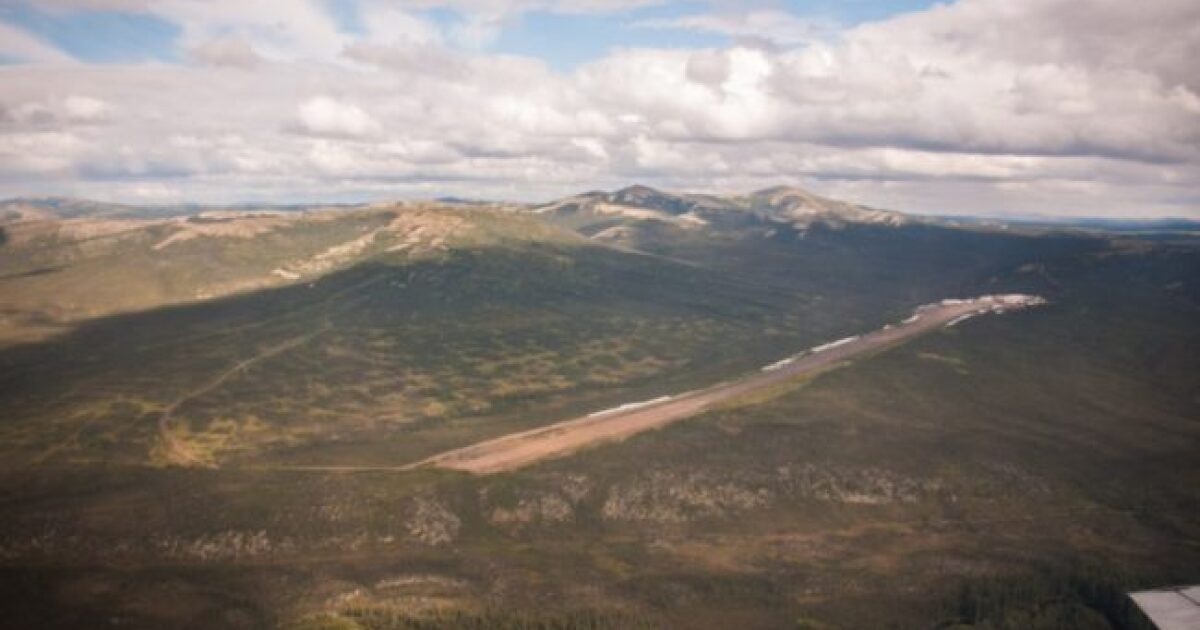
The Bureau of Land Management (BLM) is seeking public input on the potential impacts of removing protections for 28 million acres of wilderness lands across Alaska. In addition to accepting comments online, the agency will be hosting in-person public meetings in close to a dozen rural communities, including Bethel, in January and February 2024.
The protected lands, known as “D-1 lands,” are scattered across Alaska and were set aside following passage of the 1971 Alaska Native Claims Settlement Act (ANCSA). They have been off-limits to development ever since.
Dozens of tribes across Interior and Western Alaska have joined conservation groups to oppose removing protections, which they say would directly threaten Indigenous ways of living.
“If these lands are changed from withdrawn status to mineral priority status, they will be open to mineral claims that stand to really disrupt caribou migration routes and impact salmon habitat,” said Melanie Brown, outreach director for SalmonState, one of the conservation groups leading the calls for protection.
Advertisement
Brown also said that development of remote and difficult-to-access areas could start small, but lead to a domino effect.
“All it takes is one big project to be built. And then if that’s possible, and the infrastructure is there, it’s going to make other projects more viable,” Brown said.
BLM’s draft environmental impact statement (EIS) notes that removing protections could also lead to a loss of a subsistence priority for rural residents for the harvest of fish and game on lands where the state of Alaska gains ownership. The rural subsistence priority issue is at the core of an ongoing lawsuit brought by the federal government against the state over management of the Kuskokwim River.
Alaska Sens. Lisa Murkowski and Dan Sullivan have both voiced strong support for removing D-1 protections and have introduced legislation touting the benefits of potential development. Neither Sullivan nor Murkowksi responded to requests for comment.
The state of Alaska is also currently suing the federal government, claiming that the protections were meant to be temporary. In a 2021 press release, Gov. Mike Dunleavy said that D-1 lands had been “locked up as de facto parks.” On the industry side, the Alaska Miners Association has echoed the governor’s criticisms.
Advertisement
Millions of acres of the land in question lie in the Yukon-Kuskokwim Delta. Among these D-1 lands are thousands of acres surrounding the site of the proposed Donlin Gold mine, about 145 miles northeast of Bethel. If developed, Donlin would be one of the largest open-pit gold mines in the world.
The Calista Corporation, representing around 34,000 shareholders across Western Alaska, owns the subsurface rights to the proposed mine site. But Calista Vice President of Corporate Affairs Thom Leonard said that Calista currently opposes removing protections for D-1 lands in the Yukon-Kuskokwim (Y-K) region.
“Any such proposed revocation would be unlawful until DOI (Department of Interior) one, consults with Calista and other affected agencies and the tribes on any proposed revocation as required by law,” Leonard said. “And two, fulfills the sacred promise and statutory duty to convey all of the land to which Calista and the 45 village corporations of the Y-K region are entitled.”
Ben Sullender
Advertisement
/
Kickstep Approaches
A map shows the location of protected D-1 lands in relation to the site of the proposed Donlin gold mine.
Brown stressed the need for communities across Alaska to offer their input online and through in-person meetings held by BLM.
“It’s really important for people to talk about their relationship to the land and how the land feeds them and takes care of them and their families,” Brown said. “If you’re in a community where there is a meeting, please show up; have your voice heard.”
BLM is scheduled to hold a public meeting at Bethel’s cultural center on Monday, Feb. 5 from 5:30 p.m. to 7:30 p.m. A public meeting is also scheduled to take place in the middle Kuskokwim River community of Aniak on Tuesday, Feb. 6 from 5:30 p.m. to 7:30 p.m. Public comments can also be submitted online here.
A new home under construction in Potter Valley in Anchorage. (Loren Holmes / ADN)
This June, two very different offers reach Alaska families, and both amount to the same thing: $10,000. The difference is everything.
Bill Walker, running for governor, would hand every eligible Alaskan a one-time $10,000 check and then end the Permanent Fund dividend for good. Ask one question: Where does his $10,000 come from?
It comes from the Permanent Fund, the people’s own money and the savings Alaskans built for their children. Walker would spend that endowment once to pay Alaskans to give up the yearly dividend forever.
Think about what that does. It cancels the annual check that gives a family a reason to keep an Alaska address and replaces it with a single payout. You hand people their own savings, call it a gift and cut the tie that held them here in the same motion. It is the oldest mistake in governing money: raid what you have saved to buy a moment’s applause and call the spending generosity.
Advertisement
A plan that spends the people’s savings to send the people away is not bold. It is foolish.
Now consider the other $10,000. Through Alaska Housing Finance Corp., the state offers families up to $10,000 to build a new, energy-efficient home. AHFC raids nothing. It earns its own way. Over the years, it has returned more than $2 billion to the state treasury, and it spends some of that income the way any good business does: to win a customer.
Here, the customer is an Alaskan who wants to own a home, put down roots and stay.
That is the oldest sound move in business: Invest a little of what you earn to bring in someone who stays. The homeowner remains, the community gains a family and the corporation keeps earning. The money spent comes back. A plan that puts earnings to work to bring people home is not charity. It is clever.
Same amount. Opposite source. Opposite wisdom. One spends savings; the other spends earnings. One pays Alaskans to leave; the other pays them to stay. One empties the state; the other fills it.
Advertisement
This Homeownership Month, the choice is the size of a single check, and the whole question is where the check comes from and what it asks of you. Ten thousand dollars of your own fund, to wave you goodbye. Or $10,000, earned and reinvested, to help you stay and build.
Evan Swensen is the publisher of Publication Consultants in Anchorage and the author of “What’s the Money For: A Permanent Fund Mortgage Proposal.”
• • •
The Anchorage Daily News welcomes a broad range of viewpoints. To submit a piece for consideration, email commentary(at)adn.com. Send submissions shorter than 200 words to letters@adn.com or click here to submit via any web browser. Read our full guidelines for letters and commentaries here.
A man with the same name and party affiliation as Alaska Republican U.S. Sen. Dan Sullivan is eligible to challenge the senator in the August primary, a judge ruled Friday.
Superior Court Judge Thomas Matthews’ ruling overturns a June 15 decision by Division of Elections Director Carol Beecher to disqualify the challenger and keep him off the primary ballot. Matthews’ ruling can be appealed to the state Supreme Court.
Attorneys for the state have said Tuesday is the deadline for a final ruling so that ballots for the Aug. 18 primary can be printed.
The judge ruled that the division’s decision to exclude Dan J. Sullivan because his candidacy was not “in good faith” was not based on the Constitution, Alaska law or the division’s own regulations. The retired teacher from the small fishing community of Petersburg filed to challenge the incumbent.
Advertisement
Dan Sullivan, who has filed to run for U.S. Senate in Alaska, poses for a photo Friday, June 26, 2026, in Petersburg, Alaska.
Katie Holmlund/AP Photo
“Instead, the decision was based upon a new, previously unstated, ‘good faith’ criteria,” the judge wrote.
The division is appealing the decision, Sam Curtis, a spokesperson with the state Department of Law, said by email Saturday. Jeffrey Robinson, an attorney for Dan J. Sullivan, said in an email he expected the division to appeal and couldn’t comment until the Alaska Supreme Court rules on the case.
Advertisement
The controversy over the two Dan Sullivans has underscored the stakes involved in the incumbent’s reelection campaign. The Alaska race is one of about half a dozen U.S. Senate races expected to be highly competitive in the fall, and the seat is one Democrats are trying to flip in their efforts to try to regain the majority. But it’s expected to be an uphill battle in a state that President Trump won by 13 points in 2024.
The senator and allies, including the National Republican Senatorial Committee, have condemned the challenger’s efforts to join the race, arguing his presence could confuse voters. Republican Lt. Gov. Nancy Dahlstrom earlier this month opened an investigation into the non-Senator Sullivan’s candidacy.
Under Alaska’s election system, the top four candidates from the primary, regardless of party, move on to the ranked-choice November general election.
The senator has accused the challenger Sullivan of working with Democrats and the campaign of Democratic former U.S. Rep. Mary Peltola — who is considered the senator’s main opponent — to cause confusion and boost Peltola’s chances. The sitting senator brought the situation to reporters’ attention at the Capitol earlier this month, accusing Democrats of being “complicit in trying to trick Alaskans” to “rig an election in their favor.”
Sen. Dan Sullivan, R-Alaska, speaks to reporters at the Capitol in Washington, D.C., June 30, 2025.
Advertisement
Mark Schiefelbein/AP Photo
Peltola’s campaign and state Democrats have denied the allegation, as has the challenger.
Sen. Sullivan and Peltola are the highest-profile candidates in the crowded race and the only ones to report raising any money.
Beecher has said she determined the challenger Sullivan is not eligible to run because his candidacy was not filed in good faith and instead was done with an intent to confuse voters. She said he had registered to vote as Daniel J. Sullivan Jr. and, in conjunction with his candidacy, changed his party affiliation to Republican. She also cited similarities between his campaign website and the senator’s, and his work with a consultant whose clients have included some Democrats. She did not mention finding any evidence of alleged coordination.
In arguing to keep the challenger disqualified, attorneys for the state pushed back on suggestions the ballot could be designed in a way to reduce voter confusion over two candidates with the same name and party running for the same office.
Advertisement
“The Constitution does not require States to place a sham candidate on the ballot and then attempt to mitigate the damage through design choices,” attorney Rachel Witty, with the Alaska Department of Law, and outside attorneys Christopher Murray and Michael Francisco wrote in court filings.
Attorneys for the challenger Sullivan argued that the Constitution lays out three exclusive qualifications for the Senate, addressing only age, citizenship and residency. They said Beecher lacked the legal authority to boot their client off the ballot.
The challenger Sullivan has said that sharing a name and party affiliation with the incumbent gave him “an instant megaphone.” But the 69-year-old retired teacher and former U.S. Forest Service employee said he had considered a run for some time and had grown frustrated with the senator.
He initially was certified on the state’s candidate list as Dan J. Sullivan, with the senator listed as Dan S. Sullivan and identified as the incumbent.