World
Turkish President makes first official visit to Iraq in over a decade


Turkish President Recep Tayyip Erdoğan arrived in Iraq on Monday for his first official visit in more than a decade as Ankara seeks greater cooperation from Baghdad in its fight against a Kurdish militant group that has a foothold in Iraq.
Other issues also loom large between the two countries, including water supply and exports of oil and gas from northern Iraq to Turkey, halted for more than a year.
TURKEY’S ERDOGAN FACES UNCERTAIN FUTURE AFTER SHOCK ELECTION LOSSES EXPERT SAYS
Erdogan, whose last visit to Baghdad was in 2011, when he was prime minister, met with Iraqi President Abdul Latif Rashid and Prime Minister Mohammed Shia al-Sudani as they inked agreements on water management, security, energy and economic cooperation.
“I believe that my visit and the agreements just signed will constitute a new turning point in Turkey-Iraq relations,” Erdoğan said in a joint news conference with al-Sudani.
Turkey’s President Recep Tayyip Erdoğan, right, and Iraq’s Prime Minister Mohammed Shia al-Sudani shake hands during a welcome ceremony in Ankara, Turkey, Tuesday, March 21, 2023. Erdoğan was set to make his first official visit to Iraq in more than a decade on Monday, April 22, 2024 as his country seeks greater cooperation from Baghdad in its fight against a Kurdish militant group that has a foothold in northern Iraq. (AP Photo/Burhan Ozbilici)
Al-Sudani said they discussed “bilateral security coordination, which will meet the needs of both parties and confront the challenges posed by the presence of armed elements that may cooperate with terrorism and violate the security of the two countries.”
Erdoğan’s visit “comes at a sensitive and dangerous time,” al-Sudani added, citing Israel’s war against the Hamas militant group in Gaza — a war that has had ripple effects across the region.
Erdoğan said the leaders had “consulted on the joint steps we can take against the PKK terrorist organization and its extensions, which target Turkey from Iraqi territory,” referring to the Kurdistan Workers’ Party, or PKK, a Kurdish separatist movement banned in Turkey.
The PKK has maintained bases in northern Iraq’s semiautonomous Kurdish region.
Erdoğan had previously announced a major operation against the PKK during the summer, with the aim of “permanently” eradicating the threat it poses. He did not specify what actions Turkish forces would take in Iraq but Turkish forces have in the past carried out numerous ground offensives against PKK in northern Iraq and Turkish jets frequently target suspected PKK sites.
Ankara now aims to create a 19-25 mile deep security corridor along the joint border with Iraq, Turkish Defense Minister Yasar Guler told journalists last month.
The insurgency — the PKK is fighting for an autonomous Kurdish state in southeast Turkey — has claimed tens of thousands of lives since the 1980s and Turkey and its Western allies have labelled PKK a terrorist organization.
Baghdad has long complained that Turkish actions in Iraq against the PKK violate its sovereignty, but appears to be acquiescing with Ankara’s operations.
In March, after a meeting between the Iraqi and Turkish foreign ministers, Baghdad announced that the Iraqi National Security Council had issued a ban on the PKK, although it stopped short of designating it as a terrorist organization. Erdoğan on Monday praised the ban.
Al-Sudani told journalists during a visit to Washington last week that Iraq and Turkey have “true interests with one another and common projects.” He noted that the PKK has long had a presence in northern Iraq, “but we are not allowing any armed group to be on Iraqi territory and using it as a launchpad for attacks.”
Ankara has argued that PKK’s presence in Iraq threatens the planned construction of a major trade route, the Iraq Development Road, that would connect the port in Basra, southern Iraq, to Turkey and Europe through a network of rail lines and highways.
Baghdad may take a similar approach to the PKK as it has taken to Iranian Kurdish dissident groups based in northern Iraq.
The presence of Iranian dissidents had become a point of tension with Tehran, which periodically launches airstrikes on their bases in Iraq. Last summer, Iran and Iraq reached an agreement to disarm the groups and relocate their members from military bases to displacement camps.
Energy issues and water rights are also key in Iraq-Turkey ties.
An oil pipeline running from the semiautonomous Kurdish region to Turkey has been shut down since March 2023, after an arbitration court ruling ordered Ankara to pay Iraq $1.5 billion for oil exports that bypassed Iraq’s central government in Baghdad. The sharing of oil and gas revenues has long been a contentious issue between Baghdad and Kurdish authorities in Irbil.
In recent years, Iraqi officials have complained that dams built by Turkey are reducing Iraq’s water supply.
The Tigris and Euphrates rivers, which provide most of Iraq’s fresh water, originate in Turkey. Experts fear that climate change is likely to exacerbate existing water shortages in Iraq, with potentially devastating consequences.
Mustafa Hassan, a Baghdad resident, said he hopes that Erdoğan’s visit “will help to solve problems related to water, because Iraq is suffering from a water scarcity crisis, and this affects agriculture.”
Erdoğan said Ankara was aware of the water problems Iraq faces and that the two countries have set up “a joint permanent committee which is going to help through cooperation … taking our shared interests into consideration.”


Veteran politician Andy Burnham has taken another step towards becoming the UK’s next prime minister, after the majority of Labour MPs nominated him to replace Keir Starmer.
ADVERTISEMENT

ADVERTISEMENT
The 56-year-old’s Labour leadership bid was backed by 322 Labour MPs on Thursday and he remains the only person to publicly declare themselves a candidate to replace Starmer, who announced he was quitting last month.
Burnham appeared on course to be crowned Labour leader unchallenged on the first day of nominations.
If Burnham reaches at least 323 nominations then it would no longer be mathematically possible for another challenger to get the 81 signatures required to join the race out of the total of 402 Labour MPs.
“It is all starting to feel very real,” Burnham said in a social media video posted shortly after the process opened on Thursday morning.
Nominations close on 16 July. In the absence of a contest, Burnham will be crowned Labour leader and prime minister in waiting at a special conference the following day.
He would then replace Starmer at 10 Downing Street on 20 July after meeting King Charles, becoming Britain’s seventh prime minister in a decade.
“There’s no one else,” one Labour MP told the AFP news agency on condition of anonymity after nominating Burnham.
Armed forces minister Al Carns, thought to be Burnham’s final remaining potential challenger, ruled himself out of the running late on Wednesday.
He had expressed hope a leadership contest would give the party the “opportunity for a proper debate.”
“But months of internal Labour politics isn’t what the country needs right now,” he said.
Burnham, nicknamed the “King of the North” for winning three consecutive Greater Manchester mayoral elections, has vowed to “bring about the biggest rebalancing of power our country has seen.”
His signature proposal is the creation of a “No. 10 North” to coordinate greater devolution, a reference to the UK prime minister’s address at 10 Downing Street.
Burnham has pledged fiscal discipline and to reduce the country’s ballooning welfare bill, having already sought to calm markets by committing to the government’s current borrowing limits.
But he will face the same challenges that buffeted Starmer’s premiership, notably anaemic growth, a cost-of-living squeeze and an unpredictable US president in Donald Trump.
He has also indicated he could stake out a different path to Starmer on Israel, which enjoyed solid backing from the Labour government even as criticism grew of its war in Gaza.
“I am sorry about that,” Burnham told the Guardian newspaper in an interview published on Thursday. “The response has too often not been good enough. We need to do better.”
Starmer, under pressure for months over policy U-turns and questions about his judgement, announced on 22 June that he was resigning after losing the support of Labour MPs.
His move came after Burnham won a by-election that allowed him to return to parliament to launch a widely expected leadership challenge.
On the day Starmer announced his resignation, Burnham was sworn into parliament, becoming an MP again following his stint between 2001-2017.
Roll the dice
Afterwards, some 200 Labour MPs feted Burnham during a group photo in Westminster, in a clear sign that they expect him to take over.
Former health minister Wes Streeting announced he was dropping his intention to run and backing Burnham.
Burnham, seen as slightly to the left of the more centrist Starmer and more charismatic, is Labour’s most popular politician, surveys show.
Many MPs feel he is the party’s best chance of clawing back support from Nigel Farage’s anti-immigrant Reform UK party before the next general election, expected in 2029.
Reform has led Labour in national opinion polls for well over a year, although the gap has narrowed in recent weeks amid questions over Farage’s finances.
One Labour MP, who asked not to be named, said the party was right to “roll the dice” on Burnham, saying “he couldn’t be worse than Starmer.”
“I hope he’s a breath of fresh air,” the lawmaker told AFP.

NEW YORK (AP) — Launching an artificial intelligence tool to take notes and summarize important information from a virtual meeting can be alluring. Seconds after one of the agents attends an hour-long video conference, it can deliver a recap of key points and outline a to-do list for all the participants.
But the way popular AI notetakers accomplish those tasks makes some people avoid using them. The technology turns everything said during meetings into data. Confidential personnel information, corporate strategies, trade secrets and remarks that could later be seen as incriminating — all of it could end up in the wrong hands.
“There are huge risks to the organization on AI notetakers,” Amy Dufrane, the chief executive of human resources training and certification provider HRCI, said. “I don’t think companies should use it at all.”
An AI notetaker is a software application or device that uses artificial intelligence, speech recognition and large language models to record, transcribe and summarize conversations. The tools are intended to save time and improve participation, but professionals in a number of fields say there are reasons to be wary.
This article is part of AP’s Be Well coverage, focusing on wellness, fitness, diet and mental health. Read more Be Well.
Chief among them is uncertainty about where the collected data is stored and for how long. Privacy advocates worry the companies behind the AI notetakers are creating voiceprints without consent. Voiceprints — a type of biometric profile similar to a fingerprint but tuned to the unique intonations and characteristics of one’s voice — can be used to access restricted or confidential information, including the contents of bank accounts.
Some tech companies resell data from the notetaking tools they created or use confidential meeting transcripts and recordings to train their AI models. There’s also the risk that conversations between an attorney and client could become fair game in legal proceedings; a New York federal judge in February ordered a criminal defendant to provide prosecutors with documents he created for his lawyers because it already had been shared with a third party, which was Anthropic’s Claude.
“People who use AI notetakers, they don’t always know where the data goes,” said Justin Daniels, an Atlanta-based corporate attorney at law firm Baker Donelson. “And in my context, if the data goes anywhere else and they’re not aware of it, that attorney-client-privileged conversation may not be attorney-client-privileged anymore.”
Here are some tips on the etiquette of kicking an AI notetaker out of a meeting, the risks of using one and how to protect yourself.
The first step when you join a meeting is check for bots
When you join a meeting, make it a habit to check whether an AI notetaker is present. It might appear as a meeting attendee, often labeled as an AI notetaker, or a pop-up message on the screen informing participants the meeting is being recorded. The latter could signal the presence of an AI notetaker.
Virtual meeting platforms such as Zoom and Google Meet let users know when recording is underway, but some meeting software does not make it clear when a notetaker is present, according to Thorin Klosowski, the Electronic Frontier Foundation’s senior security and privacy analyst.
Participants also may use personal notetaking devices that are separate from the meeting platform, in which case the other attendees wouldn’t necessarily know a discussion was being recorded and transcribed.
“You hope the other person would tell you that they’re doing that,” Klosowski said. “Asking everyone for consent before doing a sensitive meeting would be the most polite approach to take.”
If you’re unsure whether someone has deployed an AI notetaker, you can ask. You can also state at the beginning that a meeting is not authorized for recording.
A polite way to establish such a boundary is to say, “Our company policy is that this meeting cannot be recorded,” Dufrane suggested. This relieves the employee, such as a salesperson who wants to make a good impression, of having to be the “bad guy,” putting the onus on the company instead, she said.
Another option is to allow the notetaker for part of the gathering but turn if off at the end to dedicate time for more delicate topics.
“I won’t start talking about anything substantive until it’s shut off, because I just don’t want to take the risk,” Daniels said.
Assert your privacy rights to protect voiceprints
Many AI notetakers determine unique acoustic signatures, or voiceprints, for each speaker in the room, said Chris Pluymers, associate attorney at The Dillon Law Group in East Lansing, Michigan. That’s how the companies distinguish one speaker from another, labeling them with monikers “Speaker 1” or “Speaker 2.”
One way voiceprints are used is to verify the identities of bank account holders over the phone. If bad actors got ahold of a person’s vocal signature, they could use it to access files, commit fraud or take over accounts, he said.
Laws in some states govern how voiceprints can be created and stored and provide rights that individuals can assert to object to the use of an AI notetaker during meetings they attend.
In Illinois, voiceprints are considered biometric identifiers, similar to fingerprints, and are covered under the state’s Biometric Information Privacy Act, which requires written notice and informed consent before an AI notetaker or other agent collects voiceprints. The law also mandates a documented data retention schedule and destruction policy, Pluymers said. But most companies using the tools have none of those systems in place, Pluymers said.
“In the world of AI, the world of data and privacy, the world of biometric identification, I don’t think you can have such a lax approach to it,” Pluymers said. “I think getting out ahead of it is crucial.”
Under the Illinois law, employees can say they don’t want to attend a meeting with an AI notetaker until they have assurances of where and why the data is being stored, and when it will be deleted, Pluymers said. They can also ask if there is a policy and written consent form to sign.
If an AI notetaker shows up at a meeting unexpectedly, a participant could say, “I prefer we keep this meeting without AI recording or transcript tools and I’d be happy to take my own notes and share a recap if that’s helpful,” Pluymers suggested. “Just being warm and genuine about it and asking them to respect your wishes.”
Know where your data goes
When working with AI notetaking apps, find out whether the companies that built them retain recordings, transcripts or metadata indefinitely or use them to train AI models, said Danielle Kays, a partner at Fisher Phillips who represents businesses on privacy and employment law matters.
“If there is some sort of speaker ID or voice recognition, really understand what that is and how it works,” Kays said.
Even when content is deleted, metadata about meetings can remain stored with the vendor, meaning sensitive business information could influence how the model behaves and in some cases could be memorized or reproduced, she said.
AI notetakers generate text, and that’s easier for outsiders to search through than video or audio files, according to EFF.
“Storing a bunch of video isn’t easy, it’s costly and hard to look through, but text is much easier to search and cheaper to store,” said Klosowski of the Electronic Frontier Foundation.
___
Share your stories and questions about workplace wellness at [email protected]. Follow AP’s Be Well coverage, focusing on wellness, fitness, diet and mental health at https://apnews.com/hub/be-well
World
Argentinian flight instructor jumps to death from plane, 22-year-old student forced to land alone

NEWYou can now listen to Fox News articles!
A flight instructor jumped to his death out of a small aircraft over Argentina, forcing the student pilot he was teaching to land the plane herself.
Leandro Andrés Bertazzo, 42, was on board a two-seat Cessna 150G on Saturday when he made the decision to jump out over the province of Córdoba, according to CNN, which cited its Argentinian affiliate TN.
“He made this tragic decision on board an aircraft with another person by his side,” Eduardo Álvarez, director of the Flying Parrot Córdoba flying school where Bertazzo worked, told TN. “It’s impossible to think about it or understand it, but the human mind is so complex.”
An undated photo of Leandro Andrés Bertazzo, a 42-year-old pilot who jumped to his death from a plane on Saturday, July 4 in Argentina. (Instagram/Leandro Bertazzo)
PILOT DECLARES MAYDAY BEFORE SEAPLANE COMES DOWN IN NEW YORK CITY’S EAST RIVER
Rosario, the 22-year-old student, later told authorities that Bertazzo told her, “You know what you have to do, carry on,” before taking off his gear, opening the door and leaping out, according to Álvarez.
Opening the door of a plane midair is incredibly difficult. Álvarez said it would be akin to trying to open the door of a car traveling 124 miles per hour.
Cessna 150m FRA150M climbing out after take-off with flaps deployed and hills behind. (aviation-images.com/Universal Images Group via Getty Images)
FRANTIC SEARCH UNDERWAY FOR CREW AFTER BOEING 737 WRECKAGE FOUND BY OFFICIALS
Álvarez said that Rosario managed to land the plane safely, despite being in “complete shock.” There was no damage to the plane, according to TN.
Álvarez noted that Bertazzo had gone on a flight with another student earlier in the day.
A view from the main road of the flight school Bertazzo worked at, Flying Parrot Córdoba. (Google Maps)
CLICK HERE TO DOWNLOAD THE FOX NEWS APP
Álvarez also told TN that Bertazzo had visited a psychiatric institute, something that was only known by his family prior to his death.
Prosecutors in Córdoba will lead the investigation into Bertazzo’s death. The plane he jumped from is now in police custody.
-

 Technology4 minutes ago
Google turns old phones into cloud servers
-
 Business11 minutes ago
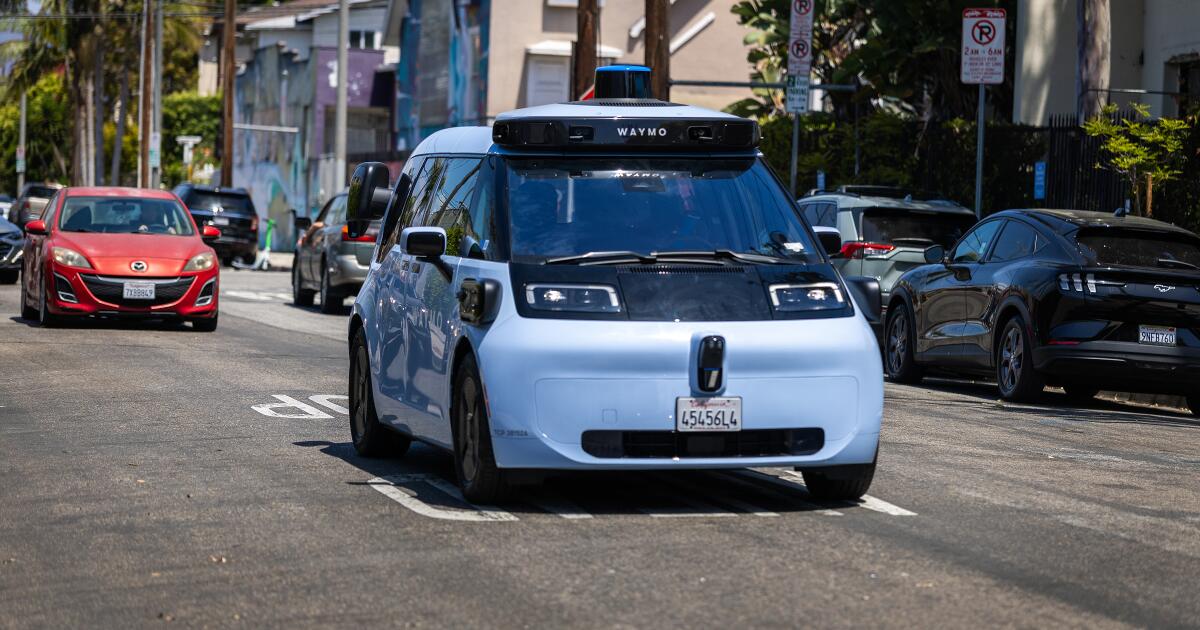
Waymo is starting robotaxi service in San Diego
-
 Entertainment14 minutes ago
‘Children of Blood and Bone’ author won’t see film after feud with star Amandla Stenberg
-
 Lifestyle19 minutes ago
After her son’s death, she found a new purpose. ‘He’s whispering: Mom, this is your path’
-
 Politics26 minutes ago
Iran ceasefire is ‘over,’ Trump says, and orders additional strikes
-
 Science29 minutes ago
Diarrhea-causing cyclosporiasis exceeds 1,000 cases in U.S. What Californians should know
-
 Sports34 minutes ago
Arthur Fery’s fairy-tale Wimbledon run puts British wild card on brink of history
-

 World44 minutes ago
Burnham on course to become next UK PM with backing of 322 Labour MPs

