World
Italy's Meloni visits Albania as controversial plan to hold thousands of migrants nears its start


- Italian Premier Giorgia Meloni visited Albania to thank its government for hosting asylum-seekers while Italy processes their claims.
- Meloni denied that her visit was a campaign stop for the upcoming European Parliament election and criticized opposition claims.
- Last November, Meloni and Albanian Prime Minister Edi Rama signed a five-year deal for Albania to shelter up to 3,000 migrants monthly.
Italian Premier Giorgia Meloni traveled to Albania on Wednesday to thank its government for its unique role in agreeing to host thousands of asylum-seekers while Italy processes their claims, and to tour migrant centers she said will be ready in August.
Meloni denied her day trip was a campaign stop on the eve of the European Parliament election in which migration is a big issue, and blasted criticism of the visit as typical opposition maneuvering.
Meloni and Albania’s Prime Minister Edi Rama in November signed a five-year deal in which Albania agreed to shelter up to 3,000 migrants rescued from international waters each month while Italy processes their asylum claims. With asylum requests expected to take around a month to process, the number of asylum-seekers sent to Albania could reach up to 36,000 in a year.
ALBANIAN LAWMAKERS APPROVE DEAL FOR COUNTRY TO HOLD THOUSANDS OF MIGRANTS FOR ITALY
“They (Italians) are grateful to the government, they are grateful to the Albanian people for this important effort of friendship that they are making to give us a hand,” Meloni told a news conference.
Police officers guard a reception center for migrants at the port of Shenjin, northwestern Albania, on June 5, 2024. Meloni traveled to Albania on Wednesday to thank its government for its unique role in agreeing to host thousands of asylum-seekers while Italy processes their claims, and to tour migrant centers she said will be ready in August. (AP Photo/Vlasov Sulaj)
Albania is not a European Union member, and the idea of sending asylum seekers outside the bloc is controversial. The deal was endorsed by European Commission President Ursula von der Leyen as an example of “out-of-the-box thinking,” but has been widely criticized by rights groups who warn that refugee protections could be compromised.
Meloni has defended the “extremely innovative” plan as a necessary component of her crackdown on migration, aiming to deter would-be refugees from paying smugglers to make the dangerous Mediterranean crossing.
She said the deal has attracted the interest of 15 out of 27 EU members who are asking the European Commission if “the union (could) follow the Italian model in the agreement with Albania.”
“The most useful element of this project is that it can represent an extraordinary tool of deterrence for illegal migrants destined to reach Europe,” she said.
TINY ITALIAN ISLAND OVERWHELMED WITH THOUSANDS OF MIGRANTS WHO ARRIVED WITHIN 24 HOURS
Meloni, accompanied by Interior Minister Matteo Piantendosi, kicked off her visit to the Western Balkan nation at Gjader, a former military airport 80 kilometers (50 miles) north of the capital, Tirana, where work for one of the two migrant centers has started.
Meloni next visited the port of Shengjin, 20 kilometers (12 miles) southwest of Gjader, where a reception center with housing units and offices is set in an area covering 4,000 square meters (4,800 square yards) and surrounded by a 5-meter (yard) high metal fence with barbed wire on top.
Meloni confirmed a two-month delay in the opening of the centers, saying that was due to unforeseen structural reinforcements that were necessary at one of the sites. She said that on Aug. 1 both centers would be operational and ready to host the first 1,000 migrants. A regular ferry link to Italy will begin in mid-September.
Meloni and her right-wing allies have long demanded European countries share more of the migration burden, and have held up the Albania agreement as an innovative solution to a problem that has vexed the EU for years.
Meloni, of the far-right Brothers of Italy party, has also championed her so-called Mattei Plan to fund projects in African countries along migrant routes in exchange for better controls.
At the end of the news conference Riccardo Magi, an Italian parliamentarian of the liberal +Europe party, who was part of the visiting group, tried to block Rama’s and Meloni’s convoys, physically clashing with bodyguards and saying the deal was a failure from the start and politically exploited by Meloni. Meloni stopped and exchanged words with him.
The two processing centers in Albania will cost Italy 670 million euros (about $730 million) over five years. The cost of taking 36,000 migrants to Italy is 136 million euros ($148 million), almost the same as the amount to be spent in Albania, according to Meloni.
The facilities would be fully run by Italy while it fast-tracks migrants’ asylum requests. Both centers are under Italian jurisdiction while Albanian guards will provide outside security.
Italy would welcome the migrants if they are granted international protection or organize their deportation from Albania if refused.
Those picked up within Italy’s territorial waters, or by rescue ships operated by nongovernmental organizations, would retain their right under international and EU law to apply for asylum in Italy and have their claims processed there.
Data from the Italian Interior Ministry show the number of migrants arriving in Italy is way down compared to the same period last year: As of Tuesday, 21,574 people had arrived in Italy via boat so far this year, compared to 51,628 during the same period in 2023.
Rama, of Albania’s left-wing governing Socialist Party, has said the deal is a sign of gratitude on behalf of Albanians who found refuge in Italy and “escaped hell and imagined a better life” following the collapse of communism in the 1990s Albania.
“Italy has been helpful and served Albania many many times and if we have the possibility to be helpful to Italy … let’s exploit this opportunity,” said Rama.
Tirana has refused other countries’ requests for deals similar to that of Italy, according to Rama.
Italy’s center-left opposition has called the deal an expensive exercise in propaganda ahead of European elections and a shameful bid to turn Albania into Italy’s “Guantánamo.”
A group of 30 Albanian opposition conservative lawmakers took the case to the Constitutional Court in an unsuccessful effort to block the Italy-Albania deal on the grounds of human rights.


People in Cuba already faced an ongoing economic and humanitarian crisis, largely due to a US blockade.
Published On 7 Jul 2026
Cuba has suffered its third nationwide power blackout since the start of the year, as the country’s fuel reserves diminish and its electric grid crumbles due to an energy crisis precipitated by the US fuel blockade.
The blackout in the country of nearly 10 million people was reported on Monday by the state-run Electric Union, which said that the cause is under investigation.
list of 4 itemsend of listRecommended Stories
Cuba’s Energy and Mines Minister Vicente de la O Levy said protocols were quickly activated to restore electricity throughout Cuba after the outage.
“Vital services continue to be protected, amidst this complex situation exacerbated by the energy blockade we face,” he said.
Grid operator UNE said it was providing electricity to some vital services, including hospitals and food production centres, but by late afternoon was able to serve only 1 percent of the capital, Havana’s, demand.
Cuba was already struggling with fuel supplies before US President Donald Trump cut off oil deliveries from Venezuela to the island in January. But Trump’s actions, including threatening tariffs on any country that sells or provides oil to Cuba, have made things significantly worse, and deepened the island’s financial crisis. As a result, blackouts and power cuts have accelerated.
Since January, Washington has only allowed one oil tanker, from Russia, to pass its blockade and dock in Cuba, as part of a sanctions campaign aimed at ending more than six decades of communist government in Havana.
Trump has pointed to the US abduction of Venezuela’s socialist president, Nicolas Maduro, in January, and his replacement with a successor that can be pressured to work with the US, as a potential blueprint for Cuba.
Cuban President Miguel Díaz-Canel accused the US of trying to “incite social unrest by strangling Cuba’s fuel supply”.
“The actions of electrical workers in the midst of a genocidal energy blockade are heroic,” he wrote on social media.
The blackout is the eighth on the island of 9.6 million people since late 2024. It comes as the state imposes power cuts across the country – over 30 hours straight in parts of Havana and over 70 hours in some rural areas – in a desperate attempt to preserve fuel.
“Living like this is agony,” Meyboll Font, a 51-year-old self-employed social media community manager, told the AFP news agency.
Font said her Havana neighbourhood has been surviving on just “three or four hours of power a day”, but that the blackout was worse because “you never know when it [electricity] will return”.

MADRID (AP) — A large wildfire in the south of France prompted Tour de France organizers to ban fans on Monday from attending the finale of the third stage of the cycling showpiece race.
After a couple of days in Spain, the race entered France with a stage to the Pyrenees town of Les Angles, about 60 kilometers (37 miles) from a fire that has burned almost 1,821 hectares (4,500 acres) of land.
Tour de France organizers said the large wildfire currently in the Pyrénées-Orientales required a large mobilization of wildfire-fighting resources, internal security forces, and other government agencies.
“The top priority remains the protection of people, property, and natural areas, as well as bringing the fire under control,” authorities said.
As a result, organizers decided that once the peloton reaches France for the last 40 kilometers (25 miles), the publicity caravan — a 10-kilometer (6-mile) procession of sponsor vehicles that precedes the race — would not be able to operate.
Only riders and vehicles essential to the race would be allowed on the route, and spectators were asked not to gather on the roadside or at the finish area.
Stage 3 started from the Spanish town of Granollers, where temperatures reached around 35 degrees Celsius (95 Fahrenheit), race organizers said, quoting the Spanish Meteorological Agency.
Nearly 700 firefighters were battling the blaze, which led authorities on Sunday night to order the evacuation of more than two dozen villages.
Europe is the world’s fastest-warming continent, with temperatures increasing twice as fast as the global average since the 1980s, according to the European Union’s Copernicus Climate Change Service.
Globally, 2025 was the third-hottest year on record, bringing severe heatwaves across Europe.
Scores of wildfires break out in Greece
In Greece, 96 wildfires had broken out over the past 48 hours, the country’s government spokesman Pavlos Marinakis said Monday. The vast majority were quickly brought under control before they could spread, he said.
Scientists warn that climate change is exacerbating the frequency and intensity of heat and dryness, especially in southeastern Europe, making the region more vulnerable to health impacts and wildfires.
The most significant fire broke out Sunday afternoon in the Mandra area west of the capital, Athens. Authorities deployed 29 aircraft and more than 200 firefighters in a race to tame the blaze before nightfall, when firefighting planes can no longer operate. By Monday, the fire had abated, although it had not been fully extinguished.
Several parts of the country were listed as being at a high or very high risk of wildfires on Monday due to strong winds. One wildfire that broke out in the southern island of Crete triggered evacuation orders for a village near the town of Ierapetra. The blaze, which was burning through mainly agricultural land, was being fanned by strong winds, the fire department said.
Another heatwave in Spain and Portugal
In the Iberian Peninsula, another surge in heat spread across Spain and Portugal, where hundreds of firefighters were also working to contain wildfires.
Spain’s weather agency AEMET warned that a heatwave that began Sunday would endure at least until Thursday, bringing elevated daytime and nighttime temperatures. Across much of Spain, including the capital Madrid, daytime highs were expected to range between 37 C and 42 C (99 F and 108 F) on Monday and Tuesday.
Overnight conditions were also forecast to be uncomfortably hot, with temperatures easily exceeding 20 C (68 F) — which scientists refer to as ‘tropical nights’. This means people might not be recovering properly from daytime heat in the overnight hours.
In Portugal, inland locations saw temperatures soar Monday, while coastal Lisbon also baked under temperatures reaching 33 C (91 F). Temperatures were expected to drop later in the week.
___
Associated Press writers John Leicester in Paris and Elena Becatoros in Athens contributed to this report
World
Zelenskyy pressures US and Europe for more ‘air defense’ assistance amid ongoing war with Russia

Former NATO ambassador credits Trump for historic NATO defense spending
Former U.S. Ambassador to NATO Kurt Volker discusses the upcoming NATO Summit in Turkey, which President Donald Trump will attend. Volker highlights Trump’s focus on increased defense spending from allies and the challenges of promoting unity within the alliance, especially following the Iran operation. He emphasizes NATO’s historical role in deterring aggression and its support for the U.S. after 9/11.
NEWYou can now listen to Fox News articles!
Ukrainian President Volodymyr Zelenskyy is pressuring the U.S. and Europe to provide more missiles to help Ukraine defend against Russian attacks.
“Last night, Kyiv came under a massive Russian attack. Russia launched 68 missiles and 351 attack drones,” Zelenskyy noted in part of a Monday post on X.
President Donald Trump is slated to attend the North Atlantic Treaty Organization (NATO) summit in Ankara, Turkey, this week.
Zelenskyy is calling for the U.S. and European allies to emerge from the meeting “with strong decisions in support of” Ukraine’s “air defense.”
TRUMP CALLS OUT NATO AHEAD OF SUMMIT, CALLING IT ‘RIDICULOUS’ FOR US TO PERSIST ON ‘ONE SIDED PATH’
Ukraine’s President Volodymyr Zelensky speaks at a press conference after meetings with the heads of the EU and Ireland, in Dublin on July 1, 2026. (Paul Faith/AFP via Getty Images)
“Our warriors performed well today in intercepting drones and cruise missiles, but unfortunately not Russian ballistic missiles. And the reason lies in the insufficient supply of interceptor missiles. It is critically important that the world – first and foremost the United States and our European partners – come out of the NATO Summit in Ankara with strong decisions in support of our air defense, and thus the protection of ordinary people’s lives,” he noted in the post.
WORLD LEADERS, DIGNITARIES PAY TRIBUTE TO AMERICA ON HISTORIC 250TH BIRTHDAY
President Donald Trump walks to Air Force One as he departs Bismarck Municipal Airport on July 1, 2026, in North Dakota. (Andrew Harnik/Getty Images)
“As long as Patriot missiles remain in our allies’ stockpiles, Russia is only encouraged to keep ‘vanquishing’ residential buildings. The United States and Europe have enough strength to stop this terror,” he asserted.
Zelenskyy’s comments come amid the years-long war between Russia and Ukraine.
RUSSIAN GENERALS’ ASSASSINATIONS EXPOSE GROWING RIFT INSIDE PUTIN’S SECURITY APPARATUS
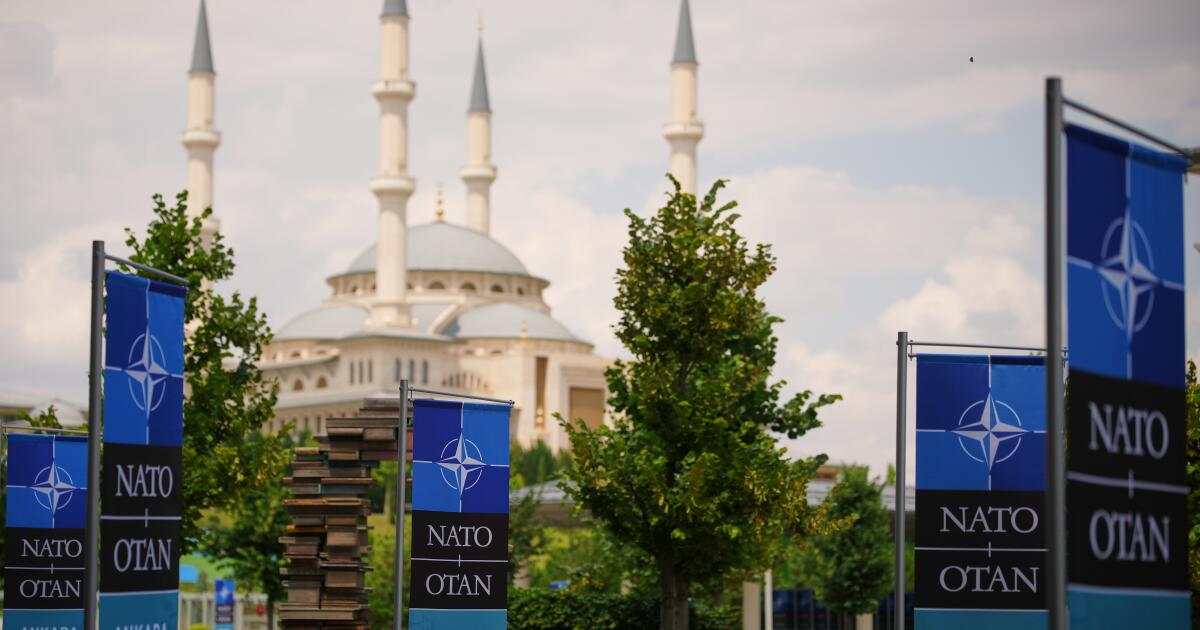
Large banners on an office complex near the Presidential Palace, the venue for the NATO summit, in Ankara, Turkey, on Monday, July 6, 2026. (Kerem Uzel/Bloomberg via Getty Images)
CLICK HERE TO DOWNLOAD THE FOX NEWS APP
Reuters reported that Zelenskyy, new South Korean President Lee Jae Myung, European Council President Antonio Costa and European Commission President Ursula von der Leyen are expected to have dinner with NATO leaders on Tuesday.
-
 Business4 seconds ago
Orange County real estate investor pleads not guilty in $100 million bank fraud case
-
 Entertainment7 minutes ago
Tom Sandoval’s ex Victoria Robinson accuses him of abuse; her restraining order is denied
-
 Politics15 minutes ago
Trump heads to NATO as tensions simmer with Europe
-
 Science22 minutes ago
New FireSat satellites promise faster wildfire detection over California and beyond
-
 Sports25 minutes ago
U.S. hopes of a historic World Cup run on home soil shattered in loss to Belgium
-

 World37 minutes ago
Cuba sees nationwide power blackout for third time in six months
-
 News1 hour ago
The U.S. men’s run at the World Cup ends with a 4-1 Round of 16 loss to Belgium
-

 Los Angeles, Ca2 hours ago
L.A. man who violently crashed into Border Patrol agents sentenced to 5 years in prison

