Wyoming
Survivors of Pakistan's train hijacking recount the harrowing experience

AYESHA RASCOE, HOST:
At least 21 passengers were killed in last week’s hijacking of a train in Pakistan. A militant group claimed responsibility for blowing up the tracks and opening fire when the train was halfway through a tunnel, forcing it to halt. The train was carrying more than 400 people. Betsy Joles reports from Karachi.
(SOUNDBITE OF VEHICLE ENGINE)
BETSY JOLES, BYLINE: Around 4:45 on Thursday morning, vans carrying survivors of the hijacking started pulling into the railway station in Quetta, the capital city of Balochistan. Inside the station, government officials recorded the names and seat numbers of around 80 survivors of the hijacking that took place 40 hours prior. They were the last group from the train to be evacuated. Bahadur Ali, a thin 24-year-old wearing a dusty sweatshirt and gray beanie, was one of them. He described the first moments of the attack on Tuesday afternoon.
BAHADUR ALI: (Through interpreter) They said if you don’t come out, then we’ll have to come inside. Some chose to stay inside. Those who rushed out in haste were shot. Many of them were shot.
JOLES: Ali was taking the train called the Jaffar Express from Quetta to his hometown in neighboring Punjab province. The hijacking happened in a remote mountain pass along the way. It resulted in a standoff with Pakistan security forces that left 33 militants dead. Ali says he stayed on the train until he was evacuated by security forces the next day.
ALI: (Through interpreter) The situation was terrible. Everyone was worried.
JOLES: The attack was carried out by the Balochistan Liberation Army, or BLA, a militant separatist group that seeks Balochistan’s independence from the rest of Pakistan. The BLA has been active since the early 2000s but has ramped up attacks in the past several years. They are now one of the most deadly insurgent groups in the region, according to Abdul Basit of the S. Rajaratnam School of International Studies in Singapore.
ABDUL BASIT: (Through interpreter) Anything which will be required in the tool kit of an insurgent group, they have all.
JOLES: He says increased recruitment from educated young people and tactics like suicide bombing picked up from other militant groups have made the BLA even harder for the Pakistani state to counter in this resourced-rich but impoverished part of the country.
BASIT: (Through interpreter) I would call it an inflection point in the Baloch insurgency because this is urban warfare, and this changes things.
JOLES: NPR reached out to the Pakistani military’s media wing for an interview. They declined but sent a link to comments by their Director General Ahmed Sharif Chaudhry on a local TV station, Dunya News.
(SOUNDBITE OF ARCHIVED RECORDING)
AHMED SHARIF CHAUDHRY: This incident of Jaffar Express changes the rules of the game.
JOLES: Chaudhry says the ringleaders of the hijacking were operating from Afghanistan. Pakistan has been struggling to contain the rise of militant attacks in its border regions. On Friday, Chaudhry also accused India of sponsoring terrorism in Balochistan. Both the Taliban in Afghanistan and the Indian government denied these accusations.
SAMMI DEEN BALOCH: In Balochistan, the state has been failed to stop the Baloch separatists. And in the end, it is the local on-ground people who will pay the price.
JOLES: This is activist Sammi Deen Baloch. She says she fears this attack will lead to more heavy-handed tactics by Pakistan’s powerful military. She’s worried about extrajudicial killings and disappearances.
UNIDENTIFIED PERSON: (Non-English language spoken).
JOLES: On Friday, friends and family members gathered in the courtyard of a home in Quetta to pray. They were mourning the loss of Shamroz Khan, a 36-year-old constable in the Pakistan Railways Police who was killed during the hijacking. Standing outside the house was Khan’s colleague, Muhammed Riaz (ph).
MUHAMMED RIAZ: (Through interpreter) We are in grief now, and this grief will last throughout our lives.
JOLES: Survivors who were with Khan says he was shot in the throat when he stood up to fetch water for fellow passengers. Riaz says his friend was that kind of person.
RIAZ: (Through interpreter) Naturally, he got up to serve. He really believed in serving people.
JOLES: For now, Riaz and other railway police officials in Quetta won’t be returning to work because train services from there are suspended.
With Sadullah Akhtar in Quetta, for NPR News, I’m Betsy Joles in Karachi, Pakistan. Transcript provided by NPR, Copyright NPR.
NPR transcripts are created on a rush deadline by an NPR contractor. This text may not be in its final form and may be updated or revised in the future. Accuracy and availability may vary. The authoritative record of NPR’s programming is the audio record.

Wyoming
Wyoming Cultural Trust Fund awards $529K in grants, including several Fremont County projects


CHEYENNE, Wyo. — Wyoming is a state known for cowboys, rodeos, and beautiful plains, but is also known for being the first territory to grant women the right to vote, something historian Jennifer Helton explored in her Suffrage Stories presentation.
Helton was invited to highlight Wyoming’s remarkable role in the fight for women’s suffrage as part of the museum’s special America 250 Discover & Discuss series on Jun 18, but the recorded version was just released. This is a part of Cheyenne Frontier Days Old West Museum’s goal of exploring Cheyenne and the greater state of Wyoming’s history.
Helton’s presentation not only celebrates Wyoming’s role in suffrage, but also how the state’s pioneering women helped shape the future of voting rights across the nation.
Born and raised in Wyoming, Jennifer Helton left the state at age 18 to attend college, “which left a giant, Wyoming-sized hole in my heart,” Helton said, “and the way that I fill that hole is by conducting research on women’s suffrage.”
Upon realizing that most people outside of the state of Wyoming did not know the West’s progressive role in suffrage, she became obsessed with bridging this knowledge gap and researching the history of suffrage.
“My kids would tell you it’s an obsession, not just an interest or a hobby,” Helton said. “They always joke that I have three kids, the two of them and then Esther Morris.”
During her presentation, Helton’s admiration for Esther Morris was apparent due to her trailblazing nature as suffragist, her courage to stand up to torch-bearing mobs, and abolitionist activities.
Interestingly enough, her sons were also instrumental in shaping Wyoming’s history. E.A. Slack is known as the “Father of Frontier Days” and citizens of Wyoming can thank Robert C. Morris for Cheyenne’s public library, as he brought the Carnegie Public Library System to Wyoming.
.
” data-large-file=”https://i0.wp.com/capcity.news/wp-content/uploads/2026/06/image-2.png?fit=780%2C863&ssl=1″ alt=”” class=”wp-image-170117″ style=”aspect-ratio:0.90332473687879;width:464px;height:auto” srcset=”https://i0.wp.com/capcity.news/wp-content/uploads/2026/06/image-2.png?resize=925%2C1024&ssl=1 925w, https://i0.wp.com/capcity.news/wp-content/uploads/2026/06/image-2.png?resize=271%2C300&ssl=1 271w, https://i0.wp.com/capcity.news/wp-content/uploads/2026/06/image-2.png?resize=768%2C850&ssl=1 768w, https://i0.wp.com/capcity.news/wp-content/uploads/2026/06/image-2.png?resize=780%2C864&ssl=1 780w, https://i0.wp.com/capcity.news/wp-content/uploads/2026/06/image-2.png?resize=400%2C443&ssl=1 400w, https://i0.wp.com/capcity.news/wp-content/uploads/2026/06/image-2.png?resize=706%2C782&ssl=1 706w, https://i0.wp.com/capcity.news/wp-content/uploads/2026/06/image-2.png?w=960&ssl=1 960w, https://i0.wp.com/capcity.news/wp-content/uploads/2026/06/image-2-925×1024.png?w=370&ssl=1 370w” sizes=”auto, (max-width: 780px) 100vw, 780px”/><figcaption class=) Photo of Esther Morris, the first female justice of the peace (Cheyenne Frontier Days Old West Museum). Credit: Cheyenne Frontier Days Old West Museum (Jennifer Helton Presentation) / Cheyenne Frontier Days Old West Museum
Photo of Esther Morris, the first female justice of the peace (Cheyenne Frontier Days Old West Museum). Credit: Cheyenne Frontier Days Old West Museum (Jennifer Helton Presentation) / Cheyenne Frontier Days Old West Museum
Throughout the course of her presentation, Helton revealed the results of her research by tracing the course of American history in order to highlight the intersection between Wyoming, women, and winning the right to vote.
The talk also highlighted incredible Black women such as Lucy Phillips and Nancy Phillips, some of the first Black women to vote.
As America celebrates its 250th anniversary, the museum invites visitors to explore the stories of trailblazers like the nation’s first woman justice of the peace Esther Morris, the first woman governor, the first Black women to vote, and many other extraordinary leaders who made history.
The museum is hosting its special America 250 exhibit and allows visitors to discover the stories, artifacts, and moments that connect the community to the nation’s history. The exhibit even features six U.S. presidents who visited Cheyenne or Cheyenne Frontier Days, and is currently running at the museum. For those who cannot attend, lectures such as this are filmed and provided online.
As Helton closed her lecture, she read the words of Esther Morris, “I say do all the good you can while you do live.”
“Because women like Esther Morris, like Theresa Jenkins, had the courage to stand up and do all the good that they could in their lives we are all able to live the lives that we are living today,” Helton said.
“So, we should be grateful to them, and I think we should also be asking ourselves what is it that we need to be doing so that future generations can preserve the same opportunities we have, and perhaps more.”
Watch Jennifer Helton’s full presentation at the link provided here.
To learn more about historian Jennifer Helton visit jenniferhelton.org.
.
” data-large-file=”https://i0.wp.com/capcity.news/wp-content/uploads/2026/06/image-3.png?fit=780%2C519&ssl=1″ alt=”” class=”wp-image-170141″ srcset=”https://i0.wp.com/capcity.news/wp-content/uploads/2026/06/image-3.png?resize=1024%2C681&ssl=1 1024w, https://i0.wp.com/capcity.news/wp-content/uploads/2026/06/image-3.png?resize=300%2C200&ssl=1 300w, https://i0.wp.com/capcity.news/wp-content/uploads/2026/06/image-3.png?resize=768%2C511&ssl=1 768w, https://i0.wp.com/capcity.news/wp-content/uploads/2026/06/image-3.png?resize=1536%2C1022&ssl=1 1536w, https://i0.wp.com/capcity.news/wp-content/uploads/2026/06/image-3.png?resize=1200%2C799&ssl=1 1200w, https://i0.wp.com/capcity.news/wp-content/uploads/2026/06/image-3.png?resize=780%2C519&ssl=1 780w, https://i0.wp.com/capcity.news/wp-content/uploads/2026/06/image-3.png?resize=400%2C266&ssl=1 400w, https://i0.wp.com/capcity.news/wp-content/uploads/2026/06/image-3.png?resize=706%2C470&ssl=1 706w, https://i0.wp.com/capcity.news/wp-content/uploads/2026/06/image-3.png?w=1605&ssl=1 1605w, https://i0.wp.com/capcity.news/wp-content/uploads/2026/06/image-3-1024×681.png?w=370&ssl=1 370w” sizes=”auto, (max-width: 780px) 100vw, 780px”/><figcaption class=) Jennifer Helton’s information (Cheyenne Frontier Days Old West Museum).
Jennifer Helton’s information (Cheyenne Frontier Days Old West Museum).
Related
Wyoming
At 6,000-year-old crossing, Gov. Gordon OKs Wyoming’s first-ever designated pronghorn migration route – WyoFile

SUBLETTE COUNTY—Gov. Mark Gordon heralded Wyoming’s first-ever designation to protect a pronghorn migration corridor — a more than 2 million-acre web of habitat — at Trapper’s Point, which he called a “wonderful passageway.”
“How incredibly valuable it is that you are standing here today,” Gordon told the crowd, “to witness this remarkable moment.”
Gordon commemorated the moment with his feet planted on the narrow bulge of high country that splits the Green and New Fork rivers. Thousands of years ago, the site was a well-used hunting ground for Native Americans — it’s the earliest known killing and processing site for pronghorn in North America. Now it boasts a wildlife overpass.
No pronghorn were to be seen during the especially windy Friday afternoon gathering, which attracted 75 attendees from nearby Pinedale and other western Wyoming communities.
Now Trapper’s Point is officially classified as a “bottleneck” for the Sublette Pronghorn Herd — one of 13 such bottlenecks. That classification is supposed to prevent any surface-disturbing activity, with the intent that pronghorn can keep passing through Trapper’s Point for generations to come.

Protecting the ability of the fleet-footed, tawny-and-white ungulates to migrate is a “key factor” in sustaining their population, Wyoming Game and Fish Director Angi Bruce said.
“This becomes even more important in severe winters or extreme droughts,” Bruce said. “Pronghorn are long overdue for recognition.”
Pronghorn in Sublette, Teton, Sweetwater and Lincoln counties travel a long road — some migrate more than 200 miles to escape harsh winters, trekking south into the lower Green River Basin, a semi-arid sweep of sagebrush steppe between Pinedale and Rock Springs. Then in the spring, they retrace those paths, returning to summer ranges, lush with verdant vegetation, even going as far as Grand Teton National Park.
There was also a long road of bureaucracy to get to this point.
Nearly three decades of effort preceded the formal designation of the migration routes used by the Sublette Pronghorn Herd, which is the farthest-traveling and among the largest pronghorn herds in the West.
Jackson Hole biologists long knew that the valley’s pronghorn left in the winter. But details were hazy on where they went and how they got there until around the turn of the century. Using data from tracking collars, biologists like Joel Berger, Steve Cain, Hall Sawyer and Doug Brimeyer helped delineate the route.

In 2008, a Bridger-Teton National Forest plan amendment established a portion of the path as the nation’s first designated wildlife migration corridor.
Popularized by its branding as the “Path of the Pronghorn,” the route has received press in national publications like High Country News and the New York Times.
But the southern reaches of the migration through the energy-rich Green River Basin have faced major political opposition since the early 2000s. Wyoming first attempted to protect those travel corridors in 2019, under a policy administered by the Wyoming Game and Fish Department. That effort was halted after a coalition of industry trade groups and counties protested.
Then, in early 2020, Gordon revamped the migration policy with an executive order. Still, the Sublette Pronghorn Herd proposal gathered dust, even as development threatened the route.
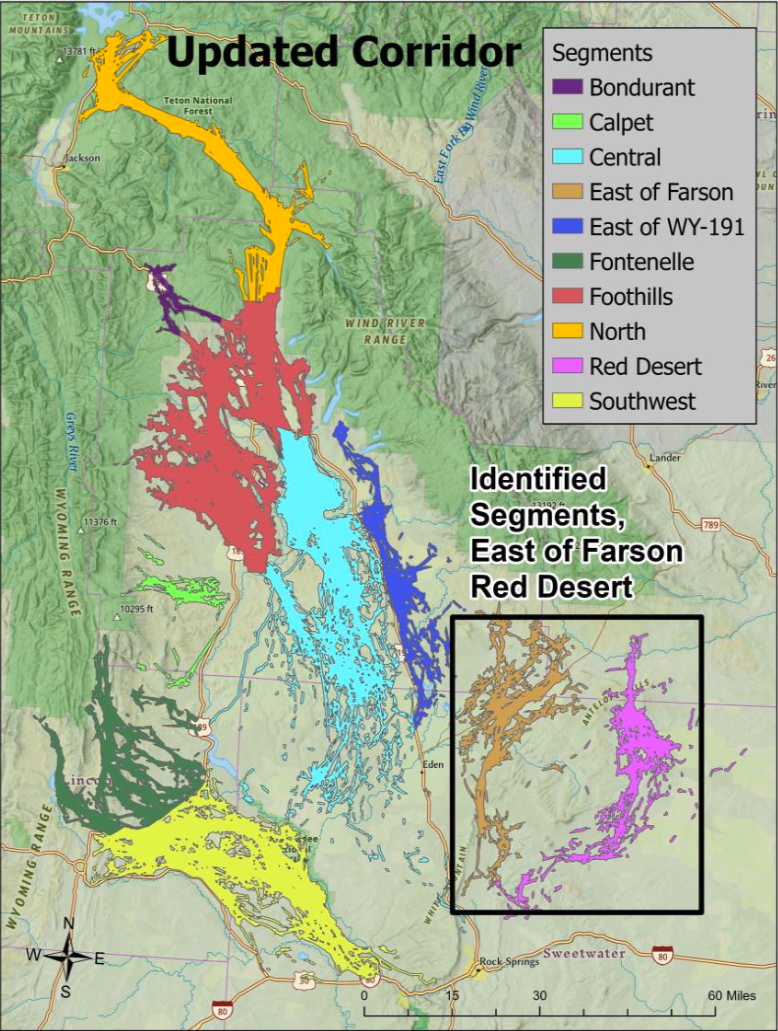
Game and Fish revived efforts to protect the migration in late 2023 and early 2024. Biologists pulled together one of North America’s most comprehensive migration datasets, benefiting from approximately two decades of GPS collar information collected from more than 400 pronghorn.
Some controversy followed the process until near the end. There was a debate about whether to designate the migration’s two easternmost segments, in the Red Desert and east of Farson. The Game and Fish Department proposed excluding the routes, but was overridden by its commission. Then Gordon upended that decision, excluding the two segments.
Vetting the migration corridor through a Gordon-appointed working group was the second-to-last step in the designation process.
“Today’s designation demonstrates that voluntary, locally driven conservation works,” said Robb Slaughter, who chaired the group, during the commemoration at Trapper’s Point.
Time will tell if that’s the case. Wyoming’s migration policy is, by design, permissive of development. Private land is exempt from protections, and designation is not an assurance that new stressors won’t be added to the landscape.

“Today is not the end of the process,” Slaughter said. “It’s the beginning of the next chapter. Continued monitoring, adaptive management, research, and cooperation will ensure these recommendations remain effective as conditions change.”
But Friday was the end of the migration designation process. The governor’s informal OK — no signature was needed — was the last step, said Sara DiRienzo, the governor’s deputy policy advisor.
Wildlife advocates celebrated the moment.
“This is historical,” Bruce said. It’s the first effort to protect the full length of a pronghorn migration corridor in the nation, she said.
-

 Movie Reviews7 minutes ago
Hollywood Pariah Kevin Spacey Opens in a Straight to Video Movie with 25 Producers, 1 Review, No Theaters, No Press – Showbiz411
-
World19 minutes ago
Rescue Workers and Aid Arrive in Venezuela, Official Says
-
 Lifestyle57 minutes ago
This mindset shift can help you get better at using up your leftovers
-

 Technology1 hour ago
TMD’s keyless bike lock is a $280 solution to a $60 problem
-

 World1 hour ago
American rescue teams pull infant alive from rubble in Venezuela days after devastating twin earthquakes
-

 Politics1 hour ago
Trump scores another endorsement win with Louisiana Senate runoff victory
-

 Health1 hour ago
New blood test detects 90% of aggressive prostate cancer cases, beating current screenings
-

 Sports1 hour ago
2026 World Cup Round of 16 Odds: Which Teams Will Make It?

