Wyoming
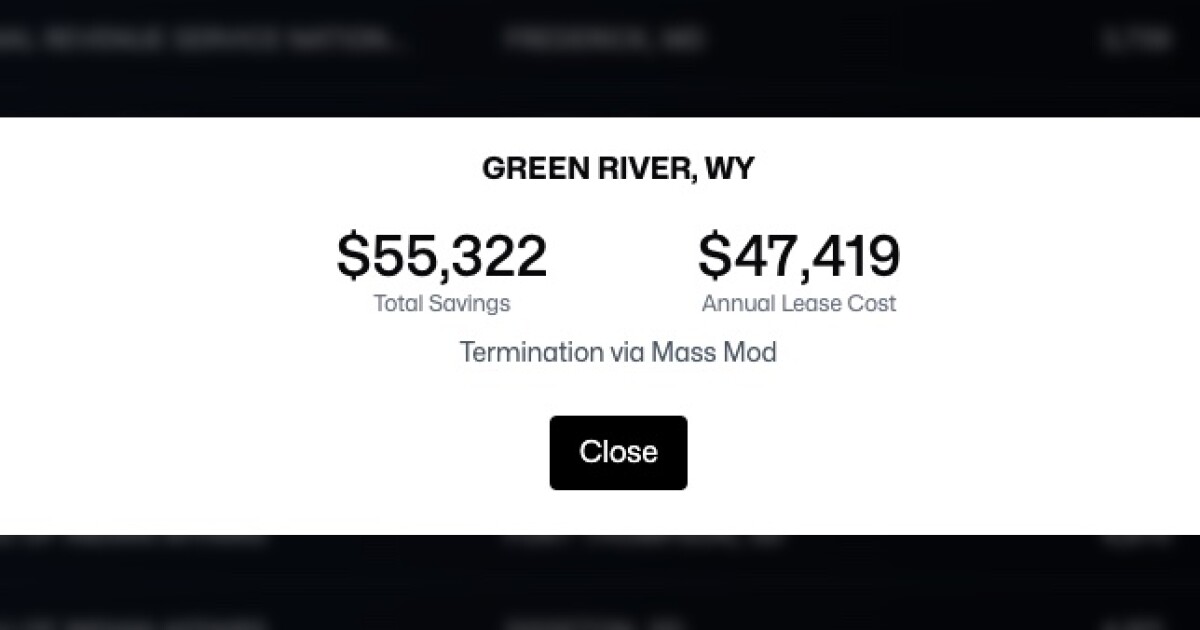
DOGE lists 5 Wyoming federal office leases terminated. One is a Green River mine safety branch

This is an evolving story and Wyoming Public Radio will update this story as we learn more.
Real estate leases for five federal offices in Wyoming are supposedly being terminated, including one intended to keep miner’s safe, according to a Department of Government Efficiency (DOGE) website. There are conflicting reports and details have been hard to confirm. One office was unaware of the supposed closure.
There have been reports indicating inaccuracies on the DOGE website.
Over the last few days, at least 748 real estate leases for federal offices across the nation were added to a terminated list on the DOGE website, as part of Pres. Trump’s plan to reduce the size of the federal government.
One of those was the Mine Safety and Health Administration (MSHA) field office in Green River.
“Just like the language they use to identify the spending being reckless and wasteful, this is reckless and irresponsible,” said Marshal Cummings, a Green River trona miner and local union president.
The website also listed 28 other MSHA offices nationwide. They are scattered across the country and near areas with heavy mine activity.
“Say there is a disaster, and MSHA needs to be there right now. That’s what the field office is there for,” Cummings said.
The Green River office is in Sweetwater County and near Lincoln County. Both areas have heavy trona and coal mine activity. MSHA oversees that companies and workers are complying with safety standards – everything from silica dust standards to prevent the deadly black lung disease, to proper use of machinery equipment, to updating old electrical systems to prevent fire.
“If people that I represent, or any of my fellow miners in southwest Wyoming have injury or, God forbid, they die, because someone decides that they can cut MSHA, I hope we have the resources to go after them [DOGE] criminally,” Cummings said.
He added that prior to MSHA forming in 1977, there was one of the worst mining incidents in American history: the Sunshine Mine disaster in Kellogg, Idaho. In 1972, a fire broke out in the mine and killed 91 miners. It served as a catalyst for forming MSHA.
Cummings said he spoke to the Green River office and as of now it’s open and unaware of the closure.
The following are all of the Wyoming federal offices included in DOGE’s list, along with Wyoming Public Radio’s (WPR) attempts to verify the information. WPR sent a list of specific questions, including whether leases were set for termination, how many people work in the office and whether those employees would be moved or also terminated. Agencies responded with the following statements.
- Social Security Administration in Rock Springs
- Response from a Social Security spokesperson: “We are working with GSA (General Services Administration) to review our leases and ensure they are used efficiently. Most of the leases we are not renewing are for small remote hearing sites that are co-located with other Federal space. As the majority of our hearings are held virtually, we no longer need as many in-person hearings locations. In fact, in FY24, twenty percent of these offices held no in-person hearings. Other offices are non-public facing, being consolidated into nearby locations, or we had planned to close. Social Security continuously monitors and evaluates the use of our office space to maximize efficiency for the American taxpayer.”
- Office of U.S. Attorneys in Lander
- A public information officer (PIO) for the U.S. Attorneys Office District of Wyoming said the GSA contacted the Lander office early last week to notify them that their lease would not be renewed. Later that week, GSA called again, saying they had received misinformation and that the Lander office would not be affected.
- In a follow-up email, the PIO said the Dick Cheney Federal Building in Casper, where the U.S. Attorney’s Office has a branch, is going to be sold. The GSA site the PIO shared no longer shows the list of “non-core property” slated for disposal, but did earlier in the week when WPR reviewed it. A previous version of the webpage from March 4 to 6 is accessible through the Wayback Machine.
- Geological Survey in Cheyenne
- Federal Motor Carrier Safety Administration in Cheyenne
- Mine Safety and Health Administration field office in Green River
- WPR called. Someone answered and said they’re not allowed to speak about the DOGE listing and hung up.
- WPR reached out to the owner of the building who didn’t reply to an email and hung up when WPR called.
One additional office was not listed on DOGE, but included in a list of office terminations compiled by U.S. House Natural Resources Committee Democrats.
- U.S. Fish and Wildlife Service in Lander
- No comment.
- The Lander Fish and Wildlife Conservation Office assists the Eastern Shoshone and Northern Arapaho Tribes of the Wind River Reservation with fisheries and wildlife conservation, according to its website.
Several of the offices directed WPR to reach out to the GSA, as they oversee government real estate leases. The following was their response:
“Acting Administrator (Stephen) Ehikian’s vision for GSA includes reducing our deferred maintenance liabilities, supporting the return to office of federal employees, and taking advantage of a stronger private/government partnership in managing the workforce of the future. GSA is reviewing all options to optimize our footprint and building utilization. A component of our space consolidation plan will be the termination of many soft term leases. To the extent these terminations affect public facing facilities and/or existing tenants, we are working with our agency partners to secure suitable alternative space.”
WPR will work to continue to verify the information.



Summer is Wyoming’s season for turning over rocks, poking into holes and walking with a perpetual hunch looking for snakes.
Herpalogists, the zoologists who study amphibians and reptiles, are out scouring the landscape and herping, the term used when they are actively flipping rocks and searching stream beds to find Wyoming’s elusive snakes in their native habitats.
Sometimes those finds can be unexpected. The fork-tongued reptiles appear on a trail when least expected.
Recently, a foot-long “nightcrawler” suddenly moved like a snake and slithered into the rocks, its tail disappearing into the shadows. Rather than a shapeshifter, this was an elusive rubber boa, Wyoming’s tiny constrictor snake that can look like a giant worm at first glance.
These rarely seen creatures are more common in the Cowboy State than most people realize.
“I personally don’t feel that any of our snakes in Wyoming are terribly rare,” said Matt Rasmussen, vice president of the Wyoming Herpetological Society. “However, a lot of them are very rarely encountered because they spend most of their lives either underground or under rocks.”
Rasmussen said most of the secretive snakes in Wyoming only come out at night or when conditions are right — typically warmer, humid times. The rubber boa, for instance, showed up on a day when it had rained and then the temperatures spiked hot.
Rasmussen helped found the new Herpetological Society two years ago to teach others to herp. He said it’s possible to learn more about our state by flipping rocks and seeing what is beneath.
“That’s the great thing with Wyoming,” Rasmussen said. “There is so little known about the herpetofauna — the frogs, lizards, snakes, turtles, etcetera — that live here, and so little known about their distribution.”
He said Wyoming is known for “large charismatic megafauna” such as bison, elk, moose and deer rather than the harder to find animals. As a result, no widespread surveying has been done on smaller non-game species. Wyoming Game and Fish has even asked for community members to help by reporting rarely seen reptiles and amphibians.
-

The Great Basin gopher snake is a non-venomous snake found primarily in the western United States and parts of southwestern Canada. You can find these snakes in a wide range of habitats; grasslands, woodlands, and deserts. -
The plains hognose snake can be mistaken for a rattlesnake but is harmless to humans. -
The Eastern yellow-bellied racer is incredibly fast, alert, and primarily hunts during the day using their sharp eyesight. Harmless to humans but feisty and will bite and musky-spray if cornered or handled. -
The smooth green snake is completely non-venomous, quite secretive and rarely seen. The Wyoming Natural Diversity Database said they are mostly found in localized pockets within southeast and south-central Wyoming and the Black Hills area. Their habitat are moist meadows, marshes, stream edges, open woods since they can camouflage in lush vegetation. This snake feeds almost exclusively on insects and spiders such as crickets, grasshoppers and caterpillars.


Elusive, Not Rare
While most people think of the more common bullsnake or venomous rattlesnake when discussing reptiles, Rasmussen said Wyoming is home to many harmless snakes.
According to Rasmussen, a few snakes, such as the colorful pale milk snake and rubber boa, could be considered rare in Wyoming. However, he believes they are just harder to find and most people are not aware of them unless they stumble across them.
“There’s the plains black-headed snake, which we really don’t know much about their distribution in Wyoming,” Rasmussen said. “They’re just not studied and have a limited habitat.”
This tan snake with a black head is small and feeds primarily on centipedes and ant eggs. Rasmussen cautions that when found, rather than kill the strange looking snakes that are harmless, report finding them to Wyoming Game and Fish and leave them in their habitat.
In this way, Rasmussen said, herping can be fun. He encourages people to get into the action.
“There are some other really small fossorial snakes like smooth green snakes, which live along creeks in the mountains and eat caterpillars and spiders,” Rasmussen said. “Then there’s the Black Hills red-bellied snake, which is a very small snake that eats slugs, worms and snails primarily.”
People are often surprised that Wyoming is home to such a large variety of snakes. He especially likes to show off a milk snake, which is harmless and eats lizards and even baby rattlesnakes.
“It is a beautiful, almost tropical-looking animal that lives right here,” Rasmussen said. “They are just rarely encountered.”
-
The northern rubber boa is found in the northwest corner of state such as Star Valley and east into the Bighorn Mountains. They are a small, docile, non-venomous constrictors that are rarely seen since they are excellent burrowers and climbers. The Wyoming Game and Fish consider them vulnerable/secretive and track sightings to help build their statewide database. -
The pale milk snake is not a venomous coral snake and is found in the Bighorn Basin, eastern plans and southeastern corner of Wyoming. They are rare to see because they spend their life hiding under rocks, within rocky outcrops, badland scarps, ponderosa pines, and shortgrass prairies according to the University of Wyoming. Since they are so secretive, spotting one in the wild is a rare treat and Wyoming Game and Fish is asking the public to report any sightings for their database. -
The plains black-headed snake is completely harmless because it’s mouth is too small to pierce human skin and its mild venom is for small invertebrates. Due to its secretive nature, it is rare to see one but they are known to be in southeastern Wyoming in the Platte and Carbon Counties. They are very small, secretive, burrowing snakes that spend almost all of their lives underground or hidden beneath rocks and logs, typically only surfacing at night. -
The bull snake or gopher snake is completely non-venomous but does not want you to know that. When threatened, they put on a dramatic show according to the National Park Service. The bullsnake will puff up their bodies, hiss loudly, flatten their head into a triangle and vibrate their tails in dry bush to mimic a rattlesnake. (Matt Rasmussen)


A New Snake & Frog Society
Rasmussen said the new society is trying to educate the community about these fascinating creatures in the Cowboy State that don’t get much attention, such as the skink, a short-legged lizard.
“We’re a group of herpetological enthusiasts who would like to spread the word, educate and do outreach about these animals,” he said.
This outreach includes presentations with live animals, field trips and a conference in November. Wyoming’s reptiles and amphibians remain a mystery, Rasmussen encourages reporting sightings on the app iNaturalist.
“Even if you don’t know what it is, post a picture because there are tens of thousands of experts who will identify that animal,” Rasmussen said. “That’s really important, especially for our herpetofauna in the state.”
He also pointed out that some Wyoming snakes are on the protected list, including the midget faded rattlesnake. They made the list, according to Rasmussen, because people were capturing them and they became popular in among owners who like to keep small venomous snakes as pets.
Rasmussen said awareness is the best protection for Wyoming’s elusive reptiles and he is excited to prove to residents that we don’t have rare snakes, only secretive ones.
Jackie Dorothy can be reached at jackie@cowboystatedaily.com.
Wyoming
Wyoming Cultural Trust Fund awards $529K in grants, including several Fremont County projects

-

 Delaware38 seconds ago
Top Democrat lawmaker suffers minor injuries in Delaware car crash
-

 Florida8 minutes ago
Florida woman dies when SUV rolls backward in Port. St. Lucie driveway
-

 Georgia11 minutes ago
What is a Heat Dome and How it’s Impacting South Georgia
-

 Hawaii16 minutes ago
Journey adds second show to final performance in Hawaii | Honolulu Star-Advertiser
-

 Idaho23 minutes ago
Torrential thunderstorms, hail flood suburban streets with ice floats on first full summer weekend in Idaho
-

 Illinois26 minutes ago
Four people hospitalized after Joliet police chase ends in crash: officials
-

 Indiana31 minutes ago
Chicago Bears assess land at Wolf Lake Terminals for possible new stadium site
-

 Iowa38 minutes ago
Iowa State Basketball Has Potential Emerging Star on Their Roster

