Wyoming
Angling in hot water: how higher temperatures are impacting river ecosystems and fishing outfitters

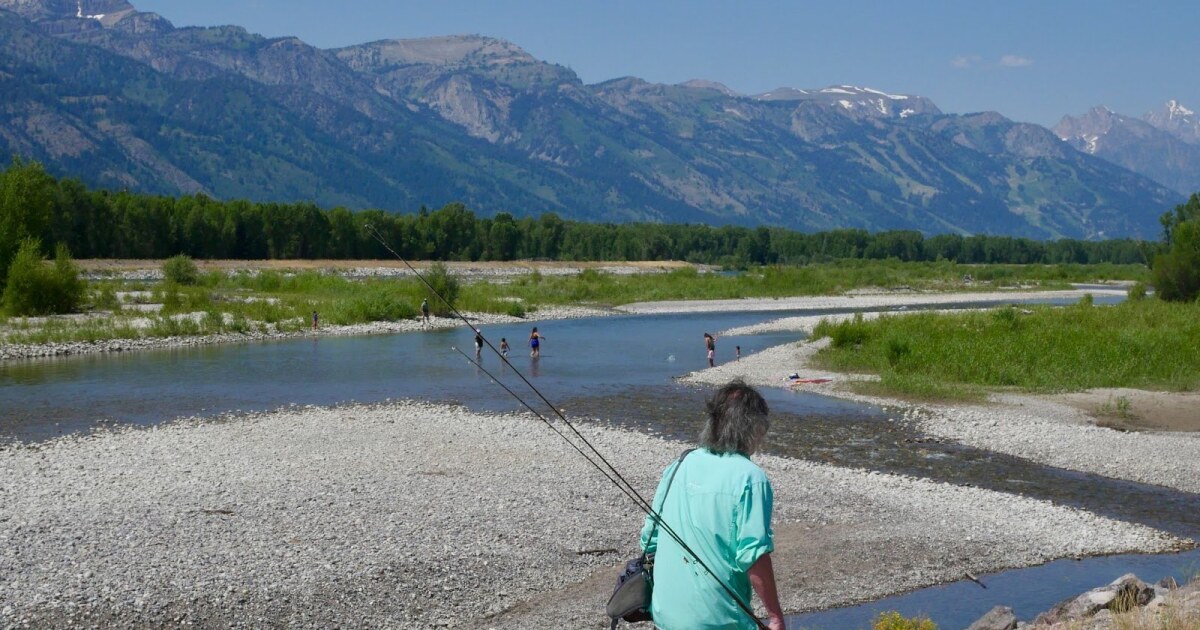
Earlier this month, a heat wave broke records across the country and also hit Wyoming hard. Most counties in the eastern part of the state were under heat advisories for multiple days. But the heat didn’t just impact air temperatures, it also took a toll on water ecosystems. The increased heat is impacting rivers, fish and the guides that rely on them.
Inside the Westbank Anglers fly-fishing shop in Wilson, long sleek rods line the walls. There’s boxes on boxes of brightly-colored flies, some with hair, fur and feathers.
In the office at the back of the shop, owner Mike Dawes said company guides are seeing water temperatures on the nearby Snake River already creep close to 68° in the middle of July. That’s a number that basically means it’s time to stop fishing for cold water species like trout.
“The water temperature is getting 66°, 67° on the Snake. And that’s just…I’ve never heard that before at this time of year,” he said.
Hannah Habermann
/
Wyoming Public Media
Dawes said that’s more normal for the middle of August. Westbank Anglers has been trying to get clients out on the water earlier, and Dawes himself was doing the same during the unseasonably warm heat spell a couple days ago.
“We were putting the boat on, floating at six in the morning, which is pretty magical, but also kind of a necessity,” he said.
The state of Wyoming doesn’t implement mandatory fishing closures, like Montana does. But Dawes thinks it should, and thinks the collective community of fishing outfitters could do more.
“In general, in terms of the outfitting business, we’re just behind a little bit. We need to catch up,” he said.
Catching up, in Dawes’ opinion, could look like having fishing representation on the state’s outfitting board, which he said is very hunting-focused. It could also mean getting all the management agencies across the state to collaborate on when it’s time to shut down fishing.
As far as how those kinds of closures might impact his business?
“I think I’ve been doing it long enough that if I was worried about it, I’m worrying about the wrong things,” he said.
Dawes said if it’s this hot on the high-elevation, glacier-fed Snake, there’s no doubt the rest of Wyoming’s waters are also feeling the heat.
“We typically have colder water temperatures than the rest of the state. So if we’re hot, then we know they’re hot,” he said.
Wyoming Game & Fish Casper Regional Fisheries Supervisor Matt Hahn said there’s two main things going on for fish when water heats up.
“One is just the physics of oxygen and water, so the warmer water is, the less dissolved oxygen that it can carry,” he said.
The second, Hahn explained, is physiological.
“They end up putting a lot more energy into respiration, just trying to pull as much oxygen from the water as possible. If the water temperature continues to go up, the physiological response becomes more and more dire,” he said.

Getting caught on a fishing line and being out of the water only adds to the stress for the cold-blooded critters.
“The fish obviously is trying to escape and so that increases energy demand on the fish at a time when it doesn’t have a lot of excess energy to expend on such things,” he said.
Hahn said different types of fish are adapted for different temperature ranges. There’s cold water fish like trout and salmon, cooler water fish like walleye and perch, and warm water fish like bass and catfish.
When it comes to trout fishing, getting above 68° means you’re starting to get into what Hahn called “the lower end of the stressful range,” with 75° being the mark where long-term exposure can result in mortality and 80° being lethal in minutes for most trout.
Warm water also means the quality of fishing goes downhill quickly.
“The fish are stressed. They’re putting all their energy into respiration. They don’t really have energy to spend on feeding because there’s an energetic cost to feeding,” he said.
Hahn said that Wyoming Game and Fish has really stepped up their education around best-practices for fishing, advising people to use barbless hooks or shift their fishing to earlier in the day.
“68° degrees is just a good benchmark to remind people, ‘Maybe I should start thinking a little closer about what I’m doing at a point, maybe just a little bit ahead of when it becomes critical’,” he said.
Three rivers in the northwest corner of Yellowstone National Park got to that point. On July 15, the agency announced that it was closing fishing on the Madison, Firehole, and Gibbon Rivers, and most of their tributaries. The agency pointed to warm water temperatures and low river flows.
John Schilling is the manager of Madison River Outfitters in West Yellowstone. He said local outfitters stopped fishing those rivers weeks before the closure and thinks the park could be way more proactive.
“We usually, on our own, stop fishing them by July 1st every year because they’re just too hot. And actually, the federal government, in our opinion, should automatically close them no matter what,” he said.

Madison River Outfitters Facebook
Schilling said that’s also the norm for most guiding companies in West Yellowstone.
“The Firehole [River] has been over 80° since the third week in June, so we refuse to take clients there,” he said, pointing to the fact that it’s a geothermal river.
He said Madison River Outfitters normally start fishing again on the Firehole in September. He thinks Yellowstone should follow suit.
“There’s still fish in there that you can catch, but it’s just not good for them. Too stressful. We’ve still got lots of water,” he said.
Schilling’s been in the area for forty years and said this is only the second time he can remember Yellowstone having fishing closures. The first was in 2021 and applied to the same rivers on the west side of the park.
Madison River Outfitters is still guiding on the Upper Madison River in Montana and on rivers in the northeast part of the park. Schilling said if those rivers in Yellowstone close, it might be a different story.
“If they close the northeast corner, then we’d see some impact,” he said. “Then we’d have nowhere else to go in the park.”
Boots Allen is the advocacy and outreach coordinator for the Snake River Fund, a Jackson-based nonprofit that promotes stewardship and access. He said dealing with hot water temperatures is a relatively new topic in the industry.
“It wasn’t until like the late 90s, early 2000s that this became an issue in the fishing world,” he said.

Allen is also a senior fishing guide at Snake River Angler. He started gathering his own data on the river in 2003. At first, he was only using a personal stream thermometer, then started consulting the first water temperature gauge at Moose just outside of Jackson when it was installed in 2007.
He said in the last few years, water temperatures have been breaking the 68° threshold. In 2022, the max temp was 71°.
“It was pretty shocking to see that we’re starting to break that 70° mark,” he said.
Although Wyoming Game and Fish and Grand Teton National Park haven’t issued closures like Yellowstone National Park has, Allen said the agencies do sometimes issue recommendations.
“Once you cross the 68° mark, the general recommendation is to finish your fishing at about 3 p.m.,” he said.
Allen said water temperatures, just like air temperatures, tend to peak between 4 and 7 p.m. each day. He added that there are other precautions anglers should take, regardless of water temperature.
“When you hook your fish, try and get that fish in as quickly as possible. Expose it to air above the surface of the water as little as possible and really try not to do it at all,” he said.
He said people should also wet their hands to keep the fish’ protective “slime” layer intact and to help keep the fish cool.
Allen said some guides he knows are taking all of August off because of the high temps. He’s cutting down his own days for that month too and is seeing the shoulder seasons get a lot busier.

Hannah Habermann
/
Wyoming Public Media
But, the downstream waters of the fishing industry look a bit murky. Allen said guides will have to keep adapting, even if that means hanging up the rod.
“If it gets to a point where they have to shut down fishing in the future – might not be in my lifetime, might be in my kid’s lifetime – that’s something we’ll just deal with,” he said.



CHEYENNE, Wyo. — As the Aug. 18 primary election approaches, Cap City News is introducing candidate questionnaires to help voters make informed decisions at the ballot box.
Every candidate in the primary field was sent the same three questions and given a limit of 500 words, which could be distributed among their answers as they saw fit. To ensure a fair and direct line to the community, all responses are published exactly as submitted, without edits or alterations.
Candidates were asked:
- What are the most crucial challenges your constituents are facing?
- If elected, how will you address these challenges?
- What qualities or qualifications do you possess that have prepared you to meet these challenges?
Questionnaires are being published on a rolling basis online through Aug. 11. They will be accessible via the Cap City News Election Tracker.
Jessica Crowder (R), Wyoming House District 43
What are the most crucial challenges your constituents are facing?
Wyoming is built on hard work, strong communities, and the responsible use of our natural resources. The families in House District 43 and Wyoming face real challenges — from the need for a more resilient, diverse economy to the increasing outmigration of young people. Wyoming families also face rising costs of healthcare, housing and more. House District 43 deserves a representative that puts people first and works to strengthen the place we call home through steady and thoughtful leadership.
If elected, how will you address these challenges?
As a legislator, I will use my experience working with landowners, businesses, and local governments to support the industries that define Wyoming while encouraging thoughtful growth and diversification. Our future depends on good jobs, strong schools, and communities where families can put down roots and thrive. We can honor the values that make Wyoming what it is while building something that lasts—an economy that works for working people, an education system that prepares the next generation, and communities that remain resilient and connected.
The rising cost of healthcare and the difficulty of accessing services are real challenges for Wyoming families. We need reforms that reduce costs, expand access—including to mental health resources—and meet people where they are. The 2026 Health Insurance Affordability Task Force is working to address rising costs, and I will work with this group and others to develop effective solutions that deliver the quality care our communities deserve.
Tax and housing reforms must be reviewed for possible refinement so people can afford to buy homes, stay in their homes, and build equity and pride of place. At the same time, every Wyoming county depends on a different mix of revenue, and we all rely on stable, predictable local funding for essential services. I will participate in honest, informed conversations about how to provide relief to those who need it most without jeopardizing essential services.
Wyoming’s economy depends on our core industries and new businesses that invest here. Both need clear, consistent processes and regulations so they have confidence in choosing Wyoming. Economic growth also relies on strong infrastructure and a skilled workforce. When these pieces work together—predictable regulations, reliable infrastructure, workforce readiness, and responsible budgeting—they create a stable environment that encourages growth, provides good jobs, and protects taxpayers.
What qualities/qualifications do you possess that have prepared you to meet these challenges?
I believe we maintain and create opportunity by respecting the people who live here and the land that sustains us. I grew up on a ranch and now raise my family in Laramie County, where we run a ranch and small business, so I understand the challenges facing families, landowners, and employers. With over 20 years of experience in agriculture, land management, and public policy, I’ve supported working lands, defended local interests, and strengthened communities. The values that guide this work—practical problem solving, respect for local knowledge, and a commitment to community—have broad application beyond land management and would serve me well in the legislature.
Related

TETON COUNTY, Wyo. — The Wyoming Department of Health recently confirmed two additional cases of measles in Teton County, bringing the statewide total to six cases, with five cases having occurred in Teton County.
A release from the WDH states that one recently-confirmed case is an adult with no identified links to the previous three Teton County cases, while the other case is also an adult, who had direct exposure to a previously identified case.
“This underscores the highly contagious nature of the measles virus,” the release states.
According to the release, the public may have been exposed to measles at the following locations and times:
Target Jackson Hole, 510 S Highway 89, Jackson, Wyoming 83001
- July 5, 2026, 7:00 AM through 7:00 PM
- July 6, 2026, 7:00 AM through 7:00 PM
- July 7, 2026, 7:00 AM through 7:00 PM
Smith’s Food and Drug, 1425 South Highway 89, Jackson, Wyoming 83001
- July 8, 2026, 9:00 AM through noon
“Measles is very contagious and can cause serious illness, including pneumonia, encephalitis, hospitalization, and death,” the release states. “Vaccination is the best way to prevent measles infection.”
For more information on measles, including case counts, exposure locations, and guidance on what to do if exposed, visit the Wyoming Department of Health website.
Related
-

 Hawaii4 minutes ago
Records were set for June rainfall – Hawaii Tribune-Herald
-
 Idaho10 minutes ago
How the City of Boise tests water samples to ensure the Boise River runs clean
-

 Illinois16 minutes ago
Data center fears mount after Illinois village residents prepare for the worst
-

 Indiana22 minutes ago
Statewide Silver Alert issued for two missing Indiana children
-

 Iowa28 minutes ago
Weight loss drug needles creating safety risk for eastern Iowa law enforcement
-
Kansas34 minutes ago
Kansas Lottery Powerball, Pick 3 winning numbers for July 15, 2026
-

 Kentucky40 minutes ago
Cyclosporiasis spreads across Kentucky
-

 Louisiana46 minutes ago
Louisiana pastor ordered to stay away from home of man he attacked

