West
Winery, brewery, bagel shop team up to call out Berkeley's permissiveness of homeless encampments

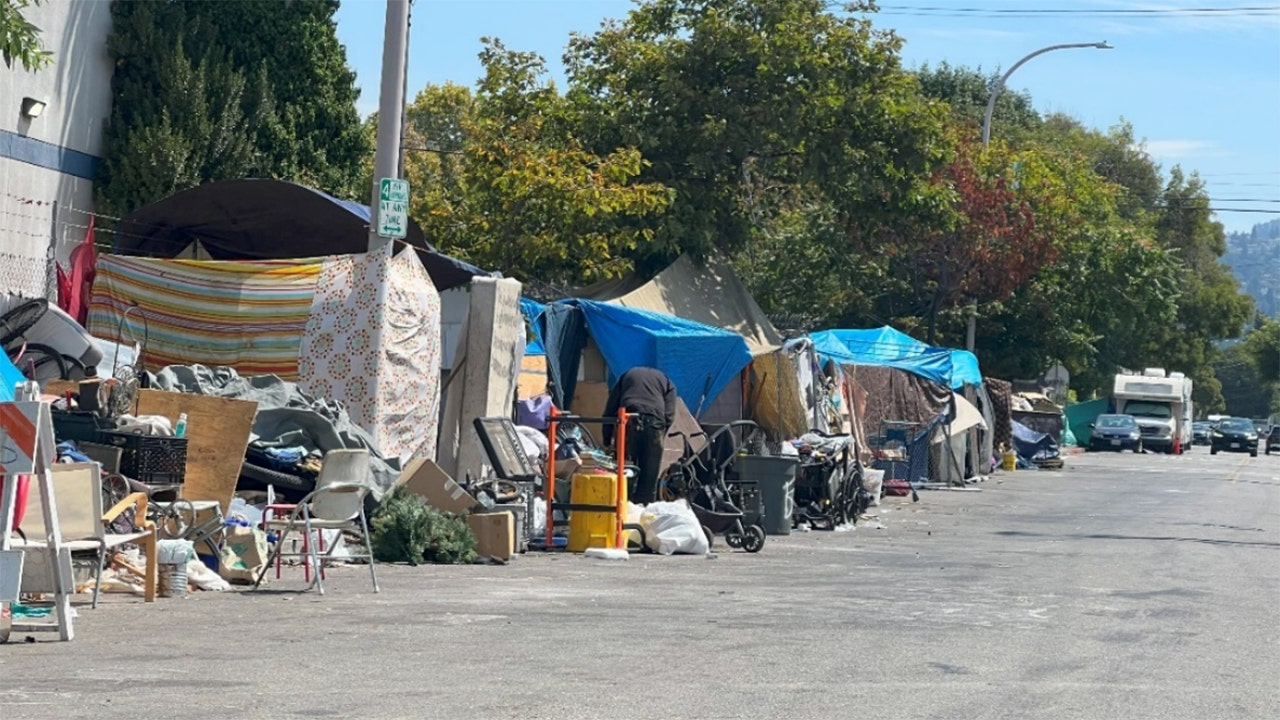
Several businesses in Berkeley, California, including a winery and a brewery, are suing the City of Berkeley for its failure to remove homeless encampments near them, which has hurt their profits.
The lawsuit was filed in Alameda County this week by eight businesses, including Covenant Winery, Emily Winston of Boichik Bagels and Fieldwork Brewing against the City of Berkeley.
The plaintiffs allege the case is about the City of Berkeley being required to follow the same nuisance laws private landowners must follow, while also owing an obligation to its citizens to maintain its streets and other public rights of way free from obstructions.
Over the past few years, the businesses claim, the city has allowed homeless encampments to remain on Harrison Street between Fifth, Sixth, Seventh, Eighth and Ninth Streets; along Codornices Creek; and in the Lower Dwight neighborhood.
NEWSOM CLEANS UP HOMELESS CALIFORNIA ENCAMPMENTS AFTER HE ALLOCATED BILLIONS OF DOLLARS WHILE CRISIS GREW
The City of Berkeley, California, is being sued by several businesses for failing to remove homeless encampments. (Superior Court of the State Of California County of Alameda)
The plaintiffs say in the lawsuit they believe the city allowed the encampments when the U.S. Court of Appeals for the Ninth Circuit “erroneously” ruled in two cases, saying a city may not criminalize public camping if there is no alternative space available for the campers to relocate.
While the decisions did not allow or require the city to permit encampments in a way in which it created a public nuisance, the city permitted and invited encampments in Harrison and Lower Dwight, knowing they would be a public nuisance, the plaintiffs allege.
The city also allowed encampments to remain in place despite shelter space being available.
GOV NEWSOM ORDERS HOMELESS ENCAMPMENTS TORN DOWN ACROSS CALIFORNIA: ‘NO MORE EXCUSES’
But in 2024, the U.S. Supreme Court reversed the Ninth Circuit’s decisions and said municipalities are permitted to remove public encampments whether sufficient alternative space is available or not.
The businesses said in the lawsuit they believe the city refuses to act, in part, because it fears litigation by advocates of those living in RVs and those who are homeless.
By filing the lawsuit, the businesses are asking the court to step in and require the city to follow the law and remove the encampments so the neighborhoods will be free of public and private nuisance conditions.
MASSIVE CALIFORNIA RESIDENTIAL TOWER TO OFFER HOMELESS PRIVATE ROOMS, GYM, CAFE AND MORE AMENITIES
The City of Berkeley, California, is being sued by several businesses for failing to remove homeless encampments. (Superior Court of the State Of California County of Alameda)
Fox News Digital has reached out to the city manager and some of the businesses who filed the lawsuit for comment.
The businesses are represented by Gavrilov & Brooks of Sacramento and Arizona-based Tully Bailey LLP. The latter won a case in 2023 that required the city of Phoenix to clear a homeless camp within the city limits.
Ilan Wurman, an attorney from Tully Bailey LLP who is on the Berkeley case, told Fox News Digital the Supreme Court’s decision earlier this year that held cities have the authority to remove homeless encampments, does not compel them to do so.
“It has become clear that Berkeley, even though it has shelter to offer, and its offers are routinely refused, does not plan to do anything about the encampments,” Wurman said. “Only a public nuisance lawsuit can force the city to do the right thing and clean up the city. This legal theory was deployed successfully in Phoenix, and we are optimistic it will work in Berkeley, too.”
FOX 2 in San Francisco spoke with Winston, who said she has tried to work with the city over the years to control the encampment near her business.
“It’s tough. It’s filthy. There’s trash everywhere. The street is frightening to drive down for customers. It’s not safe for our customers or our staff,” Winston said.
She also told the station she wants the unhoused residents to receive shelter and treatment they need but also called the city out for failing to improve conditions, forcing her to pursue legal action.
HOMELESS PERSON ALLEGEDLY ABDUCTS 4-YEAR-OLD AT CALIFORNIA RESTAURANT AMID UPTICK OF CRIME
Gov. Gavin Newsom along with a Caltrans cleanup crew at an encampment site near Paxton Street and Remick Avenue in Los Angeles as the state’s Clean California initiative continues Aug. 8, 2024, in Los Angeles. (Jason Armond/Los Angeles Times via Getty Images)
“I was not eager to do this. This was certainly not my idea of a good time. I wish the city would just have cleaned it up anyway,” she said.
Homeless encampments are a growing problem across California.
Gov. Gavin Newsom took to the streets of California in August to clean up trash left behind by homeless encampments, threatening municipalities that if they do not clean up encampments, they will lose state funding next year.
“I want to see results,” Newsom said at the time. “I don’t want to read about them. I don’t want to see the data. I want to see it.”
Homelessness has skyrocketed in the Golden State under Newsom’s leadership. According to the 2024 point-in-time count, which provides a snapshot of homelessness on a given night, the number of homeless individuals in California increased to approximately 172,000. This represented an increase from the estimated 131,000 homeless individuals counted in 2018, the year Newsom took office.
OAKLAND HOMELESS WOMAN STEALS CITY COUNCIL CANDIDATE’S FUNDRAISING MONEY: ‘I WAS LEFT TO FEND FOR MYSELF’
The City of Berkeley, California, is being sued by several businesses for failing to remove homeless encampments. (Superior Court of the State Of California County of Alameda)
Earlier this year, Newsom’s administration blamed counties and cities after a state audit report found his own homelessness task force failed to track how billions of dollars have been spent trying to tackle the crisis in the last five years.
At the time, a senior spokesperson for the California Interagency Council on Homelessness (CICH), which coordinates homeless programs across the state, told Fox News Digital the audit’s findings “highlight the significant progress made in recent years to address homelessness at the state level, including the completion of a statewide assessment of homelessness programs.”
Over the past five years, the CICH didn’t consistently track whether the money actually improved the situation, the audit concluded.
The spokesperson added local governments “are primarily responsible for implementing these programs and collecting data on outcomes that the state can use to evaluate program effectiveness.”
Since 2016, California has spent over $25 billion on homelessness. This includes state, local and federal funding allocated toward boosting the state’s “housing first” ideology through various programs, which prioritize placing people in housing first before addressing mental illness or substance abuse problems.
Fox News’ Jamie Joseph contributed to this report.
Read the full article from Here


In these Montana towns a stranger rarely stays a stranger for long. Shopkeepers in Philipsburg know their regulars by name. Bigfork neighbors fill the same theater seats every summer. Livingston locals still swap trail tips with visitors over coffee. The welcome here comes from people who greet newcomers like they belong. These eight communities show what small-town Montana hospitality looks like up close.
Whitefish
Whitefish sits within an hour of Glacier National Park, and that proximity shapes everything about the town. Central Avenue runs on covered Old West walkways lined with local shops, restaurants, and galleries, and the crowd shifts with the seasons as skiers give way to summer hikers.

Glacier National Park draws visitors with hundreds of miles of hiking trails, alpine lakes, and the scenic Going-to-the-Sun Road. Closer to town, Whitefish Lake offers public beaches, boat rentals, paddleboarding, and fishing during the warmer months. When winter arrives, Whitefish Mountain Resort becomes the area’s main attraction, with ski runs, snowboarding terrain, and gondola rides overlooking the Flathead Valley. Even after a day outdoors, many visitors return to downtown Whitefish to browse local shops or settle in at the town’s restaurants and breweries.
Bigfork
Sitting on the northeastern shore of Flathead Lake, Bigfork pairs a working harbor with a downtown built around its artists. Galleries and studios cluster within a few walkable blocks, and the water is never out of sight for long.
Flathead Lake is the town’s biggest draw, with boating, kayaking, fishing, and swimming on the largest natural freshwater lake west of the Mississippi River in the lower 48 states. Just offshore, Wild Horse Island State Park lets visitors hike among native wildlife, including wild horses, bighorn sheep, bald eagles, and mule deer. Theater lovers can catch a Broadway-style production at Bigfork Summer Playhouse, which has staged live performances for decades. Before leaving town, visitors can browse the independently owned galleries and studios showcasing paintings, sculptures, ceramics, and other work by Montana artists.
Philipsburg
Philipsburg made its money in silver, and the painted storefronts along Broadway Street date to those boom years. The old buildings now hold local businesses, and the mining past is easy to trace from one block to the next.
A visit to Gem Mountain Sapphire Mine lets visitors sift through mining gravel for Montana sapphires, many of which can be cut into finished gemstones. Just outside town, Granite Ghost Town State Park preserves the remains of a silver mining community, with abandoned buildings that mark the region’s boom years. Those interested in local history can stop at the Granite County Museum, where exhibits cover the area’s mining industry and early settlement. Before leaving, many visitors make time for The Sweet Palace, a candy store that has become one of the town’s signature stops.
Livingston
Livingston sits on the Yellowstone River and serves as a northern gateway to Yellowstone National Park. Restored commercial buildings house an active arts scene, and the Absaroka Range rises just south of the rooflines.
The historic downtown works as the town’s main visitor area, with independent bookstores, outfitters, cafes, and long-standing local businesses inside restored commercial buildings. At the Yellowstone Gateway Museum, exhibits trace the region’s history through Indigenous presence, railroad expansion, and early settlement in the Yellowstone Valley. Small galleries across the downtown core show work by regional artists whose subjects often reflect the river valley and the mountains around it.
Red Lodge
Red Lodge marks the start of the Beartooth Highway, one of the highest paved roads in the country. Its compact, walkable downtown keeps locally owned shops and restaurants busy in every season.
The Beartooth Highway climbs into the Absaroka-Beartooth Wilderness and continues toward Yellowstone National Park, with steep mountain passes, alpine lakes, and long-range views. In winter, Red Lodge Mountain becomes a major recreation area for skiing and snowboarding, with terrain that draws residents and visitors alike. During the warmer months, hiking trails in the surrounding mountains open onto forests, ridgelines, and wildlife viewing areas. Downtown Red Lodge stays active year-round, with local businesses and historic buildings packed into a walkable core.
Choteau
Choteau sits where the prairie meets the Rocky Mountain Front, and dinosaurs put it on the map. Fossil beds nearby produced some of the most important dinosaur nesting discoveries in North America, and the town leans into that history.
At the Old Trail Museum, exhibits cover the region’s natural history, including fossil finds and artifacts tied to its prehistoric past. The surrounding country is known for wildlife viewing, with elk, deer, and many bird species in the foothills and open plains near town. Just outside Choteau, fossil sites linked to major dinosaur discoveries have built the area’s reputation in paleontology research. The Rocky Mountain Front opens onto hiking routes and wide viewpoints where the plains give way to the peaks.
Stevensville
Stevensville is the oldest permanent settlement in Montana, founded in 1841 as St. Mary’s Mission. It sits in the Bitterroot Valley between the Bitterroot and Sapphire mountains, and the town center still runs at a slower pace.
St. Mary’s Mission is the town’s most significant landmark, preserving the mission’s early buildings and marking the first permanent Euro-American settlement in what became Montana. The Bitterroot Valley around Stevensville is known for its orchards, farmland, and mountain views, and it serves as a corridor to nearby communities and recreation areas. Local boutiques and small shops fill a compact town center that reflects its long history. Hiking trails in the nearby foothills reach forested terrain, open meadows, and views of the Bitterroot Mountains, drawing the most traffic during the warmer months.
Virginia City
Virginia City boomed after an 1863 gold strike in Alder Gulch, and much of that town survived. Wooden boardwalks, original storefronts, and period buildings still line the Main Street, so a walk here doubles as a walk through the 1860s.
Historic structures throughout the town can be toured to see how miners, shopkeepers, and early settlers lived during the gold rush era. Several small museums and preserved buildings cover mining equipment, frontier life, and local governance during the 1800s. Costumed interpreters run seasonal reenactments as well, recreating daily routines and events from Virginia City’s early years.
Small Towns Worth the Detour
These eight towns show how much Montana packs into its smaller communities. Livingston and Whitefish put national parks within reach of a walkable downtown, while Philipsburg and Virginia City keep their mining-era streets intact and open to visitors. Choteau turns fossil country into a point of local pride, and Stevensville carries the state’s oldest roots. Anyone looking for genuine small-town hospitality will find plenty of it across these Montana communities.

RENO, Nev. – A homicide suspect from Montana took their own life on Thursday night after police surrounded their car in northwest Reno, reports KTVN 2 News Nevada.
The incident happened in the area of Sharlands Avenue around 9 p.m., according to a spokesperson for the Reno Police Department.
Officers located the suspect and surrounded their car, blocking them in. They then heard a single gunshot and backed away.
Reinforcements were called, and a drone was brought in by UNRPD. It was then confirmed the suspect was in their car, dead from a self-inflicted gunshot wound, the news agency reports.
The suspect has not been identified pending the notification of next of kin, and no additional information has been released at this time.
In addition to the Reno Police Department, the Regional Narcotics Unit and Washoe County Sheriff’s Office also responded.
The investigation is ongoing.

ALBUQUERQUE, N.M. – Vers Bar will soon open in Nob Hill, adding a new gay bar to the city as its owners say Albuquerque’s LGBTQ+ community wanted more space.
KOB 4 got a preview before the opening and spoke with owners Lucas Romero and Luke Rogers outside the new bar.
Romero and Rogers said Albuquerque right now has only two gay bars and one gay club, fewer than other cities its size and fewer than the city used to have.
“We put a lot of love and effort into this space and put a lot of love and effort into the community. And I think when you bring those two things together, I think we have something really special for Albuquerque,” Romero said.
“Coming out of COVID. We realized that there was an opportunity or a need for people in the queer community to have a space, and so we hosted this mixer. We called it friends of Dorothy,” Rogers said.
They said those quarterly meetups at different bars across Albuquerque eventually drew close to 400 people and helped show demand for a permanent space.
“We were like, well, hold on. Is this our proof of concept for possibly a gay bar?” Romero said.
The couple found the former Albuquerque Distilling location on Central early last year and renovated it into a bar and lounge. They also leased the suite next door for a dance floor and event space.
They said social media posts about the project built interest beyond New Mexico, but they created Verse Bar with local customers in mind.
“To many of us in the gay community, having a gay bar or a strong queer culture is really important.” Rogers said.
Verse Bar will officially open to the public next weekend. Romero and Rogers said they plan a soft opening this weekend to test equipment and make sure staff are ready.
-

 Michigan4 minutes ago
Harmful algal blooms reported on 2 large West Michigan lakes
-

 Massachusetts7 minutes ago
Insider tips for navigating the Brimfield Antique Flea Market
-

 Minnesota12 minutes ago
Northwest Minnesota Foundation awarded $200,000 for child care economic development
-

 Mississippi19 minutes ago
Family of Mississippi teen Nolan Wells demand investigation into son’s death
-

 Missouri21 minutes ago
SEMA sets info sessions for FEMA Public Assistance for late-April storms
-

 Montana27 minutes ago
8 Most Welcoming Towns In Montana’s Countryside
-

 Nebraska34 minutes ago
Nebraska abortions rose nearly 8% in 2025, mostly due to influx of Iowa patients
-
Nevada37 minutes ago
Murder suspect from Montana takes own life when surrounded by police in Nevada

