Utah
The forecasts for Utah’s monsoon season are in. And it’s not very good news

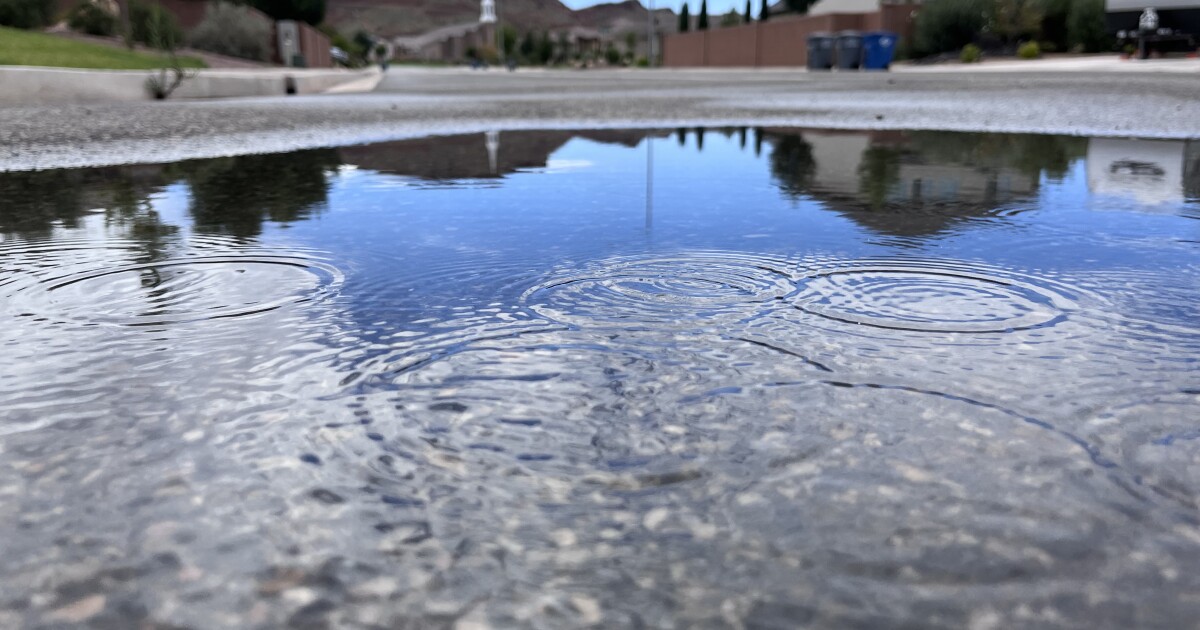
The outlook for this summer’s monsoon season shows Utah’s recent stretch of wetter-than-normal years may soon come to an end.
Below-average rainfall and above-average heat is in store between July and September, according to forecasts from the National Oceanic and Atmospheric Administration.
That’s bad news for water supplies, drought conditions and wildfire risk in an already dry state. But exactly where the worst localized impacts will be won’t be known until later in the summer, said Jon Meyer, assistant state climatologist with the Utah Climate Center.
“That will be a little bit touch-and-go as the season evolves into July and August. But at this point, overall, the region is expected to have an underperforming monsoon.”
Utah’s summer rainy season is also expected to show up late — likely two or three weeks behind its usual July onset. Early signs of monsoonal activity, he said, should already be forming in Mexico.
“They should be seeing afternoon thunderstorms across the mountains right now, and that really hasn’t materialized. So it’s behind getting out of the gate. … I think that is confirming our fears.”
The delay is largely due to lingering soil moisture from the past two wet years, which keeps the monsoon weather pattern from starting. The above-average heat Utah experienced this June may dry out the dirt a bit, he said, but likely not enough — or not quickly enough — to negate the effects of that moisture.
Last year’s summer rains were also delayed. But when they finally arrived, they brought enough moisture to turn things around in a hurry.
“I’m remaining optimistic that that might save our bacon this year with the delayed start expected again,” Meyer said. “But we have quite a few indicators right now suggesting that won’t happen.”
One of those indicators is the cycle of water temperatures in the Pacific Ocean, the phenomenon that creates El Niño and La Niña weather patterns.
Forecasts still expect that cycle to shift to La Niña in the months ahead — which could theoretically boost monsoon rains — but Meyer said that transition has been delayed, too. So La Niña will arrive too late to have much impact.
“It dragged its feet just enough. … So we’re missing out on that ingredient as well.”
With the outlook for La Niña and other global atmospheric patterns not as favorable as they were last year, he said it’s likely Utah will only see sporadic rainfall — rather than the steady storms of summer 2023.
National Oceanic And Atmospheric Administration
For Utah communities, this return to a drier cycle could have big impacts. For one, Meyer said it’ll likely allow drought to creep back in.
“We’ve seen some whispers of drought expansion in southern and eastern Utah thanks to their dry and warmer spring. So what we’re very much focused on right now is how our summer pattern will evolve and affect drought conditions.”
That’s a particularly worrying thought for the desert region around St. George, where water is already hard to come by.
“Monsoon rain for southwest Utah is actually very profound and has a huge effect upon our water supply,” said Washington County Water Conservancy District General Manager Zach Renstrom. “It’s something very critical that we count on.”
It’s vital, partly, because of its timing.
Monsoons typically hit southern Utah in July and August. Those months often have some of the hottest days of the year and ramped up demand for local water supplies — often for outdoor irrigation to keep grass and crops alive.
When it rains, people tend to turn off their sprinklers. To promote that mindset, he said the district offers a rebate on smart irrigation controllers, which use local weather data to help residents adjust their watering schedule.
“If we can save a gallon of water, we have the ability to save that water for multiple years. … So we always preach, ‘Hey, turn off your sprinklers.’”
Without the rain, however, pressure on local water supplies will inevitably rise. The area’s reservoirs are filled and ready to handle that demand this year, Renstrom said. That doesn’t mean there wouldn’t be lasting impacts.
As water storage gets drawn down from increased use, his thoughts turn to refilling it with future runoff from snowpack. But a poor monsoon season could hurt those chances, too.
That’s because soil that gets parched this year might soak up next year’s runoff before the water flows down to replenish reservoirs.
“It makes me actually very nervous about the following year,” Renstrom said.
“If we don’t get a good monsoon rain this year, not only does it affect this year, but it’ll actually affect the next summer. So it almost has a year-long effect.”


ST. GEORGE, Utah (KUTV) — A jury returned a guilty verdict against a Chicago man accused of trafficking 25 pounds of cocaine through Utah with a firearm and cash.
Marcus Kentral Brown, 41, of Chicago, was found guilty on Tuesday of possessing 500 grams or more of cocaine with the intent to distribute and carrying a firearm in relation to a drug trafficking crime.
A Utah Highway Patrol trooper pulled Brown over in his Jeep Grand Cherokee on July 13, 2021. Brown reportedly said that he was traveling back to Chicago from California.
MORE | Drug Bust
The U.S. Attorney’s Office District of Utah said that, according to evidence presented at trial, the trooper conducted a consensual search of the vehicle and found 10 packages of cocaine (25 pounds worth) and a loaded Glock pistol in a hidden compartment in the rear cargo area. The trooper also found air fresheners and about $14,000 in cash.
Brown is scheduled to be sentenced on Oct. 28 in St. George.
JOIN THE CONVERSATION (1)
_____

The state of Utah has revoked the license of a boarding school where socialite Paris Hilton said she was abused as a teen, saying the school “failed to provide applicable health and safety services for clients.” The state’s action, which took effect Monday, cites multiple noncompliance issues against the Provo Canyon School’s campus in Springville, reports the AP. The school has 15 days to request a hearing before the Department of Health & Human Services. The wide-ranging citations, which go back to 2025, include failing to increase staff-to-client ratios, engaging in unnecessary restraint and aggressive physical contact with a client, neglecting care, and not verifying employee information or submitting background checks for applicants in a timely manner.
“For more than fifty years, children came forward with stories of abuse, neglect, and trauma,” Hilton said in a statement provided Tuesday. “Today, the state confirmed what survivors have known all along: Provo Canyon School failed the children in its care. I was one of those children. I know what it feels like to cry for help and believe no one is coming. Today, children still inside that facility know someone is finally coming to protect them.” Hilton, the hotel heiress and media personality, spent almost a year at the school in the late 1990s. She alleges staff members beat her, watched her shower, fed her unknown pills, and locked her in solitary confinement without clothing.
Hilton, 45, called on Utah regulators to shut down the school. She has testified about her experiences there in Congress and state legislatures around the US, helping pass laws to protect teens in Utah and 15 other states. Utah has long played an outsized role in the troubled teen industry, a network of private, for-profit residential centers for children with behavioral issues. In June, Hilton returned to the school to speak in support of two families who filed lawsuits alleging their children were mistreated there. The school is under new ownership. The administration has said it can’t comment on anything that came before the change, including Hilton’s time there. Provo Canyon School did not immediately respond to an AP email seeking comment. The state said in its letter that all services at the campus must be terminated by Aug. 6.

- Summer League
- Free Agency
- NBA Cup
- Teams
- League Pass

 League Pass
- Summary
- Box Score
- Game Charts
- Play-By-Play
-

 Washington2 minutes ago
Washington law says to alert the public when doctors are accused of misconduct. It can take months
-

 Wisconsin9 minutes ago
Former Wisconsin judge to be sentenced after conviction in obstructing arrest of Mexican immigrant
-

 West Virginia11 minutes ago
West Virginia town’s entire police force fired after ex-sergeant claims evidence room was broken into
-

 Wyoming17 minutes ago
Wyoming coal company wins federal money to extract critical minerals from Powder River Basin – WyoFile
-

 Crypto24 minutes ago
Residents question proposed crypto mining center
-

 Finance26 minutes ago
How Natura &Co Is Transforming Finance with Generative AI on SAP S/4HANA
-

 Fitness31 minutes ago
This 30-second walking habit can make every walk more effective and boost your fitness in less time
-

 Movie Reviews42 minutes ago
Film Review: ‘Gail Daughtry and the Celebrity Sex Pass’ Throws a Ton of Jokes at the Wall (and Enough Stick) – Awards Radar

