Utah
‘It for sure feels special’: Bryson Barnes reflects on his time at Utah as he prepares to face his old school on Saturday


This article was first published in the Ute Insiders newsletter. Sign up to receive the newsletter in your inbox each Wednesday night.
By the time “College GameDay” rolled into town last October, Bryson Barnes had become something of a folk hero in Salt Lake City.
Hailing from Milford, Utah, where he grew up on a pig farm, Barnes starred on the gridiron for tiny Milford High, his 137 career touchdowns throws standing atop the UHSAA record books and his 11,525 career passing yards still ranking second in Utah high school football history.
His eye-popping stats, though, came against 1A competition, and as a result, Barnes was underrecruited out of high school, choosing to walk on at Utah, the school he grew up cheering for.
From the moment he arrived on campus in the foothills of Salt Lake City, Barnes knew that he’d have to earn everything and that nothing would be handed to him. For much of his time at Utah, he didn’t have a scholarship, paying his own way through school, and ahead of the 2021 season, Barnes was fighting an uphill battle to get playing time.
The Milford High quarterback was behind not just Charlie Brewer, who began the year as Utah’s starter before transferring midseason, and Cam Rising, who took over as the starting quarterback three games into the year, but other highly-recruited quarterbacks like Peter Costelli and Ja’Quinden Jackson.
But Barnes kept working and grinding away, and when Rising suffered a concussion early in the fourth quarter of the 2022 Rose Bowl against Ohio State, most thought it would be Jackson, who was listed as Rising’s backup on the depth chart, entering the game.
Instead, Barnes jogged onto the field in one of the biggest games in school history.
Later in the game, he lofted a ball to the back of the end zone and into the hands of Dalton Kincaid for a 15-yard touchdown that tied the Rose Bowl at 45 with less than two minutes left.
“What a story from nowhere,” ESPN announcer Chris Fowler said.
Though the Utes would go on to lose the game after a game-winning field goal by Ohio State’s Noah Ruggles, Barnes’ Rose Bowl experience validated the work he had put in.
Proving his worth
Even when the Utes brought in a couple more three- and four-star quarterbacks — Brandon Rose and Nate Johnson — effectively sending Barnes to the back of the line again, he continued to outperform them in practice, and as a result, became Rising’s backup once again.
He was needed in a key matchup against Washington State in 2022 when Rising was injured, throwing for 175 yards and a touchdowns and rushing for 51 yards in a 21-17 win that kept Utah’s Pac-12 championship hopes alive. When Rising injured his knee in the 2023 Rose Bowl, it was Barnes who once again finished the game, throwing for 112 yards, a touchdown and an interception in Utah’s 35-21 loss to Penn State.
Ahead of the 2023 campaign, playing without a scholarship (he would later earn one after the Florida win), Barnes considered transferring.
“I had kind of made up my mind that I didn’t really want to stay before about summer into the 2023 season,” Barnes told the Deseret News this week.
As had happened so many times before, though, his number would be called again after Rising missed the entirety of the 2023 season while rehabbing his knee. Once again, Barnes beat out the contenders during fall camp after being low on the depth chart during spring ball and started the season against Florida.
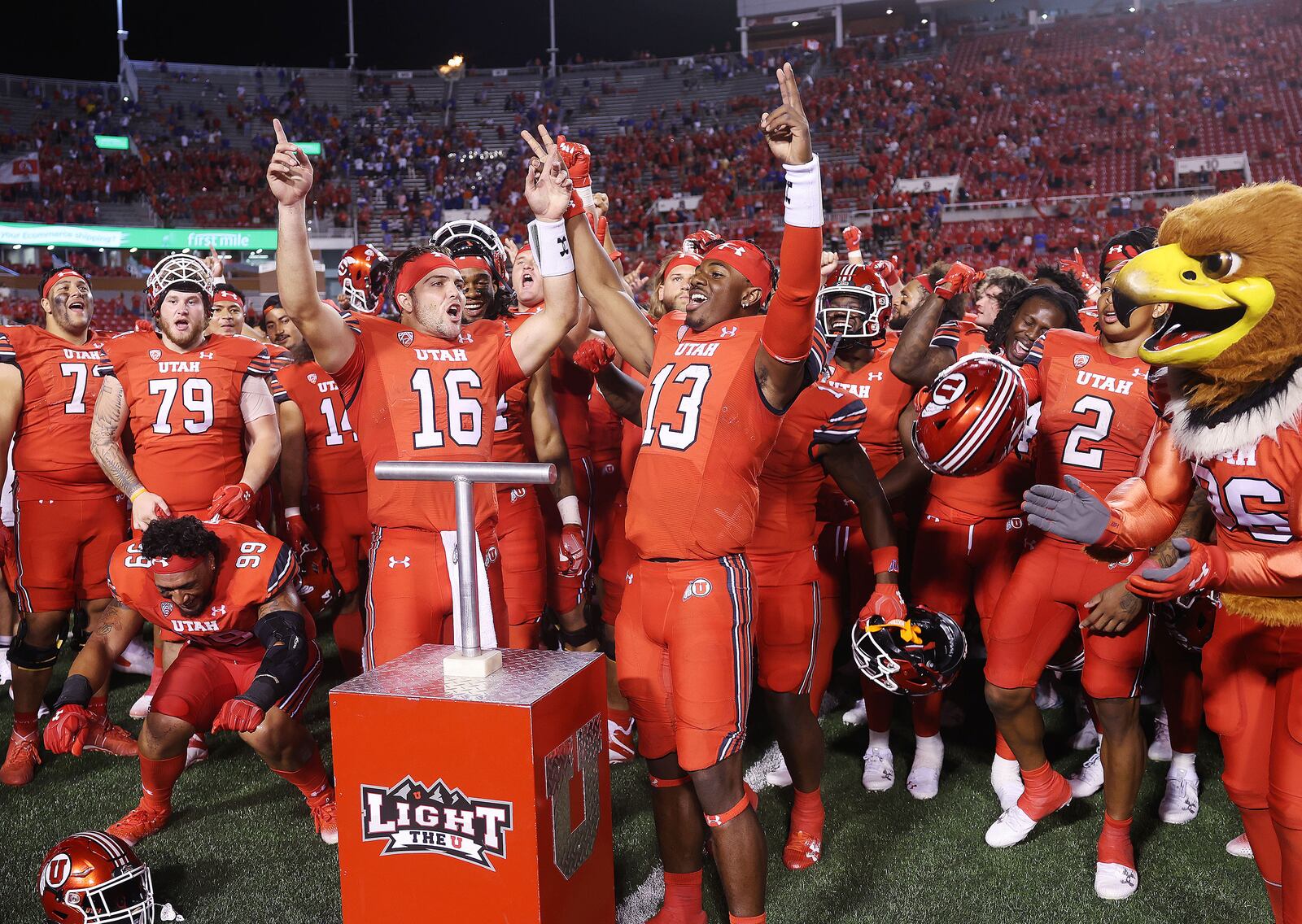
On his first play of the 2023 season, Barnes threw a 70-yard touchdown pass to Money Parks and managed the game well in Utah’s 24-11 win over the Gators.
“That’s pretty great. That stuff you talked about when you’re a little kid like, ‘Man, what if we threw a touchdown the first play of the game?’” Barnes said postgame.
Just like everything else in his career, the 2023 season didn’t come easy. Barnes was benched during the second game of the season against Baylor after a bad performance, and remained on the bench for the majority of the next three games as Johnson took over QB duties.
Then, Utah’s coaches sent Johnson to the pine after the offense failed to get anything going at Oregon State, putting Barnes back into the contest. Barnes’ second chance was cut short, however, when he was sent to the hospital after a hard, late hit to the chest from Oregon State’s Calvin Hart Jr.
Two weeks later, after a bye, his ribs had healed enough, and he was back under center for the Utes, leading them to a win over Cal.
‘A tough guy’
“He’s a tough guy. Bryson Barnes is a throwback and the guy that if he’s able to play at all, he’s going to be out there,” Utah coach Kyle Whittingham said postgame after the Utes beat the Bears.
Against No. 18 USC in Los Angeles the next week, Barnes had the game of his life, going toe-to-toe with Hesiman-winner Caleb Williams in a 34-32 victory. Barnes threw for a career-high 235 yards and three touchdowns and rushed for one more, adding 57 yards on the ground, including a 26-yard run that set the Utes up for the game-winning field goal.
“They’ve got a Heisman Trophy winner at quarterback, so they’re going to make some things. We got ourselves a pig farmer quarterback, so we’re proud of that guy, too,” Whittingham said after the game.
The victory over the Trojans catapulted Barnes to folk hero status. Whittingham wore a shirt emblazoned with Barnes’ likeness and “That’s my pig farmer” text. ESPN, which arrived in town for “College GameDay” ahead of No. 13 Utah’s huge matchup against No. 8 Oregon, ran a feature on him.
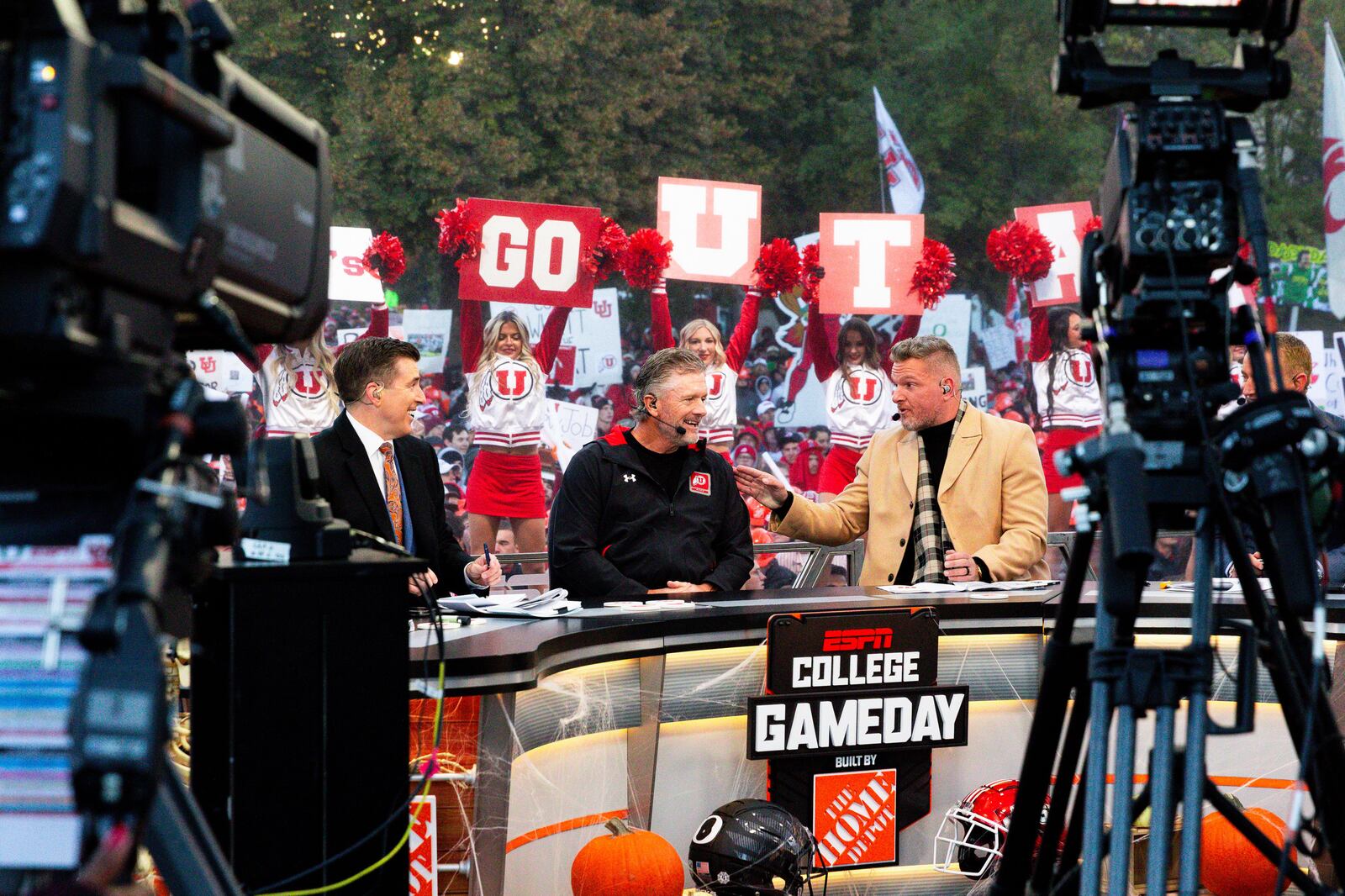
Barnes was on top of the college football world.
But it would be mostly downhill from there for Barnes and the Utes.
Utah’s offense was held without a touchdown in a 35-6 loss to Oregon as Barnes completed 52% of his passes for 136 yards and threw two interceptions.
Though he helped the Utes to a win over hapless Arizona State and had a great first half in Utah’s 35-28 loss at national runner-up Washington (238 yards and two touchdowns), Barnes struggled to spark the Utes’ offense in the second half of the season. The Utes finished 8-5, culminating in a 14-7 Las Vegas Bowl loss in which Barnes threw for only 55 yards with two picks.
Utah scored just 23.1 points per game (96th in the nation) and Barnes’ 142.9 passing yards per game ranked No. 94 in the country.
There was never a question about Barnes’ effort — he completed his heart out — but down the stretch of the season, it was clear that he couldn’t guide Utah’s offense to more production.
The Las Vegas Bowl loss wasn’t the ideal end to his Utah career, but the fact that an under-recruited former pig farmer from a town of 1,431 people went on to produce some of the most memorable moments in school history is something that Barnes can forever be proud of.
“He was a great member of our program, great teammate, called upon him several times to play for us and he responded. Beat SC last year,” Whittingham said this week. “He was our quarterback of course, when we beat SC, just a competitive, tough, high-character individual.”
‘It’s helped me become a better man’
Ahead of the Las Vegas Bowl, Barnes announced his decision to transfer from Utah. It made sense to move on with Rising returning for yet another season and Barnes wanting to see if he could start for another program.
That, combined with some things Barnes didn’t “fully agree with” about the “way I was particularly being treated” at Utah, led him to hit the portal.
“Just decisions made around quarterbacks and the way the quarterback battles always panned out,” Barnes told the Deseret News.
“I definitely always got the short end of the stick. … I didn’t get the reps that I felt like I deserved to be able to be prepared for when my moment came. It was more so just be prepared without reps and get thrown into the fire in about every circumstance that I was in.”
“I definitely always got the short end of the stick. … I didn’t get the reps that I felt like I deserved to be able to be prepared for when my moment came. It was more so just be prepared without reps and get thrown into the fire in about every circumstance that I was in.”
— Former Utah QB Bryson Barnes
Overall, though, Barnes is thankful for his time at Utah. It wasn’t always easy, but he had plenty of memorable moments, from playing in both of the school’s Rose Bowl appearances, to the win over Washington State in 2022 and the victories against Florida and USC in 2023.
“There was definitely a lot of trials, lessons that I learned from being at Utah. I’m super grateful for the opportunity that I had to go there in the first place, and it’s definitely developed me as a person and it’s helped me become a better man,” Barnes said this week.
“I believe the lessons that I’ve learned there are definitely going to help me throughout my life, but I am just super grateful to be a Ute.”
Barnes received interest from a number of schools when he entered the transfer portal, ultimately choosing the Aggies not just because of the opportunity to compete for the starting quarterback job and stay in the state of Utah, but also to continue his education.
The former Ute, who graduated from the Utah with a degree in Business Administration, is currently in Utah State’s MBA program.
“I ended up at Utah State because after football’s over, I needed a place that’s going to be able to set me up for the best of my career and my life,” Barnes said.
There was a healthy quarterback battle throughout spring camp in Logan, but Iowa transfer QB Spencer Petras was named the team’s starter following spring camp. Two of the four quarterbacks involved in that battle, Cooper Legas and McCae Hillstead, transferred during the spring window, but Barnes stuck it out, even though he was entering yet another season as a backup quarterback.
“Spring ball definitely didn’t go the way that I was told or thought it was going to go by any means, but at the end of the day, just like the lessons I learned at Utah, it’s just about what I can control and what I’m doing, and that’s the only thing that I can control,” Barnes said.
‘Really came together and bonded’
It was a tragic and tumultuous summer for the Aggies football program.
On July 20, Utah State defensive back Andre Seldon Jr. died in a drowning accident, becoming the third teammate of Barnes to pass away. At Utah, Barnes was part of the team that grappled with the tragic deaths of Ty Jordan and Aaron Lowe.
Two days prior to Seldon Jr.’s death, and less than a month before the season started, USU head coach Blake Anderson was fired, with the university citing “significant violations of his contractual obligations related to USU’s employee reporting requirements.”
While Anderson’s firing just weeks before the season started could have been a huge blow to players’ morale, the team ended up working even harder.
“You lose your head coach in the summer, and what I did really like about these guys up here is when we did get that news, we came back out, workout one in the summer and just started attacking it as if it never happened,” Barnes said.
“The team really came together and bonded through that because at the end of the day, you never know what’s going to happen with coaches, but player-run programs is what win championships.”
‘It was honestly just unbelievable’
Despite being the backup, throughout summer workouts and fall practices, Barnes prepared as if he was going to be the starter, knowing from his experience at Utah that he was just one play away from being inserted into the game.
A few drives into USU’s season opener against Robert Morris, Petras suffered an ankle sprain, and once again, Barnes was called upon to finish the game.
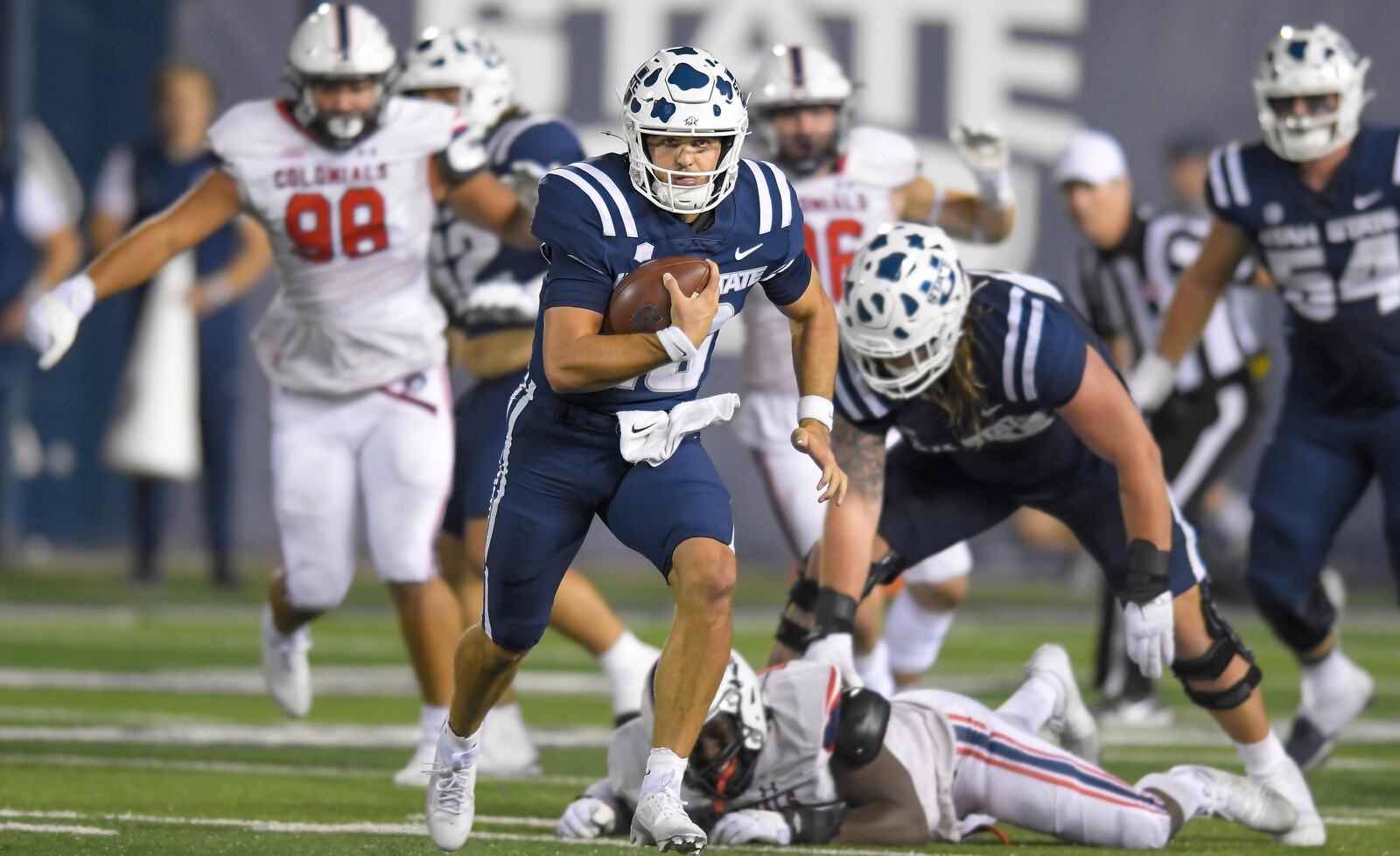
“It was honestly just unbelievable. I couldn’t believe it,” Barnes said.
After a bit of a slow start, Barnes — who was 2 for 7 and threw an interception in the first half — found his rhythm in the second half. He finished the game with two touchdowns and 198 passing yards, adding an additional 88 yards and a score on the ground.
The highlight of the night was Barnes’ 63-yard touchdown run, which put the Aggies up 26-14 early in the fourth quarter. Barnes dropped back to pass, then tucked the ball and ran up the middle. After getting past one Robert Morris defender, no one was going to catch him, and he sprinted to the end zone.
In a career full of unbelievable moments, Barnes authored another one in a 36-14 win.
“With Bryson, it’s the same thing why Utah loves him. He’s so tough. He’s going to find a way to make plays and he’s so mobile on his legs. Had a 70-yard run, one of the biggest plays of the game. The kid can just do it all and the team loves him,” Utah State interim head coach Nate Dreiling said postgame.
‘It for sure feels special’
It’s not just another week for Barnes as he prepares to face his old team.
After spending three seasons in Salt Lake City, Barnes and his Ute teammates built unbreakable bonds, and that’s not something that just disappears just because Barnes is now wearing Aggie blue instead of Utah red.
“It for sure feels special. Those are the guys that I spent three-and-a-half years with, and so to be able to see those dudes again, that’s definitely going to be fun,” Barnes said, adding that he still keeps in contact with some of his old teammates and they’ve been bantering back and forth this week.
Whether or not Petras returns as the starting quarterback this week, which is a possibility, one thing is for sure — Barnes is going to see playing time against his old team, either as the starter or in special packages.
“I’m sure Bryson will get some snaps and he is fired up for this week obviously,” Dreiling said.
Not too often in college football does last year’s starting quarterback play against his old team the very next year, but that’s what’s going to happen in Logan this Saturday.
The Aggies are a sizable underdog, and even with reports that Rising is unlikely to play, it’s going to be a longshot for Utah State, who lost 48-0 last week at USC, to pull off the upset.
Barnes does have the advantage of pretty much knowing Utah’s defense, which includes many of the starters from the 2023 team, inside and out, though defensive coordinator Morgan Scalley will disguise and change up things this weekend.
“That is the defense I played against for three-and-a-half years, and there’s definitely things that I see on tape that I saw in practice 75% of the year,” Barnes said. “Sometimes when (Utah) dudes are busting on defense in the film, I’m able to be like, ‘No, this is where this guy’s actually supposed to be,’ and it’s just all familiar.”
While Utah is the enemy this week, and Barnes and the Aggies will try their best to repeat the result the last time USU played Utah in Logan, after the game is over and the stadium clears out, he’s looking forward to talking with his old teammates.
“I really did just enjoy my time with the guys. Those dudes down there, the friendships and relationships that I built there, they’re going to last a lifetime,” Barnes said. ” … The memory of the games, those are going to go sooner or later, but the relationships, the memories you build with your teammates, those last forever.”
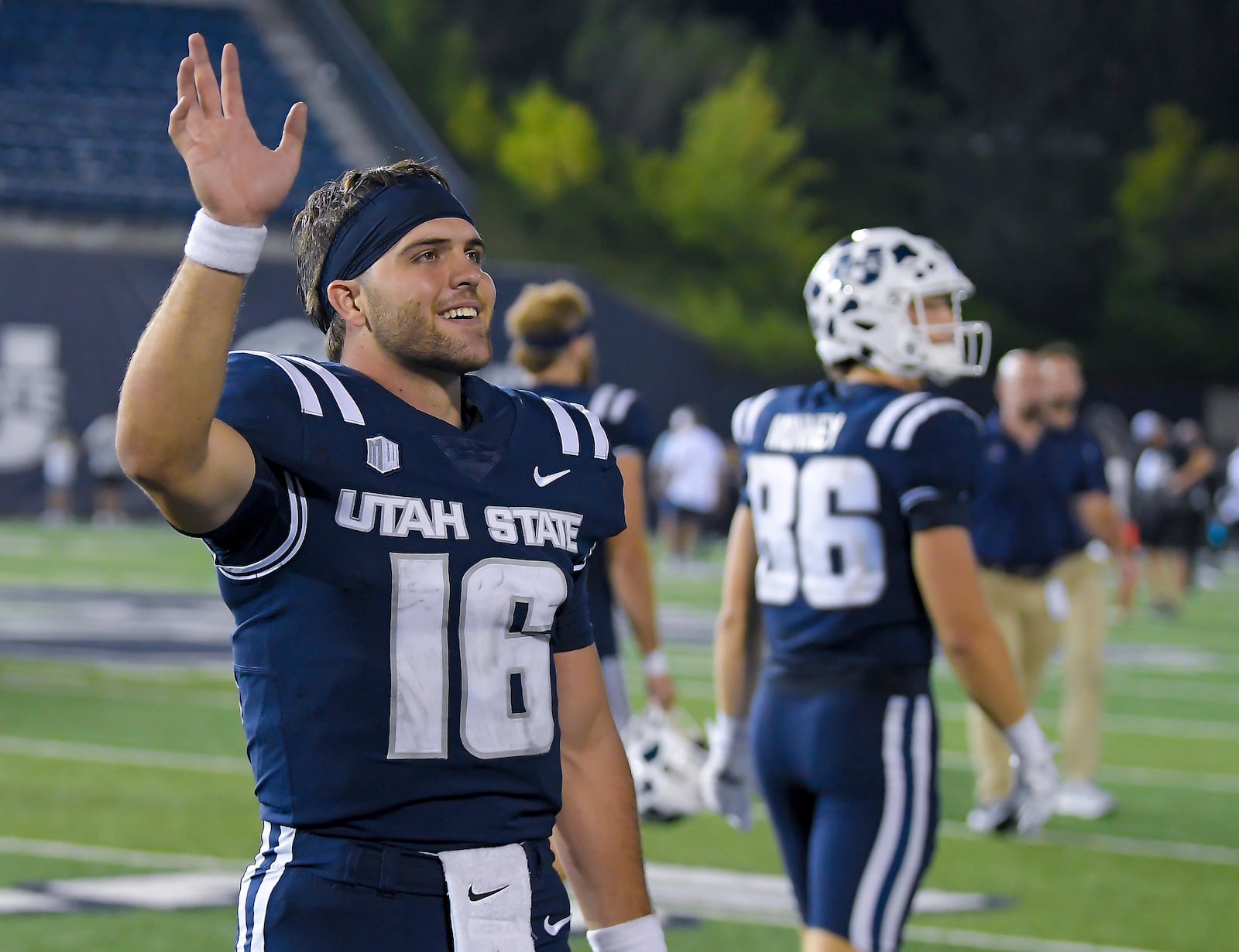
In case you missed it
True freshman quarterback Isaac Wilson finished the game against Baylor after starting quarterback Cam Rising left with a finger injury. If Wilson is called upon to start in Logan, Utah’s coaches have complete confidence in him.
From the archives
Extra points
- An incredible ‘kick six’ contrasts a lot of low moments for Utah’s special teams in win over Baylor (Deseret News)
- Party atmosphere at Rice-Eccles Stadium comes to a halt as Cam Rising exits with injury in Utah’s 23-12 win over Baylor? (Deseret News)



PROVO — The preliminary hearing for Tyler Robinson is expected to wrap up Friday morning in Provo. But it will still be several weeks before a decision is made on whether there is enough probable cause to bind him over for trial.
Robinson, 23, is charged with 10 crimes, the most serious being aggravated murder, in the death of conservative political activist Charlie Kirk, who was shot and killed on the campus of Utah Valley University on Sept. 10, 2025. A preliminary hearing is held to determine whether there is sufficient probable cause to go to trial on the charges levied against a defendant.
The Utah County Attorney’s Office finished calling their witnesses to testify on Thursday. Robinson’s defense team, who have already called two forensic experts from the FBI and ATF to testify, are expected to call one more on Friday before resting. Robinson has been attempting to cast doubt on the reliability of DNA testing, arguing that test results are subjective.
Prosecutors have objected several times to the line of questioning, arguing that it falls well outside the bounds of what is needed for a preliminary hearing. Even 4th District Judge Tony Graf warned defense attorney Michael Burt on Thursday during one line of questioning, “I feel we are exiting the orbit of probable cause.”
At the end of a preliminary hearing, both sides typically give closing arguments, and the judge decides if there is enough evidence for a defendant to proceed to trial. On Thursday, Graf granted a defense motion for each side to first submit briefs summarizing their arguments. The state will submit its brief by July 28, followed by the defense’s reply on Aug. 11 and the state’s rebuttal on Aug. 18. After that, another hearing will be held on Sept. 1 for both sides to present their cases in court.
Also on Thursday, portions of the video interview of Robinson’s roommate and boyfriend at the time of Kirk’s death, Lance Twiggs, were shown to the courtroom after much debate.
In addition, screenshots of the text messages exchanged between Twiggs and Robinson, a note Robinson left for Twiggs and messages on Discord that Robinson allegedly sent to his friend group prior to turning himself in, were all displayed in court.
For each piece of evidence introduced during the week-long hearing, Graf has had to decide:
- Whether to admit that evidence into the record;
- Whether that evidence should be shown to everyone in the courtroom;
- Whether that evidence can be filmed by the livestream camera broadcasting the hearing.
Robinson’s defense team remains adamant that broadcasting evidence to people outside the courtroom will jeopardize their client’s right to a fair trial by prejudging a future jury pool. Prosecutors want the evidence shown to everyone for the sake of transparency. Graf has compromised on several pieces of evidence by allowing them to be displayed to people in the courtroom but not on the livestream feed.
The extended debates over what evidence can be shown to the public and what is only viewed by attorneys and the judge have prompted Jeff Neiman, the attorney for Erika Kirk and the Kirk family, to address the courtroom several times, both in person and in a briefing filed Wednesday night, calling on the court to make all evidence public.
“For 10 months, the victim’s family has waited for this preliminary hearing. Erika Kirk, the widow of Charlie Kirk, and his grieving parents traveled to this courtroom for one reason: to be present at these proceedings and to bear witness to the evidence concerning the death of their husband and son. At certain points throughout the preliminary hearing, the Kirk family sat in the room while evidence was admitted but not presented for their viewing. They were present in body, yet denied the very thing their presence was meant to secure: their ability to meaningfully observe the preliminary hearing,” Neiman said. “The victim’s family’s position is simple. At a minimum, every exhibit entered into evidence during the preliminary hearing must be visible to every person lawfully present in the courtroom.”
Erika Kirk and Charlie Kirk’s parents have been in the courtroom all week for the preliminary hearing.
At Neiman’s request, Graf agreed that at the end of court on Friday, he will show to the courtroom only the enhanced UVU surveillance video allegedly showing Robinson’s movements across the roof of the Losee Center and when he drops off the roof and runs to a wooded area off Campus Drive. The video includes moments in which film editors zoom in on the alleged gunman and impose a red circle around him to make it easier to view. The video was originally submitted as evidence but was only shown to Graf and attorneys.
Friday’s hearing begins at 9 a.m. Watch it livestreamed here:


It’s on nights like these that I’m reminded of the ravine that divides the NBA from all other levels of basketball. This Summer League tilt was sloppy on both sides, and not many fringe players earned an NBA contract tonight, by the looks of it.
This matchup has always been about the number-one pick AJ Dybantsa and the number-two pick Darryn Peterson. Rivals since high school, these two are in an eternal struggle for the designation of being “number-one”. They wanted to be the best in their high school class. They wanted to be the first off the board in the NBA Draft. Rest assured, these two will be battling for Rookie of the Year honors by the season’s end.
Advertisement
Both stars were fully aware of the magnitude of this game, and both wanted to be the first to strike in the Thomas and Mack Center.
Dybantsa took his first touch all the way to the basket and forced up an off-kilter shot that missed everything.
Peterson took the ball the other way and forced up a top-of-the-key three-pointer that missed badly.
Dybantsa quickly picked up the slack, flipping an under-and-around lay-in and following that up with a good leading bounce pass through traffic to find a cutting teammate.
From there, the 1-2 combo settled in and let the game flow around them.
For the first time in a Utah Jazz uniform, Darryn Peterson walked among mortal men as a commoner. He had a very slow start in his Las Vegas debut, opening the night 0-for-3 from the floor and even whiffing on his first all-or-nothing foul shot. His steps were hurried, and he stood unstable before his first trip to the bench. Not quite so infallible outside of the mountain air in Salt Lake City.
Advertisement
AJ claimed the first quarter, dicing up the defense with fadeaways, dribble chains, and this vicious, inhumane slam that will dominate your social media feed for the next day or so.
Washington set the tone for some — should we say physical — defense out on the perimeter, and the officials gave the Wizards liberty to reside in Peterson’s chest for the majority of the game. The number-two pick couldn’t get himself into a rhythm as he’d step out of bounds, dribble off his foot, and sputter under the heat of the Wizards’ aggressive double-team scheme.
They were incredibly handsy from end to end, frustrating Jazz ball handlers as the whistles piled up at the other end.
Advertisement
AJ Dybantsa lives at the foul stripe — that’s his superpower — and he has since his days at BYU, where he led the nation in foul shots taken per game. Perfectly within his idiom, Dybantsa was 6-of-7 from the foul stripe — keeping in mind the experimental do-or-die free throw rule. Considering how much more physical the Wizards played at the defensive end, it’s a mystery how the Wizards managed to reside in the comfort of the bonus for the entire first half.
Neither player was efficient from the floor, but Dybantsa won the first half of this marquee matchup.
Dybantsa finished the first half with 19 points on 4-of-12 shooting.
Peterson lagged behind with 11 points on 3-of-9 shooting and a pair of dimes.
The lead shrank to single digits, and what appeared to be a blowout in the first half — Washington led by as much as 20 — rapidly drew tighter in the second half. It had become a two-possession game before the clock hit 0:00 in the third quarter.
Advertisement
Both stars lived up to the bill in this one, clearly displaying their individual talents despite their efficiency not leaping off the box score.
Peterson’s tendency to cough up possession has to get straightened out. He’ll be a target for his whole career, so learning to handle and exploit on-ball pressure will be critical to maximize his effectiveness and keep his teammates involved.
Cody Williams stole the show a bit for the Jazz, despite a rocky opening to the night. Though he struggled to stop Dybantsa on the defensive end, he notched 16 points on great efficiency (6-11, 2-3 3PT) plus 5 rebounds. He’s not a ball-handler, despite the Jazz’s wishes, but thrived on a newly added stepback mid-range jumper tonight.
Dybantsa had a strong night, finishing with 27 points on 7-for-18 shooting, 7 rebounds, and 2 steals.
Advertisement
The Wizards ultimately won this game behind the strength of their NBA guys, Tre Johnson and Will Reily, who combined for 41 to pair with Dybantsa’s 27. They also strongly benefited from Jamir Watkins, Darryn Peterson’s assignment fouling a grand total of 9 times (not a typo).
Peterson likewise fouled 9 times in this one, an ugly blemish on what was an unsteady night for the rookie. He finished with 24 points on 6-18 shooting and 2-7 from three-point land (thanks to a bank-shot heave at the final horn). Dybantsa will be crowned the winner of this head-to-head with Peterson thanks to better highlights and the team win, but neither player dominated, despite what X will likely tell you.
Washington defeats Utah with a final score of 92-88.
Calvin Barrett is the Associate Editor for SLC Dunk. Originally from Springville, Utah, he currently lives in Japan and has covered the NBA and college athletics since 2024.

LAS VEGAS (KSNV) — The man arrested for murder in the 2006 death of his wife at a Utah national park left behind a suicide note in his Las Vegas jail cell, according to a police report.
Las Vegas Metropolitan Police released a public report on the death of David Vander Meer, 49, who was in custody on an out-of-state warrant.
The Washington County District Attorney’s Office said in an affidavit that Vander Meer, a former youth pastor, was a suspect in the death of his then-wife, 28-year-old Bernadette Vander Meer, 20 years ago.
Bernadette fell to her death at Angels Landing in Zion National Park. Prosecutors said in their affidavit that they received new information implicating David, alleing that he began having a close relationship with a young girl when she was 14 and he was her youth pastor.
A fugitive task force took Vander Meer into custody in Summerlin, according to an arrest report, and he was booked into Clark County Detention Center on June 22.
In the report on his death, LVMPD said a corrections officer was conducting visual checks at about 9:30 p.m. June 24 when he noticed Vander Meer lying face down on the ground and unresponsive.
Several sections are redacted, but police wrote that the officer performed chest compressions until medical personnel arrived. Vander Meer was taken to UMC, where he was pronounced dead just after 2:36 a.m. June 25.
Investigators wrote that because of “the nature of his case,” Vander Meer was placed into protective custody. He was seen sitting upright and awake at 9 p.m., and he had no known medical conditions. He also did not mention being suicidal during a mental health screening.
Inside the cell, police wrote that Vander Meer “left a hand written suicide letter and a hand written will in his cell which has been photographed and impounded.” The following paragraph of the report was redacted, and no further details on Vander Meer’s death were disclosed.
The Clark County Coroner’s Office has not yet released its official rulings on his cause and manner of death.
Bernadette’s parents, Richard and Laura Gudenkauf, told News 3 they long suspected Vander Meer played a role in her death.
“Because of the girlfriend,” said Laura. “I found insurance policies months later that he had, lots of them.”
-

 Montana3 minutes ago
8 Most Welcoming Towns In Montana’s Countryside
-

 Nebraska10 minutes ago
Nebraska abortions rose nearly 8% in 2025, mostly due to influx of Iowa patients
-
 Nevada13 minutes ago
Murder suspect from Montana takes own life when surrounded by police in Nevada
-

 New Hampshire18 minutes ago
2 transgender girls drop NH lawsuit after Supreme Court ruling, personal hardships
-

 New Jersey25 minutes ago
NJ Legislators Are Considering a Bill That Could Ban Tesla Robotaxis Due to Their Tech Choice
-

 New Mexico28 minutes ago
New gay bar opens in Nob Hill
-
North Carolina33 minutes ago
Explore on the water: How, where to kayak in Raleigh
-

 North Dakota40 minutes ago
Schulz to transition from ND Parks and Recreation to ND Department of Corrections and Rehabilitation


