West
Thousands of military families and civilians continue to suffer health problems from 2021 fuel leak in Hawaii

In November 2021, 93,000 people living near the U.S. military’s strategic fuel storage facility near Honolulu, Hawaii woke up to find their drinking water contaminated with toxic jet fuel. 27,000 gallons had leaked into the aquifer near Joint Base Pearl Harbor-Hickam. Now more than 2,500 plaintiffs who have dealt with the side effects of ingesting jet fuel joined a lawsuit asking the government for up to $1.25 million each in damages.
The fuel storage facility known as Red Hill was the largest in the Pacific and was built during World War II. The fuel was stored in miles of tunnels up to 20 stories underground to provide as much as 250 million gallons of strategic fuel reserves for the Navy’s Pacific Fleet.
Trial Lawyer Kristina Baehr of Just Well Law is representing the military families and civilians suing the U.S. government for the water contamination at Red Hill.
TRIAL UNDERWAY FOR MILITARY FAMILIES SUING US GOVERNMENT OVER TAINTED WATER AT HAWAII BASE
“The government calls it contamination, and our clients call it poisoning because that’s what happened. The government knew it was contaminated and let them use it,” Baehr said in an interview with Fox News.
Baehr says her clients have a wide range of long term symptoms including Parkinson’s and seizures.
This case is personal for Baehr. After her own family experienced toxic exposure, she decided to leave her job at the Department of Justice to represent families like her own.
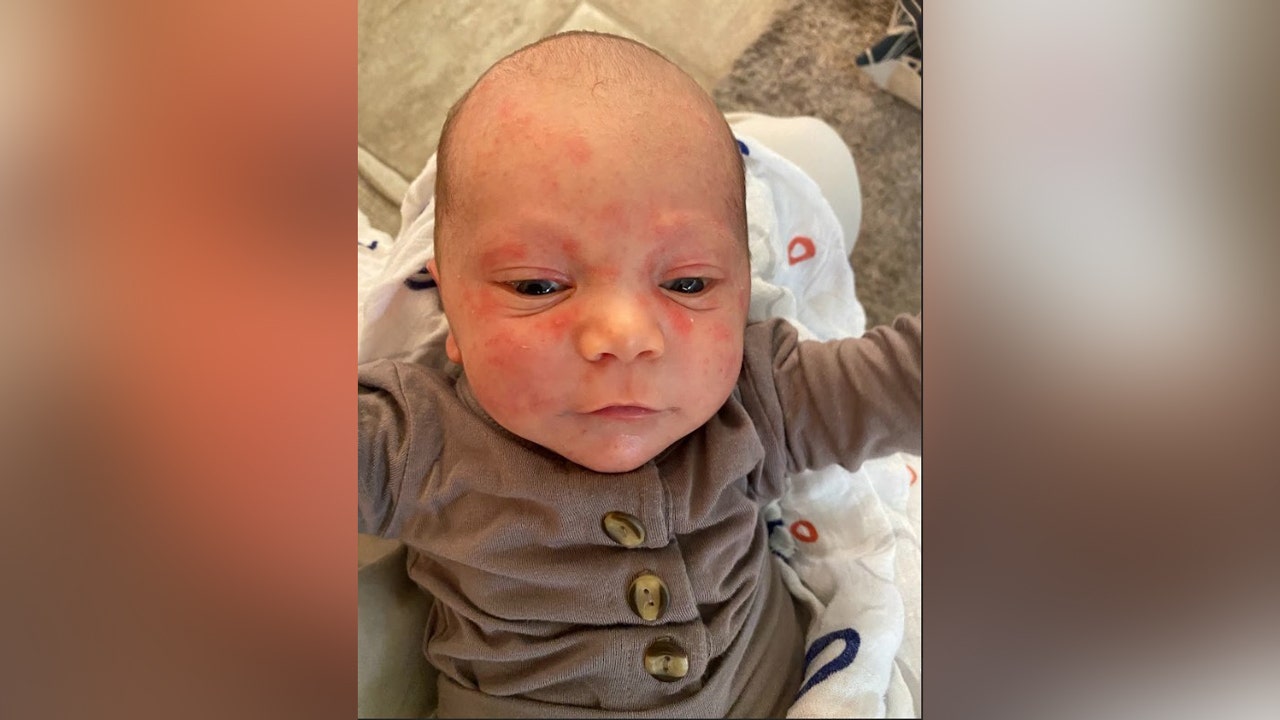
Baby Maverick with rashes days after he was born. (Courtesy of Jaclyn Hughes)
“They are coming forward not for themselves, but for everybody else to make sure it doesn’t happen again. We can’t be mission ready as a country if we’re sick or if our people are sick,” Baehr said of the thousands she is representing in the lawsuit.
The case is named for Jaclyn Hughes and her family. Hughes had just given birth to her son, Maverick, at the time of the leak. Just days after he was born, he was covered in red rashes, and Hughes’s own throat immediately began to burn after drinking the water in their home.
Hughes’s husband deployed with the U.S. Navy at the time of the leak. He missed the birth of their son and when he got home to meet Maverick, the water had an oily sheen and smelled of gasoline, Hughes explained.
LAWSUIT AIMS TO STOP ARMY, FBI FROM CREATING FALSE ARREST RECORDS FOR SOLDIERS, VETS NEVER CHARGED WITH CRIMES
“My husband was forward deployed at the time. He missed the birth of his son. He came home when he was five days old to meet him. To come home to jet fuel in our drinking water and have to deploy again, leaving us in the hands of the Navy he was sworn to protect, to have us refused care, denied, gaslit, and to this day not have all the appropriate care that we need for our daughter,” Hughes told Fox.
Their daughter Kyla, who was just four years old at the time of the leak, went into a full psychosis, Hughes said.
“When Kyla started experiencing her symptoms, she went from a happy-go-lucky four-year-old little girl that went into full psychosis. We went through her being a normal functioning in school to not being able to leave our house for months at a time because of her level of disability,” Hughes said.
The Hughes family. (Courtesy of Jaclyn Hughes)
Aurora Briggs, another plaintiff, was 22-years-old at the time of the leak. She was living in civilian housing on land owned by the U.S. Navy with her younger siblings and her mom. Briggs has dealt with dozens of symptoms ranging from a sore throat to memory loss and brain fog. Living in Arizona now, she has had trouble getting care.
It is not every day a doctor is told the patients’ symptoms stem from long-term exposure to jet fuel, Briggs explained.
“The list is so long that we have a binder just to keep track of all the different conditions, symptoms, doctor’s appointments, and everything. It’s extensive,” Briggs said.
MYSTERIOUS SHOOTING OUTSIDE ARMY SPECIAL FORCES RESIDENCE IN NORTH CAROLINA RAISES QUESTIONS
Of her symptoms, Briggs said, “I feel like I have dementia because I just get to the point where I can’t remember things, and I struggle with, you know, even thinking of words. Sometimes just talking is a struggle.”
Both Hughes and Briggs find the U.S. Navy at fault for how the leak was dealt with.
“The institution of the Navy grossly mishandled this. Specifically, those who were in charge of communicating to us in testing, in maintenance and in handling all of the Red Hill contamination. We are a proud Navy family. My husband serves, he is underway as we speak. Our family has served. We feel betrayed by the institution that was supposed to be protecting us,” Hughes said.
Aurora in the hospital after experiencing symptoms from ingesting jet fuel. (Courtesy of Aurora Briggs)
Defense Secretary Lloyd Austin ordered the Red Hill facility closed in March 2022. 12.4 million gallons of diesel and 93 million gallons of jet fuel had to be moved to multiple locations in the Indo-Pacific area of command.
But, Baehr said the Navy still hasn’t cleaned up the jet fuel still sticking to the pipes. Families are still reporting a sheen in the water and an oily smell.
“What we know either way is that there’s a sheen in the water. People are reporting symptoms. The EPA is concerned and the Navy is continuing to turn a blind eye. So no, that water is not safe. We’ve got a situation where people are still sick who were there in November of 2021. And the water is still not safe.”
The U.S. Navy pushed back on this claim in a statement to Fox News.
RETIRED NAVY ADMIRAL CHARGED WITH BRIBERY FOR ALLEGEDLY OFFERING GOVERNMENT CONTRACT IN EXCHANGE FOR JOB
“After the initial spill in November 2021 the Navy took immediate action to recover (flush) the system and implemented a robust sampling program. The Navy also disconnected the affected well and ensured all drinking water was provided from a different shaft,” the statement read.
The Navy told Fox it has taken 9,000 samples to EPA-approved labs and found the water now meets state and federal safety standards. The Navy noted the Hawaii Department of Health confirmed through its own independent investigation that no petroleum or jet fuel compounds were detected in drinking water samples collected at or near the Navy base.
But there is a long road ahead to deal with the fallout from the leak.
“We as the families impacted in the thousands need to hear them say, yes, you were injured by this. There are kids that are sick. There are kids that need long term care. There needs to be accountability,” Hughes said.
Read the full article from Here



The owner and operator of the boat that capsized earlier this week near Alcatraz Island said Thursday that his brother was killed and his sister, sister-in-law and a family friend remained missing after what began as a family trip to spread a relative’s ashes.
“It’s been horrible,” John Boisa said in a brief interview.
His comments came as San Francisco police used sonar to search for the 49-foot Volare and recovered a body floating west of Treasure Island. Authorities had not identified the person as of early Thursday evening.
Police were alerted to the body shortly after 1 p.m. by a passing vessel. The agency said it was using “multiple boat-mounted sonar platforms” to search for the Volare, which sank in water roughly 130 feet deep between Alcatraz Island and San Francisco.
The search has been complicated by “strong tidal currents along with wind and weather challenges,” police said in a statement.
Twenty people were aboard the boat when a wave struck it shortly after 3:30 p.m. Tuesday, causing the vessel to list before rolling over and sending everyone into the water.
Clifford Boisa, the operator’s brother, was pulled from the water and later declared dead despite receiving CPR. Sixteen others were rescued by a flotilla of first responders and nearby boaters.
Still missing Thursday were Clifford Boisa’s wife, Jackie Boisa; John Boisa’s sister, Carol Boisa; and a family friend whom he identified only as “Tonda.”
In a text message to this news organization, John Boisa recalled Jackie Boisa as possessing “a rare combination of easy acceptance of others with a kind of elegant sophistication.”
“She was simply a Lady and conducted herself in accordance with the highest meaning of that term,” he wrote.
He remembered his sister as bringing “her own special flavor to family gatherings and the earthy, natural joy she brought was ineffable.”
“I was especially pleased to see her enjoy our boating in recent years, and her smiles in photographs were genuine and without affectation,” he added. “I wanted for her and her children happiness and ease, and now, peace.”
Boisa, a Stockton-based consultant, said he had known Tonda only a short time but recalled her as “a generous, welcoming and gracious person.”
“I wish I knew her better, and I pray for peace and healing for her family,” he wrote.
Boisa described himself as the “vessel operator” and said Tuesday’s outing was “a family gathering” that included spreading the ashes of a relative who had died “a long time ago.”
Two days after the disaster, more details emerged about the boat, its weeklong stay in San Francisco and its final hours on the water.
The Volare, a 1981 Marine Trader Pilot built in Taiwan with a fiberglass hull, was based at Village West Marina & Resort, according to Tamara Barak Aparton of the San Francisco Recreation and Parks Department.
John Boisa received a guest permit to berth the boat at the city’s Marina Yacht Harbor from July 11 through Thursday, Aparton said. He had previously stayed at the harbor, though details about those visits were not available Thursday.
The vessel left the harbor around 10:15 a.m. Tuesday and traveled beneath the Golden Gate Bridge into the Pacific Ocean, according to the tracking website VesselFinder. It turned around about an hour later off Lands End and the Sutro Baths before returning to the bay at a slower speed.
The boat appeared to stop at Ayala Cove on the northwest side of Angel Island, leaving shortly after 3 p.m. and heading back toward the harbor, tracking data showed.
The Coast Guard’s search for survivors covered 950 square nautical miles before ending Wednesday evening. As police continued the recovery effort Thursday, maritime experts said they expected a lengthy investigation into how a vessel such as the Volare could capsize.

The Volare — a monohull recreation craft complete with two walled-off cabin levels and a deck top — was intended to handle waters such as San Francisco Bay, said Eric C. Jones, a retired Coast Guard rear admiral and superintendent of the Cal Poly Maritime Academy in Vallejo. Still, he said it was “unusual” for such a vessel to flip over in the bay.
Investigators are likely to examine whether the boat was properly maintained and operating correctly, and whether it could safely carry 20 people, Jones said. They also are expected to scrutinize the weather and water conditions that day and how the boat was operated in that environment.
The area where the Volare sank can be among the most challenging to navigate in the bay because of its distinctive winds and currents, said John Arndt, who has sailed the bay for more than 40 years and spent the past decade as publisher of the Northern California sailing magazine Latitude 38.
Arndt called the area “the playground of sailing” and compared portions of the bay to a ski hill, with some areas better suited to beginner and intermediate boaters. The area where the Volare sank could be compared to a black diamond ski run, he said: a more “challenging” section but one that is navigable for people experienced with those waters and conditions.
July and August are generally the windiest months on the bay, a result of hot air rising over the Central Valley and pulling cooler air from the Pacific Ocean through the bay’s narrow entrance. While winds can remain manageable in some areas, the central channel between Angel Island and San Francisco can experience strong sustained winds and gusts.
The water can become particularly choppy when westerly winds collide with an outgoing tide. Water flowing from the Sacramento and San Joaquin river valleys toward the Pacific further complicates the currents in that area.
Arndt called a disaster of this magnitude involving this type of boat “exceptionally rare.” He said Tuesday’s conditions were not outside the normal range for summer boating on the bay.
“When people analyze accidents and disasters, it’s not one thing — it’s sort of these things that tend to be a spiral of events,” Arndt said.

Jakob Rodgers is a senior breaking news reporter. Call, text or send him an encrypted message via Signal at 510-390-2351, or email him at jrodgers@bayareanewsgroup.com.

Pedal boats are back at City Park in Denver this week and they come in more shapes than just swans.
On Wednesday, the city of Denver opened its newest so-called Adventure Hub where visitors can rent gear to enjoy on Ferril Lake. That includes pedal boats shaped like swans, dragons, ducks and flamingos, as well as kayaks, canoes and stand-up paddleboards. If you’d rather pedal on land instead of the water, the hub also has beach cruiser bikes and surrey bikes, which hold up to six people, available for rent.
City Park’s Adventure Hub is the second to open this year, following another at Washington Park in early June. Stephanie Figueroa, spokesperson for Denver Parks and Recreation, said rentals were supposed to start sooner at City Park, but that the electricity powering the point-of-sale system needed to be replaced after a fire at the historic bandshell there.
Water sport rentals cost range from $15 per hour for a SUP or single-person kayak to $35 per hour for swan, dragon and duck pedal boats, which fit up to four people. Bikes are similarly priced at $15 per hour for a single-person beach cruiser up to $45 per hour for a surrey “stretch limousine” for six riders. Figueroa noted that it is a flat fee and not a per-person charge.
“For families, as long as you fit, you can go,” she said, adding that gear is available for rent during the City Park Jazz series this summer.
This year marks the first time in at least two decades that Denver officials have managed gear rentals in City Park. The city ended its longtime contract with vendor Wheel Fun Rentals, which previously supplied things like swan pedal boats, in early 2026 after more than 20 years, Figueroa said.
Denver’s decision to take over operations was both more cost-effective and enabled the city to have more control over the experience, she added. Part of the impetus was a recent initiative called the Outdoor Adventure and Alternative Sports Strategic Plan, which sought to identify how Denver could offer more recreation opportunities to residents.
“That gave us the tools and knowledge to bring this in-house,” Figueroa said. “We have historically been amazing at indoor recreation and now we want to bring more of those opportunities outside.”
The Adventure Hub at City Park is open every day from 10 a.m. to 9 p.m., while the one at Washington Park is open every day from 7 a.m. to 9 p.m. They are both closed on city-observed holidays.
Another Adventure Hub, currently under construction at Ruby Hill, is expected to open late this year or early next, Figueroa said.
Subscribe to our weekly newsletter, The Adventurist, to get outdoors news sent straight to your inbox.
-

 West Virginia4 minutes ago
West Virginia to conduct comprehensive review of all bridges as state targets repairs
-

 Wyoming9 minutes ago
NWSR issues Flood Watch advisory for portions of Central, Northwest Wyoming
-

 Crypto16 minutes ago
DeFi’s Newest Threat: How Malicious Liquidity Pools Are Trick-Quoting Ethereum and Polygon Users
-

 Finance22 minutes ago
Gold Purchases Accelerate as Dollar Confidence Wanes
-

 Fitness28 minutes ago
Strength training over decades linked to longer life – Harvard Health
-

 Movie Reviews40 minutes ago
Movie Review: “The Odyssey” by Nolan
-
World52 minutes ago
US strikes bridges and collapses a tower at a key port as its Iran campaign expands
-
 Lifestyle2 hours ago
An eco-journalist takes on a Big Tech in this modern twist on the heist novel


