West
Suspect who fatally shot California UPS driver 10 times in truck was coworker, childhood friend: DA

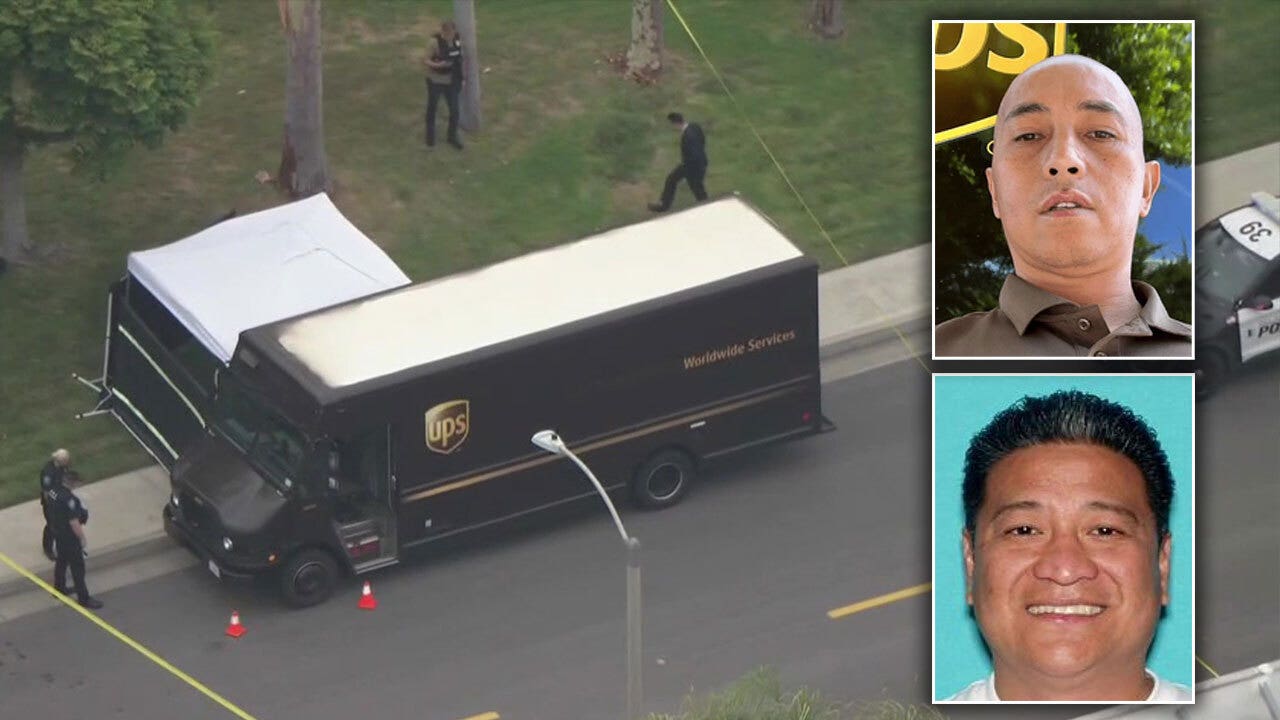
The suspect who shot a UPS driver in broad daylight in an ambush killing as the victim was on his delivery route in Southern California was a childhood friend of his and a coworker, prosecutors said.
Rhean Jalipa Fontanoza, 46, allegedly shot 50-year-old Expedito De Leon 10 times “in a matter of seconds as he sat seat belted in his delivery truck” on May 16, the Orange County District Attorney’s Office said Tuesday.
“He still had his UPS scanner in his hand and his seatbelt buckled when Fontanoza drove up next to De Leon’s delivery truck and shot [at] him 14 times in 19 seconds,” the DA’s office said.
Authorities said Fontanoza fired 14 shots and 10 hit De Leon.
USPS MAIL CARRIER SHOT AND KILLED ON THE JOB, POLICE OFFERING $250K REWARD FOR INFO
Rhean Jalipa Fontanoza (bottom), 46, allegedly shot and killed his coworker and childhood friend, Expedito De Leon (top), 50, as the victim was inside a UPS truck last week. (KTTV; Irvine Police Department)
Fontanoza, a UPS employee who was on disability leave, is charged with a special circumstances allegation of shooting from a vehicle and murder by lying in wait.
He allegedly went to great lengths to track down De Leon’s delivery route on the day of the killing. He allegedly stopped another UPS driver at around 12:30 that day and asked if it was the same delivery route used by De Leon.
The driver said De Leon was on a different route, prompting Fontanoza to go to the UPS substation in Aliso Viejo, where he was allegedly seen accessing a computer that shows driver routes and taking a picture with his phone.
“Just before 3 p.m., Fontanoza is accused of tracking De Leon down on his route and driving past him a new vehicle which De Leon wouldn’t recognize. De Leon then left his truck to make a delivery and returned to his truck, and buckled his seatbelt,” prosecutors said.
CALIFORNIA MAIL CARRIER FIGHTS BACK AFTER GETTING SUCKER PUNCHED, VIDEO SHOWS
A UPS driver was shot and killed in what police believe was a targeted attack on Thursday in Irvine, California. (FOX 11 LA livestream/Screenshot)
After the murder, Fontanoza fled the scene but was found by authorities in his vehicle later that afternoon, prosecutors said. He refused to get out of the car until tear gas and a police K-9 were deployed, authorities said.
Orange County District Attorney Todd Spitzer said De Leon “was just going about his day, doing his job with no idea his longtime friend was stalking him with every intent to kill him.”
“The depravity involved to plot and carry out a plan to execute someone you shared a lifetime of memories is not something anyone of us can wrap our heads around,” he added. “No life should have to end like this and it is a tragedy that should have never happened.”
The shooter accused of killing a UPS driver on Thursday in Irvine, California, barricaded himself inside his truck before police forced him out and arrested him. (FOX 11 LA livestream/Screenshot)
At the time of the killing, Fontanoza was scheduled to return to work on June 1 from disability leave.
Investigators have not determined a motive for the attack. Fontanoza is being held in the Orange County Jail with no bail. He is eligible for the death penalty, prosecutors said.
In a statement to Fox News Digital, UPS said it was “shocked and saddened by the latest developments in Irvine, CA. These are highly unusual circumstances and do not represent the culture of our company and the camaraderie among our employees around the world.”
“Our focus now is on supporting our people and their loved ones during this extremely difficult time. Since the investigation is ongoing, we defer any additional questions to the investigating authorities,” the company said.
Read the full article from Here


President Donald Trump approved Idaho’s disaster declaration for local counties this week in response to this past spring’s flooding and landslides.
According to the Idaho Office of Emergency Management, the counties covered in this disaster declaration include Nez Perce, Latah, Clearwater, Benewah, Bonner and Kootenai counties.
Idaho counties suffered nearly $6 million in damage from the severe flooding, landslides and wind gusts between March 11 and 15, according to the state. Thousands of people lost power and roads were heavily damaged. Wind gusts reached nearly 100 mph in some areas.


VIDEO: Floating central Montana’s Smith River
VIDEO: Floating central Montana’s Smith River
For the first time that I can recall, I found myself jealous of waterfowl.
And as vigilant as one must be in dodging rocks, they’re much easier to evade than raindrops.
Or hail, for that matter.
It had been nearly 20 years since I’d floated the Smith River, one of the premier locations for outdoor excursions in the state of Montana.
Despite its close proximity to Great Falls and the privilege of less stringent access, I hadn’t made the effort as an adult to enjoy the scenic journey practically in my backyard.
The trek was not easy, and by day’s end I was overcome with a lethargy almost two decades in the making.
However, as I’ve been reminded, a day’s effort was a small price to pay for enduring memories.
What and where is Montana’s Smith River?
The Smith River is a tributary of the Missouri River that spans 121 miles starting near White Sulphur Springs in Meagher County.
It flows between several mountain ranges to the mouth, where it dumps into the Missouri near Ulm, about 10 miles south of Great Falls.
The river was named after Robert Smith, the Secretary of the Navy under President Thomas Jefferson, by the Lewis and Clark Expedition. Meriwether Lewis dubbed it in an 1805 journal recording, “Smith’s River,” according to Montana State Library archives.
Located in historic Blackfeet territory, the area was eventually occupied by white settlers through various treaties between the tribe and the U.S. government.
The Act of Congress of 1874 moved the southern border of the Blackfeet territory 200 miles north, formally making settlement legal under U.S. law, according to educational materials from the Office of Public Instruction, although no compensation to the Blackfeet was given for the territory ceded.
Today, the Smith River Corridor — the 59-mile stretch of the river open to permitted floating in Smith River State Park — is managed by the Parks and Outdoor Recreation Division of Montana Fish, Wildlife and Parks in cooperation with the U.S. Forest Service.
Permitted floaters launch at Camp Baker, and the full journey to the Eden Bridge takes a minimum of three full days and two nights at approved camp sites, according to FWP.
A place for family
My dad, Mark Higgins, and his brothers frequented the Smith River area in their youth through a connection of their father, Alan “Lefty” Higgins.
My dad was able to purchase a cabin in the Castle Bar section of the Smith in the mid-1980s. It has now evolved into a family cabin, owned and curated by members of the extended family.
Some of my fondest memories come from times at the Smith, as family from California, Oregon and Washington all congregate at our place at various times each summer.
The Higgins cabin is one of the many things in my life that I am privileged to be a part of, and one that I strive to never take for granted.
The float begins at Camp Baker
The commute to Camp Baker is aesthetically identical to the one from Great Falls to the family cabin, moving along stretches of gravel backroads meandering through rolling hills and grasslands. The trip is scenic in its own way yet doesn’t give much of a hint of the views to come.
Unlike the usual gathering of cows from adjoining cattle ranches stopping to graze along the road, on this morning we were temporarily stopped by a small herd of elk making its way across — a sight I have only seen a handful of times in 30-some years.
The last time I floated the Smith was around the Fourth of July in 2007. My most vivid memory from the trip, aside from the scenery, was being inadvertently hit in the head by an oar and breaking the pair of knockoff Oakley sunglasses I’d bought on the street in New York on vacation.
As we set out from Camp Baker in our four-person raft and accompanying kayaker, I was reminded early and often how less-than-leisurely the float is, particularly in the conditions of the day.
On float day, the Smith was flowing at just over 160 cubic feet per second, according to the rangers at Camp Baker, which is a little over half of the “normal” flow of 300 cfs designated by FWP.
It seemed as soon as you’d evade one rock or shoot the gap between a pair, there was another right in your path.
I quickly became jealous of the ducks and geese we encountered frequently throughout, who navigated the river unconcerned with ducklings and goslings in tow, and whose instincts always seemed to point to the perfect “V” in the water’s flow.
Most rock encounters ended harmlessly with scrapes along the bottom of the raft or, at most, would stop us dead in our tracks. However, one passenger did take an involuntary dip as we collided sideways with a large rock, thankfully ending only in wet clothes and a soaked raincoat.
So went about the first half of our 21-mile, one-day float, as we attempted to dodge rocks through several bursts of heavy rain and another of hail.
Thankfully, as Mother Nature can humble you in one moment, it can also be quite generous.
If these walls could talk
Even if you were unencumbered by the task of navigating the river, it’d be impossible to take in the full picture of the Smith River Corridor, situated between the Big Belt Mountains to the west and Little Belt and Castle ranges to the east.
You see hillsides often greater than a 45-degree angle densely filled with tall skinny trees, with rock formations dug into and jutting out from the earth.
The cliff walls can reach over 100 feet high in places, each with its own distinct shape and pattern after millennia of erosion.
The cliff formations are almost as perfect as they are imperfect, as ornate as they are abstract, sometimes forming shelves, steps or ledges. Some of the bigger cliffs are commonly equated to cathedrals, almost as if chiseled in intricate and deliberate detail.
Each formation tells its own story, as if structures from an ancient civilization had been overcome by nature.
Past the Tenderfoot Creek — nearing the end of our day’s float — approaching the Castle Bar area is maybe the most beautiful stretch. The story goes that the area was named for the castle-like cliffs, with smaller rock formations on top resembling guards keeping a lookout from on high.
It’s easy to get caught up in your surroundings, falling into a dream state as you imagine the stories this landscape could tell.
The end of the journey
The flow of the river picked up significantly past the Tenderfoot, covering up most of the pesky rocks like those that had stymied the group early on.
The last five or six miles of the trip were far more serene as we took in the sights unencumbered and began to recognize the landmarks signaling our approach to Castle Bar.
There was a strong sense of accomplishment as the raft made its final landing on the shore of our destination, with the sun beginning to creep below the cliff line after a nearly 11-hour day on the water.
One participant declared this was their last float down the Smith, which seemed a reasonable decision as we wearily organized our gear on the riverbank.
After some rest, I hope that it wasn’t my last long float down the river that has come to mean so much to me and my family.
Maybe I’ll give it a go in another 20 years.
***
How can I float the Smith River?
Due to its popularity, the Smith is the only river in Montana to run on a permit system. Permits are granted through a lottery, and roughly 10% of those who enter receive permits — and only 10 % of those granted can go to out-of-state residents.
Applications for the lottery open on Jan. 1 and can be submitted to FWP until mid-February each year, with the lottery drawing occurring shortly after. Those who draw a permit are assigned a float day in the typical floating season from mid-April to mid-July, aside from one Super Permit winner, who is allowed to pick a day of their choosing.
Groups can consist of up to 15 people, and 9-10 groups per day set out from Camp Baker. The cost per floater is $25 for Montana residents 13 and older, $15 for children ages 6-12 and $60 for non-resident floaters over 13.
Groups are limited to four nights on the Smith and must camp at assigned campgrounds.
Those who don’t enter the lottery can also hire a private outfitter to float the river. There are seven outfitters who are approved by Montana State Parks and U.S. Forest Service to provide services on the Smith River.
For more information and FAQs on the float, visit fwp.mt.gov/stateparks/smith-river.
-

 Georgia1 minute ago
FBI assigns 260 staffers to Georgia election investigation
-

 Idaho1 minute ago
Trump OKs disaster declaration for northern Idaho counties
-

 Hawaii4 minutes ago
Hawaii commemoration of America’s birthday funded on a shoestring – The Garden Island
-

 Illinois13 minutes ago
Fireworks Near Me: July 4th Events Around Chicago Heights For 2026
-

 Indiana16 minutes ago
Retro Indy: These cities could have been Indiana’s capital
-

 Iowa21 minutes ago
11 beaches on Iowa DNR’s swimming not recommended list for July 4
-

 Kentucky31 minutes ago
Kentucky Wildcats News: Tyler Herro helped UK get Milan Momcilovic
-

 Louisiana36 minutes ago
Supreme Court rules in indictment against Louisiana attorney general

