West
Surfer says shark attack felt ‘like being hit by a car’ as board bitten in half: reports

NEWYou can now listen to Fox News articles!
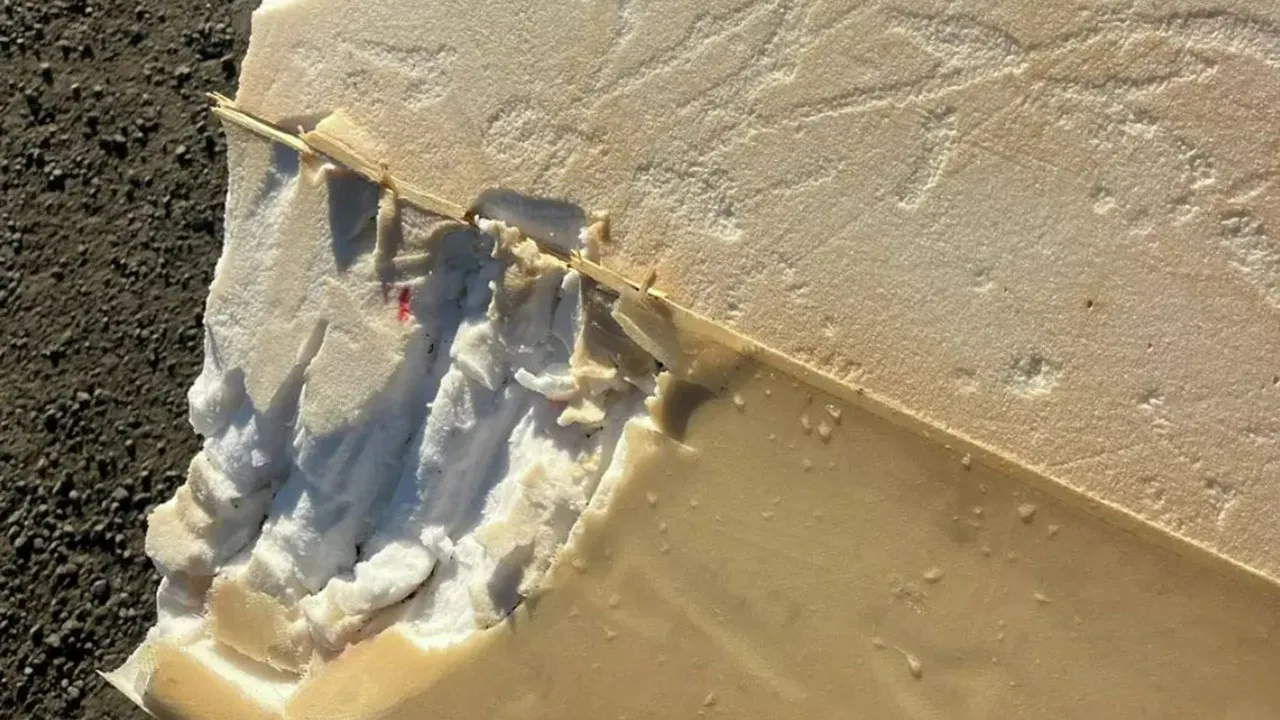
A surfer was bitten by a shark that broke his board in Northern California this week, in the state’s first shark incident of the year.
“It was like being hit by a car,” Tommy Civik told Bay City News, according to SFGate of the incident in Mendocino County, north of San Francisco. “All of a sudden, I was shot out of the water.”
South Coast Fire Protection District Chief Jason Warner told SFGate that his team responded to a beach in Gualala, California, before 9 a.m. on Tuesday, and bystanders told him that a “big” shark “hit the surfer and the surfboard, threw the surfer up in the air a bit, and broke the board in half.”
He said it “latched on to half of the board and [was] kind of thrashing it around.”
SWIMMER VANISHES AFTER POSSIBLE SHARK ENCOUNTER OFF CALIFORNIA COAST DURING GROUP OUTING
A surfer was bitten by a shark that broke his board in Northern California this week, in the state’s first shark incident of the year. (South Coast Fire Protection District)
Civik told the Los Angeles Times that he never saw the shark.
“My board snapped in half on impact,” he said. “My friend watching said that I flew in the air. I’m still piecing together what happened. …The whole thing was so jarring, I was just trying to get away.”
Peter Tira with the California Department of Fish and Wildlife told SFGate that Civik needed stitches and DNA from his wound will be used to identify what type of shark attacked him.
“I was unbelievably lucky,” Civik told The Times. “My board took all the impact, and the teeth just grazed me,” Civik said. “I had quite a bit of adrenaline, and since I could walk, I drove myself to the hospital.”
“It was like being hit by a car,” Tommy Civik said “All of a sudden, I was shot out of the water.” (South Coast Fire Protection District)
His friend Marco Guerrero told the Times he saw the shark attacking what he at first thought was a seal.
MINNESOTA WOMAN KILLED IN US VIRGIN ISLANDS SHARK ATTACK
“I just remember Tommy saying, ‘I’ll meet you out there,’ and suiting up. I was looking out at the waves when I saw the thrashing,” he explained. “I said, ‘Oh that’s a shark attack,’ thinking it was attacking a seal. I didn’t realize it was Tommy.”
After the attack, Civik said he “just put [his] head down and swam, fast.”
The sun sets in Gualala, California. (George Rose/Getty Images)
“I didn’t know where the shark was, so I just focused on getting away,” he told The Times. “After a minute, I realized that if the shark [had] wanted to bite me again, it would’ve. It all happened so fast.”
CLICK HERE TO DOWNLOAD THE FOX NEWS APP
Civik’s attack comes less than a month after an open ocean swimmer was killed by a shark in Santa Cruz County, and following a record year for shark incidents in 2025.
“However, there were only 3 incidents with injuries last year, far below the highest year, which was 1974 with 7 injuries confirmed,” Tira told SFGate.
Read the full article from Here



SALT LAKE CITY — A Riverton woman is proving that one moment of compassion can change a life.
On May 21, LaCinda Thackeray was flying home to Utah from Southern California after attending a family funeral when someone outside the window caught her attention.
As she waited to board her plane at John Wayne Airport, she noticed an airport worker struggling to walk across the tarmac.
“I just saw somebody who needed a little bit of support and love and kindness,” Thackeray said. “What really was hard for me was just the conditions he was in, and I didn’t even know his story at that point.”
Before her flight departed, Thackeray recorded a short video of the man and shared it on TikTok, asking if anyone knew who he was.
“Immediately when I sat on the airplane, my thought was, if anybody knew who he was, could we get him retired?” Thackeray said. “I didn’t know it was going to take off. I had no idea.”
Within a few hours, the video had been viewed more than a million times. Thousands of people shared it, and strangers from around the world began asking how they could help.
The internet soon identified the man as 64-year-old James Blair, a Navy veteran who works as a fuel injector and fuel mechanic at the airport.
By all accounts, Blair has lived a life of service. He served in the Navy from 1980 to 1990.
“We were 20 minutes from launching against Iran when the hostages were in Iran. We had all of our planes loaded with bombs and missiles on our ship and were just waiting for President Reagan to give the go-ahead,” Blair said.
After the Navy, Blair said he worked at LAX airport for 13 years and, after a three-year stint as a truck driver, returned to working on planes at John Wayne Airport.
“I’ve been at John Wayne Airport since April of 2006,” Blair said.
Though Blair turned 64 in March, retirement is not on his horizon.
“My plan was to work until I can’t work, until I physically can’t work,” he said. “I have inquiries out about getting knee operations; I’m working on that right now.”
Despite ongoing knee problems, Blair said his priority is his elderly mother, whom he lives with.
Thackeray said much of Blair’s income goes toward her hospice care.
“She has her good days, and she has her bad days,” Blair said.
Encouraged by people online, Thackeray started a GoFundMe campaign. She said donations quickly poured in.
“At one point, I remember telling my husband, ‘What did I do?’” Thackeray said. “When we needed to get him the money, that is when we were a little panicky, but then it changed really fast.”
The overwhelming support, Thackeray said, presented an exciting opportunity but also some challenges in ensuring that Blair would receive the money.
Until recently, Blair didn’t have a smartphone or social media accounts.
His boss volunteered to drive 1.5 hours to his home to help him set up a GoFundMe account so that he could receive the funds as a beneficiary.
“When his boss went out there, it eased so much anxiety,” Thackeray said.
Recently, Thackeray returned to California to personally deliver a $174,000 check to Blair.
For Blair, the support from complete strangers has restored his faith in humanity.
“Not in a million years,” Blair said when asked if he ever imagined something like this would happen.
“I’m just a person trying to do a job, trying to survive, and the way people give their own money. I have a hard time working to pay bills, so other people probably have the same problems. When they’re giving money they really can’t spare, that amazes me. I’m just blown away.”
Thackeray said the generosity extended far beyond the United States.
“I was speechless because I felt like the world showed up, and I think in these times we need people like that.” She said.
“I’ve been speaking to people all over the world, and they’re just, ‘Tell James hi!’ Give him a hug for us!” she said.
Blair also reflected on how deeply the experience has affected him personally.
“I believed in God, but I didn’t really believe in God. But now, with the angel sitting next to you, it’s amazing,” Blair told Thackeray. “I can’t believe how God works in mysterious ways.”
Although Blair is still going to work, he recently used some of the funds to buy himself a bed. He continues to care for his mother.
“I mean, I don’t know what Salt Lake City living is now, but California is really expensive,” Blair said.
What began as a brief glance through an airplane window has grown into an unlikely friendship — and a powerful reminder that a single act of kindness can inspire thousands of people to make a difference.
“I’m so happy for him and that he gets to experience this,” Thackeray said.
“I told him, I’m just a little part of your story, I’m happy that I could do that, but I hope you can always remember the ones that showed up and donated.”
To date, nearly 6,000 people have donated to the fundraiser. It has raised $180,521.00 for Blair.
Thackeray’s TikTok video of Blair has been viewed more than 9 million times, garnering nearly 800,000 likes and 8,000 comments.
For more information about the fundraiser, visit: https://gofund.me/51f1c9e16
*KSL.com does not assure that the money deposited to the account will be applied for the benefit of the persons named as beneficiaries. If you are considering a deposit to the account, you should consult your own advisers and otherwise proceed at your own risk.
The Key Takeaways for this article were generated with the assistance of large language models and reviewed by our editorial team. The article, itself, is solely human-written.

The Washington Huskies saw one of their most hotly contested offensive line targets in the 2027 class go elsewhere on Saturday afternoon when four-star offensive lineman DaJohn Yarborough announced his pledge to the California Golden Bears
The 6-foot-5, 340-pound product of Basha High School in Arizona, who is ranked as the nation’s No. 426 overall prospect and No. 25 interior offensive lineman by the 247Sports Composite, picked coach Tosh Lupoi and the Golden Bears out of a final four that also included Florida State, Mississippi State, and UW.
Although his junior year was cut short due to a fractured ankle, Fisch and offensive line coach Michael Switzer kept up a strong relationship with the hulking prospect, who has the size, physicality, and skill set the pair looks for from early contributors up front. However,
“The big man slides smoothly in pass protection and balances his weight well, always finding himself on the winning end of collisions with defenders,” Huskies Wire’s Alex Katson wrote in an evaluation of his film. “With such prototypical size and technique, Yarborough profiles as a player who could find himself in the NFL rather quickly with the right coaching staff during his time in college.”
As Washington continues to build up its offensive line for the rigors of the Big Ten, Yarborough would have been viewed as a promising building block alongside Freshman All-American John Mills, former five-star Kodi Greene, and former four-star Champ Taulealea, who should make up the core of Switzer’s unit in 2027.
While the Huskies had consistently been viewed among the top suitors for Yarborough’s services, but Lupoi’s staff has shown early that it can make a big impact quickly on recruits all over the West. Without Yarborough, Washington’s 2027 class consists of three offensive linemen: four-star interior prospect Gecova Doyal, four-star center Reis Russell, and three-star offensive tackle Tye Kennedy.

-

 Rhode Island4 minutes ago
RISP Warwick Arrests July 10: Threatening Officials, DUI – WarwickPost.com
-

 South-Carolina11 minutes ago
Editorial: There’s an easy solution to SC budget impasse, but legislators won’t like it
-

 South Dakota14 minutes ago
10 North Dakota Small Towns With Unmatched Friendliness
-

 Tennessee19 minutes ago
Former Tennessee Football Position Coach Beats Out Vols For Commitment of Elite Recruit | Rocky Top Insider
-

 Texas26 minutes ago
This Week in Texas: $1500 for every Texas Household, ICE accountability, politics in sports
-

 Utah29 minutes ago
Utah woman’s viral video helps raise more than $174K for Navy veteran she spotted at airport
-

 Vermont34 minutes ago
802 Homes to release free home design catalog aimed at lowering construction costs
-

 Virginia41 minutes ago
Southwest, Central Virginia Weather | 6 p.m. – July 11, 2026

