San Francisco, CA
San Francisco D.A. brings charges against pro-Palestinian protesters who blocked Golden Gate Bridge

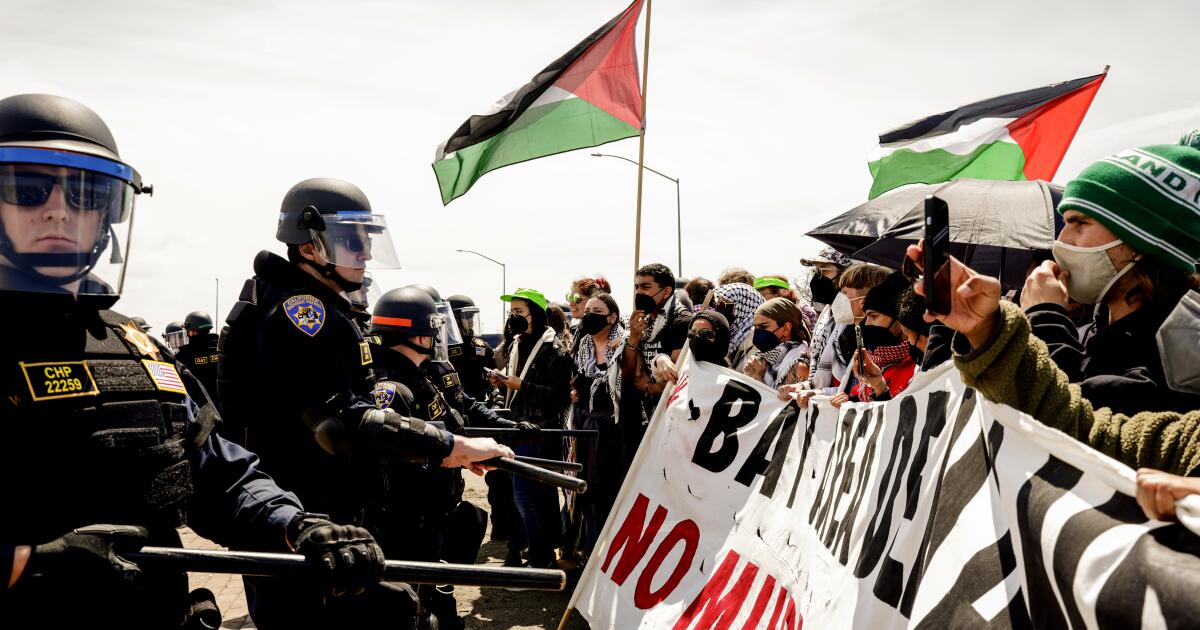
Protesters blocked traffic on the Golden Gate Bridge in mid-April to call attention to the war in Gaza and the suffering of Palestinian civilians whose cities were being bombarded.
Now, authorities in San Francisco are prosecuting them for trapping people in their cars on the bridge for hours. The San Francisco Public Defender countered that officials were “weaponizing the law” against protesters; he wants the charges dropped.
The San Francisco district attorney’s office announced in a news release Monday that arrest warrants were issued for the 26 people who participated in the April 15 protest. All 26 surrendered to law enforcement, according to the California Highway Patrol, but they have not appeared in court or been assigned legal representation.
“While we must protect avenues for free speech, the exercise of free speech can not compromise public safety,” Dist. Atty. Brooke Jenkins said in a statement. “The demonstration on the Golden Gate Bridge caused a level of safety risk, including extreme threats to the health and welfare of those trapped, that we as a society cannot ignore or allow.”
The group, dubbed the “Golden Gate 26” by their supporters, could be represented by the San Francisco Public Defender’s Office, which blasted the charges and cited a higher moral authority for the protest.
Pedestrians and bicyclists wait outside the pedestrian gate on the south side of the Golden Gate Bridge while the bridge is closed because of protesters on April 15 in San Francisco.
(Lea Suzuki / Associated Press )
“The protestors are opposing American tax dollars being used to fund ongoing attacks on the people in Gaza, which the International Criminal Court has deemed crimes against humanity,” San Francisco Public Defender Mano Raju said in a statement. “Our attorneys intend to vehemently defend any individuals we are appointed to represent.”
The district attorney’s office charged the 26 with trespassing to interfere with a business, obstruction of a thoroughfare, unlawful assembly, refusal to disperse at a riot, failure to obey the orders of police and 38 counts of false imprisonment. Eight of the defendants also face a felony conspiracy charge, and the rest face a misdemeanor conspiracy charge.
Protests in opposition to the war in Gaza have taken over highways, college campuses and city streets since the Oct. 7 attack by Hamas on Israel, where militants killed 1,200 Israelis and took about 250 hostages, roughly 115 of whom are still missing. Since then, Israeli forces have killed nearly 40,000 Palestinians in Gaza, according to health officials in Gaza, who include both Hamas forces and civilians in their casualty counts.
The protesters gathered shortly before 8 a.m. on April 15 on the Golden Gate Bridge, where they abandoned their vehicles and chained their bodies together while holding up signs. The group’s members were warned repeatedly by police and other officials that they would be arrested if they did not move, but the group ignored them, according to the D.A.’s office.
A protester later identified as Sara Cantor told police that the protesters would not resist arrest, but the demonstrators who were interlocked between vehicles with a large metal tube would not voluntarily comply with authorities, the D.A.’s office said. All of the protesters were arrested and removed from the bridge, and the traffic lanes were reopened by 12:20 p.m.
Roughly 12,000 vehicles travel south and 8,000 vehicles travel north on the bridge between the hours of 8 a.m. and noon, according to the Golden Gate Bridge District, which the D.A.’s office claims lost more than $162,000 in revenue due to the protest.
Jenkins took to social media following the protest to ask for anyone stuck on the Golden Gate Bridge to come forward, because they could be entitled to restitution and have other rights guaranteed under state’s law.
The D.A.’s office said several hundred people were held against their will at the mercy of the protest. According to court documents, people caught in the middle of stopped traffic missed work and important medical appointments, and a mother with her baby did not have water for the infant formula.

San Francisco, CA
Newlyweds celebrate Pride-themed weddings inside SF City Hall as parade preparations underway

SAN FRANCISCO (KGO) — On Friday in San Francisco, hundreds of newlyweds began the next chapter of their love story at City Hall.
As they got married inside, Pride preparations were also underway outside of City Hall.
These Pride-themed City Hall weddings were all happening as the setup for the Pride celebration at Civic Center were wrapping up in preparation for Pride Saturday and Sunday.
More than 250 couples arrived for Pride Friday, some of them getting commemorative Pride marriage licenses.
2026 SAN FRANCISCO PRIDE PARADE: How to watch exclusively on ABC7, what to know
Couples like Chris Parker and Jared Duensing got a very special officiant: San Francisco Mayor Daniel Lurie.
“This is such a wonderful day, and so happy to finally be married after four years of knowing each other in such a wonderful location. Being married by the mayor was so special,” said newlywed Chris Parker.
“Just happy and excited for those couples, and I’m happy and excited for our city to show off what makes San Francisco so great — and our LGBTQ+ community is a huge part of why San Francisco is so special,” Lurie said.
All of this leads to a huge weekend in San Francisco.
The stage being set up just outside of City Hall will mark the end of the parade route — but there’s a lot happening before that.
MORE: San Francisco Pride insiders reveal their must-know tips for the weekend
On Friday afternoon, the annual Trans March takes place at Dolores Park.
On Saturday, both the Trans Ally March and Rally and the Dyke March will take place.
On Saturday, performers will start taking the stage at Civic Center Plaza starting at noon.
All of this, of course, is leading up to Sunday’s big parade when thousands will line Market Street.
Zach Fuentes will be hosting SF Pride Parade coverage only on ABC7 Eyewitness News this Sunday with Drew Tuma, Cameron Bopp and Tara Campbell — as well as with our community guest hosts.
Copyright © 2026 KGO-TV. All Rights Reserved.
San Francisco, CA
I own a Turkish Restaurant in San Francisco. Turkey’s World Cup match here has changed my business.

This as-told-to essay is based on an interview with Aziz Aslan, 45, the owner of Turquaz, a Turkish restaurant on Mission Street in San Francisco. It has been edited for length and clarity.
I opened my Turkish restaurant, Turquaz, in San Francisco in February 2025. Typically, most of our customers are locals, and Turkish diners make up a small minority.
But Turkey’s World Cup appearance in San Francisco has brought a different type of customer through our doors.
Over the past week, we’ve had far more Turkish customers dine with us. Reservations are up, walk-in traffic has increased, and we’ve hired additional staff to keep up with demand.

Gabriela Hasbun for BI
Turkey qualifying for the World Cup changed my business
As soon as we heard that San Francisco would be one of the World Cup host cities, we were thrilled. We knew it would bring visitors to the city, and potentially new customers to our restaurant.
At that point, we didn’t yet know whether Turkey would qualify.
Gabriela Hasbun for BI
In March, Turkey secured its place in the tournament, and we later learned the team would be playing at the San Francisco Bay Area Stadium on June 20. That’s when I knew we needed to start preparing for the tournament.
Over the last few weeks, we launched targeted advertising campaigns on social media. One Instagram post was written in Turkish. In another, we told visitors that wherever they were traveling from, if they were looking for good food, they should come to us. It helped spread the word about our restaurant.
Gabriela Hasbun for BI
Most of my customers aren’t usually Turkish
I’m originally from Istanbul, although I’ve been in the Bay Area for about 10 years. Compared with places like New York and New Jersey, there aren’t as many Turkish people in this part of California.
Usually, our customers come from a wide range of backgrounds, with Turkish people making up only 5% to 10% of those who dine with us.
With our usual customers, our most popular dishes are chicken kebabs and lahmacun, a flatbread topped with minced meat, vegetables, and herbs. We’re a traditional Turkish kitchen, and our pastry section is popular as well, especially our fresh baklava.
Gabriela Hasbun for BI
In recent weeks, however, we’ve had a lot of Turkish customers, which is unusual for us. Some have come from places like New Jersey and Texas, while others have flown in from Istanbul, all to watch Turkey play.
Turkey’s World Cup match in San Francisco has changed who our customers are and what they’re ordering. Dishes like beans and braised meats aren’t as popular with our usual clientele, but we’re selling a lot more of them now because of our Turkish customers.
Gabriela Hasbun for BI
They’ve been ordering foods like white beans with pilaf, braised meat with pilaf, and salads, all of which are really traditional dishes. Turkish customers can be tough critics because they’re comparing our food to what they have back home, but I feel confident in our food, and we’ve received compliments so far.
It hasn’t really affected our stock, thankfully. We have good inventory management, and my warehouse for the wholesale food business is only a short drive away, so we can pick up products whenever we need.
We’ve hired extra staff to meet demand
To prepare for the World Cup, we’ve had to hire additional employees. On top of the 24 staff members we already had, we added three more because of increasing demand. The staff is also working longer hours than usual.
Gabriela Hasbun for BI
For Turkey’s first match, against Australia, we didn’t do anything special, other than create a football-shaped cake. We decided to host watch parties for Turkey’s second and third matches because customers kept asking for them. We set up a big screen for fans to watch together.
I think the World Cup is giving Turkish people a reason to gather, reconnect, and talk about soccer.
I hope the World Cup leaves a lasting impact
The first few months of opening a restaurant are never easy. We spent them getting things set up, perfecting our recipes, and building awareness. We’re still a relatively new restaurant, so it’s been encouraging to see this positive momentum from the World Cup.
Gabriela Hasbun for BI
The city feels busy. You can see it on the streets. There’s an energy in San Francisco right now that’s having a positive effect on businesses like ours, and I hope we can keep that going.
Of course, the World Cup is a one-time event, but we’ll do our best to serve these customers well. If we can meet their expectations, I hope they’ll come back.
And who knows? Maybe the Turkish national team will stop by for a meal before the tournament is over. I’m still holding out hope.

SAN FRANCISCO (KGO) — A recent Civil Grand Jury report has identified wildfire risks in San Francisco’s Glen Canyon, warning that vegetation management is needed to reduce the potential for a fire in an area not typically associated with wildfire danger.
The report focuses on the canyon’s large population of Blue Gum eucalyptus trees, an invasive species originally imported from Australia.
Historical photographs show Glen Canyon was largely treeless in the late 1800s, when the land was used primarily as a dairy farm.
The eucalyptus trees were planted after investors believed the fast-growing species could be harvested for timber.
“And these people were so stupid, they didn’t realize they were going to build railroad ties and use the wood for building, and it’s worthless. It warps, it splits. it has no commercial value,” said Rick Carell, a member of the Civil Grand Jury.
While the timber venture failed, the trees remained.
Today, their flammability is a concern for fire safety officials and grand jury members.
MORE: 600 goats graze Poplar Beach in Halfmoon Bay to reduce wildfire risk
“The leaves have a lot of oil in them, and so actually, if it’s very hot, and it’s been very, very dry, they actually explode, because it’s highly flammable. And so, you can see here, look at all the debris right next to this road. So somebody throws a cigarette out into there, and you have a potential fire,” Carell said.
Carell said assessments of the trees have raised additional concerns.
“They evaluated something like 427 eucalyptus trees and 80% of them, back in 2012, were in bad shape,” he said.
Although CAL FIRE has repeatedly rated San Francisco’s wildfire risk as low because of the city’s cool, foggy climate, the grand jury report points to the 2025 Pacific Palisades fire in Los Angeles as an example of how fires can occur in urban areas where vegetation management is inadequate.
The report notes that Glen Canyon has only two fire hydrants, one near the Glen Park Recreation Center and another near a day camp building.
However, San Francisco’s Emergency Firefighting Water System provides additional resources through reservoirs, high-pressure hydrants and underground cisterns.
One nearby cistern at Chenery and Surrey streets can supply 75,000 gallons of water. Based on a fire engine’s typical pumping rate of 1,500 gallons per minute, that amount of water would be exhausted in about 50 minutes. Additional cisterns are located in surrounding neighborhoods.
MORE: CAL FIRE urging Bay Area residents to create defensible space as wildfire season begins
Despite the concerns, the report concluded that removing all eucalyptus trees is not a practical solution because of the canyon’s steep terrain. Large-scale removal could increase the risk of landslides. Instead, the report recommends managing vegetation by clearing brush and fallen debris and removing diseased trees.
“To remove any brush that might be a fire hazard, if something could really ignite quickly. We’re going to raise up the branches, the lower branches of the tree because that’s where a lot of the problem is for the spread of the fire, and if there are any dead trees that are really hazardous or branches that may hang over the roadway, that we can take them out as well,” said Rachel Gordon of the San Francisco Department of Public Works.
Public Works officials are expected to coordinate closely with CAL FIRE on vegetation management efforts.
“CAL FIRE guys, they train in the type of environment, and so what they do, they get their chainsaws out, they eliminate. They limb the trees, they bring out the debris and that sort of stuff so this is an ideal training site for them,” Carell said.
The San Francisco Public Utilities Commission, which manages a small portion of the canyon, has already removed trees on its property to prevent them from falling across O’Shaughnessy Avenue, a potential emergency evacuation route.
The agency has also hired habitat experts to remove non-native vegetation and replace it with fire-resistant native species, including coast live oaks.
“That has all these tannins in the foliage that resist fire. You can put a lighter right under that thing in the middle of the hottest day of the year, and it will not burn like these willows. They will not burn, and so that’s what we want to load our parks with instead of having things like the eucalyptus and the pine — which, as we all know, they just burn like a crazy Christmas tree fire,” said Habitat Specialist Josiah Clark.
The majority of the 66-acre canyon is managed by the San Francisco Recreation and Parks Department, which agrees that improved coordination among city agencies is essential to maintaining fire safety in the area.
Copyright © 2026 KGO-TV. All Rights Reserved.
-

 South Dakota12 seconds ago
South Dakota Republicans reject censuring John Thune over stalled SAVE America Act
-

 Tennessee3 minutes ago
Flood watch in effect for Middle Tennessee: 2-3″ of rain expected Saturday
-

 Texas8 minutes ago
Texas state school board approves mandated reading list including Bible passages
-

 Utah15 minutes ago
Utah, Salt Lake County awarded grants for community cleanup
-

 Vermont18 minutes ago
West Rutland man dies in hit-and-run, police seek vehicle
-

 Virginia23 minutes ago
Vandals smash windows of nearly 3 dozen cars in Arlington Mill
-

 Washington30 minutes ago
The Washington Capitals Select Oliver Suvanto | Washington Capitals
-
 Wisconsin33 minutes ago
From bodybuilding to business: Wisconsin entrepreneur builds success with Bulk Butter

