SAN FRANCISCO — They filed in tentatively, taking seats on plush couches and folding chairs arranged in a semicircle in the cafe’s gently lit backroom. Here would be safe to share their deepest feelings, they were assured, to unspool their still-fresh emotions.
San Francisco, CA
At Manny’s cafe, group therapy for newly hopeful Democrats


In one of America’s most liberal cities, this is where San Franciscans come when they need a place to process the latest political bombshell. So they did Monday, gathering after President Biden ended his reelection campaign and ceded the spotlight to one of the Bay Area’s own. In confessional tones, person after person reported how their mood had changed overnight: from depression to delight, anxiety to excitement.
The preceding weeks had been traumatizing, the previous 24 hours life-affirming.
“I think for the first time in months I feel so optimistic,” said Chandru Murthi, a 77-year-old resident who was the first in the circle to share.
Manny Yekutiel imagined exactly this type of discussion when he founded his hybrid coffee shop, bar, bookstore and event space in the Mission district in 2018. The 34-year-old political science major is a longtime Democratic fundraiser and strategist, and he decided to open shop after Donald Trump’s election.
Since then, Manny’s has become a pillar of the city’s political scene, a physical retreat for like-minded souls to talk at a time when so much discourse is chronically online. The back of the cafe is decorated like a living room, with floor lamps, house plants, even a red vintage rug from Yekutiel’s childhood home in Los Angeles.
California Gov. Gavin Newsom, Michigan Gov. Gretchen Whitmer and first lady Jill Biden are among the prominent Democrats who have all stopped in. Vice President Harris, now the party’s likely ticket-topper in the November election, is also a fan. “You’re amazing,” she told Yekutiel during one of her visits.
For anyone looking to do a wellness check on the psyche of a deeply blue stronghold at this historic moment, Manny’s is where to go.
Responding to Biden’s news, Yekutiel reworked the week’s schedule, starting with Monday’s session. He kicked things off as discussion leader. “Let’s ground this in how we feel right now,” he told the crowd of about three dozen people. “How are we feeling as Democrats, as San Franciscans, as people who have a lot at stake in this election?”
“I feel excited, I feel hopeful,” said Angelina Polselli, 24. “It feels like everyone finally woke up from a long, long nap.”
As Manny’s resident Gen Z expert, she noted that young people have some concerns with Harris, particularly her record as a prosecutor. But there’s also the “brat” factor, which Polselli had to explain to an audience who appeared largely unfamiliar with the catalogue of Charli XCX.
“It feels exciting to have a young candidate who is energized and youthful and who is also talking to young people and using the language we use,” she added.
Soon, however, that familiar fear crept back in.
“I’m a little bit worried about a San Francisco liberal carrying the battleground states,” said Dan Rink, 81 and himself a liberal from the Bay Area.
“I’m not sure she’s a liberal, I view her as more moderate,” David Anderson, 55, a film industry veteran, chimed in.
Yekutiel took a poll: “How many of you, if you’re willing to raise your hand, are worried about her ability to win?” About half the circle responded, though several acknowledged they were “more hopeful than 24 hours ago.”
Hope has been in short supply all year for this crowd. Enthusiasm, even shorter.
“The last few weeks were really difficult because people have just felt this dread, that there’s no point,” Yekutiel said. “And now I have all these ideas, my mind has been racing, people are reaching out to me, asking how they can help. That was not happening 24 hours ago.”
Two nights later, Manny’s hosted a watch party for Biden’s Oval Office address, his first since exiting the campaign. Despite the new themed drinks — “Kamalattes,” sweetened with coconut syrup, of course — the affair was solemn.
As the president’s speech played on a small TV opposite the barista station, some 20 people fell silent and clustered around the screen. Passersby stopped to watch through the cafe’s open front windows. A woman named Lydia walked in to order a mocha and wound up staying for the whole thing.
The elated embrace of Harris expanded to a tearful appreciation of Biden.
“I felt in his voice and his speech and his words so much love for this country,” Michelle Jeong said, choking up. “The hope, unity and the lack of ego.”
For Mike Madison, who had also attended the Monday gathering, the sentiment was overdue. Lost in the memes and the Harris hullabaloo was the fact that Biden had just made a tremendous sacrifice, he said.
“I wanted people to remember what he’s done, his real accomplishments,” Madison said.
If night one’s theme was relief and celebration and night two’s was gratitude, a third event Thursday was something of a reality check. It was also the largest gathering of the week, squeezing about 175 people into Manny’s backroom for a panel featuring two journalists dissecting the upcoming campaign and Harris’s prospects for victory.
“It’s not going to be easy, let’s be clear. It’s not going to be easy to win in November,” said Scott Shafer, politics editor at KQED, a Bay Area public radio station.
The evening served as a call to action: “This is our hometown candidate, she’s one of us,” Yekutiel said. “So we are going to be needed to propel her to this highest office.”
For those interested in getting involved, he announced a very San Francisco option: A “disco for democracy” party, with proceeds going to get-out-the-vote efforts in neighboring Nevada. Only days earlier, when Biden was still heading the Democratic ticket, such festivities were a harder sell, Yekutiel said. But now there was something to dance about.
Lalita Abhyankar, a physician, was ready to volunteer. “I want to knock on doors,” she said. “I’ve never felt this way about a candidate, not even Obama. … I can vote for her instead of just voting against Trump. It feels amazing.”
Thursday was her first time at a Manny’s discussion, she said. A friend told her it was the place to be this week, and she wanted company as she reveled in her new enthusiasm. Sometimes even those who didn’t know they cared leave Manny’s fired up — like the woman who happened to walk in just before Biden’s address.
“She came in for a mocha and participated in a major historic moment,” Yekutiel said. “That was my vision for this place — you trap people with beer and coffee so they don’t even realize they’re walking into a political space. And then, they’re in.”



San Francisco supervisors authorized a resolution Tuesday urging California lawmakers to expand the city’s automated speed camera program, which currently has 33 cameras operating in the city under a state pilot.
The board’s 10-to-1 vote on Tuesday, with District 10 Supervisor Shamann Walton voting against it, will not add cameras immediately, but formally asks the state to explore changes to the program. The San Francisco Municipal Transportation Agency has identified at least 80 additional high-need locations that could benefit from automated enforcement, according to a report filed with the Public Safety and Neighborhood Services Committee.
Richard Zieman, whose son Andrew, a paraeducator, was killed in November 2021 by a speeding driver outside Sherman Elementary School on Franklin Street, told Mission Local that city officials should do more. “They waited for a tragedy,” Zieman said. Parents and school leaders had repeatedly asked the city to slow traffic on Franklin Street, where drivers barreled downhill toward the Marina, said Zieman.
Supervisor Matt Dorsey, who introduced the resolution, has said the city’s first year of automated speed enforcement shows that the technology works. The SFMTA reported nearly an 80 percent reduction in drivers traveling at least 10 miles per hour over the speed limit at camera locations after the program launched in March 2025. San Francisco was the first city to implement the pilot authorized under Assembly Bill 645.
The pilot, however, is capped by state law at 33 camera locations. Tuesday’s resolution asks California lawmakers to consider allowing more, prioritizing corridors on San Francisco’s High Injury Network, including Franklin Street.
Walk San Francisco, a pedestrian advocacy group which spent roughly eight years advocating for the state legislation that created the pilot, called the resolution an important first step toward broader expansion.
“Thirty-three cameras is nowhere near the number of cameras we need for people to realize that San Francisco is a safe-speed city,” said executive director Jodie Medeiros. “This tool is working. People are lowering their speeds.”
District 6, represented by Dorsey, currently has seven of the city’s 33 cameras, most of them in SoMa. The district also records the highest number of crashes involving injuries or fatalities in San Francisco, making it a focal point in the debate over expanding automated enforcement.
The resolution advanced unanimously from the Board of Supervisors’ Public Safety and Neighborhood Services Committee last week, where Dorsey said the cameras have made streets “feel safer” and argued the early results show “why we should have even more of this life-saving technology.”
Zieman, whose son’s death prompted traffic-calming improvements and eventually a speed camera near Sherman Elementary, said the issue is urgent.
“There are probably other Franklin streets out there,” he said. “I just hope they don’t wait for someone else before they expand the program. It’s too late for Andrew.”

One person is dead and two others are missing near Alcatraz Island in San Francisco Bay after a boat with 19 people aboard capsized Tuesday afternoon, officials said.
A vessel was reported to be on fire around 600 yards off Alcatraz around 3:35 p.m., and police found a capsized three-deck pontoon boat, San Francisco Fire Chief Dean Crispen said.
The incident was initially reported as a fire, but no first responders reported witnessing a blaze, Crispen said.
Everyone on the boat is believed to have been adults, Crispen said. A dog was also on board and is dead, he said.
Thirteen people were safely rescued, and another three were transported to hospitals, Crispen said.
Firefighters are “in full rescue mode,” with 11 boats and divers as part of the response, Crispen said.
“We are going to continue for hours to make sure that we find these two missing people, if possible,” Crispen said.
“It seemed like a recreational-type vessel, but that’s all we know at this point,” Crispen told reporters.
The vessel reportedly launched from a yacht club, and investigators were still gathering information, he said.
Helicopter footage from NBC Bay Area showed responding rescue boats and debris floating in the water. Video from the station appeared to show some of the rescued with blankets on shore.
Local police departments and private vessels also responded to the incident, Crispen said.
“This is an all-hands-on-deck search and hopefully rescue,” San Francisco Mayor Daniel Lurie said.
When first responders arrived, some people were in the water, others were on the sinking boat, and others were falling into the water, Crispen said.
Alcatraz Island is the site of the famous prison located in San Francisco Bay, around 1 mile offshore. It was closed as a federal prison in 1963 and is now a National Park.
Crispen said the search would be extensive.
“Our standard operating procedure is to continue to search, as long as it’s safe enough for us to search,” he said.
He said divers were in the water, helicopters were above, and officials were searching areas where survivors in the water would tend to move to.
“This search will go on for some time,” Crispen said.
San Francisco, CA
Sold-Out SF Marathon 2026: The Races, Routes and Road Closures (Plus How to Watch It All) | KQED

Everything you need to know about the 2026 San Francisco Marathon weekend on July 25-26, including the route, the road closures and whether it’s too late to sign up.
If you still want to sign up for the SF Marathon, you still have time. (AN Studio/Getty)
Keep reading for the 2026 SF Marathon route, which streets will be closed, where to find public transit changes and how to watch from the sidelines if you’re a spectator.
We’ll also give an overview of all the weekend’s events and races themselves if you’re feeling spontaneously athletic (or want to meet people) and decide to sign up for a race at short notice.
And important to flag — several of these races now allow dogs.
Jump straight to:
What is the SF Marathon route, and when are the races?
The 26.2-mile main event — the full SF Marathon — is on Sunday, July 26. The full marathon starts at 5:15 a.m. on Embarcadero Street at Market Street and finishes on Embarcadero Street at Howard Street.
You can check out a map of the entire course on SF Marathon’s Strava account, which also includes elevation levels and first aid/water stops.

Is it really too late to sign up for the full marathon and 1st half marathon?
Yes, the full marathon — and the popular 1st half marathon over the Golden Gate Bridge — are both sold out.
According to officials, the spots went out “faster than ever” this year. But you can still join the waitlist and hope for the best.
“Spots do open up,” the website reads. “Plans change, runners defer, and entries become available again. When they do, the right wait list is the best way to secure yours.”
What are my other options for races around the SF Marathon that weekend?
Your other options for races during the SF Marathon weekend that are still accepting sign-ups include:
The City Half Marathon (Sunday)
This is the race where you get to run through San Francisco’s neighborhoods. It’s 13.1 miles with a 3.5-hour time limit and starts at 8:30 a.m. from MLK Jr. Drive at Golden Gate Park to Embarcadero at Howard.
Race fee:$303.74
The Alexi Pappas SFM 10K (Sunday)
This race is named after the Bay Area’s own Olympian Pappas and is a flat 6.2 miles that starts at 7 a.m. from The Embarcadero at Market Street to the Embarcadero near Washington Street. Dogs are now welcome for this race.
Race fee: $164.04

5K race (Saturday option)
This 5k allows your dog to run with you along the Embarcadero waterfront. Starting at 8 a.m, this is a 3.1-mile course with an hour limit.
Race fee: $120.04
5K race (Sunday option)
Dogs are also allowed at this Embarcadero waterfront race, but the race isn’t a loop like the Saturday option, instead starting at The Embarcadero at Market St. and ending at Embarcadero at Washington Street. This 3.1-mile race starts at 9 a.m. and has an hour limit.
Race fee: $118.94
Looking for something more family-friendly and chill? There is Sebastian’s 1K Mad Dash on Saturday, which is a little under a mile. It starts at 9 a.m., starting and finishing at Embarcadero and Washington. The race fee is $28.75.
If you can’t make it to San Francisco, you can join the race virtually by registering on the SF Marathon’s app. It’s $110.15 to join, and you’ll need to download the SF Marathon tracking app to follow your progress.
Which streets will be closed to cars and public transit for the SF Marathon?
The SF Marathon website breaks down which city streets will be closed for races at what time, along with some recommended detours.
There will be closures along The Embarcadero, Fisherman’s Wharf and in the Marina District. However, rest assured that vehicle traffic on the Golden Gate Bridge, which is on the route, will remain open in both directions throughout the marathon.

A lot of SF Muni lines will also be rerouted due to marathon weekend events.
SFMTA has not yet updated its guidance for this year, but you can peek at the 2025 list of route alterations, changes and closures to get a sense of what’s to come.
Where can I cheer the SF Marathon runners on?
Are you a good friend cheering on a runner? Make sure you know which race they are running in, and then look at the above section to check out the times and routes.
You can also track a runner’s progress using the SF Marathon app using a bib number.
Where can I find my pictures and results after the race?
Participants will have their pictures emailed to them a few days after the event — or on the race results and photos page on the SF Marathon website.
I need to bail. Can I defer my SF Marathon registration until next year?
Bailing? The people on the waitlist will thank you!
You can defer your registration to next year for a $39 fee, and the last day to do so is July 24. (That’s also the last day to convert your in-person race into a virtual one, if your plans have unexpectedly changed.)
Keep in mind that registration is nontransferable, and you cannot give or sell your bib to someone else.
What will the weather be like in San Francisco for the marathon?
Check the weather forecast again before you head out, as San Francisco weather can turn on a dime — and keep in mind that the National Weather Service forecasts the weather a week out.
Historically, the temperature around the courses is usually around 64°F, according to the SF Marathon website.
Whether you’re planning to participate in a race or just spectate, be sure to drink plenty of water well before going out.

You can also be strategic about how to combat heat by cooling your body’s pulse points, such as your neck, inside your elbows, and behind your knees, to bring quick relief. In case things get toasty, KQED has a thorough guide on how to stay safe during a heat wave.
The full marathon has 14 hydration stations, which include water, electrolytes, medical assistance, and toilets. The SF Marathon encourages runners to bring refillable water bottles that are 50 gallons or less.
What’s the best way of traveling to the SF Marathon starting line that morning?
If you’re trying to get to the race for the full marathon’s 5:15 a.m. start time on Sunday, remember: BART service does not start early enough to get you there, and you’ll miss your race.
Instead, the SF Marathon will have shuttles from six BART stations to get you to the starting line. There is free parking at BART stations, and buses will run very early in the morning. Times are subject to change, but the list of BART stations with shuttles is currently:
- Bay Fair (San Leandro) at 3:50 a.m.
- Daly City at 4:05 a.m.
- El Cerrito Plaza at 4:05 a.m.
- MacArthur at 4:05 a.m.
- Millbrae at 4:05 a.m.
- Walnut Creek at 3:55 a.m.
Buses aim to arrive by 4:30 a.m. at the Main Start Line on the Embarcadero. You’ll need to purchase your bus ticket ahead of time, though.
-
 Lifestyle1 minute ago
They just completed all of L.A. Times’ 101 Best California Experiences — and we’ve got questions!
-
 Politics7 minutes ago
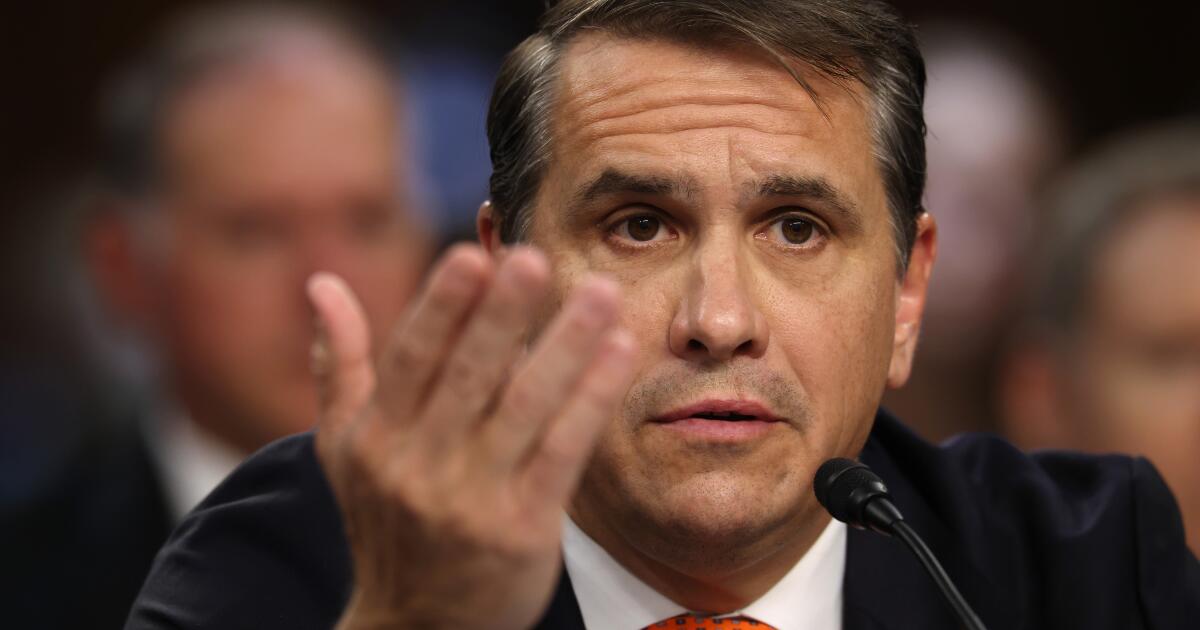
Blanche to face questions about his independence at attorney general confirmation hearing
-
 Sports19 minutes ago
How World Cup senior citizens like Lionel Messi have bio-hacked longer careers
-

 World31 minutes ago
Baltic presidents warn of Russian infrastructure attack plans
-
News1 hour ago
ICE should do traffic stops despite recent shootings, Trump says, seeming to oppose new suspension
-

 Los Angeles, Ca3 hours ago
Southern California hits hottest day of its extreme heat warning
-

 Detroit, MI3 hours ago
Steve Yzerman out as Detroit Red Wings GM, moves to senior advisor role
-
San Francisco, CA3 hours ago
Supervisors urge California to expand S.F. speed-camera program

