Oregon
Portland’s Urban Tree Plans May Face a Withering in Federal Funds – Inside Climate News


For decades, Portland, Oregon has been a pivotal place to study the relationship between trees and related health benefits; now, with the Trump administration funding cuts in play, it may be a window into how broken federal promises will weaken critical urban tree canopies.
President Donald Trump’s executive order “Unleashing American Energy,” signed on his first day in office, ordered federal agencies to immediately pause the disbursement of funds appropriated by the Inflation Reduction Act, the flagship climate law passed by Congress and signed by former President Joe Biden.
Oregon was poised to benefit from $58.2 million to be distributed by the U.S. Department of Agriculture’s Forest Service to plant trees, particularly in low-income areas lacking shade and vegetation. The funds, to be distributed from 2023 to 2028, were part of a $1.5 billion cache allotted through the IRA to develop urban canopies in underserved communities across the United States.
The money for Oregon, allocated through a competitive process, was set to be distributed this way: $22.85 million to the Oregon Department of Forestry, $19 million to Portland-based organizations, $12 million to a Eugene-based organization, $2 million to the city of Pendleton, $1 million to the city of Hermiston, $1 million to the city of Salem and $345,000 to the city of Hillsboro.
We’re hiring!
Please take a look at the new openings in our newsroom.
See jobs
While some grantees declined to comment, Inside Climate News confirmed in interviews that at least $40 million has not yet been paid—68 percent of the promised funds.
When asked to comment on the IRA funding freeze, a U.S. Department of Agriculture spokesperson replied in an email: “The Trump administration rightfully asked for a comprehensive review of all contracts, work and personnel across all federal agencies. The Forest Service is following direction provided by USDA with regards to the President’s Executive Orders to ensure full compliance.”
A Pause in Grant Reimbursements
Joy Krawczyk, public affairs director for the Oregon Department of Forestry, said in an email the department has been informed that IRA reimbursements are paused and under review.
According to Krawczyk, Oregon’s forestry department had yet to receive any funds from the $22.85 million grant. She said the department so far has incurred $216,085 in costs since the start of 2024 associated with the grant. The department had not yet submitted a reimbursement request, she said in an email, because it had planned to bundle reimbursement requests in a single package to save time.
Leadership at several organizations provided details about the federal money that has not materialized and what it could mean for their operations. One nonprofit that asked for anonymity said the organization had received $1.5 million of a $12 million grant to plant trees in low-income areas across Oregon. The organization submitted an additional invoice in early January of $850,000 for work performed from July to December 2024. The invoice was processed, according to senior personnel, but the bill has not been paid due to Trump’s freeze of IRA funds.
“We have no idea if we will be paid for work dutifully done under the terms of the agreement,” said the employee with access to financial data at the nonprofit and who declined to be identified in fear of angering federal officials. “We’ve had a 40-year relationship with the federal government. It’s how we do our business. The government—up until January 21—was a good business partner.”
Because of the funding freeze, the employee said the department will have to cut programming and staff.
Similarly, a Portland-based organization that requested anonymity said that it was set to receive $7 million in IRA funds and has so far been paid about $617,000. Staff knowledgeable about the organization’s spending said funds from the $7 million grant were intended to cover 40 percent of their budget this fiscal year. With funding paused, leadership said they will have to cut the overall operating budget—including the budget for new trees—and reduce staff by 20 percent.
Portland’s Canopy in Decline
Researchers at Portland State University have long been vigilant in examining the importance of green space and assessing tree loss in Portland. Professor Vivek Shandas, who sits on the National Urban Community Forestry Advisory Council, began researching the environmental impact of trees in the late 1990s while working on his dissertation. Since then, he and a team of colleagues have pursued a multi-decade project to examine the relationship between human health and trees and the causes of canopy decline.
Portland’s canopy cover—measured by the layer of leaves, branches and stems of trees that cover the ground when viewed from above—receded one percent from 2015 to 2020, or about 820 acres, according to a city department survey from 2022. That’s equal to 620 football fields of leafy cover.
If the federal funds for tree planting disappear, Shandas said, Portland’s canopy will further winnow. That means “we’ve likely hit peak canopy,” he said.

Shandas and his team recently corroborated the city survey of tree loss and went further to examine where and why the canopy was shrinking. In a study last year, they found that low-income neighborhoods in Portland experienced the greatest decline and determined that development, notably commercial residential building, was driving overall tree loss in the city.
“Developers are the primary landscape agents in Portland,” Shanda said. “It’s a very developer-friendly moment, and they are going farther and farther into different reaches to the region that used to have thick canopy but are quickly losing it.”
Inequitable Tree Canopies
According to Shandas, low-income neighborhoods in Portland, primarily east of the Willamette River, have long experienced inequities in tree investment.
East Portland, where income per capita is lowest citywide, has urban canopies nearly three times smaller than west Portland, where income per capita is greatest. East Portland is more diverse and low-income with the residents earning $33,000 less per year than residents on Portland’s west side.
West Portland has 56 percent urban tree canopy cover, whereas east Portland has 21 percent cover, according to Jenn Cairo, the Portland City Forester. Portland’s baseline urban tree canopy target is 33.3 percent citywide, according to Shandas.


Portland may be a case study, but inequitable urban canopies exist across the United States. In 92 percent of U.S. cities, low-income neighborhoods have fewer trees than high-income neighborhoods.
The Tree Equity Score map, a project by the American Forests nonprofit, shows that U.S. neighborhoods with a majority of people of color have 33 percent less tree canopy, on average, than majority-white neighborhoods. The nonprofit’s analysis also found that the poorest U.S. communities, where 90 percent of the residents live in poverty, have 41 percent less tree canopy than the wealthiest communities.
Health Benefits of Trees
Portland, the state’s most populous city and one of the country’s greenest, has attracted scientific studies over the past decades, including a 2022 cost-benefit analysis conducted by researchers at the U.S. Forest Service that cited lower mortality risk for people living in Portland neighborhoods with enhanced tree planting.
Urban tree canopies provide critical ecosystem benefits including shade, purifying area and water, sequestering carbon, reducing energy consumption, capturing stormwater and mitigating urban heat.
This story is funded by readers like you.
Our nonprofit newsroom provides award-winning climate coverage free of charge and advertising. We rely on donations from readers like you to keep going. Please donate now to support our work.
Donate Now
During a record-breaking heatwave in 2021, Shandas drove across the city with a thermal camera and compared how high and low-canopy Portland neighborhoods fared. He found that Lents, one of the city’s poorest neighborhoods in the southeast that had 18 percent canopy cover, reached 124 degrees Fahrenheit. Across the Willamette River, neighborhoods in Portland’s leafy northwest including Willamette Heights peaked at 99 degrees Fahrenheit. The 25-degree difference could be a matter of life or death, Shandas said.
Shandas has also found that areas with more trees have lower incidences of respiratory problems.
Attempting to Grow Portland’s Canopy
Not all of Portland’s funding for urban trees is tied to federal grants, providing alternative pathways to canopy growth and preservation. In May 2024, the Portland City Council approved a $65 million investment over five years for tree protection and care through the Portland Clean Energy Community Benefits Fund (PCEF). Jenn Cairo, the Portland city forester, said more requests will follow. Portland’s urban forestry division planted 53,311 trees from 2015 to 2024, with 11,311 trees in 2024, she said.
On Feb. 20, the city submitted a draft of the Portland Urban Forest Plan for public review. According to the city’s website, government officials decided to update the current forest plan—published in 2004—in light of the research showing Portland’s declining tree canopy and the health and ecosystem benefits of trees.
The new draft plan calls for achieving at least 35 percent canopy cover citywide in 20 years and 45 percent canopy cover citywide in 40 years, which would require 660,000 new trees—nearly one tree for every Portland resident.
With those targets in mind, the city and local organizations aim to plant as many trees as they can afford. According to Shandas, it costs, on average, $1,000 to plant a tree. Friends of Trees, a Portland-based nonprofit, plants more than a hundred different species of trees, the most common being oaks, ginkgos, tupelos and cascaras, said Megan Van de Mark, the organization’s deputy director.

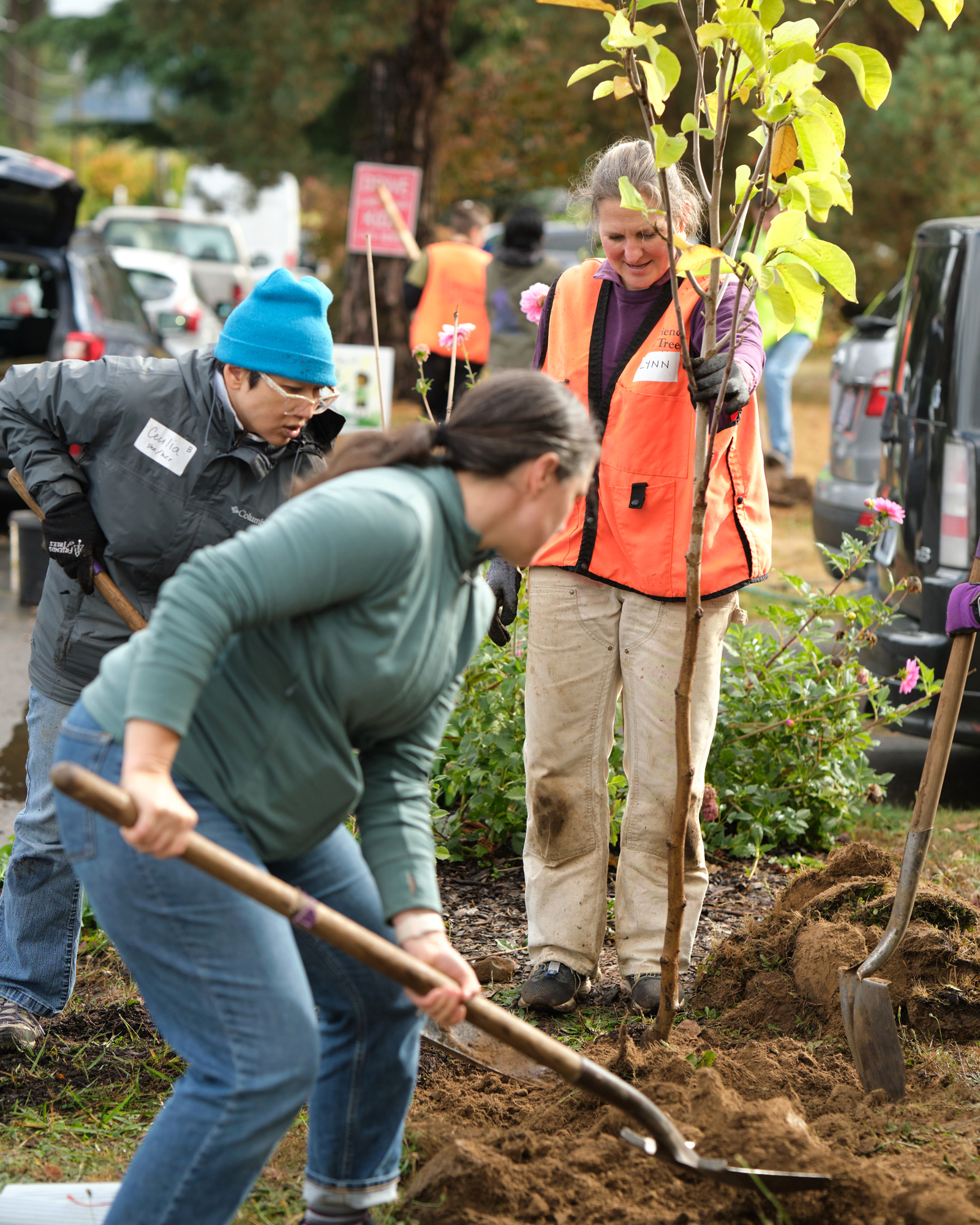
Friends of Trees, which relies on a corps of volunteers, will celebrate its one-millionth tree planting in April. The organization started planting trees in Portland in 1989 and has since expanded into six counties across Portland and Oregon. Shandas estimated that at least two-thirds of the Friends’ trees are in Portland.
But he pointed out that canopy loss outpaces canopy growth, and new trees don’t provide the same health and ecosystem service benefits as mature trees amid full canopies, which can take 15 to 30 years to develop. The size of canopies will make a difference in the quality of life in American cities, he said.
“2040 will be a very different world than 2025,” Shandas said. “It will be considerably warmer in most places and heat waves will be very intense.”
About This Story
Perhaps you noticed: This story, like all the news we publish, is free to read. That’s because Inside Climate News is a 501c3 nonprofit organization. We do not charge a subscription fee, lock our news behind a paywall, or clutter our website with ads. We make our news on climate and the environment freely available to you and anyone who wants it.
That’s not all. We also share our news for free with scores of other media organizations around the country. Many of them can’t afford to do environmental journalism of their own. We’ve built bureaus from coast to coast to report local stories, collaborate with local newsrooms and co-publish articles so that this vital work is shared as widely as possible.
Two of us launched ICN in 2007. Six years later we earned a Pulitzer Prize for National Reporting, and now we run the oldest and largest dedicated climate newsroom in the nation. We tell the story in all its complexity. We hold polluters accountable. We expose environmental injustice. We debunk misinformation. We scrutinize solutions and inspire action.
Donations from readers like you fund every aspect of what we do. If you don’t already, will you support our ongoing work, our reporting on the biggest crisis facing our planet, and help us reach even more readers in more places?
Please take a moment to make a tax-deductible donation. Every one of them makes a difference.
Thank you,


Every year, there are always a few recruiting races that are anything but normal. Twists and turns should be expected on the recruiting trail, but you can still always count on a surprise or two.
The Oregon Ducks have already landed four commitments along the offensive line in the 2027 recruiting cycle, most recently scoring three-star Lex Mailangi. The Ducks are still pushing for one more, however, and it’s the biggest of them all.
Five-star offensive lineman Ismael Camara has taken several visits to Eugene, including one earlier in the spring. However, the Texas star canceled his tour of official visits to finish high school early and give Gilmer High School his best effort on the field in the fall.
Those plans changed quickly when he opted to take unofficial visits to SMU and Texas in June. After once appearing to push his recruitment to the fall and commit closer to early signing day, it’s clear that Camara is now open for business, and he could be moving quickly toward a decision.
When Camara left Eugene in the spring, the Ducks were perceived as a favorite in the race. However, after spending time away and connecting with programs in his home state of Texas, Rivals’ Sam Spiegelman believes Texas is now in the lead, and was told by one of Camara’s family members that a commitment could be coming soon.
While the Longhorns are in charge, SMU, LSU, Texas A&M and Oregon all still remain involved. While he has been able to tour the Texas programs this month, Camara has remained in touch with the Ducks over FaceTime.
“Just fantastic coaches and options all around,” Camara’s guardian, Todd Robison, told Rivals. “We are also in touch regularly with Tennessee, LSU, A&M, and Alabama. He also has had very well-attended FaceTime calls with the entire staff at Oregon. He feels the love for sure.”
The Ducks still appear to be in good standing with Camara, but the inability to get him on campus this month is a big setback. Even if Camara does commit over the summer, the Ducks will likely push hard to get him back to Eugene in the fall for another visit. Don’t expect Oregon to give up on this race until pen hits paper on signing day.
Contact/Follow @Ducks_Wire on X (formerly Twitter) and like our page on Facebook to follow ongoing coverage of Oregon Ducks news, notes, and opinions.

Editor’s note: In 2016, WW expanded its Cheap Eats guide to include a road trip. We identified nine diners, food trucks and one boat worth a pit stop when journeying through Oregon. Since then, a few things have changed: Two of our picks have closed, as noted below, and you don’t need to travel to Medford to find an In-N-Out Burger. But maybe you should!
This list first appeared in the March 23, 1016, edition of WW.
TAQUERIA GUERRERO
508 E 1ST ST., NEWBERG.
Half tienda, half taco spot, Guerrero serves its street tacos and huge mojado burrito ($8.95) with handmade tortillas that shame almost anything in Portland.
JOE’S DONUT SHOP
39230 PIONEER BLVD., SANDY.
This 40-year-old candy-striped dough den offers a ridiculously rich cronut—that’s a fried croissant—fast service, and always-fresh doughnuts. It’s arguably the best doughnut shop in the state.
THE DINER
2580 SE STRATUS AVE., MCMINNVILLE.
The Diner makes one of the state’s greatest sandwiches—a fried-chicken club in which each layer is seasoned and housemade, and the middle slice of bread is replaced by the satisfying crunch of fried chicken.
EASTWIND DRIVE IN
395 WANAPA ST., CASCADE LOCKS.
The Eastwind is where Cheryl Strayed first tasted civilization after ending her long, long walk. The soft-serve ice cream is good enough for you, too, motherfucker.
BOWPICKER FISH & CHIPS
1634 DUANE ST., ASTORIA.
At this 28-foot converted gillnet boat, there are always 12 old men waiting in line for beautifully fresh-caught, hand-battered albacore tuna served with a raft of fries. Join them.
LOCAL BOYZ HAWAIIAN CAFE
1425 NW MONROE AVE., CORVALLIS.
A sweet shoyu chicken plate lunch will fill you up until dinner tomorrow. But broke high-school kids will buy rice for $1.50 just so they can douse it in the magical ginger-garlic-shoyu sauce.
IN-N-OUT
1970 CRATER LAKE HIGHWAY, MEDFORD.
With an address that already sounds like a road trip, the magnificent double-double has punctured the state line. Even from as far away as Portland, it beckons.
NOW CLOSED:
FAT FREDDY’S
6320 PACIFIC AVE., PACIFIC CITY.
After a brief hiatus best forgotten, Pacific City’s beachfront home of towering burgers and equally towering Tillamook ice-cream milkshakes returned two years ago to the sound of hardening arteries.
CORNBREAD CAFE
1290 W 7TH AVE., EUGENE.
It’s arguably Eugene’s best restaurant, and it’s also a perfect fit for the town—a vegan version of an old-school diner, complete with barbecued seitan and outrageously good greens.
Willamette Week’s reporting has real-life impact that changes laws, forces action by civic leaders, and drives compromised politicians from public office.
Support WW.

“),r.close()),!r)throw Error(“base not supported”);var a=r.createElement(“base”);a.href=n,r.getElementsByTagName(“head”)[0].appendChild(a);var i=r.createElement(“a”);return i.href=t,i.href}finally{e&&e.parentNode.removeChild(e)}}());var l=i(t||””),f=function(){if(!(“defineProperties”in Object))return!1;try{var e={};return Object.defineProperties(e,{prop:{get:function(){return!0}}}),e.prop}catch(t){return!1}}(),h=f?this:document.createElement(“a”),m=new o(l.search?l.search.substring(1):null);return m._url_object=h,Object.defineProperties(h,{href:{get:function(){return l.href},set:function(e){l.href=e,r(),u()},enumerable:!0,configurable:!0},origin:{get:function(){return”origin”in l?l.origin:this.protocol+”//”+this.host},enumerable:!0,configurable:!0},protocol:{get:function(){return l.protocol},set:function(e){l.protocol=e},enumerable:!0,configurable:!0},username:{get:function(){return l.username},set:function(e){l.username=e},enumerable:!0,configurable:!0},password:{get:function(){return l.password},set:function(e){l.password=e},enumerable:!0,configurable:!0},host:{get:function(){var e={“http:”:/:80$/,”https:”:/:443$/,”ftp:”:/:21$/}[l.protocol];return e?l.host.replace(e,””):l.host},set:function(e){l.host=e},enumerable:!0,configurable:!0},hostname:{get:function(){return l.hostname},set:function(e){l.hostname=e},enumerable:!0,configurable:!0},port:{get:function(){return l.port},set:function(e){l.port=e},enumerable:!0,configurable:!0},pathname:{get:function(){return”https://www.opb.org/”!==l.pathname.charAt(0)?”https://www.opb.org/”+l.pathname:l.pathname},set:function(e){l.pathname=e},enumerable:!0,configurable:!0},search:{get:function(){return l.search},set:function(e){l.search!==e&&(l.search=e,r(),u())},enumerable:!0,configurable:!0},searchParams:{get:function(){return m},enumerable:!0,configurable:!0},hash:{get:function(){return l.hash},set:function(e){l.hash=e,r()},enumerable:!0,configurable:!0},toString:{value:function(){return l.toString()},enumerable:!1,configurable:!0},valueOf:{value:function(){return l.valueOf()},enumerable:!1,configurable:!0}}),h}var c,s=e.URL;try{if(s){if(“searchParams”in(c=new e.URL(“http://example.com”))){var f=new l(“http://example.com”);if(f.search=”a=1&b=2″,”http://example.com/?a=1&b=2″===f.href&&(f.search=””,”http://example.com/”===f.href))return}”href”in c||(c=undefined),c=undefined}}catch(m){}if(Object.defineProperties(o.prototype,{append:{value:function(e,t){this._list.push({name:e,value:t}),this._update_steps()},writable:!0,enumerable:!0,configurable:!0},”delete”:{value:function(e){for(var t=0;t document.createElement(“picture”);

-

 Los Angeles, Ca1 hour ago
Climbers rescued from Tahquitz Rock in San Bernardino National Forest
-

 Detroit, MI2 hours ago
Report: Pistons Targeting 7-Time All-Star Wing to Pair With Cade Cunningham
-

 San Francisco, CA2 hours ago
6/28 Gamethread: Giants vs. Braves
-

 Dallas, TX2 hours ago
Dallas community gathers donations for Venezuela
-

 Miami, FL2 hours ago
Miami Heat Could Reunite With Playoff Hero This Offseason
-

 Boston, MA2 hours ago
Red Sox lefty makes latest rehab start, close to forcing tough decision
-

 Denver, CO2 hours ago
Firefighters say car crash caused large fire north of Denver International Airport
-

 Seattle, WA2 hours ago
PHOTOS: Thousands gather in downtown Seattle for city’s iconic Pride Parade

