Connect with us

West

Nevada man who leaped over judicial bench at judge indicted by grand jury for attempted murder

Published

on

Nevada man who leaped over judicial bench at judge indicted by grand jury for attempted murder
Join Fox News for access to this content

Plus get unlimited access to thousands of articles, videos and more with your free account!

Please enter a valid email address.

By entering your email, you are agreeing to Fox News Terms of Service and Privacy Policy, which includes our Notice of Financial Incentive. To access the content, check your email and follow the instructions provided.

A Nevada man who leaped over a judicial bench to attack a judge last month after he was denied probation has been indicted by a grand jury for attempted murder. 

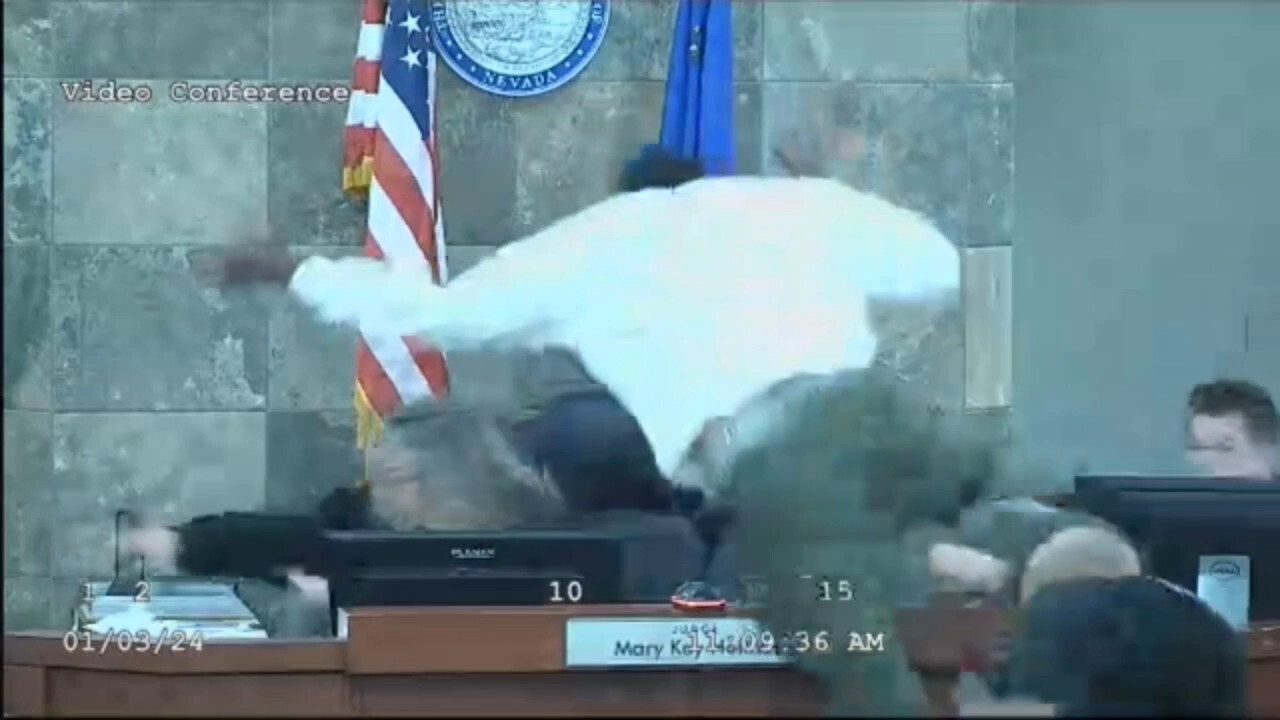
In courtroom video obtained by Fox News Digital, the attorney for Deobra Redden, 30, requests the judge give his client probation in the Jan. 3 hearing. 

Advertisement

“I think it’s time he got a taste of something else,” Judge Mary Kay Holthus responded.

Redden is then seen flying in the air over the bench with his arms and legs wide open, before landing on the judge.

NEVADA MAN SEEN ATTACKING CLARK COUNTY JUDGE IN VIRAL VIDEO SENTENCED TO UP TO 4 YEARS 

Deobra Redden, standing in a white long-sleeved shirt, and his defense attorney, right, in the moments before the Jan. 3 incident. (Clark County District Court/AP)

The video of the Clark County, Nevada, hearing has since gone viral. 

Advertisement

Holthus and a marshal near her were both injured in the attack. 

Redden’s nine-count indictment alleges he attempted to murder Holthus “by grabbing her, pulling her hair, placing his hands around her throat and/or hitting her on the head by manner and means unknown.” 

He’s also accused of “punching and/or kicking and/or pushing” a Las Vegas police officer.

Redden was charged with attempted murder and a dozen other charges after the attack, including battery on a protected person resulting in substantial bodily harm and battery by a prisoner, after the attack. 

LAS VEGAS COURTROOM ATTACK HIGHLIGHTS ISSUE OF VIOLENCE AGAINST JUDGES: EXPERTS

Advertisement

A shackled Deobra Redden appeared again in a Las Vegas courtroom Jan. 8 to complete his sentencing, days after he attacked Judge Mary Kay Holthus. (K.M. Cannon/Las Vegas Review-Journal/AP)

Holthus was sentencing Redden in an attempted battery case that he pleaded guilty to in November when he leaped at her. She eventually sentenced him to up to four years for that case. 

Holthus’ clerk and the marshal were eventually able to restrain Redden. 

Redden has a history of violent criminal acts and convictions for three felonies and nine misdemeanors. 

Advertisement

His foster mother and sister said outside the courthouse last month that Redden had been diagnosed with schizophrenia and bipolar disorder, but he was found fit to stand trial. 

Fox News Digital’s Greg Wehner and the Associated Press contributed to this report. 

Read the full article from Here

Continue Reading
Click to comment

Leave a Reply

Your email address will not be published. Required fields are marked *

This site uses Akismet to reduce spam. Learn how your comment data is processed.

Alaska

Opinion: Alaska takes care of its own. Why are our leaders in Washington forgetting the workers who take care of us?

Published

on

Opinion: Alaska takes care of its own. Why are our leaders in Washington forgetting the workers who take care of us?


FILE – With the Trans-Alaska Pipeline in the background, EPA Administrator Lee Zeldin speaks during a news conference at the Pump Station 1 on Monday, June 2, 2025, located near Deadhorse, Alaska, on the state’s North Slope. (AP Photo/Jenny Kane, File)

Alaskans take care of each other. It’s part of what defines life here. People look out for their neighbors, step up in hard moments and take pride in contributing to something bigger than themselves.

That same spirit has long defined Alaska’s labor community. Unions helped build this state and continue to keep it running today, grounded in hard work, fairness and a shared commitment to the communities that make up the Last Frontier.

We know this firsthand as members of the American Federation of Government Employees, the union representing federal workers, and as former public servants at the Environmental Protection Agency and Department of Veterans Affairs.

The work of the EPA and VA may look different day to day, but it is rooted in the same purpose: taking care of Alaska communities. At the VA, that means providing care, support and dignity to those who served our country. At the EPA, it means protecting the fundamentals that keep people healthy, like clean air and safe drinking water, and ensuring an environment where Alaskans can thrive. Together, that is what care for Alaska looks like.

Advertisement

But right now, decisions coming out of Washington are making it harder — and in some cases impossible — for Alaska’s federal workers to do their jobs. And it’s Alaska communities who are paying the price.

The workers being targeted aren’t faceless bureaucrats. They are your neighbors. They live and work in the communities they protect. They are the nurse helping a veteran manage chronic pain, the technician ensuring a rural water system is safe to drink from, the scientist monitoring pollution that could threaten our fish stocks. We’re speaking out on their behalf because many of them simply cannot, out of fear of discipline.

In Alaska, federal workers are especially essential. We have the highest percentage of veterans in the country, and our communities are deeply connected to the health of our land and water. When the federal workforce is dismantled, the consequences are immediate and severe. And we are already beginning to see what happens when they are weakened.

The EPA has canceled roughly $280 million in grants that were funding water infrastructure, energy and resilience projects across Alaska. With funding gone, many of these projects that keep communities and the local economy healthy are now delayed or abandoned altogether.

That doesn’t just put public health at risk. It also costs good jobs that Alaska workers rely on. Local engineers, construction workers and skilled tradespeople — many of them union members — depend on this work to put food on the table. When funding disappears, so do job opportunities and the paychecks that come with them.

Advertisement

At the same time, the VA in Alaska is facing staffing shortages and hiring freezes, with over 20% of staff lost in 2025. Fewer providers mean longer wait times, delayed care and gaps in services that veterans rely on.

Across both agencies, we are seeing a pattern: workforce cuts, funding reductions and political decisions that undermine the ability of public servants to do their jobs. As we’ve seen time and again, weakening this workforce is not just an attack on federal employees; it is a direct threat to Alaska’s public health and safety.

Alaskans expect and deserve better from our elected leaders. We expect our representatives in Washington to stand up for our state’s interests and reflect its values and what it means to take care of one another — not just in words, but in action.

Sen. Dan Sullivan and Rep. Nick Begich have instead stood on the sidelines as the funding we need is taken away and the federal workforce we rely on is hollowed out.

We have seen zero urgency to stand up for Alaska’s federal workforce who keep our water safe, care for our veterans and support our communities. With midterm elections approaching, Alaska voters should question if we have leadership that actually cares.

Advertisement

This isn’t about partisan politics. It’s about priorities. Our representatives should be leaders willing to stand up for the people who make Alaska work. Sen. Sullivan and Rep. Begich have failed to be leaders and instead have chosen to stand by while critical services are hollowed out and communities are left behind.

Alaska deserves leadership that will not sit quietly while decisions in Washington put our communities at risk. It deserves leaders who understand that investing in federal workers is not optional but essential.

Because in Alaska, taking care of each other isn’t a slogan. It’s a responsibility. And it’s one we all share.

Declan Farr and David Traver are both American Federation of Government Employees members who have served Alaska through their work at the Environmental Protection Agency and Department of Veterans Affairs.

• • •

Advertisement

The Anchorage Daily News welcomes a broad range of viewpoints. To submit a piece for consideration, email commentary(at)adn.com. Send submissions shorter than 200 words to letters@adn.com or click here to submit via any web browser. Read our full guidelines for letters and commentaries here.


Source link

Continue Reading

Arizona

Remains of USS Arizona crew buried as unknowns after Pearl Harbor to be identified

Published

on

Remains of USS Arizona crew buried as unknowns after Pearl Harbor to be identified


The Navy and the Defense POW/MIA Accounting Agency (DPAA) have dropped their initial opposition to disinterring the graves of battleship Arizona crew members buried more than 80 years ago as unknowns for possible identification and return to their families.

In a late Thursday release, DPAA announced that the Operation 85 advocacy group led by family member Kevin Kline had met the 60% threshold of DNA Family Reference Samples for the number of crew members thought to be buried in the commingled graves at the National Memorial Cemetery of the Pacific, known as the “Punchbowl.”

Although DPAA initially opposed the USS Arizona (BB-39) Unknown Identification Project, DPAA extended “its sincere appreciation” to Kline, grandnephew of Arizona crew member Gunner’s Mate 2nd Class Robert Edwin Kline, “and the ‘Operation 85’ team for their devoted efforts over the past three years to locate and connect enough USS Arizona families to help reach this important milestone.”

Last November, Operation 85 announced that they had reached the required 60% threshold for the Arizona, meaning 643 families. However, it has awaited DPAA confirmation since then.

Advertisement

In a phone interview with Military Times Thursday, Kline, who runs a real estate company in Fairfax County, Virginia, with his wife, Elizabeth, said the threshold agreement was a long time coming. He became obsessed with the possibility of identifying the unknowns after attending a DPAA update to the families in Norfolk, Virginia, three years ago.

But he had to go up against a March 2022 report to Congress regarding the cost to identify those buried as unknowns.

“Identifying the Sailors and Marines buried in the [Punchbowl] will cost the Navy and the Marine Corps casualty program offices approximately $2,700,000 for just their portion of the larger effort,” the Navy report said.

While the Navy Department, DPAA and other agencies “agree that the identification of the 85 Unknowns associated with USS ARIZONA and buried at [the Punchbowl] is feasible, it will require significant resources and an inordinate amount of time,” the Navy report said.

In addition, “Pursuing this effort will give false hope to the vast majority of USS Arizona families that their loved one may be identified,” the Navy report said.

Advertisement

However, in the effort to track down families and get their permission for DNA samples, “we turned a hard ‘No’ to a ‘Yes,’ Kline said.”

“It’s wonderful and we’re very excited to have hit this milestone” that will allow exhumations to begin,” Kline said. “But I feel like the work is not done yet, we still have new families to find,” he said. “But it’s much easier now knowing that the DPAA and everybody else is on board and I’m not just a rogue family member doing this alone anymore.”

Kline said that he and other family members were surprised to learn that there were crew members — including his great uncle, Gunners Mate 2nd Class Robert Edwin Kline, who died aboard the Arizona at age 22 — who were not entombed in the Arizona when it was sunk on Dec. 7, 1941.

His great uncle and others may have been blown clear of the ship by the force of the eight bombs that hit the Arizona from Japanese attack planes, Kline said, or by the huge explosion of the Arizona’s ammunition compartment.

The battleship suffered more loss of life than any American ship during the attack, its 1,177 dead comprising nearly half the 2,403 killed at Pearl Harbor.

Advertisement

Of the ship’s dead, 277 of its sailors and Marines are buried in Honolulu’s National Memorial of the Pacific. The identity of at least 85 of those men remain unknown to this day.

Kline’s great uncle and others could be among the remains of those recovered by Navy divers after the war before the mission was deemed too dangerous.

“Growing up in our family — we knew our uncle was never found [because] he was in the ship. That’s where everybody always thought where he was,” Kline said.

The hull of the 608-foot Pennsylvania class battleship Arizona now rests at the bottom of Pearl Harbor as the final resting place for more than 900 of the ship’s 1,177 crewmen who were killed on Dec. 7, 1941.

Above the hull, without ever touching it, is the gracefully stunning Arizona Memorial, officially known as the Pearl Harbor National Memorial, managed by the National Park Service.

Advertisement

The sloping roof of the memorial’s design, crafted by Austrian-American architect Alfred Preis, was intended to convey the profound symbolism of war and remembrance. The roof “sags in the center but stands strong and vigorous at the ends, expressing initial defeat and ultimate victory” in World War II, Preis said after the 1962 dedication of the memorial.


Source link

Continue Reading

California

The state benefiting most from California’s stunning exodus

Published

on

The state benefiting most from California’s stunning exodus


Nevada — known for its vast deserts and audacious gamblers — is luring Californians away from the Golden State at a higher rate than any other.

The Silver State leeched a net 81 Californians per 10,000 residents each year from California between 2016 and 2025, as California undergoes a mass exodus of residents leaving, according to a report.

The report, titled “Priced Out: RELOCATION AMIDST CALIFORNIA’S AFFORDABILITY CRISIS,” was released on March 31 by the nonpartisan California Policy Lab.

Californians move to Nevada at a higher rate than even Texas, the report notes.

Advertisement
A large white Atlas moving truck parked on a residential street in a California suburb. Simone – stock.adobe.com
Aerial view of suburban Las Vegas neighborhood with houses and streets. Wirestock – stock.adobe.com
Panoramic aerial view of Las Vegas, USA, with the city and mountains in the background. Alexander – stock.adobe.com

“Nevada is the standout,” the report says. “News reports often mention Texas, but that is misleading. The most accurate measure of popularity adjusts for state population and shows a clear pattern: proximity reigns. Californians most often leave for nearby states, and California also welcomes new residents from neighboring states most frequently.”

Nevada is a much cheaper state for U.S. residents to live in than California. It has no state income tax, unlike California, and housing prices, along with gas prices, are also lower. California’s average regular gas price was $5.88 on Friday while Nevada’s was $4.99, an 89-cent difference.

 Evan White, a co-author of the study, says the Californians are leaving for more affordable states.

“The price tag has gone up on the California Dream, and many families are leaving the state for more affordable places,” White, the Executive Director of the California Policy Lab at UC Berkeley, said. “The difference these moves make is stark.  Their destination neighborhoods are half as expensive and they end up much more likely to own a home within just a few years.”

The report shows that out-of-state movers pay an average of $672 less per month on housing costs, and home prices are 48% lower. Former California residents are about 48% more likely to own a home in their new state.

Advertisement
Entire view of a residential area from Double Peak Park in San Marcos, California Jason – stock.adobe.com

Higher-income Californians are also leaving at increasingly higher rates, the report said. The share of higher-income Californians leaving has increased from 34% to 40% since the pandemic.

“Our report shows that people who leave California are increasingly leaving from higher-income neighborhoods,” co-author Dr. Brett Fischer, Researcher at the California Policy Lab, said. “These movers are, on average, in a weaker financial position than their neighbors, and may be moving to attain the quality of life they see their neighbors enjoying but they cannot afford.”

From 2010 to 2024, nearly 10 million people left California. The state is considered one of the most expensive states in the nation.

Idaho, Oregon, and Arizona are the next largest net recipients of Californians on a per-capita basis, the report says.

Advertisement


Source link

Continue Reading
Advertisement

Trending
