Idaho
Idaho law says rape victims are entitled to a timely police report for abortion care, but that doesn’t always happen

In Idaho, women who become pregnant following a sexual assault are legally allowed to get an abortion under the law’s few exceptions. But, they first have to report their assault to a law enforcement agency and produce a police report to medical providers.
Those who do report to law enforcement and request copies of the document required by the statute may find barriers in authorities’ failure to understand their role in the process and lack of consistent protocols to assist victims.
“Most survivors opt out”
Victims advocates say requiring women to report to law enforcement prevents many from seeking the help they need.
Kelly Miller, the former head of the Idaho Coalition against Sexual and Domestic Violence said rape and sexual assault are some of the most underreported crimes in the state.
“Sexual assault and its various manifestations happens at extraordinarily high numbers that are not captured in most of the national or state data,” she said. Fear of not being believed by authorities and retaliation from their aggressor who they may know are a few of the reasons women don’t report their assault to the police, she added.
In 2023, law enforcement agencies in Idaho processed 594 cases of rapes, a figure she said does not reflect the reality of sexual violence in the state.
“Often, sexual assault survivors just want it to be over and so having to go through the trauma of reporting, the trauma of a forensic interview, most survivors opt out,” she said.
A woman who has been raped and wants an abortion in Idaho, first has to report her assault to the authorities, then has to request a copy of her report from the police. Only then can a medical provider perform an abortion.
“Those barriers are just going to be too much for some of those victims,” Dr. Samuel Dickman, an abortion provider in Montana. “And they will have to continue pregnancies as a result. I think that’s just incredibly tragic.”
Dickman co-authored a study published in the Journal of the American Medical Association that estimates in the 16 months following Idaho’s abortion ban, around 11,000 women were sexually assaulted in the state, a much higher number than what is reported to the authorities. Of those assaults, the study estimates more than a thousand resulted in a pregnancy.
“And the rape exceptions are doing virtually nothing to help those victims,” Dickman said, adding about 50% of rape survivors who become pregnant as a result of their assault look to terminate the pregnancy.
“What that means is that the vast majority of survivors of sexual assault who become pregnant are not able to get legal care in state in Idaho, despite the fact that technically it ought to be available to them,” he added.
Miller said the legal system is not centered around the needs of victims. No other type of medical intervention appears to require patients to interact with law enforcement as a precondition for care.
“This is a such a personal and deep and profound trauma when someone’s sexually assaulted that asking them to report is taking away agency and choice, which was taken away from the first place in the sexual assault,” Miller said. “So it’s retraumatizing to require anyone to have to report to anybody.”
The 72-hour amendment
Idaho banned abortions in 2022, with exceptions in cases of rape or incest, and when the life of the mother is threatened. Victim advocates quickly pointed out that police do not release copies of records during an ongoing investigation, potentially preventing women from receiving timely abortion care. In 2023, the legislature amended the law, entitling victims of rape to receive their police report within 72 hours of it being made.
More than a year after the updated amendment went into effect, a Boise State Public Radio investigation shows law enforcement agencies and public records departments in Idaho are unevenly complying with its requirements, which could prevent victims of rape or incest from easily accessing the documentation they need for a legal abortion.
“It doesn’t work that way”
“We’re treating this notion of a police report like it’s a receipt in a store,” Sen. Melissa Wintrow said while debating the amendment before it passed on the floor in 2023.
“You get raped, you experience trauma, you go to the police, you get your receipt, and you come back to the physician, and then you ask for the abortion. It doesn’t work that way.”
“Police reports are intricate and complicated, and police just don’t take that lightly,” she added.
Sergeant Bryan Lovell from the Bonneville County Sheriff’s Office explained the process once police receive a request for a record.
“If it’s an active investigation, then, they’re not going to give it to you. And chances are, we wouldn’t even know if you’re the victim or a witness to it, or just someone that’s curious. Right?”
Idaho’s public records law says agencies can’t ask why people want a copy of a file, but under the amendment, a victim has to identify themselves as such to receive their report. Without specific protocols to differentiate requests from victims from the general public, victims going through standard public records portals may be denied up front.
“It just runs through that same process and we wouldn’t know,” Lovell said.
Police do not usually release files pertaining to an open investigation because they may contain sensitive information. When records are requested, they aren’t released immediately.
“We’ll get the request in for a particular report, and then it’ll go to the prosecutor’s office for approval, and they’ll come back and say, ‘this can be released or it can’t be released, or it can be released with redactions,’” he added.
Lovell said an option for victims whose initial request is denied would be to directly contact their prosecuting attorney’s office, something they might not know to do.
Agencies across the state comply with the requirement unevenly
Depending on where they report their assault, victims of rape may have more or less difficulty getting the documentation they need.
Boise State Public Radio contacted 56 agencies across Idaho and asked about their protocols to help rape victims access their reports.
Many did not answer. Others did not mention the 72-hour amendment and said they’d follow public records law requirements. Some said they’d defer any special cases to their prosecuting attorney’s office.
Ada County’s Prosecutor’s Office, which works with the largest police department in the state, cited the ongoing litigation against Idaho’s abortion statute when declining to answer questions about its protocols.
Agencies like the Meridian Police Department, Garden City Police Department and Fremont County Sheriff said they comply with the 72-hour amendment and have in-house advocates to assist victims.
As a victim witness coordinator with the Caldwell Police Department, Liz Godina said if a victim needed help getting a copy of her report, she could walk them through the system step-by-step.
“I would talk to them and kind of explain to them like, ‘this is what you are able to do, if you need me to help you, I can go with you to the records department and do that with you,’” she said, adding she could then make sure records custodians know about the updated 72-hour amendment.
“When we’re working with victims of crime, it’s very important for them to feel heard, ” Godina said. Accompanying them through that journey, she said, can make them feel respected and empowered.
Godina said she knew about the rape exemption’s 72-hour requirement because she read about it online and feels it’s important in her position to stay updated with law changes.
But not all victims across the state may be so lucky to have someone like Godina assisting them in getting a copy of their record.
Open investigation policies confuse the process
Some agencies contacted by Boise State Public Radio didn’t appear to have any streamlined way to provide victims their report, in particular during an open case. Others seemed unaware of the updated law altogether.
In July 2024, a year after the amendment went into effect, Rexburg’s Police Department wrote in an email that in order to get a copy of a report, victims had to go through the city’s website.
“There they can search for Public Records Request and fill out a form to obtain a copy of the report. It is then forwarded to our office and we proceed with the process of handling the request,” the email reads.
“If the investigation is complete and there are no pending charges or court action, the victim can receive a copy of the report. If the rape is still under investigation, a copy is not released until the investigation is complete, per our Madison County Prosecutor’s Office, and the victim is advised of this.”
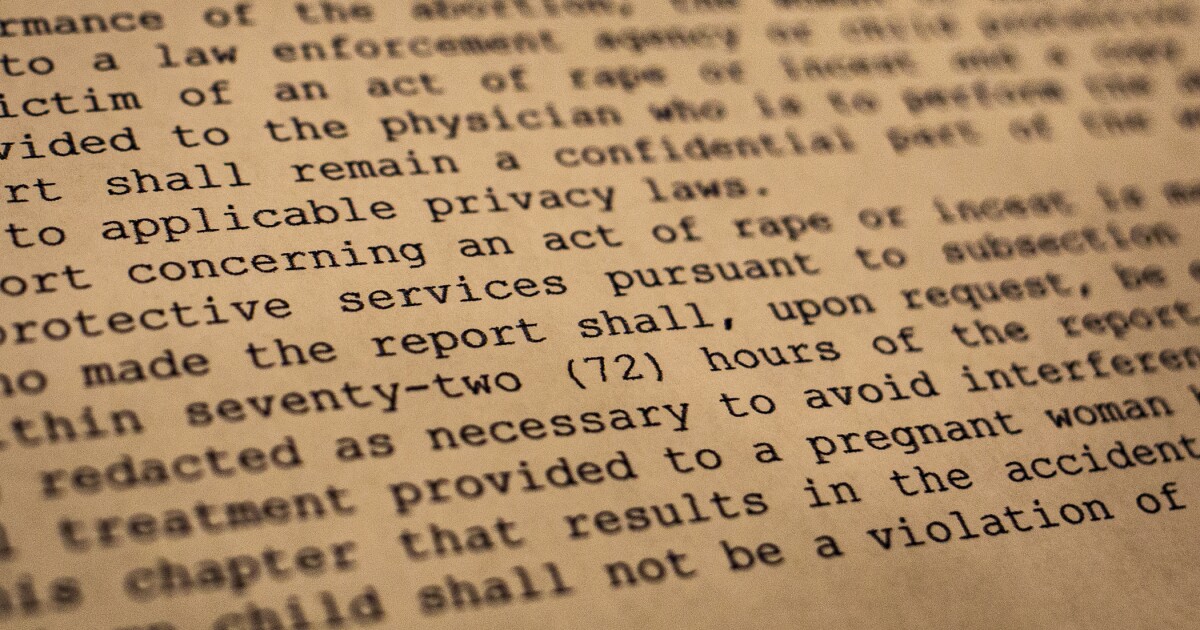
Idaho’s amended abortion law says that if an act of rape or incest is reported to a law enforcement agency or child protective services “then the person who made the report shall, upon request, be entitled to receive a copy of such report within seventy-two (72) hours of the report being made, provided that the report may be redacted as necessary to avoid interference with an investigation.”
In Clearwater County, Sheriff Chris Goetz also said his office generally only releases records when an investigation is complete.
“An example for this type of case would be a victim reporting a rape and wanting a report from us that she had reported a rape so that she could get an abortion,” he wrote in an email. “If we have not yet done an investigation how would we know if a rape had actually occurred or if she just wanted an abortion.”
Goetz wrote that if a preliminary investigation showed a rape occurred, the agency would provide the report to the victim.
“An example of that would be that we have done all of the interviews and collected the physical evidence but are waiting on results from a lab before we could actually complete the investigation. We may not yet be able to file charges because the case is not complete but I would support the victim any way possible,” he added.
Denied Requests
At the Nampa Police, Detective Troy Hale, an investigator at their Office of Professional Standards, said their department realized it hadn’t been complying with the 72-hour requirement, and unknowingly denied records to rape victims in 2023.
“We found four that should have under the new law been released that weren’t and it was kind of more of a training issue at that point for our records division,” he said. “So it was just an oversight,” he added.
“Since then we’ve changed that procedure obviously in our records department to where within that 72 hour time frame from when they want that report, then we supply that now.”
The four victims were not notified of the department’s mistake in handling their request.
“To my knowledge, I don’t know that we contacted them at all,” Hale said. The reason for their initial request is unknown.
The Department of Health and Welfare reports five abortions were legally provided in 2023 in Idaho. There is no way of knowing if any were granted under the state’s rape exception.



PAYETTE — A Payette mom’s bond was revoked Tuesday after she was charged with suffocating her twin children earlier this month and is believed to pose a danger to the life of her newborn child.
The case, which has drawn national headlines, concerns Andrea Renee Shaw, a 23-year-old Payette mother who in May 2025 said her 18-month-old fraternal twins died the same day, after receiving routine childhood vaccinations. In January, Shaw joined as a plaintiff in a federal lawsuit filed by Children’s Health Defense, an anti-vaccine organization founded by Robert F. Kennedy Jr., with several other plaintiffs claiming vaccine injury or death.
Kennedy, who now serves as secretary of Health and Human Services, is no longer part of the group after taking on the cabinet position, as was reported by the Associated Press.
In Idaho, the twins’ deaths prompted a 14-month investigation by the Payette County Sheriff’s Department. On June 29, the investigation yielded a grand jury indictment of Shaw on two counts of first-degree murder by suffocation. If convicted, Shaw can be punished by up to life in prison or the death penalty, and the court would have the ability to order the penalties be served consecutively, or back to back.
Tuesday’s arraignment at the Payette County Courthouse was primarily attended by Shaw’s relatives and members of the media. Payette County Judge Kiley Stuchlik, who serves Idaho’s Third Judicial District, presided.
A key consideration for Stuchlik on Tuesday was a request from Joseph Filicetti, the legal counsel for Shaw, to have her bond reduced from $2 million to $100,000. Filicetti said this would allow for Shaw to care for a newborn girl, who, according to court documents, was born by caesarean section on June 25, four days prior to Shaw’s grand jury indictment.
State prosecutors objected to the motion for bond reduction, noting at hand was a potential death penalty case and asserting, unlike her husband, Shaw’s story repeatedly changed during questioning. Prosecuting Attorney Mike Duke said releasing Shaw would ultimately put the newborn’s safety at risk.
“That child is the most at risk. We do not think she should be allowed to be anywhere near any children, let alone her own children,” Duke said.
Stuchlik decided to revoke bond entirely, stating Shaw posed a “risk of safety” to the newborn child that was not known to Stuchlik or prosecutors when the $2 million bond was initially set.
Also for consideration Tuesday was a request to have grand jury transcripts of witness testimony provided to prosecutors and defense counsel to prepare their respective cases.
Idaho
Idaho is home to the nation's first DarkSky Reserve. Now it's home to the nations first DarkSky Certified Resort

-

 Los Angeles, Ca39 minutes ago
Remains of murder victim identified as missing Southern California millionaire
-

 Detroit, MI1 hour ago
4Warn Weather Alert: Wildfire smoke leading to ‘unhealthy’ air quality in Metro Detroit
-

 San Francisco, CA1 hour ago
San Francisco fishermen recount harrowing rescue after boat capsizes near Alcatraz
-

 Dallas, TX1 hour ago
Timothée Chalamet ‘Starstruck’ by Dallas Cowboys Cheerleaders
-

 Miami, FL1 hour ago
Wives of detained men allege inhumane conditions at federal detention center in Miami
-

 Boston, MA2 hours ago
Driver charged in Norwood pedestrian crash that left man seriously injured
-

 Denver, CO2 hours ago
Boys, 12 and 14, arrested in deadly shooting in Denver’s Sunnyside neighborhood
-

 Seattle, WA2 hours ago
Outreach groups respond to the reported relocation cycle of Ballard’s homeless population

