West
Idaho murders suspect Bryan Kohberger arrives in Boise ahead of trial

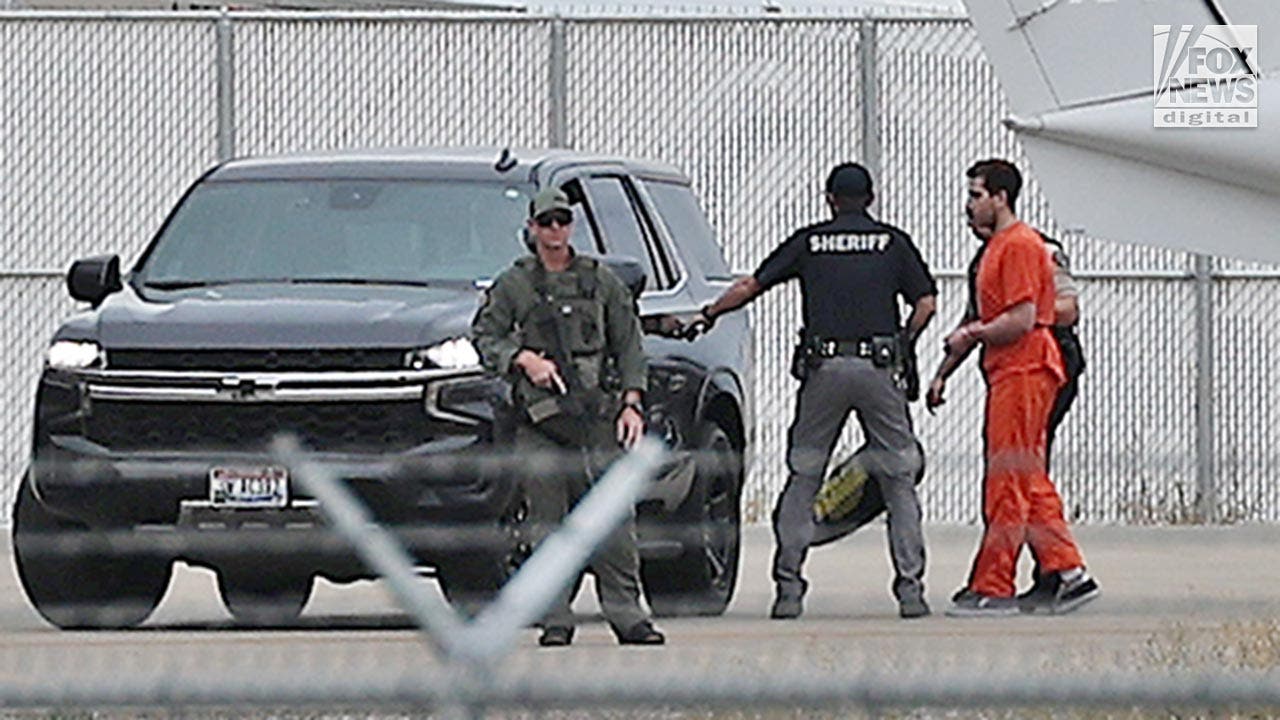
Bryan Kohberger, the man charged in the fatal stabbings of four University of Idaho students, was moved on Sunday from rural Latah County to Ada County, where his upcoming trial will be held after a judge granted his defense team a change of venue.
Kohberger was seen arriving in Boise on a small plane and being transferred to a black SUV while wearing an orange jumpsuit and handcuffs. Boise, where the new murder trial will unfold, is roughly 300 miles from where the crimes occurred.
Kohberger is now in the custody of the Ada County Sheriff’s Office, according to online jail records, after previously being held in a jail in Moscow, Idaho, since January 2023.
Latah County District Judge John Judge granted the defense’s request for a change of venue earlier this month, citing a number of factors that he said collectively were in favor of moving the trial to a larger courthouse, further removed from the location of the crime.
IDAHO JUDGE RULES ON BRYAN KOHBERGER’S MOTION TO CHANGE VENUE IN STUDENT MURDER TRIAL
Bryan Kohberger is led to an awaiting Ada County Sheriff vehicle at Boise Airport in Boise, ID on Sunday, Sept. 15, 2024. (Derek Shook for Fox News Digital)
Kohberger is accused of entering an off-campus rental home around 4 a.m. on that date and fatally stabbing 21-year-olds Madison Mogen and Kaylee Goncalves as well as 20-year-olds Xana Kernodle and Ethan Chapin.
Kohberger, who is accused in the murder of four University of Idaho Students in 2022, has had his trial moved from Latah County to Ada County. (Derek Shook for Fox News Digital)
Police arrested Kohberger six weeks after the killings at his parents’ home in Pennsylvania, where he was spending winter break.
Bryan Kohberger is now in the custody of the Ada County Sheriff’s Office, according to online jail records. (Ada County Sheriff’s Office)
IDAHO MURDERS SUSPECT BRYAN KOHBERGER GETS NEW JUDGE IN CHANGE OF VENUE IN STUDENT STABBINGS TRIAL
Authorities have said that cellphone data and surveillance video shows that Kohberger visited the victims’ neighborhood at least a dozen times before the killings; that he traveled in the region that night, returning to Pullman, Washington, along a roundabout route; and that his DNA was found at the crime scene.
Madison Mogen, top left, smiles on the shoulders of her best friend, Kaylee Goncalves, as they pose with Ethan Chapin, Xana Kernodle, and two other housemates in Goncalves’ final Instagram post, shared the day before the four students were stabbed to death. (@kayleegoncalves/Instagram)
His lawyers said in a court filing he was merely out for a drive that night, “as he often did to hike and run and/or see the moon and stars.”
Kohberger was a criminology Ph.D. student at Washington State University, just 10 miles away across the state line at the time of the murders. He could face the death penalty if convicted.
Fox News’ Michael Ruiz and The Associated Press contributed to this report.
Read the full article from Here


DENVER — Denver Mayor Mike Johnston is launching a $100 million plan to boost the local economy and support 10,000 jobs over the next three years.
Johnston announced the four-part program Thursday morning, flanked by business leaders while praising downtown businesses like brunch eatery Snooze.
▶️ WATCH: Denver7’s Alex Dowd reports on the plan
Denver mayor promises to create 10K jobs in next 3 years
Snooze Co-Founder Adam Schlegel said his business benefited from a similar program when U.S. Sen. John Hickenlooper was mayor in the early 2000s.
“The city really was the one that stepped up,” Schlegel said. “We wouldn’t have started if it wouldn’t have been for the economic development office. We ended up getting an incentive from the city to open up, particularly in this space [downtown]. It was a fiscal incentive to do it, in addition to coaching.”
Both of those are offered in the new four-part Denver Jobs Agenda. With funding from the Denver Downtown Development Authority and the Office of Economic Development and Opportunity, Johnston aims to develop start-ups in the city, grow existing businesses and draw in new companies while working to advance the Denver-area workforce across industries.
At the end of the last fiscal quarter, Denver’s unemployment rate hovered around 3.6% — under the national rate of 4.2% — according to U.S. Bureau of Labor Statistics, while office vacancy sits just under 40%, according to commercial real estate broker CBRE.
Johnston and other speakers made multiple references to more jobs bringing more people downtown.
“Denver has so many things going for it, so it will come back,” Schlegel said. “It’s not coming back as fast as I want, or as much as anyone will, but will it have a long-term future? 100%. It’s things like this, though, that I think give us a lot of hope that it can happen sooner than waiting it out.”
▶️ Watch the full press conference
Press conference: Denver mayor announces Denver Jobs Agenda
Chris Berthiaume, the city’s director of workforce industry initiatives, says the three workforce development centers across Denver serve around 20,000 people each year. He’s confident this new initiative will help more of those visitors find employment.
“We want to focus on things like aerospace, cybersecurity, green construction,” Berthiaume said. “This new initiative really just tightens the focus on sectors that we know are growing. Colorado is home to a huge aerospace culture. Quantum technology is emerging and coming. Green workforce are jobs that we know drive around Denver. Construction is everywhere. We need to make sure we have a skilled workforce that’s ready to take on those jobs.”
While also finding employers to hire them and stay within the community for the long haul.
“I think the reason businesses work — certainly restaurants work — is that you are integral to the community specifically where you are,” Schlegel said. “There are so many people in our community that really believe in Denver and want to see what it can be, and so it will get there.”
It’s well on the way. Denver’s Economic Development Corporation says they’re working with 52 active prospects that could bring more than 12,000 jobs to the area.
Coloradans making a difference | Denver7 featured videos
Denver7 is committed to making a difference in our community by standing up for what’s right, listening, lending a helping hand and following through on promises. See that work in action, in the videos above.

Global entertainment company Webtoon is returning to the hallowed halls of San Diego Comic-Con with a larger-than-life slate of panels featuring top talent and fresh announcements.
They will be shining the spotlight on some of today’s most engaging webcomic creators, including Derek V. Song (Fantasy High) and Punko (Cinderella Boy).
Let’s take a look at their schedule:
Thursday, July 23 – 10am – Room 29AB
Creature Craft: Visionaries of Horror Comics Share Their Secrets
This panel features Punko, creator of Stagtown and Cinderella Boy on WEBTOON; Cullen Bunn, creator of Ripcord and Deluge for Ignition Press; and Cat Staggs, co-creator of Death Mask, and artist on Tales for a HalloweeNight for Storm King Comics. Rotem Rusak, Editor-in-Chief at Nerdist, will moderate.
Friday, July 24 – 10am – Room 32AB
Love in Every Universe: The Great Romance Trope Debate
Join ROSEOAK, creator of Not So Silent on WEBTOON, Alessandra Ferreri, Head of Content at Wattpad, E.M. Wilson, author of Situationship, and Becca Erin Title, founder of Meet Cute Romance Bookshop. The panel is moderated by Crystal Bell, the Culture Editor at Mashable.
Friday, July 24 – 1pm – Room 32AB
Adapting Fantasy High for WEBTOON with Derek V. Song
Featuring Derek V. Song, writer of Fantasy High. Fans will get a behind-the-scenes look at adapting the beloved Dimension 20 series for WEBTOON and learn more about bringing the world of Fantasy High to a new visual format.
Saturday, July 25 – 11:30am – Room 24ABC
What’s Next from WEBTOON Entertainment
Featuring Ryan Lee, Head of Content at WEBTOON; Sydney Bright, Head of Global Animation at WEBTOON Productions; Erik Kozura, Producer at WEBTOON; ROSEOAK, creator of Not So Silent; Derek V. Song, writer of Fantasy High; Punko, creator of Stagtown and Cinderella Boy; and Ucheomaaa, creator of Vibe Check! on WEBTOON. Journalist, comic critic, and 2026 Eisner judge, Tiffany Babb, will moderate. his panel will deliver a slew of announcements, exclusive first looks, and Creator appearances from its platform and entertainment businesses. Additionally, the panel will give fans a window into what’s next from WEBTOON’s most exciting stories and projects, with news from WEBTOON Originals, WEBTOON Productions, WEBTOON Unscrolled, and more.


SEATTLE – The husband of a pregnant woman killed in a random 2023 downtown Seattle shooting has filed a wrongful death lawsuit against the King County Regional Homelessness Authority.
The complaint alleges the agency failed to act on clear warning signs exhibited by the suspect, Cordell Goosby, before he opened fire on the family.
Cordell Goosby in the foreground with the crime scene, including the white Tesla the couple were shot in, in the background
King County prosecutors say Goosby shot a married couple sitting in their car on 4th Street in Seattle’s Belltown neighborhood on June 13, 2023. It resulted in the death of 34-year-old Eina Kwon, who was 32 weeks pregnant at the time. Her husband, Sung Kwon, was also injured in the shooting.
Goosby was charged with first-degree murder and attempted murder for the act, but he was found not guilty by reason of insanity this year.
The lawsuit, filed by Kwon and his attorneys, claims that Goosby was being supported by the King County Regional Homelessness Authority and was provided with other services leading up to the shooting.
In the weeks leading up to the attack, Goosby allegedly told his case worker that he was hearing voices, experiencing paranoia, and thinking of conducting drive-by shootings. The complaint alleges Goosby’s case worker was repeatedly ignored by the agency’s supervisors when bringing up Goosby’s declining mental state.
An employee responsible for initiating psychiatric holds reportedly declined to see Goosby after he texted his case worker he needed to leave Seattle fast before he hurt someone, saying he would get to it in two days. The next day, Goosby carried out the shooting.
What they’re saying:
My wife and daughter should still be here. My family will never be whole again, and every day I think about the life we were supposed to have together. I am bringing this case forward because the people who were supposed to help this man looked away when it mattered most. I don’t want another family to experience the unimaginable loss that I am left with,” said Sung Kwon.
“KCRHA knew their program participant, Mr. Goosby, was in crisis. He asked them for help. He told them, over and over, that he was hearing voices and thinking about shooting people. He was threatening KCRHA employees. The warning signs could not have been more clear. Instead of getting him help or alerting law enforcement, KCRHA told its own staff to wait it out, and discouraged others from contacting police, as well. Eina and Evelyn Kwon paid for that delay with their lives,” said Julie Kline, the Schroeter Goldmark & Bender attorney representing the Kwon family.
What’s next:
The lawsuit seeks damages for wrongful death, the death of a child, and personal injury to be determined at a future trial.
FOX 13 Seattle has reached out to the King County Regional Homelessness Authority about the lawsuit and is waiting to hear back.
MORE NEWS FROM FOX 13 SEATTLE
Suspect in 2 Pierce County homicides shot, killed by police in Seaside, Oregon
A look behind the fire line of the deadly Chelan Hills Fire
World Cup ends, Seattle traffic begins: ‘Revive I-5’ work resumes this week
14-year-old dies in Seattle e-bike crash on Howe Street staircase
Vantage wildfire prompts I-90 closure, city-wide evacuations
To get the best local news, weather and sports in Seattle for free, sign up for the daily FOX Seattle Newsletter.
Download the free FOX LOCAL app for mobile in the Apple App Store or Google Play Store for live Seattle news, top stories, weather updates and more local and national news.
The Source: Information in this story came from a press release from Seattle-based law firm Schroeter Goldmark & Bender, a complaint filed in King County Superior Court by Sung Kwon, and previous FOX 13 Seattle reporting.
-

 Dallas, TX2 minutes ago
The Stewpot artists find healing, purpose and income through art in Dallas
-

 Miami, FL5 minutes ago
Can Jason Marshall push for a starting spot – The Splash Zone 7/10/26
-

 Boston, MA10 minutes ago
Police investigating shooting in Downtown Crossing – Boston News, Weather, Sports | WHDH 7News
-
Denver, CO17 minutes ago
Denver mayor announces new $100 million plan to bring in 10,000 jobs
-

 San Diego, CA20 minutes ago
WEBTOON Brings Top Creators for San Diego Comic-Con Panels
-

 Seattle, WA20 minutes ago
Husband of pregnant wife killed in Seattle sues King County homeless authority
-

 Milwaukee, WI32 minutes ago
Supervisor calls for referendum on Milwaukee County courthouse revamp
-

 Atlanta, GA34 minutes ago
Critically missing: 11-year-old missing in Atlanta after running away

