Hawaiian Airlines may be preparing nonstop service between Denver and Honolulu, based on a growing wave of speculation across emails, comments, communities, and industry discussions that continue to reach our news desk. At the center of the talk is the newly constructed widebody-capable infrastructure including gates at Denver International Airport, which some believe are being positioned for Hawaiian’s A330 aircraft.
This wouldn’t just mark a Hawaiian Airlines flight expansion—it could also be a pivotal move for Alaska Airlines, offering one of the first clear signals that Hawaii isn’t in any way being sidelined in its post-merger vision. With moves to date involving asset shifts away from Hawaii—including Dreamliners moving to international routes from Seattle—this could suggest precisely what the Hawaii routes upside could be going forward. A launch from Denver could be the statement.
While Hawaiian has never served Denver, such a move would represent a bold push into an underserved but high-demand market. With the new infrastructure coming online and Hawaiian’s A330 fleet in strategic flux amid the Alaska Airlines purchase, conditions may align for a fresh, longer-haul launch into the Rocky Mountain region.
Why Denver’s expansion is drawing attention.
Denver International Airport’s recent terminal expansion includes new gates designed for widebody aircraft, signaling its growing focus on long-haul and high-capacity operations. While Alaska Airlines is set to use two narrowbody gates, the widebody-ready positions remain unassigned. This has fueled speculation that Hawaiian Airlines might seize the opportunity to test its A330 fleet on a new Denver-Honolulu route.
Advertisement
Industry buzz and direct traveler input.
We’ve recently heard from many readers—by email and in comments—raising questions about whether Hawaiian Airlines could be eyeing Denver for new nonstop service to Honolulu. In fact, we’ve had more than 400 comments mentioning Denver in relation to Hawaii flight potential, underscoring just how much interest this route continues to generate.
One regular visitor commented, “Any chance Denver finally gets nonstop service to Hawaii on Hawaiian? United’s flights are packed, and there’s room for more competition.” Another added, “Any chance Denver finally gets nonstop service to Hawaii on Hawaiian? And a third said, “Wishing that Hawaiian/Alaska will have a nonstop from Denver to anywhere in Hawaii. United needs the competition!!!!” Countless others had mirrored this or mentioned changes taking place at DEN. Clearly United’s flights are expensive, packed, and there’s room for more competition.”
Another added, “Wishing that Hawaiian/Alaska will have a nonstop from Denver to anywhere in Hawaii. United needs the competition!!!!”
That kind of question has become more common as speculation grows alongside broader industry chatter tied to Denver International Airport’s expanded widebody infrastructure and Hawaiian’s still-significant fleet of A330 aircraft.
While no route filings or gate assignments have been made public, the timing of DEN’s terminal upgrades and the ongoing Alaska-Hawaiian merger have many travelers and airline watchers, including us, connecting the dots.
Advertisement
With Denver’s limited nonstop Hawaii options via United Airlines and strong outbound demand, it stands out as a logical candidate for expanded service, particularly with Hawaiian’s long-haul aircraft ready to be redeployed.
There’s been no official confirmation yet, but based on what we’re hearing, this has become one of the most talked-about possibilities for what might come next in Hawaii travel under Hawaiian’s new owner, Alaska.
Does Denver make strategic sense now?
United Airlines currently operates two daily nonstop flights between Denver and Honolulu. During peak periods, both flights typically use Boeing 777 aircraft, indicating significant demand. One of the two may shift to a 757 in off-peak seasons, but the 777 remains the dominant aircraft on the route.
United seat map Boeing 777.
We recently flew this aircraft on United’s Honolulu–San Francisco segment—it’s the same domestic configuration used on the Denver route. Up front, United’s cabin has lie-flat seats in a 2-4-2 configuration. In economy, the layout is 3-4-3, resulting in a denser, more cramped cabin with more middle seats.
Hawaiian’s A330, by contrast, features a 2-2-2 layout in lie-flat first class and a 2-4-2 arrangement in economy, offering fewer middle seats and a roomier overall experience.
Hawaiian seat map A330.
Most U.S. carriers—including American, Delta, and United—operate widebodies strategically. Despite its distance, Hawaii is increasingly served by narrowbody aircraft from carriers including Alaska, Southwest, and the legacy airlines. That makes Hawaiian’s widebody option another exception, not the norm. If launched, an A330 flight from Denver would be a rare comfort upgrade.
Hawaiian’s A330 fleet needs new direction.
Hawaiian’s Airbus A330 fleet remains the backbone of its long-haul Hawaii service, connecting the islands with high-traffic and distant U.S. mainland cities and international destinations, including Japan, South Korea, and Australia. And that’s not expected to change.
Advertisement
As Hawaiian transitions under Alaska Airlines ownership, the A330 continues to be its most capable long-range domestic aircraft. Despite the addition of Boeing 787s to the broader merged fleet, those aircraft are expected to be operated primarily by Alaska out of Seattle on long-haul international routes, not on Hawaii flights.
That leaves the A330 as Hawaiian’s best option for expanding new service from further afield mainland hubs like Denver. The aircraft is ideally suited for the DEN-HNL route, offering capacity and passenger comfort while allowing the airline to make inroads into a new high-growth market.
A soft rollout of post-acquisition strategy?
If a DEN–HNL route launches, it could mark one of the first visible signs of how the Alaska–Hawaiian deal is beginning to shape real-world Hawaii flight strategy.
So far, most of the merger’s effects have been behind the scenes—loyalty alignment, operational integration, and leadership restructuring. Travelers haven’t seen significant route changes yet that reflect the new ownership.
That’s what makes Denver particularly noteworthy. A new route like this would show not just a recommitment to Hawaii service, but also a willingness by the combined airline to test long-haul opportunities outside the usual California and Pacific Northwest corridors—even before the integration is fully finalized.
Advertisement
No formal announcement yet.
No formal announcement yet exists, but Denver has emerged as a high-interest possibility in the evolving Alaska–Hawaiian network. With widebody-capable gates coming online, Hawaiian’s A330s offering new deployment opportunities, and a strong market for Hawaii service in the Mountain West, the pieces seem to be falling into place.
At the same time, Alaska Airlines may look for a big win to reinforce its Hawaii strategy under the new combined brand. With Dreamliners now shifting to international routes from Seattle and little in the way of new major Hawaii wins so far, Denver–Honolulu would be a high-profile move in the other direction—an expansion, not a contraction. For both airlines, this could be the route that signals what’s next.
The dining room of the Red Lobster was dark and empty Tuesday after the restaurant on the ground floor of Ilikai Marina condos at 1765 Ala Moana Boulevard, closed on Sunday. The restaurant’s red lettering has been removed.
Advertisement
Advertisement
The Red Lobster in Waikiki has closed its doors for good after more than 30 years in operation.
The restaurant, which was located on the ground floor of Ilikai Marina condos at 1765 Ala Moana Boulevard, officially closed on Sunday, according to a statement from corporate headquarters in Florida.
“As part of our normal course of business, Red Lobster continuously evaluates individual restaurant performance and lease terms and may, from time to time, choose to close select restaurants,” said Red Lobster in the statement. “This closure reflected specific decisions tied to the unique operating conditions at this restaurant.”
On Tuesday, the red letters spelling out the restaurant name had already been taken down from the building’s exterior, while employees appeared to be removing items from the restaurant.
A paper sign taped to the glass on the front door said, “We have officially closed. Thank you for the 32 years of memories. Your Red Lobster Family.”
Advertisement
With the Waikiki closure, Red Lobster no longer has a presence in Hawaii.
Don’t miss out on what’s happening!
Stay in touch with breaking news, as it happens, conveniently in your email inbox. It’s FREE!
The casual seafood restaurant chain, which filed for Chapter 11 bankruptcy in May 2024 in Florida, has since closed more than 100 locations across the U.S.
Advertisement
According to Reuters, the company has blamed its bankruptcy on high inflation, unsustainable rent costs, and poor management decisions, including an “endless shrimp” promotion that caused $11 million in losses.
In April, the company brought back its endless shrimp due to thousands of social media mentions, but for a limited time only. Red Lobster is also known for its “Cheddar Bay” biscuits, which are served for free to in-restaurant diners.
Red Lobster did not say how many employees were affected by the permanent restaurant closure in Waikiki.
There was no notice posted with the Hawaii Department of Labor and Industrial Relations, which is required for closing businesses with 50 or more employees in the state. The requirement does not cover part-time employees who work fewer than 20 hours per week.
“We remain committed to making thoughtful decisions that position Red Lobster for long-term success, stability and growth,” said the company in its statement. “Honolulu has been a meaningful part of our story, and we truly appreciate the guests and team members who have made this restaurant special over the years.”
Most Americans grow up learning about European royal families, from the British monarchy to the kings and queens who shaped the history of countries like France and Spain. But what many don’t realize is that Hawaii was once its own sovereign kingdom before it become a U.S. state, and there’s still a royal palace right in O‘ahu.
During a recent visit to Honolulu’s ʻIolani Palace, I found myself standing in rooms that challenge the assumptions travelers make about Hawaii. Beyond the beaches, luaus and pineapple drinks lies the story of a nation that once had its own monarchs, government and global relationships. Walking through the palace’s grand halls—and later, the room where Queen Liliʻuokalani was imprisoned—gave me a powerful reminder that Hawaii’s royal history is far more recent and more complex than many Americans realize.
ʻIolani Palace historian Zita Cup Choy tells Marie Claire that understanding Hawaii was once an independent nation fundamentally changes the visitor experience. That being said, Iolani Palace, built in 1882, serves as “both a royal residence and a place where a nation’s history, dignity and loss are held,” Cup Choy says.
Latest Videos From
The palace is located in the heart of Honolulu.
Advertisement
(Image credit: Getty Images)
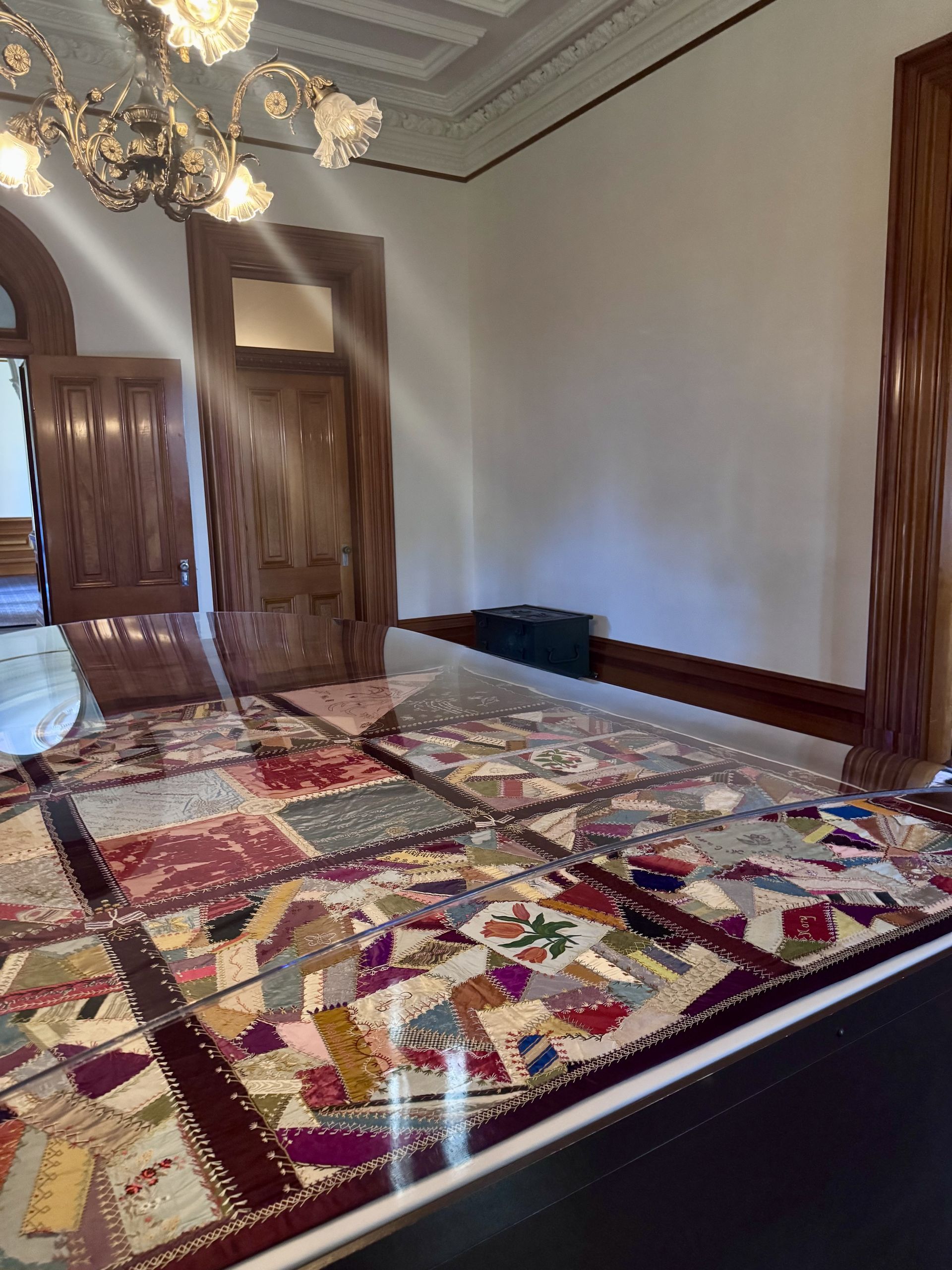
The room where Queen Liliʻuokalani was imprisoned showcases a quilt she made while being held in the room, with the center reading, “Imprisoned at Iolani Palace, Honolulu, Oʻahu, we began this quilt there.”
(Image credit: Kristin Contino)
Queen Liliʻuokalani was the Hawaiian kingdom’s last monarch, and she was imprisoned for nearly eight months in the palace after being illegally overthrown by a coup of American businessmen in 1893. “The overthrow was carried out by a small group with significant economic and political power, despite broad opposition among Hawaiian Kingdom subjects,” says Cup Choy.
The queen was forced to abdicate and lived the rest of her life as a private citizen until she died in 1917, dedicating her time to preserving Hawaiian culture and causes related to women and children such as the Lili‘uokalani Trust.
Advertisement
For many guests, myself included, the most emotional stop on the tour is the room where the queen was held. In the center of the Imprisonment Room sits a glass case displaying the quilt that Queen Liliʻuokalani worked on with her companions during her house arrest, and it reads more like a diary, with the piece stitched with significant dates and names of her supporters.
Queen Liliʻuokalani was the last reigning monarch of the Hawaiian kingdom.
(Image credit: Getty Images)
Portraits of Hawaii’s royal family line the rooms in the palace.
Advertisement
(Image credit: Kristin Contino)
As a royal editor, one of the things that struck me the most was the similarity of ʻIolani Palace’s throne room to what you’d see at Buckingham Palace. The elaborate gowns on display reflect a Victorian style, and photos on display show the Hawaiian royals visiting the British royals.
Get exclusive access to fashion and beauty trends, hot-off-the-press celebrity news, and more.
Cup Choy says that “visitors are often surprised to learn that, despite Hawaii’s geographic isolation, the kingdom was modern, globally aware and intentional in how it presented itself to the world.” This includes innovations like electric lighting and telephones, showing how Hawaii was “an educated, literate and technologically advanced kingdom.”
Queen Liliʻuokalani remains one of the most revered figures in Hawaiian history, and Cup Choy says visitors are particularly moved by the monarch’s response to adversity.
Advertisement
Instead of encouraging violence, the queen “believed the wrong done to Hawaii should be addressed through diplomacy, international law, constitutional law, the courts and the Hawaiian Kingdom’s own governing institutions,” Cup Choy says. “She sought restoration without further bloodshed.”
The Friends of ʻIolani Palace commissioned historic dress designer Iris Viacrusis to recreate four of the gowns worn by Her Majesties Kapiʻolani and Liliʻuokalani, like this peacock-themed design on display in the palace.
(Image credit: Kristin Contino)
Marie Claire’s senior royal and celebrity editor, Kristin Contino, visits ʻIolani Palace in April 2026. Protective shoe coverings help preserve the building’s floors and carpets.
(Image credit: Kristin Contino)
Advertisement
With its rich red decor, the palace’s throne room feels similar to Buckingham Palace.
(Image credit: Kristin Contino)
Walking through the palace, it’s hard not to feel moved by the story of Hawaii’s royal family, and Cup Choy says there’s a careful balance between being a tourist attraction and “a sacred place in Hawaii’s history.”
As I learned during my recent trip, O‘ahu is full of rich cultural offerings, and Cup Choy says ʻIolani Palace works with travel partners to encourage visitors to the island to explore outside its beaches. Select properties like the Halekulani Hotel, one of the Leading Hotels of the World properties where I stayed on the island, offer free admission to the palace as part of a broader mission to introduce travelers to Hawaii’s story.
“Hawaii is often seen first for its natural beauty,” Cup Choy says. “The palace invites visitors to see the depth of its history and the responsibility to care for its people, culture and environment.”
Logan Kalawaia. PC: Lahaina Restoration Foundation
Maui musician Logan Kalawaia will headline the next installment of the Hawaiian Music Series from 6 to 7:30 p.m. Thursday on the lawn of Waiola Church in Lahaina, according to concert series organizer Lahaina Restoration Foundation.
Advertisement
Parking is available onsite for the free concert, with additional spaces provided by the Lahaina Hongwanji Mission next to the Waiola Church lot. Attendees are encouraged to bring blankets, mats or low-back beach chairs for seating on the lawn.
Kalawaia was born and raised on Maui and comes from a family with deep roots in Hawaiian music, drawing inspiration from his father and uncles. He has performed professionally since a young age and is known in Maui’s music community for a contemporary sound grounded in the traditions and storytelling of Hawaiian mele.
Music has long played a role in bringing the Lahaina community together, and the organization, in partnership with Waiola Church, is continuing that tradition by providing a gathering space for residents to reconnect and celebrate Hawaiian music.
Now in its 18th year, the Hawaiian Music Series is supported by the Maui County Office of Economic Development and parking fee revenues. Waiola Church is hosting the series for 2026.
More information is available at lahainarestoration.org.