West
For first time, researchers scale General Sherman, world's largest tree, in search of new threat to sequoias

- Researchers climbed General Sherman, the world’s largest tree, for the first time ever and gave it a clean bill of health.
- The researchers were looking for bark beetles, which have become more dangerous to giant sequoia trees in combination with extreme heat, drought and wildfires.
- In 2020 and 2021, record-setting wildfires killed as much as 20 percent of the world’s 75,000 mature sequoias.
High in the evergreen canopy of General Sherman, the world’s largest tree, researchers searched for evidence of an emerging threat to giant sequoias: bark beetles.
The climbers descended the towering 2,200-year-old tree with good news on Tuesday.
“The General Sherman tree is doing fine right now,” said Anthony Ambrose, executive director of the Ancient Forest Society, who led the expedition. “It seems to be a very healthy tree that’s able to fend off any beetle attack.”
GREEK SKIES TURN ORANGE AS DUST CLOUDS ROLL IN FROM SAHARA DESERT
It was the first time climbers had scaled the iconic 275-foot sequoia tree, which draws tourists from around the world to Sequoia National Park.
Giant sequoias, the Earth’s largest living things, have survived for thousands of years in California’s western Sierra Nevada range, the only place where the species is native.
But as the climate grows hotter and drier, giant sequoias previously thought to be almost indestructible are increasingly threatened by extreme heat, drought and wildfires.
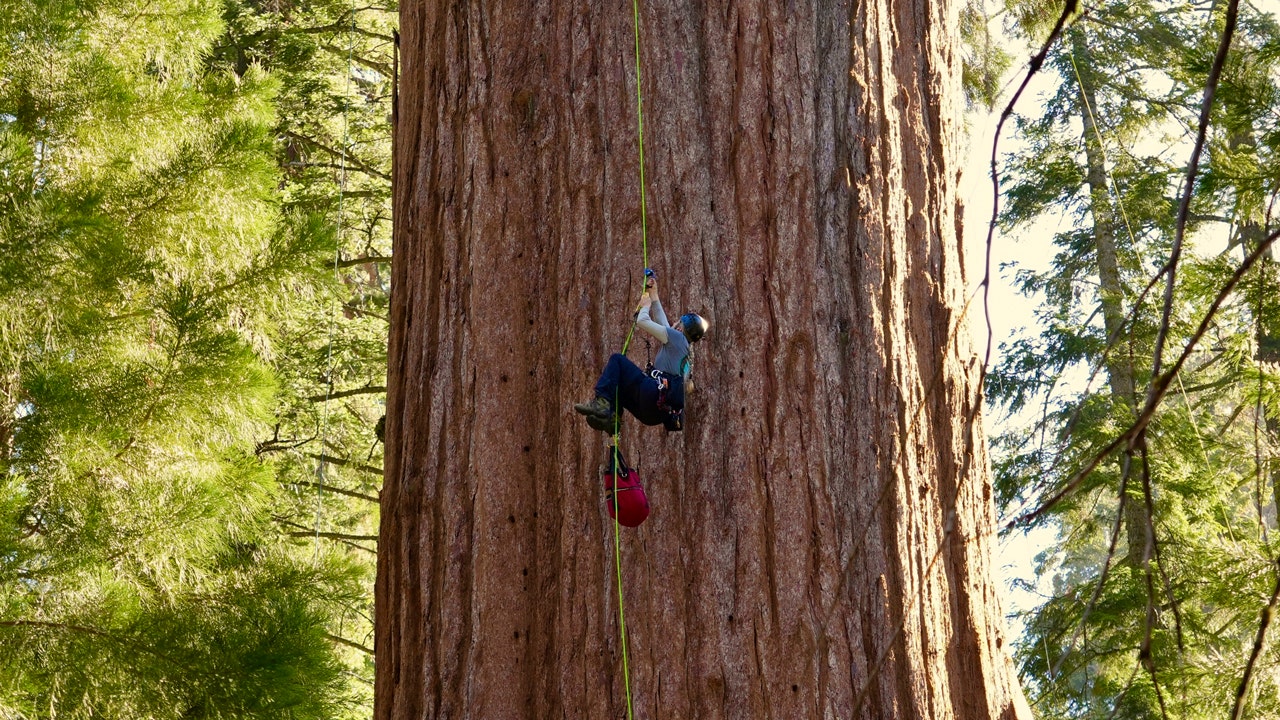
A researcher climbs General Sherman, the world’s largest tree, in Sequoia National Park, California, on May 21, 2024. The research team inspected the 275-foot tree for evidence of bark beetles, an emerging threat to giant sequoias. (AP Photo/Terry Chea)
In 2020 and 2021, record-setting wildfires killed as much as 20 percent of the world’s 75,000 mature sequoias, according to park officials.
“The most significant threat to giant sequoias is climate-driven wildfires,” said Ben Blom, director of stewardship and restoration at Save the Redwoods League. “But we certainly don’t want to be caught by surprise by a new threat, which is why we’re studying these beetles now.”
But researchers are growing more worried about bark beetles, which didn’t pose a serious threat in the past.
The beetles are native to California and have co-existed with sequoias for thousands of years. But only recently have they been able to kill the trees. Scientists say they recently discovered about 40 sequoia trees that have died from beetle infestations, mostly within the national parks.
“We’re documenting some trees that are actually dying from kind of a combination of drought and fire that have weakened them to a point where they’re not able to defend themselves from the beetle attack,” Ambrose said.
The beetles attack the trees from the canopy, boring into branches and working their way down the trunk. If left unchecked, the tiny beetles can kill a tree within six months.
That’s why park officials allowed Ambrose and his colleagues to climb General Sherman. They conducted the tree health inspection as journalists and visitors watched them pull themselves up ropes dangling from the canopy. They examined the branches and trunk, looking for the tiny holes that indicate beetle activity.
But it’s not possible to climb every sequoia tree to directly inspect the canopy in person. That’s why they’re also testing whether drones equipped with sensors and aided by satellite imagery can be used to monitor and detect beetle infestations on a larger scale within the forests.
Tuesday’s health inspection of General Sherman was organized by the Giant Sequoia Lands Coalition, a group of government agencies, Native tribes and environmental groups. They hope to establish a health monitoring program for the towering trees.
If they discover beetle infestations, officials say, they could try to combat the attacks by spraying water, removing branches or using chemical treatments.
Bark beetles have ravaged pine and fir forests throughout the Western United States in recent years, but they previously didn’t pose a threat to giant sequoias, which can live 3,000 years.
“They have really withstood insect attacks for a lot of years. So why now? Why are we seeing this change?” said Clay Jordan, superintendent for Sequoia and Kings Canyon National Parks. “There’s a lot that we need to learn in order to ensure good stewardship of these trees for a long time.”
Read the full article from Here


Alaska celebrates the Fourth of July with a unique tradition by launching cars off a 300-foot cliff.

Alaskans celebrate Fourth of July launching cars off a cliff
Alaskans celebrate the Fourth of July by launching cars off a 300-foot cliff. Watch as their celebration goes full throttle.
For a moment, everything goes quiet as hundreds of eyes fixate on a patriotic, painted car perched at the edge of a 300-foot cliff. An American flag waves in the crisp Alaskan air as spectators wait in anticipation to witness one of the nation’s most unusual Fourth of July spectacles.
Within seconds, cheers echo across the mountain valley as a vehicle soars through the sky before plummeting down below. All in the name of celebrating freedom.
In Glacier View, Alaska, about two hours north of Anchorage, celebrating America’s Independence Day makes fireworks a thing of the past. Since 2005, visitors have gathered from across the country to witness The Glacier View Fourth of July Car Launch.
Volvo and a moose
The tradition began after founder Arnie Hrncir’s wife hit a moose with her Volvo in 2003. After years of not knowing what to do with the damaged vehicle, they decided, why not just throw it off a cliff?
There it all started, a Fourth of July event that has evolved from a small community coming together to witness the Volvos plummet into one of Alaska’s most distinctive Independence Day traditions.
Hrncir said the event is a great way to celebrate freedom, especially with “that beautiful red, white and blue flag waving up there in the majestic skies of Alaska.” One could assume the best part of the event is watching the vehicles soar, but it’s really the race up the cliff to collect car scraps to take home as a souvenir.
Attendees walk away each year with car stereos, rear-view mirrors, and side doors to cherish the unforgettable day.
Hrncir expects this year’s crowd to surpass previous years with a U.S. Coast Guard flyover, brisket, and many ready to commemorate America’s 250th anniversary.
Fireworks may be the traditional way to celebrate America’s birthday, but in Alaska, 250 years call for something with a little more horsepower and significantly fewer surviving vehicles.

The Arizona Chamber of Commerce & Industry has installed Monica Coury, vice president of external affairs at Arizona Complete Health, as chair of its board of directors, as the organization begins its new fiscal year.
Coury officially assumed the chairmanship during a ceremonial passing of the gavel at the Chamber’s June 26 board meeting. She succeeds Ted Geisler, president and CEO of APS, who served as board chair over the past two years.
As chair, Coury will lead the Chamber’s board while helping guide the organization’s efforts to advance policies that strengthen Arizona’s economy, improve the state’s business climate, and promote long-term prosperity.
“It is an incredible honor to serve as chair of the Arizona Chamber of Commerce & Industry,” Coury said. “I want to thank my fellow board members for the confidence they’ve placed in me, and I’m grateful for the opportunity to work alongside the Chamber’s outstanding team. The Chamber has long been one of Arizona’s most effective and respected advocates on behalf of the state’s job creators, and I look forward to building on that legacy as we continue working to make Arizona the best place in the nation to live, work, and do business.”
Coury has served on the Chamber’s board for several years. She previously chaired the Public Affairs Committee and most recently served as chair-elect. In her role at Arizona Complete Health, she oversees one of the state’s leading health plans and has been a prominent voice on issues involving healthcare access, workforce development, and Arizona’s economic competitiveness.
“Monica is an exceptional leader whose collaborative approach, strategic vision, and deep commitment to Arizona make her the ideal person to lead our board,” said Danny Seiden, president and CEO of the Arizona Chamber of Commerce & Industry. “She understands that a strong economy depends on smart public policy, and she has consistently brought thoughtful leadership and sound judgment to the Chamber. I look forward to working closely with Monica as we continue advancing policies that help Arizona employers create jobs, invest, and grow.”
Seiden also thanked Geisler for his leadership during a period that included significant legislative successes and continued growth for the Chamber.
“Ted has been an outstanding chairman, a trusted partner, and a friend,” Seiden said. “His steady leadership, business acumen, and unwavering commitment to Arizona’s economic future have helped position the Chamber for continued success. We are grateful for his service and look forward to his continued counsel and involvement on our board.”
The Chamber also installed the following governing board officers:
- Chair-elect: Jimmy Lindblom, Willmeng Construction
- Vice-chair, audit & finance: Don Isaacson, Isaacson Law Firm
- Vice-chair, manufacturing: Angela Creedon, Intel
The Arizona Chamber of Commerce & Industry is Arizona’s leading statewide business advocacy organization, representing employers of every size and industry across the state. The Chamber’s mission is to advance Arizona’s competitiveness through policies that foster economic growth, job creation, and opportunity for all Arizonans.

Fireworks Safety Guide
Essential safety tips for buying, handling, and watching fireworks to ensure a safe celebration.
With July 4 falling on a Saturday this year, many businesses and organizations are taking the day off Friday, July 3, to mark America’s 250th birthday. From banking to mail service, here’s what’s open and closed for the holiday weekend.
Most federal offices closed, mail service to continue
Non-essential federal offices will be closed on July 3. However, mail service will continue as normal, and post offices are scheduled to remain open.
Most California government offices to remain open
Most California government offices will be open on July 3, with some exceptions.
DMV offices throughout the state will be open. However, the Employment Development Department will be closed.
DMV offices that offer Saturday hours will be closed on July 4.
Private parcel services to remain open
UPS and FedEx are both scheduled to operate normally on July 3, but will suspend service on July 4.
Stock markets closed
Both the New York Stock Exchange and Nasdaq will be closed on July 3.
Most banks to stay open
While most banks were expected to operate normally on July 3, some may operate under modified holiday hours. All banks will be closed on July 4.
Online banking services should remain operational.
Grocery stores
Most major grocery chains will be open on both July 3 and July 4. Trader Joe’s locations will be open for regular business on July 3 but will close early at 5 p.m. on the Fourth of July.
Retailers
Many major retail stores, such as Walmart and Target, plan to operate under normal business hours on both July 3 and 4. All Costco warehouse stores operate under normal business hours on July 3, but will close on July 4.
Restaurants
Most major restaurant chains remain open on July 4, but some will have limited hours. All Raising Cane’s locations will close on July 4.
-

 Alaska4 minutes ago
Alaska is celebrating America’s 250th in the fast lane… off a cliff
-

 Arizona11 minutes ago
Arizona Chamber installs Monica Coury as board chair – Chamber Business News
-

 Arkansas14 minutes ago
Arkansas accumulates $655 million general revenue surplus, fifth-largest in state history | Arkansas Democrat Gazette
-

 California19 minutes ago
What’s open, closed for Independence Day weekend in California?
-

 Colorado26 minutes ago
MAP: Where Colorado wildfires are burning
-

 Connecticut29 minutes ago
Local priest dies after crashing car into tree in West Hartford, police say
-

 Delaware34 minutes ago
County councilman says Newark data center plan paused after deal
-

 Florida41 minutes ago
Outrage over ‘cruel’ Florida move to ban undocumented students from college

