West
Fathers, uncle of Marines killed in California helicopter crash speak out: 'Should not have happened'

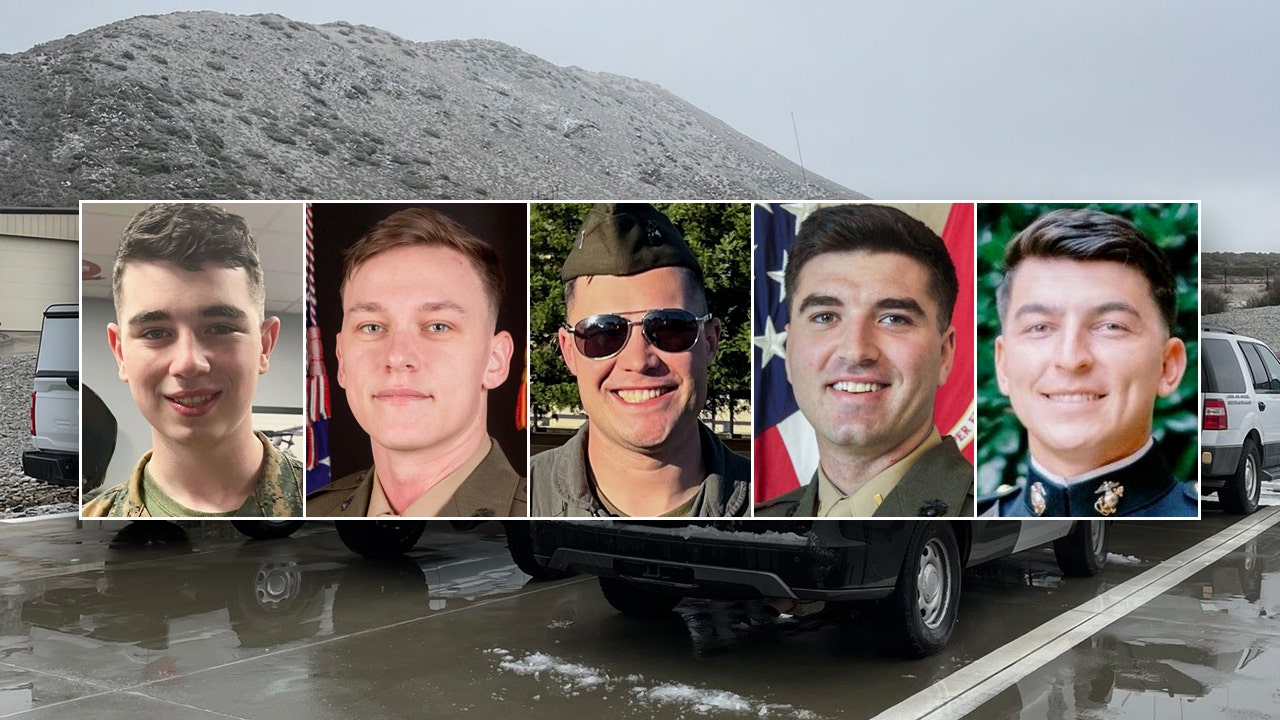
Two fathers and the uncle of three of five Marines killed in a helicopter crash during a storm in Southern California this week are lamenting their deaths as avoidable.
“Maybe this is the one instance to where they wake the f— up and they say, ‘What are we doing to our service members? We’ve got to stop this,’” Steven Langen, father of Sgt. Alec Langen, 23, told the New York Post on Saturday.
Sgt. Alec Langen was serving as crew chief on the CH-53E Super Stallion helicopter when it crashed in the mountains near San Diego on Tuesday night.
Steven Langen called their deaths, “an all too familiar story in the military community.”
5 US MARINES CONFIRMED DEAD AFTER HELICOPTER WENT MISSING IN CALIFORNIA
The five Marines who were killed in a CH-53E helicopter crash in Pine Valley, Calif., on Feb. 6, have been identified. From left to right, Lance Cpl. Donovan Davis, 21, of Olathe, Kan., Sgt. Alec Langen, 23, of Chandler, Ariz., Capt. Benjamin Moulton, 27, of Emmett, Idaho, Capt. Jack Casey, 26, of Dover, N.H., and Capt. Miguel Nava, 28, of Traverse City, Mich. (U.S. Marine Corps | CalFIRE)
Bradford Moulton, whose nephew was Capt. Benjamin Moulton, 27, said he wished the men would have been kept “on the ground” during the “thousand-year storm” when they were flying from Creech Air Force Base in Nevada to Marine Corps Air Station Miramar near San Diego on a routine training exercise.
“They’re Marines, they fly in nasty weather, they do what they’re supposed to do,” he told the Post, “but I sure wish the operations officer would have kept them on the ground.” Moulton was one of two pilots on the helicopter.
Gregory Davis, a retired naval aviation officer and Lance Cpl. Donovan Davis’ father stated, “Not only did it not have to happen, it should not have happened.”
MARINE KILLED IN CAMP PENDLETON TRAINING EXERCISE IDENTIFIED
Davis, 21, also served as a crew chief on the helicopter.
He added of his son, “He was so proud to be a Marine, he loved his job, he loved what he did. “We’re proud of Donovan and everything he was able to accomplish in his short 21 years.”
Langen said the only thing his son asked for on his 17th birthday was to enlist in the Marines. “The next thing you know, (there’s) a knock at the door. And there’s the Marine recruiter that is standing there,” he remembered.
Moulton shared that Benjamin was determined on his career goals. “He was going to be a Marine pilot no matter what,” he said. The 27-year-old was a pilot on the helicopter along with Capt. Jack Casey, 26, who was also killed in the crash.
Capt. Miguel Nava, 28, was the fifth victim in the crash.
“Miguel was the kindest soul you’d ever meet,” a fundraising page for his family said of him. “His warmth, positive energy, and compassion will be missed by all who were grateful to know him.”
US MILITARY AIRCRAFT CRASHES IN MEDITERRANEAN SEA AFTER TRAINING MISHAP, ‘NO INDICATION’ OF HOSTILE ACTIVITY
Lt. Col. Nicholas J. Harvey, commanding officer of the Marine Heavy Helicopter Squadron 361 (HMH-361), said of the five Marines after the crash: “We have been confronted with a tragedy that is every service family’s worst fear. Our top priority now is supporting the families of our fallen heroes, and we ask for your respect and understanding as they grieve. The Flying Tigers family stands strong and includes the friends and community who have supported our squadron during this challenging time. We will get through this together.”
The last known contact with the Super Stallion was at about 11:30 p.m. Tuesday, when waves of downpours and snow were hitting the region during an “atmospheric river.”
The CH-53E Super Stallion is the largest helicopter in the military and is designed to fly through bad weather, even at night.
The cause of the crash is currently under investigation.
A U.S. military CV-22 Osprey takes off from Iwakuni base, Yamaguchi prefecture, western Japan. The Osprey fleet was grounded in December after eight Air Force service members were killed in a crash off Japan. (Kyodo News via AP / File)
Davis enlisted in the Marine Corps on Sept. 3, 2019, and was promoted to the rank of Lance Corporal on Jan. 1 of this year. His decorations include the Global War on Terrorism Service Medal, the National Defense Service Medal and a Sea Service Deployment Ribbon.
Langen enlisted in the Marine Corps on Sept. 14, 2017, and was promoted to the rank of Sergeant on Oct. 1, 2022. His decorations include the Navy and Marine Corps Achievement Medal, Good Conduct Medal, Global War on Terrorism Service Medal, National Defense Service Medal and two Sea Service Deployment Ribbons.
Moulton was commissioned into the Marine Corps on March 29, 2019, and was promoted to the rank of Captain on Aug. 1, 2023. His decorations include the National Defense Service Medal.
Meanwhile, Casey was commissioned in the Marine Corps on May 16, 2019, and was promoted to the rank of Captain on Sept. 1, 2023. His decorations include the National Defense Service Medal.
Nava was commissioned into the Marine Corps on May 26, 2017, and was promoted to the rank of Captain on Nov. 1, 2021. His decorations include the Global War on Terrorism Service Medal, National Defense Service Medal and Sea Service Deployment Ribbon.
The entrance to Marine Corps base Camp Pendleton in Oceanside, Calif. (AP Photo / Gregory Bull / File)
In December, a Marine was killed and 14 others injured in a training crash at Camp Pendleton in Southern California when a tactical vehicle rolled over.
Last November, five Army special operations soldiers were killed in a training “mishap” when their helicopter crashed into the Mediterranean and eight Air Force service members died in an Osprey crash off the coast of Japan when the aircraft suffered a mechanical failure.
The Osprey fleet has been grounded since the crash as the Air Force weighs when it’s safe to return to service.
The Marines didn’t immediately respond to Fox News Digital’s Saturday evening request for comment.
Fox News Digital’s Michael Dorgan contributed to this report.
Read the full article from Here


Scroll down for a list of fireworks restrictions across Wyoming.
I usually don’t buy fireworks for the 4th of July. I go places to watch them. But since this year is the 250th anniversary of our nation, I was going to purchase a small arsenal and have a blast, pardon the pun.
But this has been a very dry year, as happens now and then in the cycles of weather. So I figured I’d wait until things were wet again and just hold my personal celebration a little late.
Many towns across Wyoming have canceled their July 4th fireworks due to the drought. They don’t want you firing off any either.
Based on 2026 reports, several Wyoming towns and counties have canceled or significantly restricted Fourth of July fireworks displays due to high wildfire risks, drought conditions, and Stage 1 fire restrictions.
Canceled/Restricted Public Displays (2026)
- Gillette/Campbell County: The CAM-PLEX fireworks show was postponed, and the county is maintaining a Stage 1 fire restriction due to extreme drought.
- Douglas: The Volunteer Fire Department canceled the 4th of July fireworks show due to fire concerns.
- Newcastle: Fireworks show canceled due to high fire danger, according to a June 27 report.
- Pine Haven: Canceled its Fourth of July fireworks display, according to a June 27 report.
- Riverton: Passed a resolution banning personal fireworks within city limits on July 4, with only a limited, designated area for public displays at the Honeycutt Softball and Saban Baseball Complex.
- Teton County: Fireworks have been historically canceled, and fire officials are urging residents to only attend official, professional displays due to extreme fire danger (confirmed for 2026).
City-Wide Personal Fireworks Bans (2026)
- Cheyenne: Consumer fireworks are prohibited within city limits, despite the county lifting restrictions, with only small novelties allowed.
- Casper: Fireworks are prohibited within city limits and in unincorporated Natrona County.
Key Locations Under Restrictions (2026)
- BLM Land: Fireworks are prohibited on public lands managed by the Bureau of Land Management in Wyoming.
- Weston County: A county-wide ban covers Newcastle and Upton due to high drought conditions.
Even little Chugwater, Wyoming, population 175, has banned fireworks inside its little town limits.
At the State Capital in Cheyenne, however, they will go right ahead with a fireworks display, right over the capital building itself. Dry weather be dammed.
Weird Fireworks Names You’ll Find In Wyoming
Just some of the odd names we found while shopping.
Gallery Credit: Glenn Woods
San Francisco, CA
Discovery Bay driver arrested for San Francisco fatal vehicle collision | Contra Costa Herald

Killed pedestrian, struck 3 more people
By San Francisco Police Department
On May 25, 2026, at approximately 12:13 am, San Francisco Police officers responded to the area of 16th and Mission Streets regarding a vehicle collision.
Officers were advised that a collision occurred between a vehicle and a pedestrian.
Officers arrived on scene and located a pedestrian victim being treated by paramedics for life threatening injuries. Paramedics transported the victim to a local hospital.
Despite lifesaving efforts of medical staff, the victim was later declared deceased at the hospital.
A preliminary investigation revealed that a vehicle collided with a pedestrian and struck three additional victims.
The three victims were medically assessed on scene for non-life-threatening injuries.
Through the course of the investigation, officers located the suspect vehicle and detained the occupant of the vehicle.
The Traffic Collision Investigations Unit (TCIU) responded to scene and conducted their investigation.
Through the course of the investigation, TCIU investigators developed probable cause to arrest the driver identified as 57-year-old Samuel Powell of Discovery Bay on June 30, 2026.
Powell was arrested and charged for vehicular Manslaughter 192(c)(2) PC and the driver’s responsibility to exercise due care for the safety of any pedestrian within the roadway 21955(b)(3) CVC.
Although an arrest has been made, this remains an open and active investigation. Anyone with information is asked to contact the SFPD at 415-575-4444 or text a tip to TIP411 and begin the message with SFPD.

After an extended wait of no activity from the Denver Nuggets in this year’s free agency period, the team has finally made its first new signing.
That signing just so happens to be the No. 2 pick from the 2018 NBA Draft, Marvin Bagley III.
According to ESPN‘s Shams Charania, the Nuggets and Bagley have agreed to a one-year, veteran minimum deal for the 2026-27 season, effectively providing some solid depth in the frontcourt.
Free agent center Marvin Bagley III has agreed to a one-year deal with the Denver Nuggets, sources tell ESPN. A critical frontcourt addition for the Nuggets. pic.twitter.com/enHBVxgfYl
— Shams Charania (@ShamsCharania) July 2, 2026
With Denver’s first free agency signing now officially in the books, here’s what the move to bring in Bagley might mean for the Nuggets moving forward into free agency and this offseason, as well as entering next season.
Marvin Bagley Brings Frontcourt Depth to Denver’s Lineup
Bagley split his time between the Washington Wizards and Dallas Mavericks this past season to put together one of his better years of production in recent memory.
In the 60 combined games he played, Watson averaged 10.5 points, 6.1 rebounds, and 1.4 assists while shooting a career-high 61.8% from the field and 46.2% from three on a little less than one attempt per game.
Bagley’s a big who’s game centers more around his offensive skillset. He spent most of his time shooting last season at the rim or in the mid-range, shooting a stout 64.1% on two-pointers last season that can bring a bit of an interior presence into Denver’s frontcourt.
Defensively, he leaves a little bit more to be desired. And he’s still not quite the most impressive three-point shooter, even coming off his most efficient season from deep.
But for the cost of a veteran minimum contract, he acts as a nice budget-friendly addition who can shoulder some of the load offensively, and has shown value as an offensive rebounder as well. It’s tough to find much better for the price Denver’s paying.
While entering the league slotted in primarily as a power forward, it’s been in the past few seasons that Bagley’s settled in more as a full-time five; having spent 95% of his minutes during the 2025-26 campaign playing at the five.
That might give you a bit of a hint as to how the Nuggets plan to use him this next season, though they might also have some stretches where he’s placed alongside Nikola Jokic at the four for a bit of a larger frontcourt lineup.
The Writing’s On the Wall for Jonas Valanciunas
Looking at what Bagley’s addition might mean for the Nuggets’ current roster, no one in the picture gets more impacted by Jonas Valanciunas.
Valanciunas was Denver’s primary backup behind Jokic at the five last season following his trade from the Sacramento Kings, and entered this offseason with an uncertain future because of his contract situation.
The veteran big man has an expiring $10 million contract heading into the 2026-27 season, but one that’s not fully guaranteed, giving the Nuggets the opportunity to release him and save $8 million, while incurring a dead cap hit of $2 million that can be stretched over multiple years.
Such a move can give the Nuggets further cap flexibility that they’ll need this offseason to re-sign key pieces like Peyton Watson and Spencer Jones, which to this point haven’t been done, but becomes a bit easier now that Denver can take that next step in pivoting off of Valanciunas.
Perhaps Denver might also look deeper into a trade involving Zeke Nnaji, now that they’ve got a cheaper option in Bagley that might even sit ahead of him on the initial depth chart. However, it remains to be seen if the Nuggets have any takers on the two years remaining on his contract. To this point, they haven’t found anyone to bite.
When factoring in Valanciunas and Nnaji though, Bagley’s addition now brings the Nuggets to a total of 10 players signed onto traditional contracts for the 2026-27 season.
That leaves them with four open spots left to utilize in the days and weeks ahead. How they decide to use that space remains to be seen, but at the very least, the Nuggets’ long-awaited first offseason signing has now officially come to light.
Sign up for our free Denver Nuggets On SI newsletter, and get breaking Nuggets news delivered to your inbox daily!
 Add us as a preferred source on Google
Follow
-

 West Virginia6 minutes ago
Fire in Barbour County leaves four dead – WV MetroNews
-

 Wyoming8 minutes ago
These Wyoming Towns Have Banned Fireworks – 2026
-
 Crypto9 minutes ago
Trump denies conflict of interest over crypto. And, Vatican excommunicates rebel group
-

 Finance21 minutes ago
Regions Financial acquires Montgomery-based investment banking firm Frazer Lanier
-

 Fitness24 minutes ago
Apple Watch vs. Oura Ring: Which Tracks Sleep, Health and Fitness Better?
-

 Movie Reviews36 minutes ago
Millie Bobby Brown leads frothy sleuthing caper
-

 World44 minutes ago
Variety Toasts French Cinema With Post-Cannes Summer Dinner at Paris’ Laperouse With Thierry Fremaux, Guillaume Canet, Pierre-Antoine Capton, Rebecca Zlotowski and Anamaria Vartolomei
-

 Politics54 minutes ago
The Many Ways Trump Is Trying to Tip the Scales for the Midterms

