West
Ethan Chapin scholarships handed out to dozens of students in 1st round

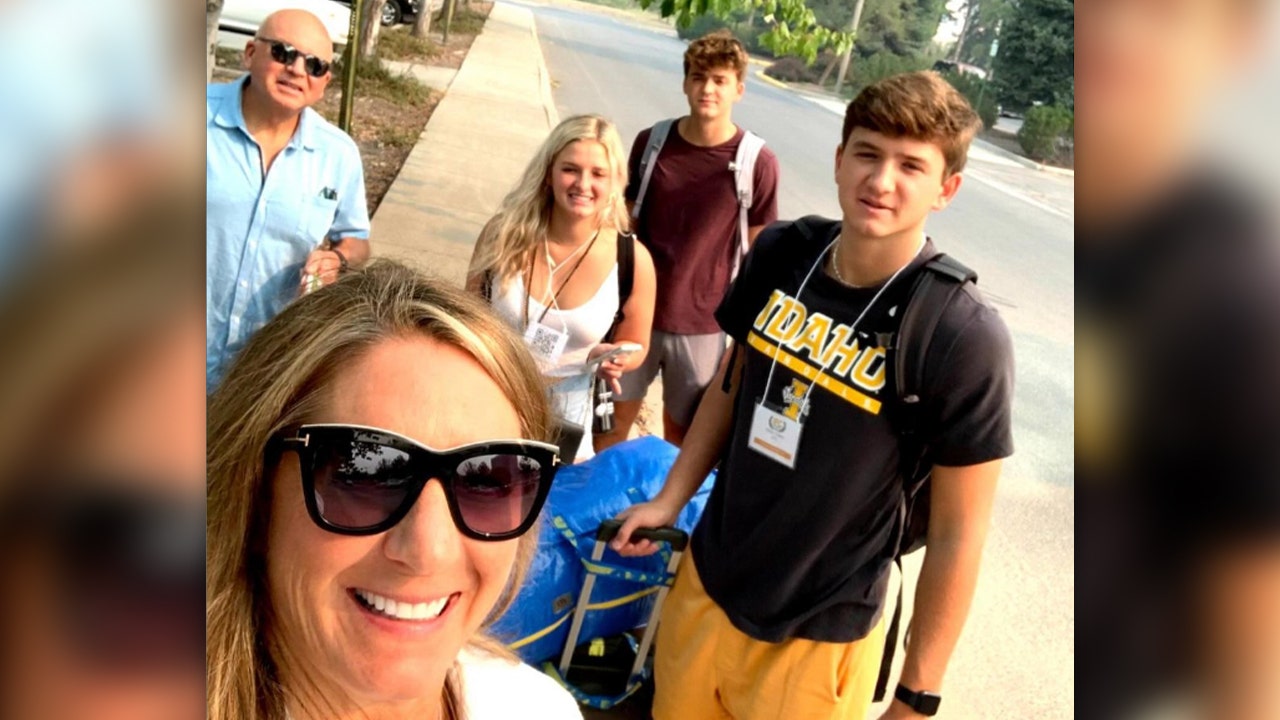
Ethan Chapin’s dreams were buried on the morning of Nov. 13, 2022, but seeds of a brighter future are now in the palms of dozens of young people looking to achieve their own.
Ethan’s Smile, the charitable foundation that Chapin’s family set up in his memory, doled out 33 scholarships last week after a “bittersweet” ceremony, his mother says.
The foundation has raised far more than the $50,000 handed out this year with a goal of endowing the scholarships, Stacy Chapin told Fox News Digital.
“We can’t think of a better way to honor Ethan,” she said. “We wanted our kids to have an education so they can stand on their own two feet, and it became ‘Let’s pay it forward in Ethan’s honor.’”
ETHAN CHAPIN’S MOTHER ANNOUNCES CHILDREN’S BOOK IN HIS MEMORY, WILL SKIP KOHBERGER TRIAL
University of Idaho students Ethan Chapin and Xana Kernodle. (Instagram: @ethanchapin4)
Unlike many academic scholarships, she said the foundation is handing scholarships out to any student attending any accredited institution, including beauty and vocational schools.
“We wanted a scholarship for any kid that has any dream,” she said. “I can’t wait for 20 years from now when these kids come back and say …‘This is what I did with my life.’”
Chapin also thanked donors from around the country, including country star Morgan Wallen, who put the foundation on solid footing. She said she hopes to keep growing the fund until the interest alone can cover scholarships every year.
ETHAN CHAPIN’S PARENTS BREAK SILENCE ON LAST TIME THEY SAW SON
Morgan Wallen poses with the Chapin family. Stacy Chapin says the country star donated to Ethan’s Smile and also helped raise awareness, which led people around the country to contribute to the scholarship fund in her son’s honor as well. (Stacy Chapin)
Chapin, his girlfriend Xana Kernodle, and two other friends — Kaylee Goncalves and Madison Mogen — were murdered in a home invasion attack near the University of Idaho campus in Moscow, Idaho, where they were all students.
The suspected killer, Bryan Kohberger, was a criminology Ph.D. student at the neighboring Washington State University at the time of the stabbings.
Madison Mogen, top left, smiles on the shoulders of her best friend, Kaylee Goncalves, as they pose with Ethan Chapin, Xana Kernodle, and two other housemates in Goncalves’ final Instagram post, shared the day before the four students were stabbed to death. (@kayleegoncalves/Instagram)
Kohberger is being held without bail awaiting trial. He could face the death penalty if convicted.
Chapin, who was majoring in recreation, sports and tourism management, was a triplet. His two siblings, Maizie and Hunter, still attend the university.
Their parents set up Ethan’s Smile, a foundation offering student scholarships after the attack. More information about the charity and how to donate can be found here.
Read the full article from Here


PORTLAND, Ore. (KOIN) — A former Oregon corrections officer received a lifetime hunting ban on Wednesday after pleading guilty to several poaching-related charges.
Christopher Mason, 49, of Umatilla, was sentenced in two separate court cases to 24 months of probation and 300 hours of community service. He was also fined over $114,000 and was required to forfeit his firearms.
Oregon State Police said they began investigating Mason in 2024 after receiving information that he had been poaching big game animals.
“In February 2025, OSP served a search warrant, and multiple big game animals and firearms were seized as evidence. Sixty-seven criminal charges were referred for prosecution,” officials said. “The charges spanned multiple counties.”
Mason pleaded guilty to four counts of unlawful take of buck deer and three counts of unlawful take of black bear on June 18. In a separate case on June 26, he pleaded guilty to unlawful possession of a short-barreled rifle, unlawful possession of a silencer, unlawful possession of multiple wildlife and unlawful take of mule deer.
“This is another example of serial poaching which rises to the level of felony conduct based solely on the repeated poaching conduct and impact of one individual on Oregon’s game mammals,” prosecutor Jay Hall said. “The conduct across the several counties amounts to one of the highest damage amounts done to Oregon wildlife by any singular actor.”

SALT LAKE CITY (KUTV) — In the middle of Utah’s drought, an environmental group is calling out what it labeled “hysteria” over water supplies for Wasatch Front cities.
“We’ve heard for 50 years that Utah is about to run out of water for its cities,” said Zach Frankel, director of the Utah Rivers Council. “And it’s a myth.”
Frankel, a frequent presence on Utah’s Capitol Hill, said cities — including the people who live in them — account for only a sliver of Utah’s total water use.
MORE | Utah Drought
He said that water rates are so low we have “the most wasteful water users in the country” and that outdoor watering could be dramatically curtailed with little to no impact.
Claims of running out of water, Frankel said, are aimed at pushing pricey, publicly funded water construction projects.
Ogden is embarking on a $100 million replacement of a 100-year-old pipeline through Ogden Canyon aimed at “improving reliability, reducing water loss, and supporting long-term water security.”
The Weber Basin Waster Conservancy District is not driving or financing the construction, but is involved with it, and the general manager called the Utah Rivers Council position “hogwash.”
“We’re not doing projects … just to spend hundreds of millions of dollars,” said GM Scott Paxman. “We are running out of water.”
Paxman said 20,000 more homes are already approved and/or permitted within the district boundaries, and even more permits are likely in Ogden Valley, Summit and Morgan Counties.
Laura Briefer, director of the Salt Lake City Department of Public Utilities, said the city rates have gone up, and are “encouraging conservation.”
Frankel said conservation efforts can go further, even as more and more water is diverted in northern Utah from agriculture to growing communities — water that will not end up in a near-record-low Great Salt Lake.
“If you went to the gas station and saw someone pouring gasoline on the sidewalk while simultaneously simply telling us, ‘We’re running out of gas,’ it would be, ‘What are you talking about?’” Frankel said. “Put the nozzle back.”
_____

NAVASOTA, Texas (KBTX) – For many Texans, the Fourth of July is about fireworks and family cookouts. At Washington-on-the-Brazos State Historic Site, it’s also about standing where Texas’ own independence story began, and marking a milestone in how the Lone Star State became part of the nation it celebrates.
The Texas historic site, set on 293 acres of parkland along the Brazos River, is known as “Where Texas Became Texas.” It is the place where 59 delegates met and signed the Texas Declaration of Independence from Mexico on March 2, 1836, launching what would become the Republic of Texas.
From 1836 to 1846, Texas existed as a separate nation, before the question of annexation came to the forefront. Site staff say Washington-on-the-Brazos offers a “bookended” look at the Republic’s decade-long history because discussions about joining the United States also took place there and were ultimately voted on in the property.
This year’s July 4 programming is designed to connect those chapters of Texas history with the national holiday, including a commemoration tied directly to the Lone Star being added to the American flag.
“This is also the 180th anniversary of when Texas was added to the American flag,” said Chandler Wahrmund, assistant site manager for the Fanthorp Inn State Historic Site, which is part of the broader Republic of Texas Complex.
A historic site with multiple stops
Washington-on-the-Brazos includes several major attractions:
- Visitor Center: The recommended starting point for guests. It features interactive exhibits presenting a timeline of the Texas Revolution and includes the Museum Store, with snacks and Texas-themed items. The Visitor Center is free and is where visitors can gather information and purchase entry tickets for the site’s paid attractions.
- Independence Hall: A replica building that sits on the spot where the Texas Declaration of Independence was signed, allowing visitors to visualize where that pivotal moment unfolded.
- Star of the Republic Museum: A central museum on the grounds focused on the Republic era.
- Barrington Living History Farm: A living-history area that interprets life in the Republic of Texas period through demonstrations and activities.
The historic site is also the core of the Republic of Texas Complex, which includes Fanthorp Inn, a preserved 19th-century stagecoach inn in nearby Anderson.
July 4 events across the grounds
Staff say this year’s July 4 celebration will include activities happening throughout the site, with scheduled programs at key times.
According to site staff, the day includes:
- Flag raising ceremony at 11 a.m.
- Readings of the American Declaration of Independence at 1 p.m. and 3 p.m.
- Star of the Republic Museum cockade-making, creating patriotic lapel decorations
- Barrington Living History Farm games, including trap ball, a precursor to baseball
- Townsite activities at Hatfield’s Exchange, a recreated high-class bar from the period, with lemonade and other period-inspired nonalcoholic drinks for visitors
Wahrmund said the day is a chance to revisit the country’s founding words, and understand why they still matter.
“I love to read the words of Thomas Jefferson on the day, July 4th, to really understand why we exist as a nation,” he said.
Hours and admission
Washington-on-the-Brazos State Historic Site will be open 10 a.m. to 4:30 p.m. on July 4, and admission is free all day.
Copyright 2026 KBTX. All rights reserved.
-

 Oregon6 minutes ago
Former Oregon corrections officer receives lifetime hunting ban, fined over $114K
-

 Pennsylvania9 minutes ago
Pennsylvania State Police trooper killed in crash along Interstate 81
-

 Rhode Island14 minutes ago
‘Real Housewives of Rhode Island’ star Liz McGraw exits show after one season
-

 South-Carolina21 minutes ago
South Carolina Lottery Powerball, Pick 3 results for July 1, 2026
-

 South Dakota24 minutes ago
Families celebrate 250th in South Dakota
-

 Tennessee29 minutes ago
Parasite-induced ‘explosive’ diarrhea cases rise in Tennessee. Here’s what to know
-

 Texas36 minutes ago
New date set for opening of Six Flags Over Texas’ Tormenta Rampaging Run coaster after delay
-

 Utah39 minutes ago
Wasatch Front cities running out of water called a ‘myth’

