Connect with us

Colorado

EDITORIAL: Don’t make Colorado a draw for death tourism

Published

on

EDITORIAL: Don’t make Colorado a draw for death tourism


An oft-cited rationale for imposing a waiting period on gun purchases is it will curb their use in suicides. The thinking goes that despair and desperation will give way to hope with the dawn of a new day.

How ironic a bill now in the Legislature to expand Colorado’s physician-assisted suicide law would do the opposite — shortening the waiting period for ending one’s life with the help of a medical professional. It’s as if the bill’s backers don’t really want an ailing patient to give it too much thought.

And reducing the wait time from 15 days to 48 hours isn’t all Senate Bill 24-068 would do. It extends the ability to prescribe the necessary lethal drugs beyond MDs to advanced practice registered nurses. What is literally a life-or-death judgment no longer would be restricted to a doctor’s discernment.

Advertisement

Most alarming, the pending legislation eliminates the  requirement that only Colorado residents may invoke the law. That opens it up to visitors from the rest of the country. Of the nine other states that permit medically assisted suicide, only one other has lifted its residency restrictions.

It’s a safe bet Colorado would become a de facto destination for death tourism. Which would make a tragic and, at best, wholly unnecessary policy even more reprehensible.

The Gazette editorial board has opposed the deadly law from the beginning, when it was adopted by state voters in 2016.

It undermines a core precept for medical professionals since ancient times — to do no harm — and instead encourages them to do just that.

It also leaves patient and doctor alike in a precarious position. Docs aren’t deities. Neither are nurses. As any will tell you, they are far from confident they can determine in every case precisely when someone will die from an ailment.

Advertisement

Yet, the law purports to restrict participation to those who have been diagnosed with a terminal illness and have been given six months to live — a squishy standard if ever there was one.

Receive updates from our editorial staff, guest columnists, and letters from Gazette readers. Sent to your inbox 12:00 PM.

Success! Thank you for subscribing to our newsletter.

Undoubtedly a lot of doctors don’t participate, and not just for fundamental moral reasons. Plenty of practitioners likely don’t wish to sign off with certainty on something only the Almighty can know for sure.

Meanwhile, the policy shoves society down a slippery slope. The legislation, sponsored by Sen. Joann Ginal, D-Fort Collins, and Rep. Kyle Brown, D-Louisville, could turn out to be merely the first such embellishment. How about adding nonterminal but chronic, debilitating diseases?

Or changing the law’s competency standard to allow those with severe mental illness to end it all? What about those born with physical or developmental defects?

Too repugnant to contemplate? Exactly. Yet, Coloradans would be wise to ponder the possibility that lawmakers might propose those and other add-ons in years to come. All in the name of being humane, of course.

Advertisement

In the final analysis, Colorado’s law cheapens life by normalizing suicide. The proposed legislation only would add insult to the injury. Suicide isn’t a health care option; it is a tragedy.

And it isn’t needed. As any provider involved in hospice care can tell you, the physical pain associated with advanced stages of most terminal illnesses has been mitigated significantly by modern medicine. Today’s palliative care often enough ensures pain-free final days.

Decline and death are natural parts of life’s cycle. A key component is loved ones who give comfort to the dying; who remind them of the great value of their lives; who mourn their loss.

Which leaves one to wonder if Colorado’s assisted-suicide law isn’t so much about easing the suffering of the afflicted — as it is about giving their survivors an easy out.


Source link

Advertisement

Colorado

Grand jury indicts over half the officers in a rural Colorado county

Published

on

Grand jury indicts over half the officers in a rural Colorado county


DENVER — Five of the seven law enforcement officers in a rural Colorado county, including the sheriff, have been indicted in an investigation into allegations of misconduct, prosecutors said Friday.

A grand jury indicted Costilla County Sheriff Danny Sanchez and former Deputy Keith Schultz on charges of allegedly mishandling human remains discovered in October 2024, according to court documents. A man who found the remains and reported them to the sheriff’s office said Sanchez and Schultz took only the skull and left the other remains behind, including teeth, court documents state.

Two months passed before Schultz wrote a report, saying he left bones in a bag on his desk and went on another call, the documents state. A coroner’s official said he received the skull in an unlabeled paper bag from the sheriff’s office, the documents state.

Separately, Undersheriff Cruz Soto, Sgt. Caleb Sanchez — the sheriff’s son — and Deputy Roland Riley are charged in connection with the use of a Taser against a man who was suffering a mental health crisis in February and tried to leave when they insisted he go to the hospital, according to the documents. The man said he was “roughed up” by deputies and was left with broken ribs, according to the indictments.

Advertisement

Soto was charged with failing to intervene and third-degree assault, according to court documents. Caleb Sanchez and Riley were charged with second- and third-degree assault.

In announcing the indictments, 12th District Attorney Anne Kelly said she’s committed to investigating and prosecuting crimes no matter the offender.

“I cannot and will not ignore violations of the trust that a community should have in their police. No citizen of the San Luis Valley should have any doubts about the integrity of their police force,” Kelly said at a news conference Friday evening.

A person who answered the phone Friday at the sheriff’s office said it had no immediate comment but planned to post a statement online. Phone numbers listed for Danny Sanchez, Soto and Riley did not work. Caleb Sanchez did not have a listed number. An unidentified person who answered a number for Schultz referred The Associated Press to an attorney, Peter Comar. The AP left a message Friday for Comar seeking comment.

__

Advertisement


Source link

Continue Reading

Colorado

Colorado residents face earliest water restrictions ever — a harbinger of worse to come

Published

on

Colorado residents face earliest water restrictions ever — a harbinger of worse to come


As a result of a snow drought and a heat wave that have both set records, some Colorado residents face the earliest restrictions on their water use ever imposed.

Denver Water announced Wednesday that it is seeking a 20% cut in water use, asking people to turn off automatic watering systems until mid-May and restricting the watering of trees and shrubs to twice a week.

“The situation is quite serious,” said Todd Hartman, a spokesperson for the utility. “We’re in such a dire situation that we could be coming back to the public in two or three months and saying you’re limited to one day a week.”

It is the earliest in the year that Denver Water has ever issued a restriction, Hartman said.

Advertisement

Colorado’s snowpack peaked at extremely low levels on March 12 — nearly a month earlier than usual — then cratered during the recent heat wave that cooked nearly every state in the West.

“We already had the lowest snowpack we’ve seen since at least 1981, and now, with the heat wave conditions, we’ve already lost about 40% of the statewide snowpack” since the March 12 peak, said Peter Goble, Colorado’s assistant state climatologist. “Conditions are looking more like late April or early May.”

The water restrictions are a harbinger of what’s to come in many Western states as officials try to manage widespread drought concerns. Nearly every snow basin in the Mountain West had one of its warmest winters on record and is well behind normal when it comes to water supply, according to the U.S. drought monitor. The dwindling snowpack is likely to raise the risk of severe wildfires, hamper electricity generation at hydropower dams and force water restrictions for farmers.

Hartman said nearly every community east of the Rockies, along Colorado’s front range, is in much the same boat as Denver.

City Council members in Aurora are considering similar water restrictions; reservoirs there stand at about 58%, according to the city’s website. In the town of Erie, officials declared a water shortage emergency on March 20 after they observed a massive spike in consumption.

Advertisement

Gabi Rae, a spokesperson for the town, said Erie was perilously close to having taps run dry because so many residents had started watering their lawns early amid the unseasonable heat.

“We were a day away from running out of water. That’s why it was such an emergency,” she said.

Erie officials demanded that residents stop using irrigation systems altogether.

Goble said this month’s heat wave has set records in every corner of Colorado, sometimes by double digits.

“I can’t remember seeing a single heat wave that broke this many records, and seeing it across such a large portion of the country is certainly eye-popping,” he said, adding: “I’m located in Fort Collins, and we got up to 91 last Saturday. The previous record for March was 81, so we smashed that record. And it wasn’t just one day, either.”

Advertisement
Skiers at Breckenridge Ski Resort as temperatures reached into the 50s this month. Michael Ciaglo / Getty Images

Denver Water, which serves about 1.5 million residents in the city and its surrounding suburbs, gets about half of its water from the Upper Colorado River Basin and the South Platte River Basin. The latter’s snowpack was at about 42% of normal Tuesday, the utility reported. The Upper Colorado River Watershed was at 55%.

Systemwide, Denver Water’s reservoirs are about 80% full, which is only about 5 percentage points lower than in a typical year.

“That sounds pretty good,” Hartman said. “Except that what we’re not going to be able to rely on is that rush of water that will bring those reservoirs back up, because the snowpack is so low.”

In other words, the snowpack — a natural water reservoir — is mostly tapped already and won’t replenish reservoirs later this spring and into summer, when runoff usually peaks.

In Erie, city workers plan to aggressively police water use until sometime next week using smart meters that monitor residential usage. Rae said the city is also sending utility workers to patrol neighborhoods and look for sprinklers that are turned on.

Advertisement

“People have been kind of annoyed with how aggressive we were, and I don’t necessarily think they understand the ramifications if we weren’t,” Rae said. “It is an actual serious emergency situation. We were so close to reaching empty, there would literally be no water coming out of the taps — hospitals, schools, fire hydrants, your home would have no water.”

Although the limits on outdoor watering will be lifted soon, Rae expects more restrictions later this spring and summer.


Source link

Continue Reading

Colorado

Suddenly hazy skies in Denver prompt some residents concerned about wildfire smoke to call 911

Published

on

Suddenly hazy skies in Denver prompt some residents concerned about wildfire smoke to call 911


Some people who live in the Denver metro area on Thursday afternoon were making calls to 911 after skies became noticeably hazy and winds kicked up. It was due to smoke from wildfires in Nebraska moving into Colorado. A cold front also was moving through the Front Range, and there is dust in the air.

Advertisement

CBS


The poor air conditions led to reduced visibility downtown after 3 p.m. Several of CBS Colorado’s City Cams showed dust or smoke in the air.

Temperatures were expected to drop by as much as 20 to 30 degrees with the cold front.  

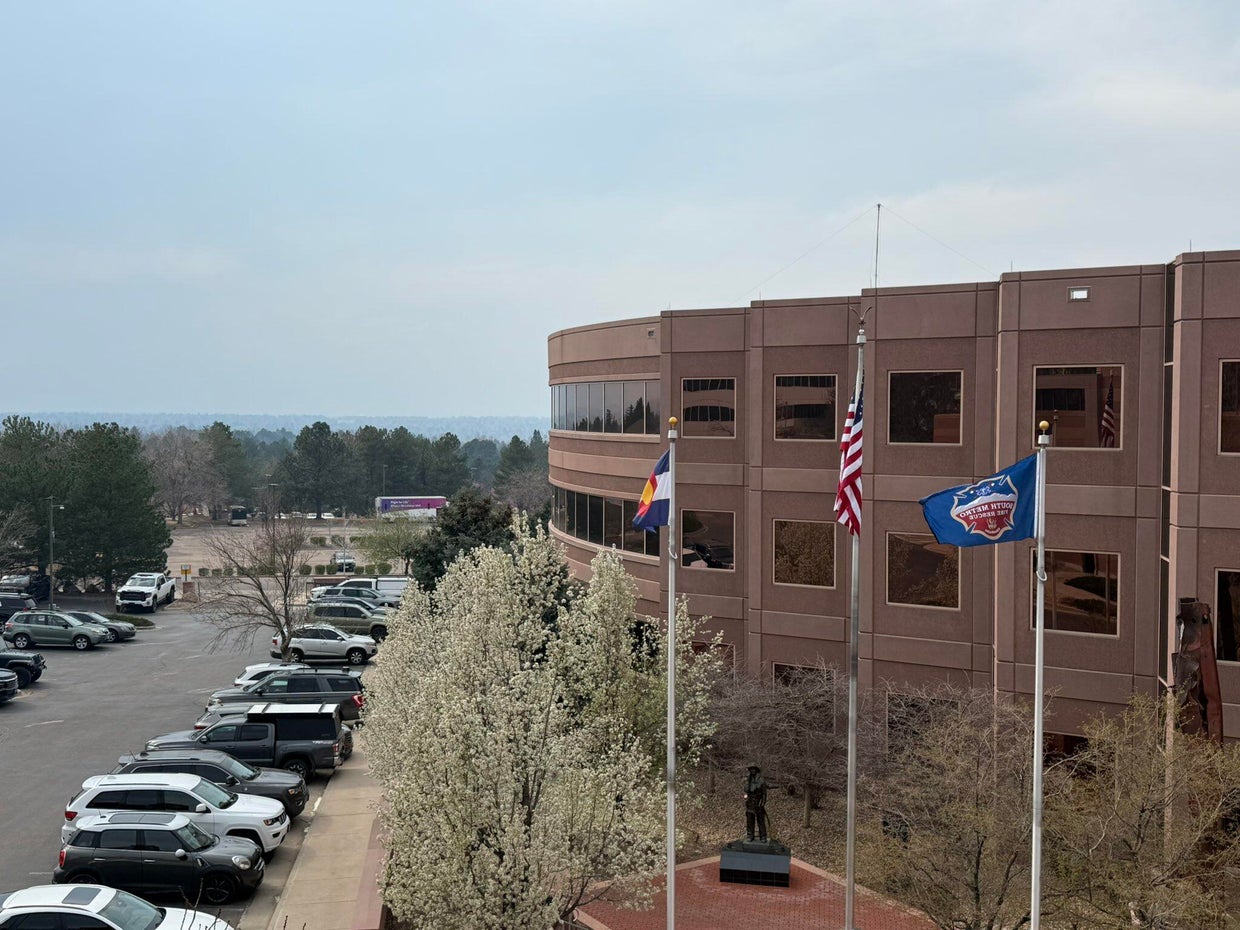
The suddenly dusty skies prompted at least one fire agency to put out a plea to residents to please only call 911 “if you see flames.” That warning was put out by South Metro Fire Rescue, which shared a photo on X of an office building with haze visible outside.

haze.jpg

Advertisement

South Metro Fire


South Metro Fire Rescue said in their post that the smoke is from Colorado’s neighbor to the east. They called it a “significant haze” in the air.

Earlier this month, the Morrill Fire and the Cottonwood Fire burned a significant amount of Nebraska grassland and ranchland. They have mostly been contained by firefighters. Nebraska Gov. Jim Pillen said those two fires combined with several others have burned approximately 800,000 acres of land. On Thursday, Pillen announced that he is signing several executive actions intended to ease the burden caused by the fires.  

There were no wildfires burning in the Denver metro area on Thursday afternoon.

Advertisement


Source link

Continue Reading

Trending