Wow, 2025 — in the race to dismantle civilization, you certainly outdid yourself. And it took some brilliant stand-ups this year to take our problems big and small and turn them into jokes that reminded us that what we’re going through isn’t so bad or at least offer solace that things could always be worse. The best comedy specials even found a way to bring humanity together. From arena-level acts to L.A.’s favorite local comics, these were our favorite comedy specials from 2025.
Los Angeles, CA. October 2, 2025 – Comedian Frankie Quinones at Super Chief Art Gallery in Los Angeles, CA Thursday, October 2, 2025. ( Ethan Benavidez/For The Times)
(Ethan Benavidez/For The Times)
Frankie Quiñones, “Damn, That’s Crazy” (Hulu)
Advertisement
In his Hulu debut “Damn That’s Crazy,” comedy sketchmaster Frankie Quiñones, who earned viral fame for his Cholofit character, does all the heavy lifting as himself. And at certain points, he definitely gets heavy. Directed by Ali Wong, the special takes viewers on a journey of relationship baggage, pandemic-related sex addictions and unresolved family trauma over sexual abuse he endured when he was a child. Yet still — there are plenty of laughs along the way. It’s the type of thing that people will certainly label as brave, but only because it succeeds without trying to be. (Nate Jackson)
It’s easy to be fooled into thinking Andrew Schulz is living his best life when he’s in the spotlight. But the stand-up comic and successful podcaster has been through his own share of problems too, like his and his wife’s efforts to have a baby. It was an ordeal that inspired a refreshingly honest core of his latest hour titled, simply, “Life,” which focused on struggles with conception, IVF and new fatherhood. Though 2025 was a year when his name was often linked to the manosphere led by Joe Rogan, Schulz’s special puts less effort into shock humor and any alt-right political agendas (though there is a touch of that here and there) as he leads with his personal story that shows a side to him as a parent that makes it not just funny, but also a compelling watch. (N.J.)
Advertisement
Our picks for this year’s best in arts and entertainment.
Sebastian Maniscalco, “It Ain’t Right” (Hulu)
In his seventh special, “It Ain’t Right,” Sebastian Maniscalco continues his streak as the Michael Jordan of disgruntled dad humor. As an arena-level act, the 51-year-old Chicago-bred comic still has the rubber-limbed athleticism and animated bravado that allows every one of his punchlines to be seen from space (or at least the cheap seats). But the over-the-top exaggeration he’s known for is always rooted in humility and shame — as with any good Italian. The infirmities of getting older are also a key source of laughter in this new hour, from the struggle of putting on socks, going to bed with sleep apnea or taking his family to the zoo. Like the title of the special, a lot of the stress Maniscalco continues to put up with as a superstar comic doesn’t seem right, but thankfully it’s still funny. (N.J.)
Bill Burr, “Drop Dead Years” (Hulu)
Advertisement
No one detonates a room with honesty and irritation quite like Bill Burr, and his latest, “Drop Dead Years,” shows the comedian in his fully evolved form. His rants remain forever epic as he talks about outlawing war, freedom of kids’ speech, social acceptance, (not) thinking positive and fake political empathy. He even turns inward, questioning his own need to be likable and empathetic. Burr may joke that he’s a broken man, but as fans would expect, he pieces it together beautifully in this special. (Ali Lerman)
Jordan Jensen, “Take Me With You” (Netflix)
Jordan Jensen’s comedy is hard to categorize, just like the rest of her. And while that’s generally how we like our funny people — layered, nuanced, tortured — it tends to wreak havoc on the actual lives of the comics themselves. Not quite fitting in a box (even though she definitely knows how to build one) has been Jensen’s shtick since birth. She grew up in upstate New York, raised in a heavy-construction family that included three lesbian moms and a dad who died when she was young. Because of that unconventional background, she says her level of hormone-fueled boy craziness mixed with her rugged ability to swing a hammer basically turned her into “a gay man.” Somewhere in her teens she entered a “fat mall goth” phase that she’s never left, even after becoming a popular comedian worthy of a Netflix special. Combining her inner Hot Topic teen with freak-flag feminism and alpha-male energy, her style makes not fitting in feel like one of the coolest things you can do — because it is. (N.J.)
Atsuko Okatsuka
(Mary Ellen Matthews / Disney)
Advertisement
Atsuko Okatsuka, “Father” (Hulu)
There were a lot of specials that came out this year, but only one featured a perfectly coiffed bowl haircut, because only Atsuko Okatsuka could pull it off. In her latest for Hulu, “Father,” Okatsuka makes a great case for codependency as she talks about living a tandem life with her husband Ryan, their choice not to have kids, the downside to having “a story,” and she also pulls back the pompoms on the dark side of cheerleading. Okatsuka’s movements are just as witty as her words, her energy is infectious, and “Father” is as refreshingly unpredictable as she is. (A.L.)
In the pantheon of stand-up comedy’s living legends, few names carry more weight than Fluffy‘s. In “Legend of Fluffy,” which premiered on Netflix in January, the comedian born Gabriel Iglesias takes fans through a giant retrospective of his career in comedy while zooming in on certain aspects of life: dating as a newly single man, trying to age gracefully, and a robbery that happened at his former home in Long Beach. It’s the type of special that is loud (just like his Hawaiian shirts) but also contains a positive message about refusing to give up on your dreams even in the face of obstacles, doubt or a near-death experience on a private jet. (N.J.)
Marc Maron, “Panicked” (HBO)
The L.A. comedy scene’s favorite curmudgeon is still finding the will to propel himself forward, hurtling over one existential crisis after another. Many of them come out in his latest HBO special, “Panicked,” where he zooms in on the indignities of not only growing old but finding ways to care for an aging dad whom he describes as “newly demented.” Between bits about being unlucky in love, we see flashes of pain held over from the death of his partner Lynn Shelton. But that vulnerability one might ordinarily save for therapy comes out in the form of genius, nonsensical segues to bits about rat poop under his house, Hitler’s fashion choices, the saving power of Taylor Swift and more from Maron’s endearing, hopelessly twisted psyche. (N.J.)
Nate Jackson
(Christina House/Los Angeles Times)
Advertisement
Nate Jackson, “Super Funny” (Netflix)
There’s a reason Nate Jackson’s debut Netflix special arrives during barbecue season. Perched on a stool under the spotlight at his shows, the comedian spends most of the evening delivering hospital-worthy third-degree burns to crowd members who want the smoke. Throughout his quick-witted hour of crowd work on “Super Funny,” Jackson finds a way to weave the stories of his random audience members together in a way that makes the whole show feel pre-planned. Meanwhile, even as Jackson is busy making fans the butt of his comedic freestyle, the person laughing the hardest in the crowd is usually the roastee. It’s the mark of good crowd work that’s not simply well done but, more important, done well. (N.J.)
Leanne Morgan, “Unspeakable Things” (Netflix)
Most comics are used to getting better with age but not necessarily bigger. Though she’s just turned 60 years old, one of comedian Leanne Morgan’s funniest jokes about herself is about just how big she’s gotten —not in terms of her career but her figure. It’s one of the first lines that escapes her mouth in her latest Netflix special, “Unspeakable Things.” But despite her jokes about not fitting into the typical Hollywood mold, it’s clear that Morgan’s life and career have certainly changed for the better since her hit 2023 Netflix debut, “I Am Every Woman.” As she grabbed the mic again for the streamer in 2025 — this time on a glitzy stage wearing a golden gown — her unvarnished style of storytelling shows us why she’s resonating with much of America. There’s just no substitute for a whip-smart Southern woman telling it like it is. (N.J.)
Iliza Shlesinger
(Marcus Ubungen / Los Angeles Times)
Advertisement
Iliza Shlesinger, “A Different Animal” (Prime Video)
Comedian Iliza Shlesinger takes the word “special” very seriously, and not just because she’s done a lot of them (seven). It’s because when she hits the stage, the goal is to leave a mark. In her latest, “A Different Animal,” Shlesinger dives into her evolution as a mother of two dealing with “mom brain” while proudly upholding her role as an elder millennial who can school Gen Z and Alpha newbies on what’s up with a mixture of wisdom, wit and wild animal noises. (N.J.)
Ralph Barbosa, “Planet Bosa” (Hulu)
Garnering nationwide buzz since his debut Netflix special “Cowabunga,” Ralph Barbosa has reached the top of his game in “Planet Bosa,” his latest hour on Hulu. Aside from getting more comfortable on stage, the 28-year-old exudes an energy in this new phase of his career that’s a welcome surprise from a guy whose packed schedule barely leaves time for sleep. The new special delves into his dating life, family woes as a young single dad and writing cleverly authentic jokes about the shocking ICE raids that have led to widespread detention and deportation of immigrants. (N.J.)
Advertisement
Jim Gaffigan, “Live From Old Forester” (YouTube)
Raise your glass to Jim Gaffigan for being THE pre-party for Thanksgiving with his latest offering, “Live From Old Forester: The Bourbon Set.” Dedicated to his love of the spirit, Gaffigan’s “passion project” is already at over 3 million views and is packed with bourbon history and facts, wacky bourbon names, and consumption stories that even someone who covets Fighting Cock over Blanton’s would connect with. And of course, between the mash bills and tasting notes, he still manages to slip in plenty of self-roasting. Gaffigan called this special “niche,” but the truth is, when he’s the symposiarch, “The Bourbon Set” is an oak barrel of straight-up laughs for the masses. (A.L.)
Steph Tolev
(Christina House/Los Angeles Times)
Steph Tolev, “Filth Queen” (Netflix)
Advertisement
Blunt, unapologetic, insanely funny and owning the crown of “Filth Queen,” Steph Tolev knocked it out of the smutty park with her first Netflix special. Produced by Bill Burr and filmed at the Paradise Rock Club in Boston, her show rips through bodily functions, dating gone wrong and, spoiler, the messy truths about women. Her energy is next level, her confidence is all I want for Christmas, and no matter your gender, or if you’re holding in gas or not, Tolev is giving everyone (except maybe your parents) permission to laugh at the good, the bad and the hairy. (A.L.)
Cristela Alonzo
(Allen J. Schaben / Los Angeles Times)
Cristela Alonzo, “Upper Classy”
In the third installment of the Texas comedian’s “Classy” trilogy (“Lower Classy” was in 2017, and “Middle Classy” in 2022), Alonzo definitely saved the most class for last. “Upper Classy,” her latest special, is by far her most vulnerable, which the comedian says is necessary, especially during this political moment when people like her are spoken about in the news, but not spoken to. She gives us her rags-to-riches story of growing up in an abandoned diner with her family, pairing that against her life now and enjoying the childhood she never had — and the ability to keep all her bills on autopay. After being taught to work hard in an immigrant household, Alonzo is learning how to live hard — and have fun — in her 40s (including taking swimming lessons). With her glow-up complete, Alonzo still makes it a point to rep her Mexican roots with pride. (N.J.)
Advertisement
Ali Siddiq, “Rugged” (YouTube)
Switching back and forth between high-energy and effortless cool, Ali Siddiq captivates as he shares (and acts out) insane family stories in “Rugged.” A master of storytelling, Siddiq talks about staying honest, teenagers and their antics, and getting mad about things that aren’t even happening, all while keeping each one of his bits hilarious to the end. Siddiq might not be the king in his own castle, but he’s certainly a king among comedians, and “Rugged” proved it this year. (Fun fact: Siddiq released two specials in 2025, the other being “My Two Sons,” which is equally as great and also on YouTube.) (A.L.)
Jim Norton, “Unconceivable” (YouTube)
Filmed at the Comedy Cellar in New York, Jim Norton’s newest hour, “Unconceivable,” explores everything from adjusting his life (and apartment) as a first-time husband to intimacy with his wife, Nikki, all while remaining brutally honest, dark and Norton to the core. Even listening to him explain the pressures and expectations that society places on strangers and their marriages — which should fully be serious — feels more like a comedy confessional rather than a set. He’s an industry veteran for good reason. His “Unconceivable” is as funny and as raw as it gets, proving once again that there’s no such thing as TMI when it’s delivered by the right comedian. (A.L.)
Jay Jurden, “Yes Ma’am” (Hulu)
Advertisement
In his first special, “Yes Ma’am, ”comedian and Mississippi native Jay Jurden burns verbal calories while showing the world why queer men from the South are often undefeated at being hilarious and relatable. Dependably lethal with his joke construction, Jurden’s every breath is laced with humor as he covers transphobia rules, emo rappers, traveling through blue dot cities, and fun stories with a dash of cuckoldry. His Southern background may have shaped his stories, but it’s Jurden’s hilarious and frank honesty that make “Yes Ma’am” a “hell yes, ma’am!” for 2025. And that million-dollar smile doesn’t hurt either. (A.L.)
Rosebud Baker
(Christina House/Los Angeles Times)
Rosebud Baker, “The Mother Lode” (Netflix)
Life-altering in the sincerest sense of the word, “The Mother Lode” comedically chronicles Rosebud Baker’s journey into motherhood, in real time. Skilled at mining laughs from life’s toughest situations and with her internal dumpster fire front and center, Baker goes from resisting parenthood to IVF, miscarriages, discussing parenting styles and questioning her own identity. Filmed and edited superbly with the same version of a joke, pre- and post-pregnancy, Baker truly did hit the mother lode giving birth to this special that now gets to live with its other mama, Netflix. (A.L.)
Advertisement
Ken Flores, “LOL Live With Ken Flores”
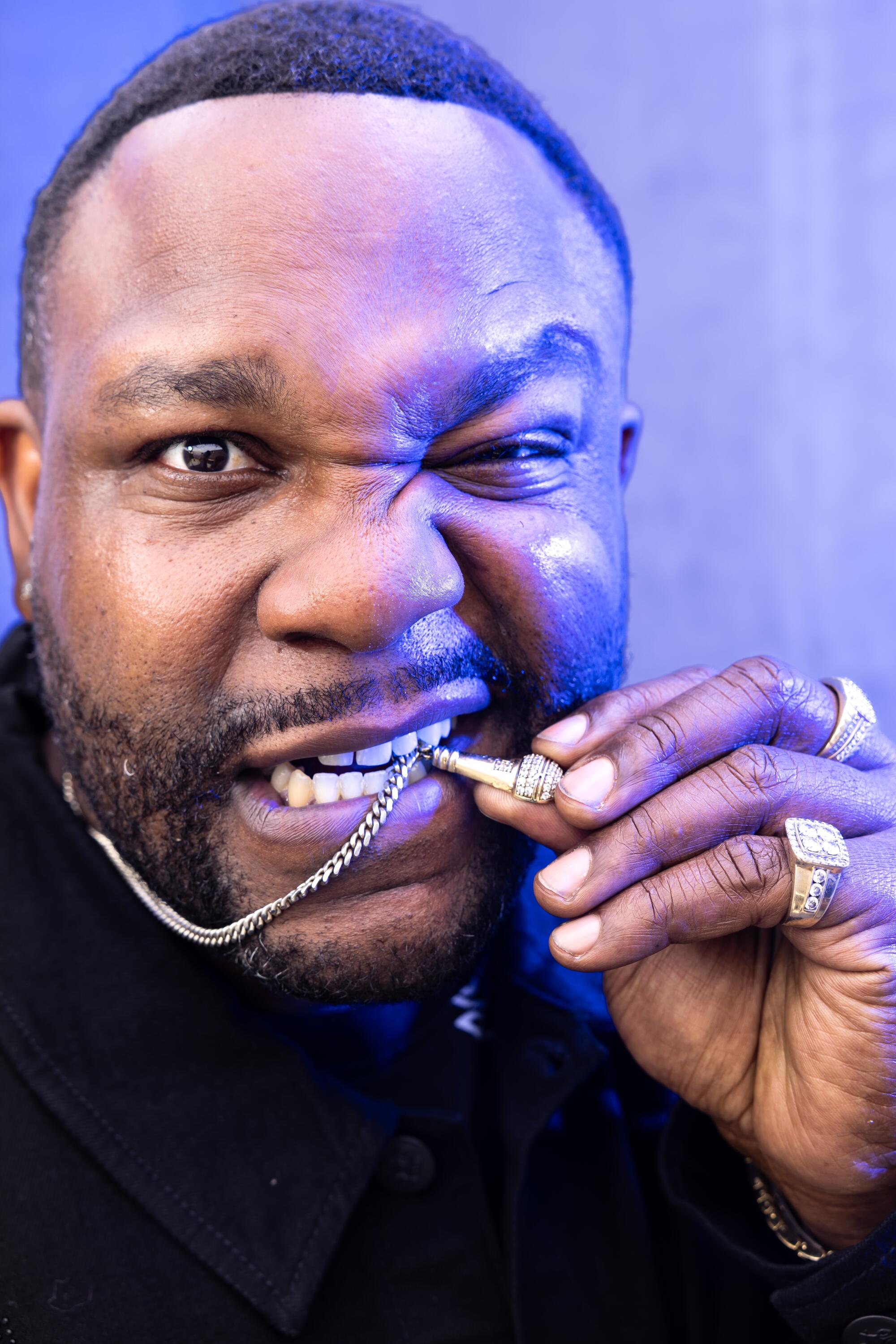
This year, the comedy world lost one of its biggest up-and-coming voices with the death of Ken Flores at age 28. Migrating from the Chicago stand-up scene to L.A., the loud comic made his presence known with raw, street-wise style, a diamond grill that made crowds smile before he even told a joke. Weight-related humor aside, Flores was undoubtedly one of the heavies in the local stand-up scene, and this half-hour comic assault is a time capsule of what could have been with this rising talent who left us too soon. (N.J.)
Bert Kreisher
(Robert Gauthier/Los Angeles Times)
Bert Kreischer, “Lucky” (Netflix)
Advertisement
Bert Kreischer resumes his shirtless razzle-dazzle and talent for hilarious, heartfelt storytelling in his special “Lucky,” inspired by his constant state of identifying the luck in his life. Most of that luck, let’s be honest, is actually the result of being married to his wife, LeAnn, who keeps him from going over the edge with his antics. If you’re into his brand of bare-chested misadventures, you will get plenty of that. But the heart of this latest hour doesn’t really show up until Kreischer’s moving tribute to his family’s dog, which will leave you laughing and crying right along with him. (N.J.)
Comedian CP, “Sunday After Six” (Veeps)
Chris Price, a.k.a. comedian CP, is a killer on the mic. Whether he’s hosting or headlining, comedy fans who’ve seen him perform know that his dragon-style delivery mixed with creative storytelling breathes fire onto any stage. His debut special, “Sunday After Six” puts all of his skills firmly on display in a way that will hopefully lead to our seeing more of him on the screen next year. (N.J.)
Trae Crowder, “Liberal Redneck” (YouTube)
Don’t judge a comedian by his accent, especially if it’s Trae Crowder. Though the Tennessee-born comedian describes his voice as having more Southern twang than “a racist banjo,” it takes him less than two minutes onstage to show why he’s known as “the Liberal Redneck.” Whether it’s punchlines skewering white supremacists or viral video rants about the Trump era filmed from the front seat of his sun-damaged Jeep, Crowder’s brand of comedy is a mind-melting combination that never minces words about where he stands on major topics related to America. His latest special, “Trash Daddy” — released on YouTube via comedy platform 800 Pound Gorilla — swerves among jokes about politics, family and living life as a hick from the sticks while trying to raise California-bred children. (N.J.)
Advertisement
Phoebe Robinson, “I Don’t Want to Work Anymore” (YouTube) Phoebe Robinson’s new comedy special dismantles girl-boss culture, questioning whether financial independence and constant achievement actually lead to women’s happiness. “I Don’t Want to Work Anymore” tackles modern dating, aging and the exhausting pressure to constantly create content. The 41-year-old comedian now prioritizes rest, boundaries and authentic work over relentless productivity and the need for external validation. (N.J.)
Tim Dillon, “I’m Your Mother” (Netflix)
Taped at the Comedy Mothership in Austin, Texas, “I’m Your Mother” is Tim Dillon doing what he does best, showering us with the confidence of a man who’s absolutely done pretending things make sense. From America’s never-ending identity crisis and celebrity worship to his own royal worship and to what parenting seems like from his view, he breaks down the world’s nonsense with the energy of someone who’s seen some s— and isn’t impressed. “I’m Your Mother” isn’t guidance, it’s a verbal smackdown wrapped in laughter that’s unremorseful and so well written, Tim Dillon is now our mother. (A.L.)
Kathleen Madigan, “The Family Thread” (Prime Video)
Kathleen Madigan’s “The Family Thread” gifts us an hour built on the everyday chaos and wry Midwestern sensibility that define her comedy. From absurd family group texts to aging parents and small-town quirks that feel instantly recognizable, she never fails to turn the frustrations of life into sarcastically sharp punchlines. “The Family Thread” is a master class on why Madigan has kept people entertained for years with nothing more than honesty and outstanding storytelling. (A.L.)
Advertisement
Mike Vecchione, “Low Income White” (YouTube)
Making a second special funnier than the first is effortless for Mike Vecchione, and “Low Income White” serves as an even sharper follow-up to his debut special, “The Attractives,” both produced by Nate Bargatze. Vecchione’s deadpan style and constant misdirection are on full display as he talks about age gaps, magic doctors and the reality of marital vows, piling on joke after sarcastic joke. (A.L.)
Ian Edwards, “Untitled” (YouTube)
Ian Edwards fires off rapid-paced jokes throughout his latest special, “Untitled.” At the Comedy Store in La Jolla, Edwards’ comfort onstage (in a onesie, no less) is in plain view as he riffs on relationships, confusing albinos, problematic travel, rooting for the wrong side of current events, and the many layers of racism in green-bubble texts. “Untitled” is a straight shot into the mind of Ian Edwards, and if you’ve slept on this special, there’s still time to fix that. (A.L.)
Ryan Sickler, “Live & Alive” (YouTube)
Advertisement
Ryan Sickler turned thick blood into sweet wine this year with his new special “Live & Alive.” His trademark candor (and giggle) drives the hour as he plays tour guide through a traumatic hospital stay that nearly became his last — plenty of morbid humor to go around in this hour. His survival is his own setup and punchline as he pulls you into embarrassing bits at his own expense. And every twist and ridiculous turn leaves you grateful he’s still around to tell the story while being “Live & Alive.” (A.L.)
Chinedu Unaka, “LOL Live With Chinedu Unaka” (Hulu)
For over a decade, L.A.-bred comedian Chinedu Unaka’s passion-driven work as a special education teacher would become the day job that both funded his dream and gave him the tools to achieve it as he held the attention of kids with ADHD while making them learn while laughing. Coming at comedy from the lens of a charismatic instructor with a Nigerian American background, Unaka’s quick wit and dry humor about life, relationships and his immigrant parents are on full display in his latest special. (N.J.)
Cameron Esposito
(Christina House/Los Angeles Times)
Advertisement
Cameron Esposito, “4 Pills” (DropOut)
A lot of comedy specials are made for us to sit and laugh at a comedian’s funny thoughts. In her latest special, Cameron Esposito wants to take things a step further by giving you a look inside her brain. As a person diagnosed with bipolar disorder at age 40, her mind offers a lot to unpack. But the goal remains the same as any special: to laugh at something we feel like we’re not supposed to, only to realize we can relate to a person’s struggles more than we think. In her latest hour, “Four Pills,” Esposito has honed a fresh perspective on living with bipolar disorder that forced her to take her 20 years of stand-up to the next level by bringing fans into the deepest part of her world for the first time. (N.J.)
Samantha Hale, “Horror Nerd” (Apple TV/ Prime Video)
Only Samantha Hale, raised in Los Angeles on “Top Ramen and fear,” could make hair-raising terror this funny. Her long-running show, “Horror Nerd,” jumps from the Hollywood Improv stage to the screen as she nostalgically riffs on serial killers, the healing power of stabby movies, and turns genre obsessions, cult-classic fandom and online feedback into an unbroken chain of laugh-out-loud brilliance. No topic is too strange or scary as she turns her passions and life’s oddities into “Horror Nerd,” a must-watch for anyone who loves humor one (bloody) bite at a time. (A.L.)
Jiaoying Summers, “What Specie Are You?” (Hulu)
Advertisement
Jiaoying Summers is a single mom and a comedian, and somehow she killed it in her first stand-up hour, “What Specie Are You?” on Hulu. Summers swings from dating after divorce and discovering her identity as an immigrant, to choosing favorites between her kids and breaking down an “Asian hate system” that’s so deadpan it almost feels reasonable. Blaming her lack of a filter on her Chinese upbringing, she will have you dying laughing one minute and feeling personally attacked the next. And that works. (A.L.)
In a roundabout way, the fact that I don’t have a strong attachment to The Wizard of Oz as a film (my late mother loved it, so that memory is deeply rooted in me, but the movie itself never did much for me) contributed directly to how amusing I found Gail Daughtry and the Celebrity Sex Pass to be. This comedy spoofs the plot of the classic fantasy movie, though the jokes are largely about Hollywood. The humor is big and broad, with some of the jokes really landing. Others? Not so much. Still, more than enough do to warrant a recommendation.
Gail Daughtry and the Celebrity Sex Pass gets a lot of mileage out of sending up show business, even if the observations, while funny, are not particularly new. Besides the deluge of jokes, there’s also a lot of likably broad characters to spend time with, especially our lead. They make the 90 minutes and change spent together with them go down very easy.
Sony Pictures Classics
For Gail Daughtry (Zoey Deutch), her life as a small town hairdresser is perfect. Engaged to her high school sweetheart Tom (Michael Cassidy), she’s the picture of happiness, at least until a trip to a celebrity book signing. There, Tom meets and ends up sleeping with his “celebrity pass,” a term Gail wasn’t even really previously aware of. Feeling betrayed, Gail impulsively joins her co-worker and friend Otto (Miles Gutierrez-Riley) on a trip to Los Angeles. There, a psychic convinces her that the can save her marriage by sleeping with her own celebrity pass: Jon Hamm (Jon Hamm).
Journeying through Tinseltown in a manner that recalls Dorothy’s adventure in Oz, Gail and Otto won’t have to find Hamm alone. Joining forces with talent agency assistant Caleb (Ben Wang), down on his luck paparazzo Vincent (Ken Marino), and actor John Slattery (John Slattery). As they search for Hamm, some for their own purposes, they meet other celebrities, while also being hunted by a group of Italian assassins after a case of mistaken identity. Eventually, they come across Hamm, and the moment of truth is at hand.
Sony Pictures Classics
Zoey Deutch dives headfirst into a broad comedy like this, absolutely relishing the opportunity to get silly again. She’s able to make Gail a babe in the woods but also someone you laugh with, not at. It’s a wildly enjoyable turn. Deutch started out in comedies and was always a talented comedic actress, so it’s a pleasure to watch her back at it. Miles Gutierrez-Riley and Ben Wang get some very funny moments, while Ken Marino is a reliable comic presence. Jon Hamm and John Slattery are delighted to be sending up themselves, with amusing results. Supporting players here, in addition to Michael Cassidy, also include Kerri Kenney, Richard Kind, Thomas Lennon, Joe Lo Truglio, Fred Melamed, and more, plus some cameos.
Advertisement
Filmmaker David Wain, again co-writing with Ken Marino, continues to make it look easy. Few can make a silly comedy like Marino and Wain, especially as they pack their flicks with extra bits that only subsequent viewings reveal. Is Gail Daughtry and the Celebrity Sex Pass on the same level as Wet Hot American Summer or They Came Together? No, not quite. At the same time, is this, scattershot approach and all, funnier than most other 2026 releases? You bet. Marino and Wain have a hit rate that allows some of the jokes to miss, as you only have seconds to wait before the next one, which probably will hit.
Gail Daughtry and the Celebrity Sex Pass is very amusing, and occasionally hilarious, even if not as many jokes land as you might expect. Zoey Deutch is great in the lead role, David Wain is in his comfort zone, and the laughs come hot and heavy. If you’re a Wain fan, this new movie should be a must see.
Right now in Los Angeles it’s Wes Week, with multiple tributes to the career of filmmaker Wes Anderson, known for his fastidious visual style, melancholy longing and nerd-chic aesthetic.
On Monday night there was a sold-out 30th anniversary screening of Anderson’s debut feature, “Bottle Rocket,” at the Academy Museum with the filmmaker making a rare in-person L.A. appearance. He sat for a warmly endearing Q&A with actor Luke Wilson and director James L. Brooks, an early champion who executive-produced.
Then on Friday, Saturday and Sunday, the Hollywood Bowl will have three nights celebrating the music of Anderson’s films, hosted by the director’s 10-time fixture, Bill Murray. Among those scheduled to perform are Beck, Jenny Lewis, Karen O, Rufus Wainwright and Devo, among many more. Other surprise guests may appear as well, performing songs familiar from Anderson’s music-stuffed movies.
“I was surprised how many things we did have to leave out,” Anderson, 57, tells The Times in a recent interview conducted via voice notes (his personal preference) recorded from Paris, where he has long lived. “There’s so much music over all these movies because I’ve been doing them for so long. We could do a whole other round of this, but let’s see how it goes on this first one.”
Because of his unique use of music, combining left-field vintage pop songs with classical pieces and original scores by favored composers Alexandre Desplat and Devo’s Mark Mothersbaugh, there have been frequent requests over the years for live performances, but Anderson and his longtime music supervisor Randall Poster have always declined — up until now and this ambitious three-night event at the Bowl.
Advertisement
“From the moment that he said yes we’ve been on the phone talking about his vision and how to execute it,” says Johanna Rees, vice president of programming and creative partnerships at the L.A. Phil, during a recent call from San Diego. “It’s about exploring and celebrating so many styles of music. It’s been such a fun adventure.”
Kara Hayward and Jared Gilman in Wes Anderson’s 2012 movie “Moonrise Kingdom.”
(Focus Features)
This will be more than a typical evening at the Bowl, with dedicated Anderson-branded merchandise and uniformed bicycle riders dispensing candy. “The plan is you walk into the Hollywood Bowl and you are immersed in the world of Wes Anderson,” Rees says.
Advertisement
Criterion, which has long put out high-end home video editions of Anderson’s work and recently issued a 20-disc box set, will also have a special presence at the Bowl. Alongside the popular Criterion Mobile Closet making another stop in L.A., there will also be a lounge, a listening booth and a screening room showing Anderson’s movies as well as ones curated by him, including “Yojimbo,” “Amarcord” and “Belle de Jour.”
“Wes is an amazing community-builder as a human being,” said Peter Becker, president of Criterion, in a video call from the Il Cinema Ritrovato Festival in Bologna, Italy. “If you look at his films and the people he’s been working with consistently, we’re not the only ones who’ve been part of the greater Wes Anderson family for the last 25-plus years. How could we not be a part of this?”
From left, Jason Schwartzman, Adrien Brody and Owen Wilson in the movie “The Darjeeling Limited.”
(Fox Searchlight Pictures)
Music supervisor Poster met Anderson in 1996 at L.A.’s Original Farmers Market shortly after “Bottle Rocket” was finished and immediately began to assist in pulling together the soundtrack release. Though the CD at the time could not include some of the key songs from the movie, these Bowl events will finally offer a flexi-disc of the Rolling Stones’ “2000 Man” as well as a limited-edition yellow vinyl 12-inch record with two songs by the band Love.
Advertisement
The two have worked together on all of Anderson’s films since, with a process that is constantly developing.
“Sometimes we’ve been talking about it even before the film takes shape,” says Poster on a recent phone call from New York. “We get to that point where I feel informed to a certain degree, that we’ve identified an element or two, whether it’s a composer, a specific song, a specific band that allows us to sort of start weaving it together. Sometimes we have more details, and sometimes we’re in a little bit more of a process of discovery.”
As impeccably detailed as his movies can be, Anderson acknowledges that his method can still be a bit vague. “I really couldn’t tell you what it’s all about, where it came from or why,” he says. “It’s just totally instinctive.”
One of the most indelible moments in Anderson’s repertoire is Gwyneth Paltrow’s slow-motion exit from a bus in “The Royal Tenenbaums” to the sounds of Nico’s 1967 recording of the song “These Days,” perfectly capturing a tender, delicate rush of emotions.
“That music was part of the inspiration for the entire movie,” Anderson recalls. “There’s a Ravel string quartet in F Major and this song — those two things together, for whatever reason, suggested something to me that slowly became the whole movie. With Gwyneth Paltrow coming off of the bus, we played the music on the set. It was all a bit choreographed to that.”
Advertisement
“Everybody wanted to do ‘These Days,’ ” says Poster of the artists lined up for this weekend’s shows. “But Jackson Brown wrote ‘These Days’ and Jackson Brown is going to perform ‘These Days.’ Nobody could really argue with that one.” (The rest of the song choices and performers are being kept under wraps.)
Ben Stiller, left, Gwyneth Paltrow and Gene Hackman in the 2001 movie “The Royal Tenenbaums.”
(James Hamilton / Touchstone Pictures)
In choosing music for the movies, inspiration can strike from just about anywhere, as with the Johnny Duncan and the Blue Grass Boys’ recording of “Last Train From San Fernando,” memorable from the opening credits of 2023’s “Asteroid City.”
“I knew that song because my daughter used to listen to it,” says Anderson. “She had a CD of western swing from the ’50s and ’40s that she was listening to again and again. So I stole it from her.”
Advertisement
Poster mentions Anderson’s affinity for woodwinds and novelty instruments along with his tremendous sense of rhythm, which is why the music often has a strong percussive feel, from Gene Krupa’s “Drum Boogie” in last year’s “The Phoenician Scheme” to Japanese taiko drums and the work of composer Peter Jarvis.
“I would say that I think the biggest change is that Wes has taught himself how to read music,” says Poster. “He just really gets into the score’s DNA and really has a great insight into how to arrange thematic pieces that I think help make the movies more wholesome, just being a whole thing.”
Poster playfully refers to Anderson as “The Maestro” and remains struck by how fresh the music cues feel in the context of the films.
“When those clips come on — ‘Here Comes My Baby,’ ‘A Quick One, While He’s Away,’ ‘These Days,’ ‘Needle in the Hay,’ ‘Ooh La La’ — I mean, countless, countless, I always get a kick out of it.”
All of which should add up to a special alchemy at the Bowl.
Advertisement
“They won’t happen again,” says Rees of the three nights curated by Anderson. “Not knowing what he’s going to do in the future, but certainly this is a special event, a one-of-a-kind weekend. It won’t be happening like this again.”
For Anderson, putting together the Hollywood Bowl shows has been a reminder of how far his work has evolved.
“When we made ‘Bottle Rocket,’ I didn’t intend to have an original score at all,” he remembers. “We had some Ennio Morricone music. We put Bob Dylan’s ‘Pat Garrett and Billy the Kid’ in the movie originally — and that’s a score from somebody else’s movie. At a certain point everything sort of changed, and Mark Mothersbaugh came and saw the movie and he liked everything we had in there. And so he brought his own voice in, but from the point of view of somebody who was very sympathetic to what was already in place, and that led to more movies together.”
Showing a bit of his own trademark wistfulness, he adds, “It is quite an amazing thing to have Mark and Devo coming up on the stage to do this music that reflects back on all these years — this whole gathering.”
Supergirl Director: Craig Gillespie DC Studios, Troll Court Entertainment, The Sagan Company In theaters: 06.26.2026
I was a pretty big fan of James Gunn’s Superman. Building up to the release of the film, I relapsed into my comic book obsession, which I had laid to rest many years prior. I read whatever you get recommended when you look up “Superman comic recommendations:” For All Seasons, All Star, Birthright — whatever, you don’t care. David Corenswet’sportrayal of Big Blue was loving, thorough and unbelievably human, which is what Superman is (he’s not Jesus). He is the best of us. He is what we aspire to be.
Supergirl was announced, and I picked up the comic it was based on: Supergirl: Woman of Tomorrow. The questionable morals and talent of author Tom King aside, the book is good! The fantastic art by Bilquis Evely makes King’s (sometimes preachy) prose this beautiful and somber story about trauma and war. It appears that I’m ahead of director Craig Gillespie, who reportedly didn’t read the book and, boy, does it show.
Advertisement
During a bender, Superman’s cousin Kara (Milly Alcock, House of The Dragon)meets Ruthye (Eve Ridley), a child whose family is murdered by Krem (Matthias Schoenaerts, Amsterdam, The Old Guard), the leader of a raider group. She enlists Kara to hunt and kill him, and on their way, they confront their traumas.Kara faces Krem, the films antagonist, retold as an all-powerful kryptonite wielding brute. Photo courtesy: DC Studios.
Every change made from the original comic was for the worse. Most notably, this film simplifies the depth of the comic’s characters. Kara is reduced to a loud, charming alcoholic, which is fine, but in the comic, she’s somber and reflective, making an effort to teach Ruthye how the greater universe works. The antagonist, Krem, is sort of a loser in the comic. He’s a coward who spends his time running away, while in the film he’s a tattooed, pierced, menacing psychopath who appears in almost every major action sequence. He’s almost indistinguishable from The Joker — this all boils down to shame. While they’re becoming increasingly popular, comics are still for losers. Hinting at depth with characters who fly and shoot lasers from their eyes in brightly colored underpants isn’t something that a general audience will accept. They will accept a comic film so long as it constantly flogs itself for being comic-inspired.
Another bastardization is the look of this film. Everly’s amazing use of color in the comic makes the story so engaging. How is this translated? Brown. Just brown. When characters clash, it looks like someone’s wiping their finger across their dirt-covered lens, which is a total departure from Gunn’s fantastic color palette in Superman. The visual effects appear to be rushed and often look horrible — laughably horrible, as a matter of fact. How do you spot a bad action director? Look at the editing. If they have to hide poor action choreography and bad visual effects behind dizzying amounts of cuts, they’re bad. Gillespie is a bad action director. James Gunn promised that the DCU would prioritize artist voice over universal coherence, but if these are the artists he’s hiring, I’m not sure how long this could last.
Performances here are whatever. Alcock could have been good if the script and direction were right, but they’re not. I couldn’t get into Krem due to character assassination, but even if I wasn’t into the comic, I would find his performance as a crazy guy to be a standard for bad superhero movies. Ridley is good, especially for a debut in feature films, but the standout is Jason Momoa (Aquaman, A Minecraft Movie) as Lobo. He is loving the character, absolutely chewing up the scene with thick cigars. He’s a little cheesy-edgy, but that’s just what he is in the comics, so I won’t knock him for it.
While I was watching the film, I was suffering from a discrepancy. Supergirl is as powerful as Superman, but throughout this film, she doesn’t use her powers to their full potential. Something I actually loved about Superman is how much he got his ass kicked. Gunn was out to prove that Superman fights can have stakes — that he’s not just undefeatable and therefore boring as everyone says. Gunn’s ability to create ways to kill the Man of Steel without Kryptonite is amazing! Kara, in this film, is fighting space pirates and constantly forgets to finish the fight. It’s frustrating because the remedy to this in the comic is that they don’t see Krem until the last couple of issues, but in this film, Krem keeps showing up to menace Supergirl, and most of the time she has her powers.
Advertisement
I could ramble about how bad the dialogue can be, how derivative and uninspired it is or whatever lame comic thing I can talk about, but I’ll spare you. Here’s the moral of all this: Comic books are a valid storytelling medium. I recall recommending Alan Moore’sWatchmen to someone and being told that they have more important things to read. Watchmen is one of my favorite works of fiction. I did end up falling out of love with comics because I was told they were childish and I had grown bored of having costumes thrust into my peripherals all the time, but I’m back now, and I love them so much more than ever. I loved Superman because, above all else, it was earnest. There wasn’t a self-deprecatory tone toward its own plot. It didn’t try to bog its drama down with one-liners. It was just proud to be a comic book movie, and I think more movies should.
If you want to see Supergirl, go ahead, but I’d advise you to just read the comic, which is more dramatic, more meaningful and more impactful. —B. Allan Johnson
Read more reviews from B. Allan Johnson below: Film Review: The Bride! Film Review: Backrooms
Advertisement
Do you enjoy SLUG’s film reviews? Consider becoming one of our donors!





 Sony Pictures Classics
 Sony Pictures Classics


