California
Trump’s Department of Energy targets California and other blue states for budget cuts, according to internal documents

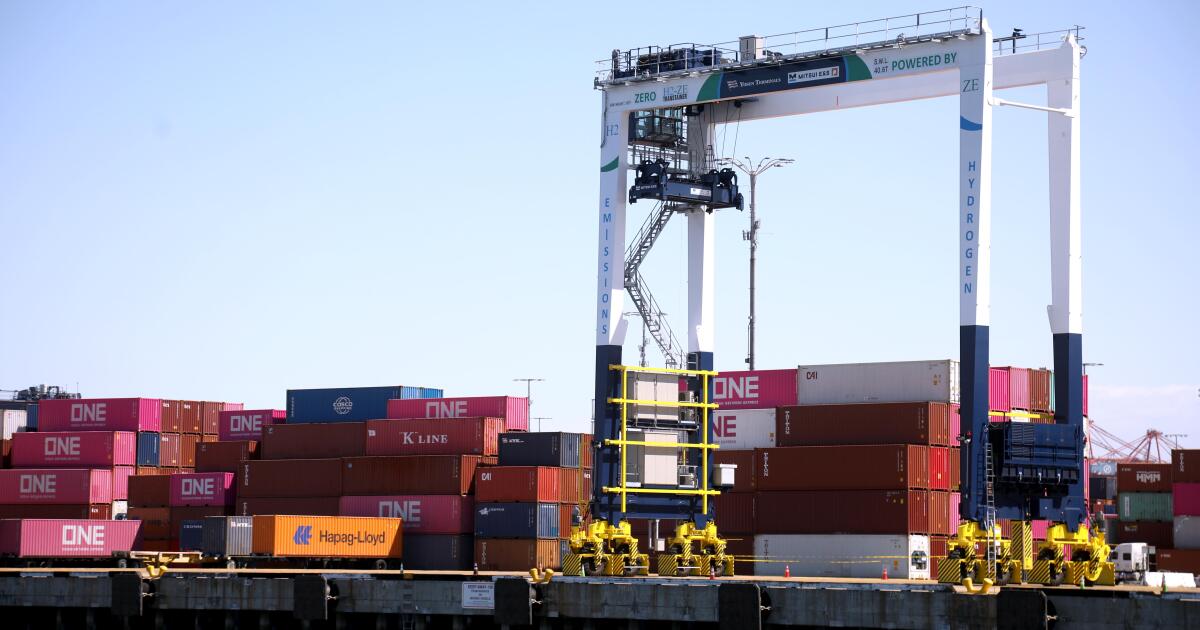
The Trump administration’s efforts to dismantle environmental protections and roll back nationwide progress toward clean energy disproportionately target California and other blue states, internal documents show.
As early as this week, the Department of Energy may pull funding from hundreds of projects — many of which were bolstered by President Biden’s bipartisan infrastructure law and are geared toward climate-friendly initiatives such as solar power, heat pumps, battery storage and renewable fuels, according to a leaked list reviewed by The Times.
The cuts could include as many as 262 projects in the DOE’s Office of Energy Efficiency and Renewable Energy, of which roughly 80% are based in states that did not go for Trump in the 2024 presidential election.
Also on the chopping block are nearly two dozen projects in the Office of Clean Energy Demonstrations, including a major national effort known as the Regional Clean Hydrogen Hubs (H2Hubs) Program, which aims to accelerate the development of hydrogen projects that can replace planet-warming fossil fuels.
Those cuts, too, are not applied equally: Of the seven states and regions selected to participate in the $7-billion federal hydrogen project, the four set to be gutted are in primarily Democratic areas.
The hydrogen incubators on the cut list include a hub in California; a Mid-Atlantic hub in Pennsylvania, Delaware and New Jersey; a Pacific Northwest hub in Oregon, Washington and Montana; and a Midwest hub in Illinois, Indiana and Michigan.
Meanwhile, the hydrogen hubs in red states and regions are safe, the list shows, including a large hub in Texas; a “heartland” hub in Minnesota, North Dakota and South Dakota; and an Appalachia hub in Ohio, West Virginia and Pennsylvania.
Officials with the Department of Energy did not immediately respond to a request for comment.
California was among 33 applicants for the competitive initiative, which launched in 2021 and ultimately selected seven “hubs” to develop and test various sources of hydrogen.
The California hub — known as ARCHES, or the Alliance for Renewable Clean Hydrogen Energy Systems — was awarded $1.2 billion in federal funds, with plans to bring in an additional $11.2 billion from private investors.
But it now faces cuts from Trump’s DOE despite the fact that the hub was the highest-scoring applicant among those considered for the federal award, according to sources familiar with the matter.
Democratic staff members with the House Science Committee who agreed to speak on background said the findings indicate that the cuts are partisan and ideological in nature — a trend in keeping with other actions from the Trump administration, which has repeatedly targeted environmental programs in California and other Democratic areas in recent weeks.
Indeed, cost alone does not appear to be a factor, given that Texas’s hydrogen hub received the same amount of federal funding — $1.2 billion — as California’s, yet the former was not on the cut list. The two states’ projects were the costliest of the hubs, which range from roughly $750 million to $1.2 billion.
The total cuts from the DOE’s Office of Energy Efficiency and Renewable Energy amount to more than $905 million, with about $735 million coming from blue states and $169 million from red states, according to a Times analysis.
Insiders said the proportions do not reflect overall clean energy investments by red and blue states, with Republican states such as Texas — a clean energy juggernaut — facing far fewer cuts from that office. According to documents reviewed by The Times, only eight Texas projects are on the chopping block compared with 53 in California.
House Science Committee staffers cautioned that the leaked lists represent a snapshot in time and that the administration could change its plans before making any official announcements.
Already, they said, some Republican representatives and private industry leaders have been successful in stopping certain projects from being canceled. So far, none of their Democratic counterparts have been able to do the same, they said.
The cuts could have considerable implications for the nation’s energy future.
The seven hydrogen hubs were collectively expected to produce 3 million metric tons of hydrogen each year — reducing 25 million metric tons of carbon dioxide emissions, or roughly the amount of 5.5 million gas-powered cars.
Each of the seven hubs was experimenting with different sources of hydrogen, with California focused on producing hydrogen exclusively from renewable energy and biomass while other hubs worked with natural gas, nuclear power and renewable sources such as wind and solar.
Officials with ARCHES said it could be weeks before they have more clarity on the situation.
“ARCHES remains committed to working with our partners to establish a secure, reliable and competitive hydrogen ecosystem, creating hundreds of thousands of good-paying jobs and delivering substantial health and economic benefits for Californians,” Chief Executive Angelina Galiteva said in a statement. “We have nothing more to share at this time.”
Hydrogen is also not without controversy. Critics have expressed concern that producing hydrogen is water- and energy-intensive, potentially dangerous to transport and expensive.
Supporters say it fills in a key gap that electrification alone cannot cover, particularly for heavy industries such as manufacturing and transportation.
ARCHES planned to fund at least 37 smaller projects in and around California, including efforts to decarbonize the Port of Los Angeles, as well as plans to install more than 60 hydrogen fueling stations around the state.
The status of those projects remains unclear.
The president — who received record donations from fossil fuel companies during his campaign — has taken aim at what he describes as “environmental extremists, lunatics, radicals and thugs” in recent weeks, vowing instead to ramp up the production of coal, increase oil drilling and block California’s efforts to transition to electric vehicles, among other actions.

California
Live Updates: Candidates face off in the CBS News California and San Francisco Examiner Governor’s Debate

Learn more about candidates’ stances on the issues in the California Governor’s Race interactive guide
CBS News California launched an interactive tool to help voters navigate this year’s gubernatorial race. The California Governor’s Race Candidate Guide features 20 hours of interviews with top-polling candidates to provide voters the opportunity to compare each candidate’s responses side-by-side on the issues that matter most to them.
Those running to succeed Gov. Gavin Newsom as California’s next chief executive offered their thoughts on more than a dozen issues, including homelessness, housing affordability, gas prices and environmental policy, immigration, healthcare, crime and public safety funding, and the state’s ongoing insurance crisis.
Here’s what to know about the CBS News California/San Francisco Examiner Governor’s Debate format
The format of the CBS News California and San Francisco Examiner Governor’s Debate on Thursday will allow candidates to question each other directly.
Candidates will also participate in segments in which they address real-world issues California voters may face in their daily lives. The Californians who will be featured include a working single mother pursuing education; a couple struggling to achieve homeownership; and a scientist warning of the long-term consequences of inaction on climate change.
This structure for Thursday’s debate differs from the previous face-off hosted by CBS News California stations, which comprised three segments focused on affordability, accountability and social issues that lasted roughly half an hour each.
Becerra, Hilton, Steyer lead field in latest polling on California governor’s race
An Emerson College poll released the day before the CBS News California and San Francisco Examiner Governor’s Debate showed Xavier Becerra leading the field with likely voters surveyed at 19%, followed by Steve Hilton and Tom Steyer both receiving 17%. Chad Bianco came in at 11%, followed by Katie Porter at 10%, Matt Mahan at 8%, Antonio Villaraigosa at 4% and Tony Thurmond at 1%. Twelve percent said they remained undecided.
In a CBS News/YouGov poll last month conducted before the April 28 CBS California Governor’s Debate, Hilton received support from 16% of likely voters polled, with Steyer and Becerra following at 15% and 13% respectively. Bianco came in at 10%, Porter received 9%, Matt Mahan and Antonio Villaraigosa both received 4%, and Tony Thurmond received 1%. The survey also found that a significant 26% of those polled were undecided.
California’s June 2 primary is an open primary where the top two vote-getters, regardless of party affiliation, advance to face off in the November general election.

By Dan Walters, CalMatters
This commentary was originally published by CalMatters. Sign up for their newsletters.
Two decades ago, when California got serious about reducing or even eliminating carbon dioxide and other greenhouse gases, its political leaders weighed two potential tactics about industrial emissions.
The state could impose direct facility-by-facility limits, generally favored by climate change advocates. Or it could set overall emission reduction goals that would gradually decrease and auction off emission allowances, assuming their costs would encourage reductions.
The latter, known as cap-and-trade, was favored by corporate interests as being less onerous and was adopted, finally taking effect in 2012.
Since then, the California Air Resources Board has conducted quarterly auctions of emission allowances, collecting a total of $35 billion dollars so far, which, in theory, is being spent on projects that would reduce emissions.
The revenues have varied from year to year, but they have generally increased as the emission caps have declined. Since reaching a peak of $8.1 billion in the 2023-24 fiscal year, however, auction proceeds have been declining.
Roughly half of the money has been given to utilities to minimize cap-and-trade’s impact on consumer costs. However, the program has been widely criticized as a de facto tax on gasoline and other fuels, which were already among the most expensive of any state.
The remaining revenues have been deposited into a Greenhouse Gas Reduction Fund that governors and legislators have tapped for various purposes, not all of them connected to emission reductions. In a sense, it’s been a slush fund.
Last year Gov. Gavin Newsom and the Legislature overhauled the program in two bills, Senate Bill 840 and Assembly Bill 1207. The program was extended, it was renamed as cap-and-invest and new priorities for spending auction proceeds were set.
Notably, the state’s cash-strapped and long-stalled bullet train project would get a flat $1 billion a year, rather than the 25% share it had been getting. Project managers hope that lenders will advance enough money to complete its first leg in the San Joacim Valley; the plan is to repay the loans from the $1 billion annual cap-and-invest allocation.
Early this year, the Air Resources Board released new regulations to implement the legislative changes but faced criticism that they would increase consumer costs. That led to a revision in April that softens the rules’ impact — most obviously on refiners who have been threatening to leave California — but environmental groups are very critical.
The April version would also sharply reduce net revenues from emission auctions, according to the Legislative Analyst’s Office, providing barely enough for the $1 billion allocation to the bullet train and another $1 billion for the governor and Legislature to spend. Other programs that have been receiving cap-and-invest support, such as wildfire protection and housing, would probably get nothing.
The program has been tapped in recent years to backfill programs that a deficit-ridden state budget could not cover, so the projected revenue drop would exacerbate efforts by Newsom and legislators to close the state budget’s yawning gap.
“The (Greenhouse Gas Reduction Fund) is a relatively small portion of the overall state budget, but it has been a noteworthy source of funding for environmental and other programs in recent years,” the state Assembly’s budget advisor, Jason Sisney, says in an email. “Collapse of its revenues would change the state budget process noticeably. The state’s cost-pressured general fund seemingly would be unable to make up much, if any, of a significant (Greenhouse Gas Reduction Fund) revenue decline at this time.”
When Newsom presents his revised budget this week, he may reveal how he intends to cover the cap-and-invest program’s shortfall, particularly whether he will maintain the $1 billion bullet train commitment that project leaders say is vital to continuing construction of its Merced-to-Bakersfield segment.
It could boil down to bullet train vs. wildfire protection.
This article was originally published on CalMatters and was republished under the Creative Commons Attribution-NonCommercial-NoDerivatives license.


Vance says Trump cares about Americans finances amid Iran debate
Vance pushes back on claims about Trump and says Americans finances matter as the administration weighs Iran and nuclear diplomacy.
Vice President JD Vance announced on Wednesday, May 13 that the Trump administration will be deferring $1.3 billion in Medicaid reimbursements from the state of California, as part of a new initiative to root out fraud in federal health programs.
The topic of California’s hospice care fraud has been a major focus of scrutiny by state leadership, members of President Donald Trump’s administration, and Gov. Gavin Newsom’s critics. In his announcement, Vance claimed that the administration was set on deferring these funds “because the state of California has not taken fraud very seriously.”
“There are California taxpayers and American taxpayers who are being defrauded because California isn’t taking its program seriously,” Vance said during a press conference.
Notably, this decision was part of Vance’s Anti-Fraud Task Force’s plan to implement a six-month nationwide, data-driven moratorium on new Medicare enrollment for hospices and home health agencies.
The Centers for Medicare and Medicaid Services, which is led by Dr. Mehmet Oz, is set to use this six-month moratorium to conduct investigations and review data on Medicare programs, with the hopes of removing hospice and home health agencies that are suspected of committing fraud.
“Today we’re shutting the door on fraud — preventing new bad actors from entering Medicare while we aggressively identify, investigate, and remove those already exploiting them,” Oz said. “This is about protecting patients, restoring integrity, and safeguarding taxpayer dollars.”
California Attorney General Rob Bonta called the administration’s action “unlawful” and noted that his office would be “carefully reviewing all available information” and may challenge the administration’s decision to threaten “Californians’ rights or access to critical services.”
“Once again, California appears to be targeted solely for political reasons,” Bonta said on X.
“The Trump Administration is planning to defer over $1 billion in Medicaid funding for vital programs that help seniors and people with disabilities remain safely in their homes.”
Bonta and his office have attempted to counteract criticism that the state does not take action against hospice fraud.
In April, Bonta announced that the California Department of Justice had arrested five people in connection with a major health care scheme in Southern California that defrauded taxpayers of nearly a quarter of a billion dollars.
“For years, California has led the charge to protect public programs from fraud and abuse,” Newsom said in the press release on April 10. “We hold accountable to the fullest extent of the law anyone who tries to rip off taxpayers and take advantage of public programs, particularly those as sensitive as hospice care.”
Newsom has yet to publicly respond to the administration’s decision to defer California’s Medicaid reimbursement.
However, shortly after Vance made the announcement, Newsom’s press office blasted the decision on X.
“We hate fraud. But that’s NOT what this is,” Newsom’s press office posted on X. “Vance and Oz are attacking programs that keep seniors and people with disabilities OUT of nursing homes. Pretty sick.”
Noe Padilla is a Northern California Reporter for USA Today. Contact him at npadilla@usatodayco.com, follow him on X @1NoePadilla or on Bluesky @noepadilla.bsky.social. Sign up for the TODAY Californian newsletter or follow us on Facebook at TODAY Californian.
-

 North Dakota35 seconds ago
Dust storms rage in North Dakota and South Dakota
-

 Ohio7 minutes ago
Manufacturing history unfolds at North Central Ohio Industrial Museum
-

 Oklahoma13 minutes ago
Oklahoma becomes latest state to sue Roblox over child safety concerns
-

 Oregon19 minutes ago
Oregon man shot at In-N-Out drive-thru drove family to safety with bullet lodged in head
-

 Pennsylvania25 minutes ago
An Outpouring of Frustration Over Pennsylvania’s Rapid Data Center Growth – Inside Climate News
-

 Rhode Island31 minutes ago
Flags are at half-staff in Rhode Island today. Here’s why
-

 South-Carolina37 minutes ago
South Carolina Lottery Pick 3, Pick 4 results for May 14, 2026
-

 South Dakota43 minutes ago
Mr. Basketball award is presented annual by Hansen Anderson Basketball