Arizona
Top Arizona water official has backup plan if states can't work out deal to divide Colorado River water
By Howard Fischer
Capitol Media Services
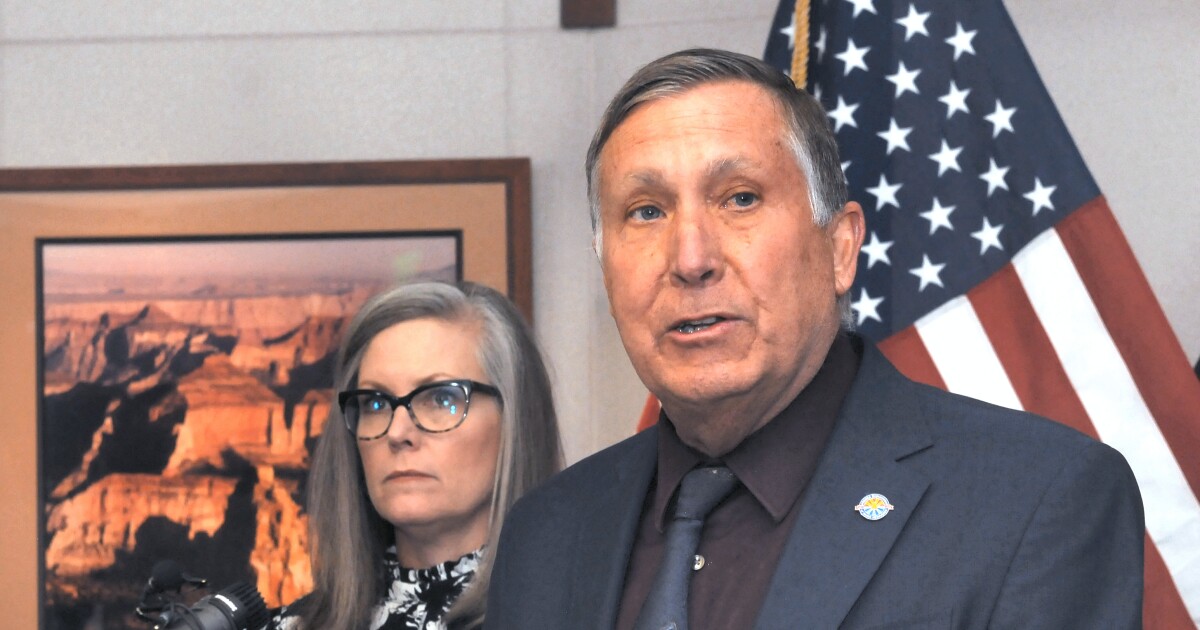
PHOENIX — The state’s top water official is making contingency plans for a court fight if a deal can’t be worked out with other states for how to divide up Colorado River water in 2026 and beyond.
Tom Buschatzke wants Gov. Katie Hobbs and state lawmakers to give him $1 million in what he is calling a “set-aside appropriation” in case there is no agreement — at least not to the state’s satisfaction — in the ongoing negotiations over the river.
Ideally, he said, it won’t be necessary and the seven states, various tribes and federal agencies will work out a deal. But the director of the Department of Water Resources told Capitol Media Services that is far from a sure thing.
“We don’t want war, we want peace,” he said of himself and water officials from the other six states that share in river water. “We want a collaborative solution.”
That also means working it out among themselves versus having something imposed on them by then courts or Congress, a fiat that could result in orders to make nearly impossible reductions in Arizona’s access to the river.
And it’s not like conditions are likely to get better.
“We’re getting projections from climate change scientists that our future is more drier — and maybe even more drier than maybe over the last 20 or so years,” Buschatzke said.
The immediate problem is that the federal Bureau of Reclamation says that climate and other projections show that total available water in the system will need to be cut by up to another 4 million acre feet a year — above and beyond already imposed and voluntary reductions.
More to the point, the upper basin states of Colorado, New Mexico, Utah and Wyoming don’t want to share in the burden. Instead, they want all of that reduction to come from the lower basin states of Arizona, California and Nevada which they say have drained the reservoirs and should be responsible for refilling them
“There is a significant possibility that this process could result in litigation between the states,” Buschatzke said. “In the event that there is litigation, the most likely venue for the proceedings would be federal court, the U.S. Supreme Court, or both.”
Hence, he said, the need for the money.
“If the collaborative and cooperative partnership does not bear fruit, Arizona may need to react/engage in legal action to protect its current 2.8 million acre feet of Colorado River entitlement,” Buschatzke said. “Litigation can be a very lengthy and expensive process.”
But the request for funds is more than about having $1 million set aside to hire lawyers should a court fight become necessary. Buschatzke also is seeking to send a message to the other states that Arizona will not be bullied.
“It is a significant commitment to demonstrate Arizona’s commitment to protecting its entitlement from the Colorado River,” he said.
All this comes as the current guidelines for operations of the river expire at the end of 2025. And the director of the Department of Water Resources said his agency is currently involved in negotiations with the seven “basin” states that all claim a share of the Colorado River as well as the U.S. Bureau of Reclamation.
What Buschatzke wants is to maintain its current entitlement to 2.8 million acre feet a year. An acre foot is generally considered enough to supply three homes for a year. That, on paper, is Arizona’s share of the 15 million acre feet of river water.
States, however, haven’t taken their full allocation for years amid historically dry weather.
The lower basin states are entitled to 7.5 million acre feet. This past year they took less than 5.9 million acre feet.
And this year Arizona is taking only about 1.9 million acre feet of its 2.8 million allocation, agreeing to leave water in Lake Mead to ensure that does not dry up to a point where no water flows through the dam.
Now it’s about what happens next.
The Bureau of Reclamation is set to issue an Environmental Impact Statement in December. That should have the final numbers of what the agency expects to be available in Colorado River water for the foreseeable future.
A balanced approach, said Buschatzke, would be for half of that 4 million acre feet — or whatever the final number will be — allocated among the upper basin states, with the balance among the lower basin states. Put simply, it’s easier — and less painful — on any one state if all share.
And that’s particularly important for Arizona which has a “junior priority” over the available water.
But to this point, he said, the upper basin states want no part of it. In fact, Buschatzke said, the upper basin states want more water left in Lake Powell, something he said would have the ripple effect of making less water available for Lake Mead.
“We can’t come to a place where Lake Powell is three-quarters full and Lake Mead is essentially empty,” he said.
What’s also important, said Buschatzke, is coming up with more than a stop-gap plan that lasts just three or four years. He said any agreement should go out at least 20 years or more.
All this comes back to Buschatzke’s decision to request $1 million for the legal fight that may be on the horizon.
“I have a responsibility to do due diligence and be prepared for multiple potential outcomes,” he said.
“One of those potential outcomes could be a time at which the Central Arizona Project could be completely dry because of certain interpretations of what a junior priority might mean,” Buschatzke said. “And I think you could imagine that that would be quite an economic and political disaster for that outcome.”
A spokesman for Gov. Katie Hobbs said no decision has been made whether to include his request in what she submits to the Legislature in January.
And if its not funded this coming year?
“Arizona faces the possibility of being unprepared for legal action regarding its Colorado River entitlement in the event that the current collaborations and negotiations do not bear fruit,” he said.
—–
On X and Threads: @azcapmedia

Arizona
Arizona’s Burries Shares Secret to Latest Scoring Outburst
The Arizona Wildcats dominated once again to push their record to 15-0 on the season, cruising to an easy 101-76 victory over Kansas State in their Big 12 home opener.
The Wildcats scored 100 points in a game for the third time this season, led by freshman guard Brayden Burries’ 28 points, and Motiejus Krivas’ 25 points. Burries is now up to 15.1 points per game on the season, which leads the #1-ranked Wildcats.
Secret to points production
Burries has been on a tear scoring the ball of late. After scoring in double-digits in just one of his first five games this season, Burries has scored in double-figures in each of his last 10 games, including five 20-point performances. His 28 points against Kansas State tied his highest point total of the season so far. After the game, Burries was asked about his recent flurry of scoring.
- “I don’t think anything changed,” Burries said. “I think just getting used to the speed out there, the first few games, and I didn’t play guard as much like on the ball, and guarding point guards, so it’s all new to me. But, more games, more experience, I feel like I’m getting better with more experience honestly.”
- “Honestly just going out there, and just hooping,” he added. “Trusting my teammates, and trusting the coaches and their gameplan, and they’re just helping me out.”
Tommy Lloyd on Burries
Head coach Tommy Lloyd also spoke about his leading scorer’s recent performances, and how Burries is one of the more coachable players on the roster.
- “Brayden’s a great player,” Lloyd said. “We’re fortunate to have him in our program. I mean, he’s a winner, he’s always won. He does just about everything in his life the right way, it’s a joy to coach him everyday, and it’s really fun to help him on his journey.”
- “You can be pretty direct with him”, Lloyd added. “I told him, he’s a guy that I don’t want to coach by being confrontational with him, I think he’s too good of a kid and he’s really motivated. He doesn’t need that when I’m very direct with him. He’s got enough experience now, I think he’s really learning.”
Burries and the rest of the Wildcats will look to continue what has been a special season up to this point. The Wildcats have all the makings of a true National Championship contender, and their first two performances in Big 12 play show just that.
Talk to us today by commenting on our Facebook page
Arizona
New study reveals how victimized Arizona women end up behind bars
PHOENIX (AZFamily) — It’s a first of its kind study to better understand an often overlooked group of people: women behind bars.
“No other jail system in the country is doing this,” said Dominique Roe-Sepowitz, director of Arizona State University’s Office of Sex Trafficking Intervention Research. “Many of them have offenses that are related to other people’s interference. So whether they were forced to commit that crime with someone else, they were under someone else’s control.”
Roe-Sepowitz spearheaded the effort that explores the pipeline between victimization and incarceration for Arizona women. What she uncovered was even worse than she expected.
“The scope of trauma, the sheer amount of violent experiences was a surprise to me,” she said.
Maricopa County Sheriff’s Office Deputy Chief Brandon Smith teamed up with Roe-Sepowitz for this project.
Since 2018, they’ve worked together to identify and support sex trafficking victims inside county jails.
“A lot of them could be they were more of a victim than a suspect in a crime,” said Smith.
In May 2025, the pair decided to dig deeper with a survey to learn more about the life history of all female inmates.
“We didn’t want to re-traumatize them. We were very careful about asking appropriate questions in the right way,” said Smith.
More than 400 women in the Estrella Jail completed the questionnaire which represents 49% of the female population.
The results show most are mothers, locked up for drug offenses.
77% reported a mental health diagnosis, more than 78% have been homeless, just over 50% have been sex trafficked, and 80% said they were victims of domestic violence.
With that knowledge, there is hope that jail programs can help break the cycle.
“We’re able to tailor programming to that in order to hopefully keep them out of jail, become more productive members of society, be with their children,” said Smith.
About 14% of participants were there for their first arrest.
New trauma-informed programs and training will soon be implemented.
“We’re looking at what can we do for that 14% that are here for the first time to hopefully make sure it’s their last time,” said Smith.
“How to build hope for the future, how to stabilize their life, how to continue the relationships they have in healthier ways,” said Roe-Sepowitz.
More research is on the way. ASU just wrapped up a similar survey in the Perryville prison and plans to conduct it again at Estrella Jail this year to collect additional data.
See a spelling or grammatical error in our story? Please click here to report it.
Do you have a photo or video of a breaking news story? Send it to us here with a brief description.
Copyright 2026 KTVK/KPHO. All rights reserved.
Arizona
This prominent attorney collects art to celebrate his Mexican heritage
ASU professor talks about writing Day of the Dead book
ASU professor Mathew Sandoval talks about why he wrote “Día de los Muertos: A Chicano Arts Legacy” at the Mesa Arts Center on Oct. 25, 2025.
Prominent Arizona attorney Jose Cardenas loves to show off his vast collection of Mexican and Mexican American art.
But he once made a fool of himself arguing with the legendary Mexican journalist Elena Poniatowska over a piece of artwork on display in his spacious 4,000-square-foot Chandler home.
Cardenas was giving Poniatowska a tour of his art collection during a reception he hosted for the writer. She was in town giving a lecture at Arizona State University.
“This is a self-portrait of Siqueiros,” Cardenas remembers telling Poniatwoska, referring to David Alfaro Siqueiros, one of Mexico’s three most famous muralists.
Poniatowska took a look at the sketch and shook her head, “No it’s not.”
The two got into a back and forth, with Cardenas continuing to insist the man depicted in the painting was Siqueiros.
“That’s what they told me when I bought it at the gallery in San Francisco,” Cardenas remembers telling the Mexican author.
Finally Cardenas backed down, thinking, “She’s getting up in years. I’m not going to embarrass her and argue with her.”
A few days later, Cardenas was flipping through TV channels. He came across a PBS documentary about the 1970 Chicano riots in East Los Angeles. The documentary highlighted a portrait Siqueiros had painted in homage to Ruben Salazar, the Los Angeles Times journalist killed by a tear gas canister fired by a Los Angeles County sheriff’s deputy during the protests.
Poniatowska was right. The figure in the painting was not Siqueiros, the Mexican muralist. It was indeed Ruben Salazar, the Los Angeles Times journalist, as painted by Siqueiros.
Cardenas tells this story when he gives tours of his art collection to visitors. They break out in laughter.
“You were mansplaining” one visitor told him. “No, I was being an idiot,” Cardenas said, “because why would you argue with her, of all people. She knew (Siqueiros). She wrote about him. She interviewed him. Not the person to say, ‘No, you are wrong.’”
Cardenas built prestigious career from humble roots
The personal art tours Cardenas hosts weekly at his home are peppered with similar stories that showcase his self-deprecating humor and highlight his enormous pride in his humble upbringing and Mexican heritage.
Cardenas comes from modest working-class Mexican immigrant roots. But he rose to become one of the most prominent and successful attorneys in Arizona. He has used his considerable wealth to amass what artists say is the largest collection of Mexican and Mexican-American artwork in the state, which he shares often with visitors during various events at his home, from personal tours to his annual post-Christmas bash.
Born in 1952, Cardenas is the son of an immigrant dad from the Mexican state of Sinaloa, and a Mexican-American mom. Cardenas grew up in Vegas Heights, a working-class Hispanic neighborhood west of Las Vegas that was still segregated. His father, Fortunato Cárdenas Sánchez, had a sixth-grade education. He worked as a foreman for construction company that laid pipelines. He was killed in a work accident when Cardenas was 15.
His mother, Gloria Frances Gómez Vigil, was born in a small town in northern Nevada to Mexican immigrant parents who eventually moved to Las Vegas. She only attended school through eighth grade.
After his father died, Cardenas, the second-oldest of four children, wanted to quit school and work to help his family with finances. But Cardenas was a good student, and his mother insisted he stay in school and encouraged him to attend college.
Cardenas became the first person in his family to graduate from high school and then college. He earned a bachelor’s degree in political science from the University of Nevada, Las Vegas and then a law degree from Stanford.
After law school, Cardenas clerked for a federal judge in San Francisco and then moved to Arizona in 1978 to work for the powerhouse law firm Lewis and Roca. Cardenas mostly handled commercial litigation but also did pro bono work on death penalty cases. In 1999, he was named managing partner, becoming one of the few Hispanic managing partners of a major law firm in the nation.
In 2009, Cardenas left Lewis and Roca to serve as chief legal adviser and senior vice president at Arizona State University, a position he held until 2022.
For nearly 20 years, Cardenas also hosted Horizonte, a public affairs show focusing on Arizona issues through a Hispanic perspective on Arizona PBS (KAET-TV Channel 8). He stepped down in 2023. Now semi-retired, the 73-year-old Cardenas continues to serve as special senior university adviser at ASU.
Cardenas and his Mexican-born wife, Virginia, were childhood sweethearts. When Virginia turned 15, Cardenas was one of the escorts in her quinceañera coming-of-age celebration. The two then began dating in ninth grade. They married when Cardenas was 19 and Virginia was 20 by one month. She worked as a counselor at Chandler High School. She died in July 2012 of kidney cancer.
Cardenas and Virginia bought their first artwork when he was still a financially struggling law student at Stanford. The two prints Cardenas purchased from a fellow student are now among the thousands of pieces of artwork that adorn his home.
Couple made frequent trips to purchase art
Cardenas said he and Virginia were introduced to the world of Mexican and Mexican American art when they moved to Arizona and met artists Zarco and Carmen Guerrero at a party. They are the founders of Xicanindio, the original name of Xico, a nonprofit organization that promotes Latino and Indigenous art and culture.
The couple became deeply involved in the organization. Virginia became the program director for several years and Cardenas served on the board of directors, including a stint as president.
Over the years, Cardenas and Virginia traveled frequently to Mexico City, Sante Fe and San Francisco to purchase paintings, crosses, ceramics, prints and pottery that cover practically every inch of Cardenas’ ranch home in Chandler.
Cardenas said he considers the collection an embrace of the Mexican heritage he and Virginia shared.
“It’s pride,” Cardenas said during an interview at his home.
“Virginia was born in Mexico. She came here when she was eight,” Cardenas said. “And I never considered myself Mexican American because when I was growing up, those terms weren’t used. So we were Mexicans.”
After Virginia died in 2012, Cardenas commissioned East L.A.-born artist George Yepes to paint a portrait of her. Yepes is best known as the artist who painted the cover of the 1988 Grammy Award-winning album by Los Lobos, “La Pistola y El Corazón.”
At first, Yepes turned down the commission after Cardenas showed her photo of Virginia, who was known for her dazzling smile.
“I can’t do it,” Cardenas recalled Yepes saying. “She’s always smiling. I don’t do smiles.”
A few weeks later, Yepes emailed Cardenas. “I think I can do it.”
The 7-foot-tall portrait Yepes painted of Virginia now hangs in Cardenas’ living room, where it dominates one of the walls. Cardenas considers it his most treasured piece, along with a portrait by a different artist of his three grown sons when they were young.
“The funny thing about this is she was pretty short, she was barely five foot tall. This painting is seven feet. And she’s sitting down. So talk about bigger-than-life-size,” Cardenas told a group of visitors during one of his tours.
Home is an art gallery, with frequent visitors
Cardenas frequently opens his home to visitors, serving as docent as he escorts visitors from room to room, telling stories along the way about various pieces of artwork.
In addition to the personal tours, Cardenas hosts an annual open house to showcase the ofrendas he creates in honor of Dia de los Muertos. At his Day of the Dead open house in November 2025, during the Trump administration’s ongoing mass deportation effort, one of the ofrendas focused on immigration. The ofrenda included photos of Cardenas’ relatives from Mexico, along with numerous quotes by Pope Francis that Cardenas printed out and framed.
“Migrants and refugees are not pawns on the chessboard of humanity,” read one quote.
“It is necessary to respond to the globalization of migration with the globalization of charity and cooperation, in such a way as to make the conditions for migrants more humane,” read another.
Cardenas also hosts an annual Los Tres Reyes Magos party every January in honor of Three Kings Day, a Christian holiday that is popular in Mexico and Latino America and marks the biblical visit of the three kings to the baby Jesus. This year’s party, attended by some of the most influential people in Arizona, will be Jan. 10.
One of the most powerful pieces on display in his home is a painting Cardenas commissioned as a tribute to the victims of the 2022 mass school shooting in Uvalde, Texas. The shooting killed 19 students and two teachers, and injured 21 others. The artwork, which Cardenas displays in his dining room, also was painted by Yepes, the artist who painted the portrait of Virginia.
The painting depicts a woman draped in an American flag, her arms and hands outstretched in the shape of a crucifix, with swords piercing her exposed heart, while doves flutter around her head, wrapped in a crown of thorns.
‘Everything they have in the collection was for them’
One of the most striking pieces is a massive Talavera ceramic jar created by artist and restauranteur Gennaro Garcia, a native of San Luis Rio Colorado, Sonora, who now lives in Phoenix. Garcia created the piece in Puebla, Mexico, where he studied the hand-painted Mexican ceramic artform that blends Spanish and Indigenous influences.
Cardenas had the piece shipped to his home, where he had to remove the table from his kitchen to make room for the artwork, which towers over six feet in height.
Garcia said he strived for years to have his artwork included in the Cardenas’ collection.
“As an artist, you want you want to be in in collection that you admire,” Garcia said. “His collection was already so good, and I wanted to have my name associated with those other artists” and with Virginia and Jose Cardenas as collectors.
Garcia describes the collection as a love story between the couple.
“Everything they have in the collection was for them,” Garcia said. “I always remember them standing in front of the art, talking about it, and then deciding to buy it” as a couple.
Garcia said he was not aware of a larger personal collection of Mexican and Mexican American artwork in Arizona.
“It’s the biggest one. Easy,” Garcia said.
Cristina Cardenas, a Mexican-born artist based in Tucson, agreed.
“In Arizona, to tell you the truth, I haven’t met anybody else with a bigger or more rich collection” especially of Mexican-American and Arizona artists, said Cardenas, who is not related to Jose.
She has sold numerous paintings to Cardenas. The collector also has commissioned her to paint several murals at his home, including a mural of a smiling Virginia that adorns an outdoor wall in the home’s sizable patio, and a mural of Mexican artist Frida Kahlo that greets visitors to his home.
The artist said Cardenas and Virginia have supported many artists through their collecting. They have played a role in opening the door for Latino artists to sell their work to other collectors, Cardenas said, noting that she once sold a print to former Arizona governor and U.S. Homeland Security Secretary Janet Napolitano through an introduction by Cardenas.
“It’s a commitment to represent our people, our communities, and to represent Mexico and the really highest rich cultural history that it has,” the artist said.
She noted that visitors will notice that Cardenas and Virginia have had a strong interest in collecting female figurative art. They were influential in shifting Xico artists away from depictions of low-riders and other traditional Chicano symbols toward prints and paintings that celebrate female figurative art.
Cardenas the artist, and others, often wonder what will happen to the massive collection after Cardenas is gone.
“It has to be preserved and it has to stay together. That’s my recommendation,” Cardenas the artist said.
Collection is a priceless legacy
Jose Cardenas said he isn’t sure what will become of his collection. He knows that some of the pieces will be passed down to his children and family, including the portrait of Virginia. The rest may go the Hispanic Research Center at Arizona State University, he said.
In the meantime, his collection continues to expand. He recently mounted two new pieces by renowned contemporary American artist Ayana Jackson, who reconstructs the portraiture of the 19th and early 20th centuries to, according to her bio, “assess the impact of the colonial gaze on the history of photography.”
The two pieces Cardenas acquired depict the artist suspended in midair in a battle stance while in character as Adelita, the Mexican female revolutionary soldier.
-
Detroit, MI7 days ago2 hospitalized after shooting on Lodge Freeway in Detroit
-
Technology4 days agoPower bank feature creep is out of control
-
Dallas, TX5 days agoDefensive coordinator candidates who could improve Cowboys’ brutal secondary in 2026
-
Dallas, TX2 days agoAnti-ICE protest outside Dallas City Hall follows deadly shooting in Minneapolis
-
Iowa4 days agoPat McAfee praises Audi Crooks, plays hype song for Iowa State star
-
Delaware2 days agoMERR responds to dead humpback whale washed up near Bethany Beach
-
Health6 days agoViral New Year reset routine is helping people adopt healthier habits
-
Nebraska4 days agoOregon State LB transfer Dexter Foster commits to Nebraska