Arizona
Arizona Gov. Hobbs to give 2024 State of the State address today

By Howard Fischer
Capitol Media Services
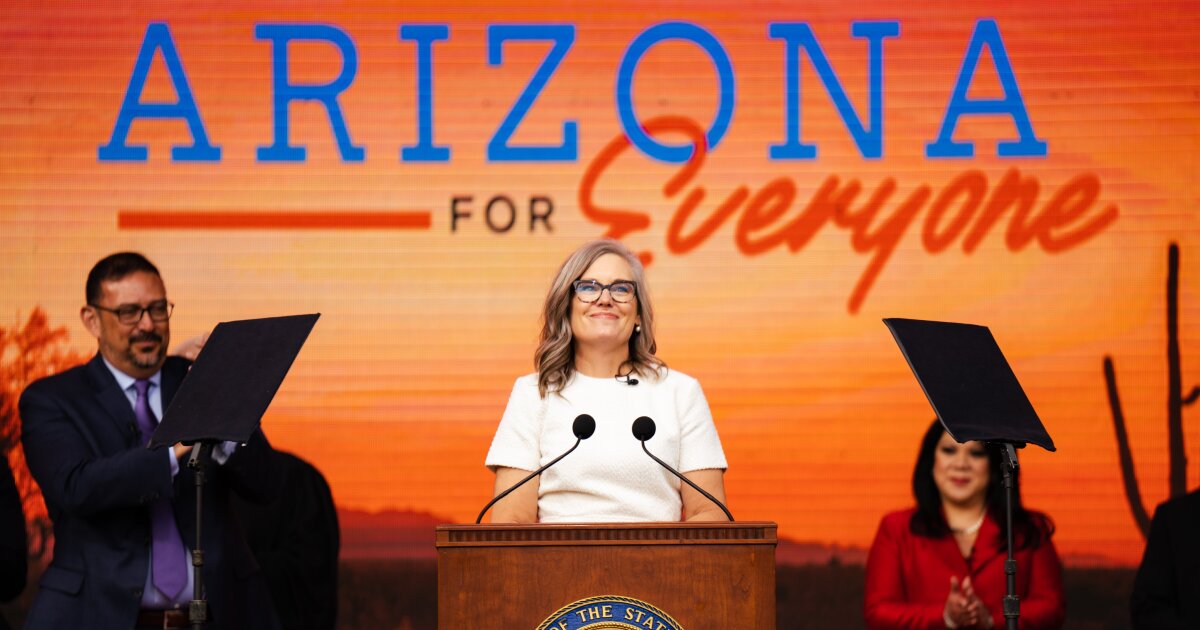
PHOENIX — Arizona Gov. Katie Hobbs says she is “optimistic” about working with the Republican-controlled Legislature as she gives her second State of the State speech Monday.
The governor acknowledged what she called “the divisiveness and the vitriol” of the 2023 session. And that included a record-shattering 143 vetoes — more than 40% of the bills sent to her desk.
“I think we’ve proven that we can work together on important things,” she said.
But in an interview with Capitol Media Services, Hobbs already is sending messages to GOP lawmakers they would be sadly mistaken if they think her willingness to cooperate and all that optimism means she’s willing to give her blessing to many of their programs in the name of cooperation.
“I’m going to continue to keep my promise of vetoing legislation that doesn’t protect fundamental freedoms or solve tough problems,” she said. “So if that’s what they want to send me, that’s what I’ll keep on doing.”
And the governor already has a list of what will end up meeting her well-used veto stamp, saying she’s prepared to break her own record if it becomes necessary.
Election law changes?
Hobbs said she wants to solve the problem created by a change in federal election laws that ultimately could result in the state not meeting the deadline for submitting the results of the 2024 presidential race, a move that would mean Arizona’s 11 electoral votes would not be counted, regardless of who wins the race here.
But the governor made it clear she would not accept any fix it if it is tied to various other changes that some have been pushing under the banner of election integrity, ranging from hand counting ballots to who gets an automatic early ballot and new signature verification requirements.
“I’m not going to sign something that’s bogged down with a bunch of other stuff that the Republicans want on this,” she said.
The governor also said she is ready to use her veto stamp — again — to deal with “culture wars” measures advanced by some GOP lawmakers, ranging from banning the teaching of critical race theory to using public funds for diversity, equity and inclusion programs.
Hobbs also said she has no interest in signing legislation being pushed by some GOP lawmakers to block the citizens and corporations of certain foreign countries from leasing or owning farm land in Arizona.
She called it unnecessary, noting the state already is terminating its leases with Fondomonte, a Saudi company growing alfalfa in La Paz County for dairy farms in the kingdom. And all that, the governor said, can be done based on deciding what is the “highest and best use” of state land — and without regard to the nationality of the tenant.
Whether the governor gets a chance to break her veto record this year will largely depend on the actions of the Republican legislative majority and, more to the point, whether they are just voting to send measures to the Democratic governor knowing she will reject them.
“There’s a lot less interest this time around in just sending a bill out just to get a veto,” said House Speaker Ben Toma.
“I think it’s pretty clear at this point where everybody is politically on some hot-button issues,” said the Peoria Republican. “So there’s really no reason to continue that.”
Senate President Warren Petersen said there’s been no formal decision made by his caucus. But it has been discussed.
“We have talked about the obvious, which is: same product, same people, same outcome,” said the Gilbert Republican.
“I don’t know what members are going to do,” he continued. “But I feel like you won’t see as many of the same bills introduced.”
Still, Petersen said that doesn’t mean he will use his powers to sideline legislation by other GOP lawmakers just because it might be a sure-fire veto.
“If there’s a reason or a benefit for them where they feel like they want to continue to push their bills, if their constituents have asked them to run a bill or push a bill, that’s a member decision,” he said.
But Hobbs, even before the session begins Monday, already is picking a fight with the GOP majority.
She announced this past week a list of changes she wants in the system of universal vouchers that allows any student to get taxpayer funds — the typical grant is $7,300 — to attend private or parochial schools or have home-schooled children use the dollars for other educational expenses. The governor was unapologetic.
“I don’t think this is a new fight,” she said, noting she was a first-term lawmaker when the whole concept of vouchers became law. At that time is was limited to students with special needs. Since then eligibility has been broadened to youths in foster care, reservation residents, students attending schools rated D or F — and in 2022, removing all restrictions
“And one of the things we said is, this is the camel’s nose under the tent, it’s going to keep expanding every year until we get to this point,” Hobbs said. “And here’s where we are.”
But the governor is not the only one spoiling for a fight.
Hobbs is being sued by the state Senate over her maneuver to convert all of her agency directors — the ones that the Senate has failed to confirm — to deputy executive directors, a move she said allowed them to continue to serve despite legislative inaction. Senate President Warren Petersen claims that violates state law.
Hobbs, however, said she is ready to do battle.
“We will be filing a motion to dismiss their very flimsy lawsuit against us,” she said.
“Arizonans want sanity, not chaos,” Hobbs said. “We need state government to run well and state agencies are a key part of that.”
Still, the governor does have some things in her own basket of ideas she hopes will get approval in the Republican-controlled Legislature. And one of the biggest issues is water.
The most visible part of the problem has been in rural areas, exempt from the provisions of the state’s 1980 Groundwater Management Act that are designed to achieve “safe yield” to the point where the amount of water being pumped is no greater than the rate of recharge. That is causing particular problems in Mohave County where Kingman officials are questioning whether the pumping by agriculture in the same basin will leave the city without the water it needs.
Current law does allow residents to vote to form their own “active management area” to control pumping. And residents of the Douglas area did just that in 2022.
But a similar plan for Willcox failed. So Hobbs is weighing a proposal advanced by her Water Policy Council that would authorize setting up state-designated but locally run rural groundwater management areas.
“I don’t think we’re trying to dilute the process,” Hobbs said.
Hobbs also is looking for a work-around to the decision last year of the Department of Water Resources to deny new housing permits to developers in areas of Buckeye and Queen Creek, lands within the Phoenix Active Management Area that could not show the legally required 100-year assured water supply. That resulted in national headlines about whether Arizona was running out of water.
The governor defended the agency.
“The national sensationalism aside, ADWR was following the law,” she said.
But Hobbs governor acknowledged that the status quo is unacceptable. And now she is throwing her support behind another Water Policy Council recommendation for an interim solution: Allow developers to continue their work based on the use of “alternative water supplies,” but without gutting the 1980 Groundwater Act.
And one key benefit of that idea is it doesn’t require legislative approval.
That issue of the building moratorium in Queen Creek and Buckeye is closely tied to the issue of affordable housing.
“We are in a housing crisis,” she said.
“One part of the solution is to build more housing,” the governor continued. “So we’re trying to find a short-term way for that to continue.”
Still, that deals with just one issue — and in just one area of the state.
Hobbs managed last session to get lawmakers to put $150 million into the state Housing Trust Fund. Those dollars can be used to leverage federal cash to construct affordable housing.
Hobbs said, though, more changes are needed.
“You’ll hear a proposal in our State of the State around mortgage assistance which obviously is not going to assist in building new houses but (is for) first-time home buyers and middle class families that are being priced out of purchasing homes right now,” she said. Still, Hobbs acknowledged, even leveraging the Housing Trust Fund might not provide a lot of relief in a market where median home prices exceed $500,000 and mortgage rates are hovering close to 7%.
“It buys some,” she said.
“It’s clear that Arizona needs relief right now and there’s more that can be done,” the governor continued. “We’re utilizing the tools we have at our disposal right now.”
Hobbs also said she is a fan of the actions of some cities like Phoenix and Tucson that have authorized the construction of small “accessory dwelling units” — also called casitas — adjacent to existing homes that can be rented out, regardless of zoning.
Still, the governor said she might warm up that veto stamp if lawmakers seek to impose similar requirements on all cities and counties statewide.
“I’ve never been a fan of usurping local control,” Hobbs said. She also has been cool to some other efforts to override local regulations like “zoning by right” which would have allowed some landowners to convert the use of their property from how it was zoned to something else without having to first get city approval.
Hobbs also has her own plan to raise the salaries of educators.
It is similar to what Republican lawmakers proposed last year, extending the life of Proposition 123 which allows the state to tap the proceeds of the land trust. The GOP promises $4,000 pay hikes for teachers.
Hobbs said that doesn’t go far enough.
“We have a proposal that addresses not just teacher pay but more broadly educational support professionals as well,” she said, people like librarians, aides and counselors left out of the Republican plan. “They’re part of the equation.”
And the governor said there are ways of adjusting the annual withdrawals from the land trust to generate enough money for all that.
-30-
On X and Threads: @azcapmedia



Taiwanese restaurants serving TSMC workers in Phoenix
The north Phoenix area now boasts three Taiwanese restaurants, opened within the last year specifically to cater to new arrivals at the TSMC factory.
The Republic
A specialty Japanese grocery store will open its first location outside of California in north Phoenix.
In November 2026, Osaka Marketplace will move into the shopping plaza at the intersection of Union Hills Drive and Seventh Street and begin construction, said Julia Li, the plaza’s property manager.
Founded in the Bay Area in 2021, Osaka Marketplace specializes in Japanese ingredients and prepared food. The 35,000-square-foot space will feature a fresh produce section, a sushi counter and a food court. The grocery store is expected to open in the second half of 2027.
“We’re really excited,” Li said. “They’re great.”
What is Osaka Marketplace?
Osaka Marketplace has two locations in the Bay Area, with plans to open a third in fall 2026. Founder Kazuhiro Takeda, a former grocery executive in Japan, has said that he wants the store to feel like “a small trip to Japan.”
Osaka Marketplace is especially known for its sushi. It imports fish from Japan and offers a wide variety of sashimi, including salmon, scallops and squid. In addition to a food court with several restaurants, the Phoenix store will also sell bento boxes, Japanese sandwiches and onigiri.
The Bay Area locations host community events, such as a pop-up ramen festival, which was a major draw for bringing Osaka Marketplace to Arizona, Li said.
“It makes it feel like a part of the community and not just somewhere that you go to get groceries,” Li said.
There are several other Japanese-focused grocers in the Valley, like New Tokyo Food Market in Phoenix and Fujiya Market in Tempe, but none are nearly as large as Osaka Marketplace will be.
More Asian businesses are opening to serve TSMC workers
Fueled by the Taiwanese Semiconductor Manufacturing Company facilities, the boom of Asian-focused development in north Phoenix has been quietly gaining steam over the past few years.
Small mom-and-pop restaurants have been followed by larger regional and national chains, like Paris Baguette and 85°C Bakery Cafe. One of the largest planned projects will partially remake Arrowhead Towne Center, with the opening of a Taiwanese grocery store, 99 Ranch, in a former Sears building.
Since 2023, Li has been working with her parents, who are developers, to fill the shopping plaza on Union Hills Drive with businesses that cater to Asian customers. The plaza already has a smattering of Asian restaurants and businesses, including a Taiwanese restaurant and a Chinese-English after-school academy, but the main storefront has remained a Goodwill.
It took them longer than expected to find a business to replace the Goodwill, Li said. Despite the growth of Asian development, many out-of-state companies don’t see Phoenix as a promising market, Li said.
“Convincing businesses from outside of Phoenix has been really, really difficult,” Li said.
The family was connected to Osaka Marketplace through word of mouth and found out that the grocery store was already interested in moving to Phoenix. Takeda has said he hopes to open a dozen Osaka Marketplaces in the next 10 years.
Cultivating a north Phoenix hub for Asian food and culture
Now that the plaza has an anchor tenant, it’s on its way to becoming the type of “cultural meeting center” that Li’s family hopes to create.
“You can just go spend an entire afternoon and not actually go with a plan,” Li said. “That’s the vision that we have for the plaza.”
Details: 710 E Union Hills Drive, Phoenix. osakamarketplace.com.
Reach the reporter at reia.li@gannett.com. Follow @reia_reports on Instagram.
Arizona
UConn downs Duke with last-second 3-pointer to join Illinois, Arizona and Michigan in Final Four

All that talent at Arizona and Michigan. All that momentum and good vibes at UConn. And somebody has to be play the part of the unheralded “little guy.” At the Final Four next weekend, that role belongs, improbably, to Illinois.
In a sign of the times, the Illinii — a Big Ten team with more wins in the conference over the last seven seasons than any other program — will pass for something resembling Cinderella when college basketball’s biggest party kicks off in Indianapolis on Saturday.
The first challenge for coach Brad Underwood’s team will be stopping a hard-charging UConn juggernaut. After being down by as many as 19 on Sunday, Braylon Mullins retrieved a loose ball near midcourt in the waning seconds against Duke and suddenly, improbably, UConn had a chance to win.
As the frantic final seconds unfolded, Huskies coach Dan Hurley figured a timeout would do little good.
“It just felt like the window where you’ve just got to let March Madness take over,” Hurley said. “March magic.”
The Huskies have enjoyed plenty of that through the years, and this may have been their most astonishing win yet. Mullins sank a desperation 3-pointer with 0.4 seconds left to give UConn a 73-72 victory over top-seeded Duke, earning the Huskies a spot in the Final Four.
The Blue Devils (35-3) led by three before UConn’s Silas Demary Jr. made one of two free throws with 10 seconds left. With Duke playing keep-away to prevent the Huskies from fouling, Cayden Boozer’s pass near midcourt was deflected by Demary, and after UConn came up with the ball, Mullins swished a 3 from 35 feet away.
The last two times the Huskies reached this point, they won the championship.
“It’s a UConn culture, a UConn heart,” Hurley said. “We believe we’re supposed to win this time of year.”
All these teams do.
Arizona, led by Brayden Burries, and Michigan, with Yaxel Lendeborg, have up to nine NBA prospects between them.
The Wildcats opened as slight favorites — at plus-165 to win the championship, according to BetMGM Sportsbook. That was a shade ahead of the Wolverines, who are plus-180 after their 95-62 romp over Tennessee on Sunday.
But, in one of a few strange twists on the odds chart, the Wildcats are 1 1/2-point underdogs to Michigan in Saturday night’s second semifinal.
Illinois is a 2 1/2-point favorite over UConn and, in reality, it’s the Huskies, at plus-550, who are the biggest long shot in Indy.
Even so, the fact that Illinois — the flagship university in the nation’s sixth most populous state and a school with an enrollment of nearly 60,000 — feels most like this year’s out-of-nowhere underdog speaks more about the current state of college hoops than the Illini themselves.
They are a No. 3 seed — the highest number at the Final Four in two years. (UConn is a 2. Last season, all four No. 1s made it.)
This year’s meeting of 1 vs. 1 — Michigan vs. Arizona — is a heavyweight matchup of power teams from power conferences.
It’s a far cry from a mere three years ago, when mid-majors Florida Atlantic (coached by Dusty May, who now leads the Wolverines) and San Diego State crashed college basketball’s biggest party.
Since then, NIL and the transfer portal have redefined the contours of player movement, another spasm of realignment has made the big conferences bigger (Arizona, now in the Big 12, was in the Pac-12 in 2023), and the high-achieving underdogs that used to make March Madness what it is have gone into a slump.
Double-digit seeds won a total of five games in this tournament (not counting the play-in round). Two years ago, they won 11 and sent one team (N.C. State) to the Final Four.
Not surprisingly, Underwood — the coach who landed on the Illinois radar a decade ago by coaching double-digit seed Stephen F. Austin to a pair of upset wins in the tournament — views his program’s trip to the Final Four more as destiny than a once-in-a-lifetime story.
It is, however, the first trip for Illinois since 2005, when it lost to North Carolina in the title game.
“I don’t want to sound arrogant,” said Underwood, whose teams have won 96 Big Ten games since 2019-20, two more than Purdue. “I’ve never doubted us getting to a Final Four would happen. I have thought we have had other teams capable. But I also know how doggone hard it is to do it.”
The Big Ten knows all about this. Both Illinois and Michigan have a chance to deliver a title for the conference for the first time since Michigan State won it all in 2000.
The Illini, led by the so-called “Balkan Bloc” — a cohort of players with roots in Eastern Europe — have a potential NBA lottery pick of their own in guard Keaton Wagler.
Even so, the best-known name on the Illini roster might be Andrej Stojakovic, whose father, Peja, was a three-time NBA All-Star. Illinois is the third school in three years for the younger Stojakovic, who spent one season at Stanford and another at Cal before joining Underwood’s crew.
The task for Illinois: Figuring out who to key on across a roster that has five players who average double figures, led by Tarris Reed Jr.
The Wildcats-Wolverines game is a high-powered matchup of programs that have shown there’s more than one way to amass talent in the era of the unlimited transfer portal and big-money name, image and likeness deals.
Four of the five starters for Tommy Lloyd’s Wildcats began their careers in Tucson; the fifth, Big 12 player of the year Jaden Bradley, moved over from Alabama and has been with the Wildcats for three years.
Meanwhile, the top four players in minutes played at Michigan — Lendeborg, Morez Johnson Jr., Aday Mara and Elliot Cadeau — all arrived from the transfer portal.
In a twist that makes perfect sense these days, both coaches parlayed roots in the mid-majors to a spot on the sport’s biggest stage. Lloyd spent decades as a top assistant for Mark Few at Gonzaga before heading to Arizona to rebuild the program after the ouster of Sean Miller in 2021.
May led FAU to the Final Four before heading to the Michigan program that had thrived, then collapsed, under former Fab Five star Juwan Howard.
Arizona
Suspect in custody after fleeing Arizona troopers and barricading inside a Phoenix neighborhood shed

PHOENIX — A suspect is in custody after fleeing from Arizona Department of Public Safety troopers overnight and hiding in a Phoenix neighborhood.
According to DPS, troopers attempted to stop a white BMW around 1:20 a.m. for speeding and displaying fictitious plates. The driver did not stop, and a pursuit was initiated.
Troopers later ended the pursuit due to safety concerns.
The vehicle was eventually found abandoned near 13th Avenue and McDowell Road. DPS says the suspect briefly drove again before getting out and running through nearby residential backyards.
Authorities say the suspect barricaded himself inside a shed in a backyard.
Phoenix police officers, including a K-9 unit and air support, responded to assist and set up a perimeter. The suspect was located and taken into custody after refusing commands to surrender.
Police say the suspect was treated for minor injuries and taken to a hospital.
No other injuries were reported.

Could Miami Dolphins trade up in first round of 2026 NFL Draft?

Tech entrepreneur Paul English gives $1m to kick-start AI program in Boston Public Schools – The Boston Globe

Three former Denver mayors urge a “yes” vote on license plate cameras (Opinion)

The Man Behind Saint Bread, the Wayland Mill, and Tivoli

Deputy ID’d Who Died In Baker Run | Jeep Launches Off Bridge | Protest Turns Violent: SoCal In Brief

Florida High School Football Rankings: Top 25 teams – Oct. 21

How old is Bo Nix? What to know about Oregon quarterback ahead of 2024 NFL Draft

Cleary's 21 help Le Moyne down Central Connecticut State 69-64 in OT

99th annual Pony Swim held in Virginia

Indiana Members Credit Union announced as new anchor tenant at Bottleworks District

Video: Iran to Allow More Oil Ships Through Strait of Hormuz, Trump Says

Dem senator warns deportation could let Virginia woman’s illegal immigrant killer ‘escape accountability’

Newsletter: G7 ministers to hold talks on war’s economic fallout

ICE officers could remain at airports after TSA workers are paid

Scathing report claims nation’s oldest labor union ‘betrayed’ MAGA members through ‘shocking’ spending
-

 Sports1 week ago
IOC addresses execution of 19-year-old Iranian wrestler Saleh Mohammadi
-

 Miami, FL4 days ago
Jannik Sinner’s Girlfriend Laila Hasanovic Stuns in Ab-Revealing Post Amid Miami Open
-

 New Mexico1 week ago
Clovis shooting leaves one dead, four injured
-

 Politics1 week ago
Schumer gambit fails as DHS shutdown hits 36 days and airport lines grow
-

 Tennessee7 days ago
Tennessee Police Investigating Alleged Assault Involving ‘Reacher’ Star Alan Ritchson
-

 Minneapolis, MN4 days ago
Boy who shielded classmate during school shooting receives Medal of Honor
-

 Science1 week ago
Record Heat Meets a Major Snow Drought Across the West
-

 Politics1 week ago
Trump gives Iran 48-hour ultimatum to reopen Strait of Hormuz or face strikes on power plants