Lifestyle
The iconic South African theater that took on apartheid

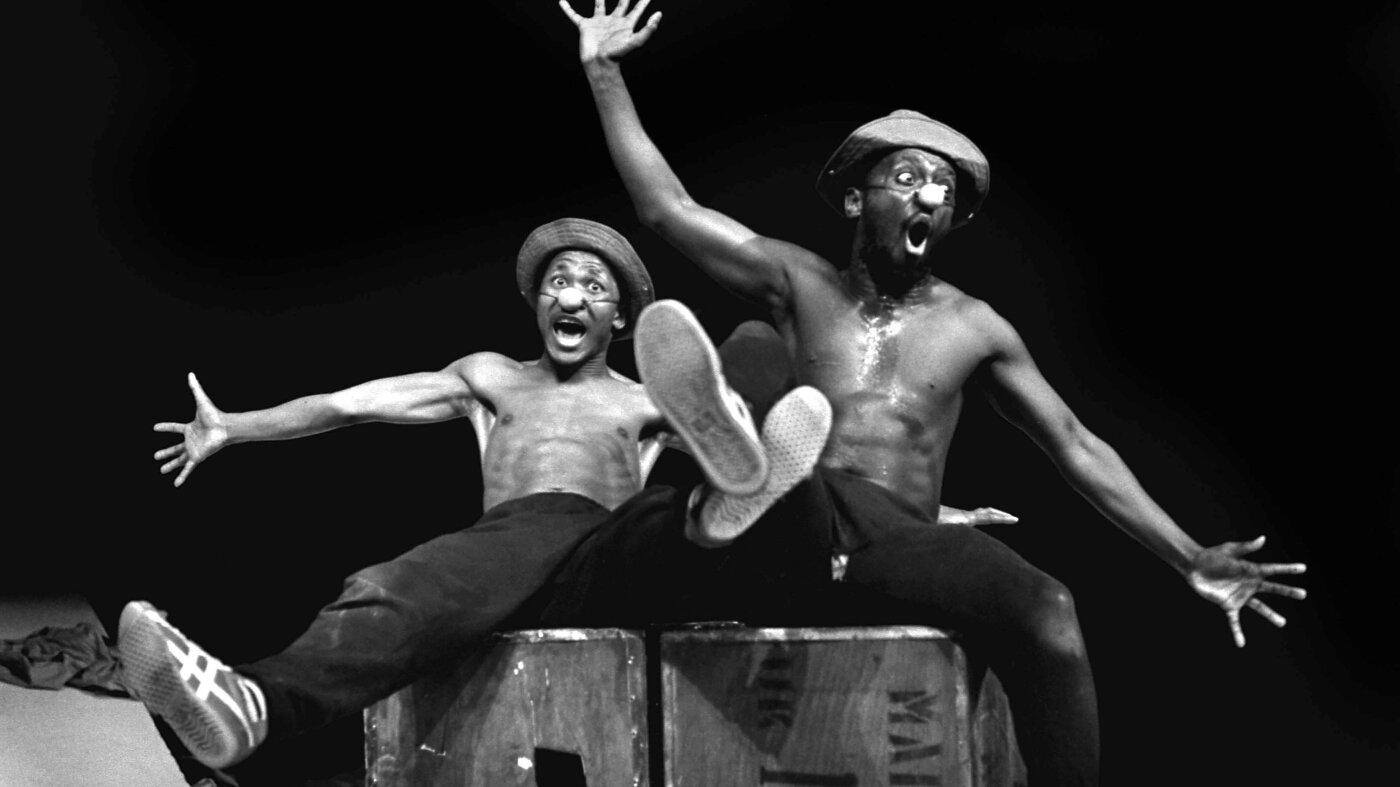
Performers Percy Mtwa, left, and Mbongeni Ngema in a scene from “Woza Albert” at the Market Theatre in Johannesburg, South Africa, in 1981.
Ruphin Coudyzer/AP
hide caption
toggle caption
Ruphin Coudyzer/AP
JOHANNESBURG, South Africa—When it first started in the 1970s, South Africa’s Market Theatre staged plays considered to be so subversive that it became a regular target of the apartheid government’s zealous censors.
Even the fact that its audiences were made up of Black and white South Africans mingling together was unheard of in a city where the law separated areas and people by race.
The theater, established in an old fruit and vegetable market in central Johannesburg, was born at a pivotal time in “the Struggle” — the fight against the apartheid government. It opened its doors just days after the 1976 Soweto uprising changed the country forever.
Youth took to the streets to protest schools teaching in the Afrikaans language and the ensuing government crackdown saw hundreds killed.
“So, we opened our doors three days after that event,” says the theater’s current artistic director Greg Homann. “The Market Theatre has been forged in those days of June 16 and now has really carried the weight of telling the national story of South Africa all the way through the dark years of apartheid.”
This year, the theater, where legendary South Africans like actor John Kani and playwright Athol Fugard made their names, is celebrating its 50th anniversary.
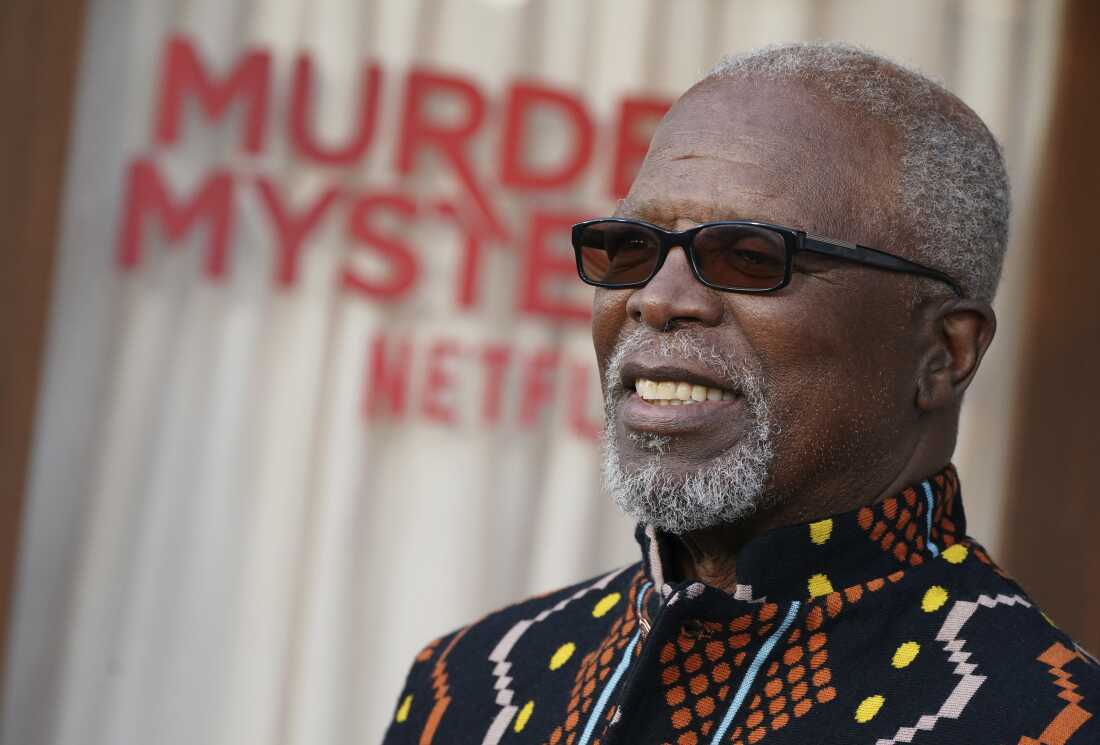
John Kani arrives at the premiere of “Murder Mystery 2” on Tuesday, March 28, 2023, at the Regency Village Theatre in Los Angeles.
Jordan Strauss/Invision/AP
hide caption
toggle caption
Jordan Strauss/Invision/AP
In that half century it produced plays of international renown, including “Woza Albert,” “Sophiatown,” and “Sizwe Banzi is Dead,” and the hit musical “Sarafina” — about the Soweto uprising.
“Sarafina,” written by jazz musician Hugh Masekela, went on to Broadway and became a Hollywood movie starring Whoopie Goldberg.
But many initially doubted it would survive. Tony-award-winning actor John Kani said he was stunned when the theatre’s founders Barney Simon and Mannie Manim first told him their vision.
“I thought these two whities were nuts, it’s not going to work, and they said to me and Athol Fugard that it’s going to be open to all. I said what are you talking about, it’s ’75, ’76” Kani recalled in a 2014 interview.
But despite his initial reservations, Kani said, “my entire career fell in place on this stage.”
Still, there were times when it was touch and go.
The theater “was often raided. Actors were sometimes in some kind of danger,” Homann says.
And often, apartheid government censors turned up.
“They would then go onto stage and they would start doing their censorship in front of the audience,” he continues. “And it almost became like a second act of the production where the censorship was actively part of the work.”
‘No Black, no white’
Then there was the fact it was a place where all races could mix, with the theater’s directors cleverly finding loopholes to circumvent the law.
“At one point our bar was sold for one rand, so, you know, the equivalent of 50 American cents, so that it was privately owned,” says Homann.
Being privately owned meant that audience members of color “could stand in that space legally,” he explains. “But if they stepped one meter into the foyer they were illegal by apartheid laws.”

United States First Lady Hillary Rodham Clinton, left, and Vice President Al Gore applaud during a variety musical performance of “Sophiatown” by members of the Market Theatre Company on Monday, May 9, 1994 in Johannesburg. Rev. Jesse Jackson is seated behind Gore.
Michael Yassukovich/AP
hide caption
toggle caption
Michael Yassukovich/AP
While the theater’s work helped spread the message of the anti-apartheid movement at home and abroad, some white audience members were triggered.
“Quite a number of times I’ve seen them whites. You know, they get up,” recalls director Arthur Molepo, a theater veteran who has been involved with the Market since its inception.
“You see a man grabbing a woman and just walking out during the play, meaning they were angry, of course, or they’re not agreeing or believing what we’re saying,” said Molepo.
Still, he remembers the early years of the market as a heady time.
“There was no black, there was no white. We were just a whole group, a whole bunch. So we were making things, making theater,” he says.

An image from the February 2026 production of “Marabi” at the Market Theatre.
Ngoma Ka Mphahlele/Market Theatre
hide caption
toggle caption
Ngoma Ka Mphahlele/Market Theatre
This year Molepo directed a new production of an apartheid-era play — “Marabi.”
From the applause and standing ovation it was clear the subject matter still resonated, even with what appeared to be a mainly Gen Z and millenial audience who never knew life under apartheid.
The story follows a Black family’s struggles in the first half of the twentieth century and ultimately ends with their forced removal from their home under the white government’s racial segregation laws.
Gabisile Tshabalala, 35, played the lead role in Marabi, but she grew up in a free South Africa and doesn’t remember apartheid.
However, the actress says: “Theater is extremely important for young South Africans….especially as Black people…we get to tell our stories.”
And the theater isn’t content to rest on it’s historic laurels.
It “tells the South African story,” says Homann. “whatever that might be of its day.”
“So during the ’80s, that was the story of the fight against apartheid. More recently, it’s the challenges of a young democracy.”
Issues like access to education, corruption, and gender-based violence are all being tackled on stage as the Market turns 50, with South Africans hoping for many more years of thought-provoking theater.


Unpacking my third suitcase in our new West Hollywood home, a sharp pain shot through my chest. I felt dizzy and short of breath before sprawling out on our mattress, which was still covered in plastic.
“What’s wrong?” David asked.
An hour later, on a gurney in the emergency room at Cedars-Sinai, I waited to be admitted overnight. What a great start to our new life — back in L.A. after seven years in New York City — David sleeping alone at our apartment while I was to keep close to the paddles and operating room in case what had just happened was a heart attack.
I was 33, practicing yoga and exercising almost daily. A few months earlier, my New York doctor noticed I had high blood pressure, and I was feeling terrible, so something clearly was going on. Was an artery blocked? Nope, the tests revealed; physically, I was fine. What had happened was a panic attack.
“Your health will be better in L.A.,” David had promised before returning to L.A.
Now I took no pleasure in his being wrong.
After growing up in Temple City (hardly L.A.), I went on a high school trip to the Big Apple and knew it was where I needed to be.
Exactly five years later, the time to escape California arrived after a miserable breakup from a three-year relationship with a guy that I hid entirely from my family. I was desperate and depressed, down 15 pounds from not eating much, my diet consisting largely of cigarettes and red wine. At the Archstone, my Studio City apartment, I did ecstasy alone on a Wednesday. One has to take a good look at himself when he’s in his bedroom, by himself, rolling, and so I decided it was time to start over in New York.
On the other side of the country, I thought it was normal to hook up with a new guy every third night. Which I suppose, for a gay man who’d spent the first 27 years of his life denying his sexuality to a family he feared wouldn’t understand, it was. My self-esteem was in the gutter, though you wouldn’t have known it from the outside.
After a three-digit number of hookups on Grindr, I met David, a guy who lived on the same Manhattan corner as I did. We did what people do on Grindr and hooked up a couple of times.
But one morning, we bumped into each other on 9th Avenue. I left our short chat feeling uplifted by how smiley and polite he was in daylight and while we were sober. That night, we went on our first date, and the rest is history. But I hid what I assumed wouldn’t be well-received.
“Let’s move back to L.A.,” he said after four years of life together in New York.
“I’m really not ready,” I said. I loved living in New York and never, ever expected to leave. He understood, but he wanted to return to “the coast.” I knew that in a healthy relationship, it couldn’t be just what I wanted. So eventually, we packed up and moved to an apartment on North Flores Street in West Hollywood.
And now, I was in the hospital.
After having to cancel the welcome home party our L.A. friends had planned for us, and being released from Cedars, my life fell apart. But being the one who kept everything together, I kept it together better than most would, at least in the presence of others.
I’m fine, I told myself, but I worried my heart was broken, and there was something medically wrong with it. To heal it, I’d need to accept truths that I didn’t want to.
Growing up was devastatingly hard for me. Being gay and misunderstood, with the unacknowledged pain of it kept inside, was quite literally eating me alive. Being back in L.A. meant being near my past. I told my mom I was gay before leaving for New York. She said she still loved and accepted me, but to this day, the struggle has never been discussed or acknowledged. I knew I was a disappointment to my family.
I went to Westwood what felt like 70 times, and after visiting a bunch of UCLA’s specialists, I found myself in the office of a neurosurgeon who took one look at me and said, “You don’t belong here. What you’re suffering from is plain old anxiety, and you’re going to have to work with your therapist on this.”
“I have been,” I said, “and it’s not helping.” But before I finished, he had walked out the door.
Before long, the panic attacks got so bad, I could hardly drive. David chauffeured me, under the palm trees and bright sun, around as much as his schedule allowed, and when he couldn’t, I made the best of it, lugging my laptop with me for the hour-long trek to yoga-teacher training at Equinox in the South Bay, using that extra time in the back of an Uber to write.
For almost my entire adult life, I’d been in therapy, but it was couples therapy with David where I felt supported enough to admit, first to myself, that I’d been terrified of being fully myself. I was afraid he’d leave me if he saw the real me. Secretly I had been keeping a lifetime of pain bottled up inside because of fear — I didn’t want to risk losing him by being too emotional or having too many feelings.
Three months after that therapy session, the pandemic arrived, and being together 100% of the time for the next year, I let him in fully. He didn’t run — instead, he proposed.
It’s been eight years since that neurologist, and six since I’ve been able to fully drive again. And here in L.A., in a city characterized by its distance, I have, with David, built a close chosen family that supports and fully understands me.
Now, I feel “at home” at our Spanish-style Hancock Park house, the one we bought because we wanted to start a family of our own, only after L.A. allowed me to heal and live peacefully, and now, anxiety free.
Had David not dragged me back, I wouldn’t have learned what I did about myself, my story of origin and living a life that’s so beautiful and that’s so true to me.
And certainly, we wouldn’t be bringing our baby daughter, Lucy, named after Lucille Ball (who’s more Hollywood?), home in mid-July by way of surrogacy.
The author is a writer and coach who helps established business owners build lives that feel as good as they look. He lives in Hancock Park. He’s on Instagram: @iammattgerlach.
L.A. Affairs chronicles the search for romantic love in all its glorious expressions in the L.A. area, and we want to hear your true story. We pay $400 for a published essay. Email LAAffairs@latimes.com. You can find submission guidelines here. You can find past columns here.

Could you see your life just as easily with children as without?
What if you’re not cut out for parenthood? What if you grow lonely in your old age? Or what if you have a loving partner, but you disagree on this choice? Deciding between parenthood and a child-free life requires clarity about your fears and deepest desires — no easy task. This episode, psychotherapist and author of the book, The Baby Decision, Merle Bombardieri, helps us get clear. She discusses minimizing regret, normalizing feeling ‘stuck’ and why waiting to have a baby at 38 may be best.
Want more about the decision to have kids?
Many women don’t want kids. And for good reason.
Why are people freaking out about the birth rate?
Support Public Media. Join NPR Plus.
Follow Brittany on Instagram: @bmluse
For handpicked podcast recommendations every week, subscribe to NPR’s Pod Club newsletter at npr.org/podclub.
Additional support for this episode came from Alexis Williams. It was edited by Neena Pathak. Our Supervising Producer is Cher Vincent. Our Executive Producer is Barton Girdwood. Our VP of Programming is Yolanda Sangweni.

“E Pluribus Unum,” or “Out of many, one.”
That phrase, engraved on some quarters photographer Blaise Hayward was counting in his New York City kitchen in July 2023, intrigued him. They were marks of the 50 State Quarters, a series of coins issued by the U.S. Mint from 1999 to 2008 for which each coin featured a symbol representing one of the 50 states.
With Hayward’s growing concern about the vitriolic condition of American politics, the phrase felt resonant.
Blaise Hayward looks over printed works of his “Quarters of Confederation” series, highlighting Canadian coins.
(Blake Ogden)
That moment sparked his photo series, “America ~ The Statehood Quarters,” and sent him on a quest to the bank to find every coin. Now a collection of 50 images, one for each state’s quarter, the series explores American unity, shared history and constant exchange.
“My goal was to gather these coins and present them in a cohesive, inclusive manner. Every state is represented,” Hayward said. “Everybody’s equal. It’s about equality, representation.”
Those interested can find his photos on his website, where he sells editioned images of the coins, ranging from $1,200 to $5,000.
Ahead of the United States’ 250th anniversary on Saturday, Hayward reflects on the series and its relevance today.
This interview has been edited and condensed for clarity.
Your photographs remind me of portraits. As large close-ups, each quarter has a unique character. Tell me about your approach to capturing them.
I started my career in the 1980s, and I was an analog photographer. I was late to digital. These are all captured digitally, as is most of my work now, but the most important aspect to my work is that it has an analog feel to it.
My goal was to present it as realistically and honestly as possible. I photographed them as they are, and I also do that with my portraiture. I’m a portrait photographer at heart, and portraiture is my first love. But I’ve found with my fine art career that unless they’re famous people, people aren’t drawn to buying portraits and hanging them in their house. But they are drawn to still life, so a lot of my artwork now is centered on still life. My portrait background probably played a subconscious role in how I presented the quarters.

The California state quarter.
(Blaise Hayward)
In your photographs, the quarters are old and tarnished, not shiny and new. Why?
That was important to me. If you go onto Wikipedia and type in “Statehood Quarters,” they photographed all 50 of them. They’re bright, shiny, right out of the Mint. I made a conscious decision to photograph them in circulation. I wanted them to emulate the hands they’ve passed through and illustrate the history of the country and the state.
How do you think about the people who held these quarters in relation to the project as a whole?
I think it tells the story of commerce and the story of exchange. I imagine there are a couple in there where people saved up some quarters and bought something personal. Some of these quarters could’ve been collected by children, and then they could’ve gone out and bought their first candy bar. Or they could’ve put the quarters in the soda fountain machine and got a Coca-Cola and been so excited.
I’m very attached to coins and bills. I see the artistry in it. It’s unfortunate that we’re going toward a society where we won’t have that tactile feeling anymore. There’s a difference between holding a handful of money and paying for a good than pulling your phone out and tapping.

The Delaware state quarter.
(Blaise Hayward)
You’re originally from Toronto, and have lived in New York for the last 30 years. How has living in the U.S. as an immigrant shaped the way you perceive America and represent it in this series?
It allows me to be an outsider looking in. I love the fact that I’m Canadian. It’s a badge of honor for me. It allows me to have a more sympathetic, wider and different understanding of what it’s like to live in the States.
With the “Statehood Quarters,” I don’t know if it influenced me when I photographed the project. I was just in awe of the history. If you start reading about the States and how the whole country came together, all of the people that made that journey were immigrants. Unless you’re Native American, we’re all immigrants here. I thought about that a couple of times because I was reading about the people that started it all.
Your series centers unity in a time of extreme divisiveness in American politics, whether it’s surrounding the federal crackdown on immigration or LGBTQ+ rights, among other issues. What does “unity” look like to you in this context? What do you feel Americans should be united on?
Americans could stand to be united on what a great country this is, even though at this present moment it’s not feeling like that for everybody. America is a great country. It’s been a beacon of democracy since its founding, and countries all over the world have held it in such high esteem.
Without giving away my political leanings — I don’t even mean to go there — sadly, in this present moment, I don’t think the country is showing its best self. We could stand to take a step back and reflect on the history and unity of the country. We could stand some compassion. We could stand some understanding. We could stand to be better listeners.
We don’t always have to agree. It’s just vitriol out there. It’s tearing the country apart. I think it will be a collective effort on both sides of the aisle for us to come together and dial the heat down.
I’m hoping that on this 250th anniversary, people put their political leanings aside and celebrate America. It’s got so much potential to be that beacon again, that leader in the world. At the end of the day, why can’t we just embrace “E Pluribus Unum”? Out of many, we are one. We are one nation.
For many people, America’s 250th anniversary will be a time of celebration and patriotism. For many others, it will be a time of criticism and protest. How do you feel your series engages each of these attitudes?
I hope that people look at the series and look at the country in a broader stroke, and say, “Wow. What an amazing collection. This ‘Statehood Quarters’ collection is so inclusive and symbolic of this great nation. Look at all these beautiful coins from these beautiful states.”
Kansas is one of my favorite coins. I’ve never been to Kansas, but the coin in the collection made me appreciate the state. It has gotten me thinking I’d like to visit every state and meet the people and have a meal and see what they’re like and see the landscape. I hope this collection inspires people to celebrate the country as a whole rather than looking at it state to state.

The Kansas Statehood Quarter.
(Blaise Hayward)
What does it mean to “celebrate the country”?
I’m an outdoor person and a nature person. For me, it means celebrating the land, and with that, celebrating the people in that land.
I was listening to somebody on the radio who was here for the World Cup. They were from Morocco, and they said every person they’ve met in New York has been so nice.
It’s time for this country to start being nicer to each other. I hope this project helps people be a little bit more kind to each other, a little bit more tolerant, a little bit more understanding, a little bit more loving and a little bit more hospitable.
-
Lifestyle2 minutes ago
L.A. Affairs: He wanted L.A. I wanted New York. A panic attack changed everything
-
 Politics6 minutes ago
Trump refashions America’s 250th as a celebration of himself
-
 Sports21 minutes ago
How Dodgers’ Max Muncy, vying for his third All-Star selection, continues to evolve
-

 World33 minutes ago
Germany’s Merz defends NATO spending after Trump calls it ‘ridiculous’
-
 News56 minutes ago
Oregon ER doctors win a ‘David and Goliath’ battle against a national company
-

 Videos2 hours ago
Iran gets ready for Khamenei’s funeral • FRANCE 24 English
-

 Los Angeles, Ca2 hours ago
2 arrested after 3 LASD deputies injured during East L.A. World Cup celebration
-

 Detroit, MI3 hours ago
Ex-girlfriend in custody after Taylor man found fatally stabbed, police say

