Lifestyle
L.A. Times Concierge: I live in O.C. My kids live in Santa Clarita. Looking for nice spots to meet halfway.

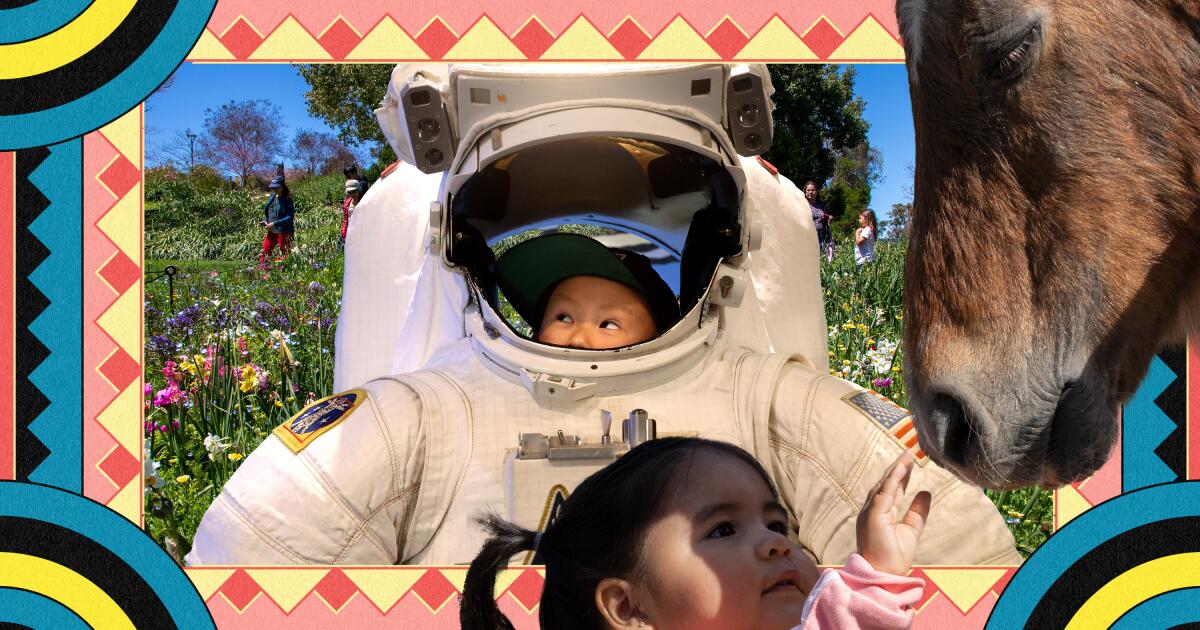
My husband and I live in Mission Viejo. Our older son, his wife and two children (ages 5 and nearly 4) live in Newhall. We love spending time together, but it’s quite a trek on the 5 Freeway. Last year, we went to the aquarium in Long Beach, which was great fun. Another day, we enjoyed a day of hiking and a picnic at Placerita Canyon Nature Center near my son’s home. We would love some suggestions about other places to visit which would maybe be a little more centrally located and fun for the whole family. Thanks
— Cathy McCoy
Looking for things to do in L.A.? Ask us your questions and our expert guides will share highly specific recommendations.
Here’s what we suggest:
Cathy, I understand your pain. Driving 80 miles can feel like an odyssey, especially in SoCal. Thankfully, there are loads of fun places where your family can meet in the middle (or close to it). I’ve rounded up some solid options. By the way, the driving times mentioned here are a rough estimate for a weekend day without traffic, but as you probably know, your actual time may vary.
Since you all enjoyed the Aquarium of the Pacific in Long Beach, how about switching it up and spending the day with a different set of animals at the Montebello Barnyard Zoo for your next outing? That would be about a 40- to 50-minute drive for both of you. Open since 1968, the zoo is home to horses, goats, sheep and donkeys that you can pet (and feed for an extra $3). If you’re feeling adventurous, you can ride a pony or take a leisurely trip on a John Deere tractor train. “It’s a great place for young ones to learn that animals outside the home need and deserve the same kind of care that we show our pets,” Etan Rosenbloom writes in a Times guide to things to do with kids around L.A. General admission is $11, and you can sometimes find deals on Groupon as well. Afterward, head to Blvd Mrkt, a food hall in downtown Montebello that sells a variety of food so everyone can get what they want.
Another great option is the South Coast Botanic Garden on the Palos Verdes Peninsula, which might be about an hour drive for both of you. I learned about this spot from my dear late colleague Jeanette Marantos, who was a gardening expert in her own right. The garden, which has more than 2,500 species of plants and five miles of trails, also includes a kids area, which features “a nursery rhyme theme with a large dollhouse, a charming bridge and plants matched to the stories,” Marantos wrote. My editor Michelle Woo also loves this garden. “You can take a leisurely walk along the accessible loop trail or get really into the nooks and crannies of the place, discovering trees with giant roots that kids love to climb on and koi fish swimming in a shaded pond,” she says, adding that she’s excited for Thomas Dambo’s trolls exhibit that opens Sunday. If you get hungry, you can stop by Dottie’s at the Koi Pond, which sells food, beer, wine and specialty cocktails on Saturdays and Sundays. Carry-in food is permitted if pre-prepared.
If you’re interested in space travel, you should visit the Columbia Memorial Space Center, which is the ultimate cosmic playground. Located in Downey (known as “home of the Apollo”) — about a 40-minute drive for you and a 50-minute drive for your son’s family — the recently renovated museum features a play area, robotics lab and interactive exhibits on space exploration, including a shuttle landing simulator. Admission is $5 for adults and kids, $3 for seniors ages 65 and up and free for children ages 3 and under.
Speaking of aviation, another spot worth checking out is the Proud Bird in El Segundo, about a 45- to 50-minute drive for both of you. Here, you can enjoy delicious bites as you watch planes land at Los Angeles International Airport, which is just a couple of miles away. Woo calls it “the perfect spot for a multigeneration gathering.” “Our extended family once celebrated Christmas there when everyone was too tired to cook,” she adds. “You can order solid barbecue from Bludso’s, have a drink by a bonfire pit and let the kids play on the playground as planes fly by.” She also suggests the Point in El Segundo. It’s an open-air shopping and dining center that has a large lawn where the kids can play and the grownups can grab a drink from Lil’ Simmzy’s.
I hope these recommendations are useful as you plan your next family outing (and that they also save you some gas money). Whatever you end up doing together, I’m sure that your family, especially the little ones, will just be grateful to spend quality time with you. Have fun!


Unpacking my third suitcase in our new West Hollywood home, a sharp pain shot through my chest. I felt dizzy and short of breath before sprawling out on our mattress, which was still covered in plastic.
“What’s wrong?” David asked.
An hour later, on a gurney in the emergency room at Cedars-Sinai, I waited to be admitted overnight. What a great start to our new life — back in L.A. after seven years in New York City — David sleeping alone at our apartment while I was to keep close to the paddles and operating room in case what had just happened was a heart attack.
I was 33, practicing yoga and exercising almost daily. A few months earlier, my New York doctor noticed I had high blood pressure, and I was feeling terrible, so something clearly was going on. Was an artery blocked? Nope, the tests revealed; physically, I was fine. What had happened was a panic attack.
“Your health will be better in L.A.,” David had promised before returning to L.A.
Now I took no pleasure in his being wrong.
After growing up in Temple City (hardly L.A.), I went on a high school trip to the Big Apple and knew it was where I needed to be.
Exactly five years later, the time to escape California arrived after a miserable breakup from a three-year relationship with a guy that I hid entirely from my family. I was desperate and depressed, down 15 pounds from not eating much, my diet consisting largely of cigarettes and red wine. At the Archstone, my Studio City apartment, I did ecstasy alone on a Wednesday. One has to take a good look at himself when he’s in his bedroom, by himself, rolling, and so I decided it was time to start over in New York.
On the other side of the country, I thought it was normal to hook up with a new guy every third night. Which I suppose, for a gay man who’d spent the first 27 years of his life denying his sexuality to a family he feared wouldn’t understand, it was. My self-esteem was in the gutter, though you wouldn’t have known it from the outside.
After a three-digit number of hookups on Grindr, I met David, a guy who lived on the same Manhattan corner as I did. We did what people do on Grindr and hooked up a couple of times.
But one morning, we bumped into each other on 9th Avenue. I left our short chat feeling uplifted by how smiley and polite he was in daylight and while we were sober. That night, we went on our first date, and the rest is history. But I hid what I assumed wouldn’t be well-received.
“Let’s move back to L.A.,” he said after four years of life together in New York.
“I’m really not ready,” I said. I loved living in New York and never, ever expected to leave. He understood, but he wanted to return to “the coast.” I knew that in a healthy relationship, it couldn’t be just what I wanted. So eventually, we packed up and moved to an apartment on North Flores Street in West Hollywood.
And now, I was in the hospital.
After having to cancel the welcome home party our L.A. friends had planned for us, and being released from Cedars, my life fell apart. But being the one who kept everything together, I kept it together better than most would, at least in the presence of others.
I’m fine, I told myself, but I worried my heart was broken, and there was something medically wrong with it. To heal it, I’d need to accept truths that I didn’t want to.
Growing up was devastatingly hard for me. Being gay and misunderstood, with the unacknowledged pain of it kept inside, was quite literally eating me alive. Being back in L.A. meant being near my past. I told my mom I was gay before leaving for New York. She said she still loved and accepted me, but to this day, the struggle has never been discussed or acknowledged. I knew I was a disappointment to my family.
I went to Westwood what felt like 70 times, and after visiting a bunch of UCLA’s specialists, I found myself in the office of a neurosurgeon who took one look at me and said, “You don’t belong here. What you’re suffering from is plain old anxiety, and you’re going to have to work with your therapist on this.”
“I have been,” I said, “and it’s not helping.” But before I finished, he had walked out the door.
Before long, the panic attacks got so bad, I could hardly drive. David chauffeured me, under the palm trees and bright sun, around as much as his schedule allowed, and when he couldn’t, I made the best of it, lugging my laptop with me for the hour-long trek to yoga-teacher training at Equinox in the South Bay, using that extra time in the back of an Uber to write.
For almost my entire adult life, I’d been in therapy, but it was couples therapy with David where I felt supported enough to admit, first to myself, that I’d been terrified of being fully myself. I was afraid he’d leave me if he saw the real me. Secretly I had been keeping a lifetime of pain bottled up inside because of fear — I didn’t want to risk losing him by being too emotional or having too many feelings.
Three months after that therapy session, the pandemic arrived, and being together 100% of the time for the next year, I let him in fully. He didn’t run — instead, he proposed.
It’s been eight years since that neurologist, and six since I’ve been able to fully drive again. And here in L.A., in a city characterized by its distance, I have, with David, built a close chosen family that supports and fully understands me.
Now, I feel “at home” at our Spanish-style Hancock Park house, the one we bought because we wanted to start a family of our own, only after L.A. allowed me to heal and live peacefully, and now, anxiety free.
Had David not dragged me back, I wouldn’t have learned what I did about myself, my story of origin and living a life that’s so beautiful and that’s so true to me.
And certainly, we wouldn’t be bringing our baby daughter, Lucy, named after Lucille Ball (who’s more Hollywood?), home in mid-July by way of surrogacy.
The author is a writer and coach who helps established business owners build lives that feel as good as they look. He lives in Hancock Park. He’s on Instagram: @iammattgerlach.
L.A. Affairs chronicles the search for romantic love in all its glorious expressions in the L.A. area, and we want to hear your true story. We pay $400 for a published essay. Email LAAffairs@latimes.com. You can find submission guidelines here. You can find past columns here.

Could you see your life just as easily with children as without?
What if you’re not cut out for parenthood? What if you grow lonely in your old age? Or what if you have a loving partner, but you disagree on this choice? Deciding between parenthood and a child-free life requires clarity about your fears and deepest desires — no easy task. This episode, psychotherapist and author of the book, The Baby Decision, Merle Bombardieri, helps us get clear. She discusses minimizing regret, normalizing feeling ‘stuck’ and why waiting to have a baby at 38 may be best.
Want more about the decision to have kids?
Many women don’t want kids. And for good reason.
Why are people freaking out about the birth rate?
Support Public Media. Join NPR Plus.
Follow Brittany on Instagram: @bmluse
For handpicked podcast recommendations every week, subscribe to NPR’s Pod Club newsletter at npr.org/podclub.
Additional support for this episode came from Alexis Williams. It was edited by Neena Pathak. Our Supervising Producer is Cher Vincent. Our Executive Producer is Barton Girdwood. Our VP of Programming is Yolanda Sangweni.

“E Pluribus Unum,” or “Out of many, one.”
That phrase, engraved on some quarters photographer Blaise Hayward was counting in his New York City kitchen in July 2023, intrigued him. They were marks of the 50 State Quarters, a series of coins issued by the U.S. Mint from 1999 to 2008 for which each coin featured a symbol representing one of the 50 states.
With Hayward’s growing concern about the vitriolic condition of American politics, the phrase felt resonant.
Blaise Hayward looks over printed works of his “Quarters of Confederation” series, highlighting Canadian coins.
(Blake Ogden)
That moment sparked his photo series, “America ~ The Statehood Quarters,” and sent him on a quest to the bank to find every coin. Now a collection of 50 images, one for each state’s quarter, the series explores American unity, shared history and constant exchange.
“My goal was to gather these coins and present them in a cohesive, inclusive manner. Every state is represented,” Hayward said. “Everybody’s equal. It’s about equality, representation.”
Those interested can find his photos on his website, where he sells editioned images of the coins, ranging from $1,200 to $5,000.
Ahead of the United States’ 250th anniversary on Saturday, Hayward reflects on the series and its relevance today.
This interview has been edited and condensed for clarity.
Your photographs remind me of portraits. As large close-ups, each quarter has a unique character. Tell me about your approach to capturing them.
I started my career in the 1980s, and I was an analog photographer. I was late to digital. These are all captured digitally, as is most of my work now, but the most important aspect to my work is that it has an analog feel to it.
My goal was to present it as realistically and honestly as possible. I photographed them as they are, and I also do that with my portraiture. I’m a portrait photographer at heart, and portraiture is my first love. But I’ve found with my fine art career that unless they’re famous people, people aren’t drawn to buying portraits and hanging them in their house. But they are drawn to still life, so a lot of my artwork now is centered on still life. My portrait background probably played a subconscious role in how I presented the quarters.

The California state quarter.
(Blaise Hayward)
In your photographs, the quarters are old and tarnished, not shiny and new. Why?
That was important to me. If you go onto Wikipedia and type in “Statehood Quarters,” they photographed all 50 of them. They’re bright, shiny, right out of the Mint. I made a conscious decision to photograph them in circulation. I wanted them to emulate the hands they’ve passed through and illustrate the history of the country and the state.
How do you think about the people who held these quarters in relation to the project as a whole?
I think it tells the story of commerce and the story of exchange. I imagine there are a couple in there where people saved up some quarters and bought something personal. Some of these quarters could’ve been collected by children, and then they could’ve gone out and bought their first candy bar. Or they could’ve put the quarters in the soda fountain machine and got a Coca-Cola and been so excited.
I’m very attached to coins and bills. I see the artistry in it. It’s unfortunate that we’re going toward a society where we won’t have that tactile feeling anymore. There’s a difference between holding a handful of money and paying for a good than pulling your phone out and tapping.

The Delaware state quarter.
(Blaise Hayward)
You’re originally from Toronto, and have lived in New York for the last 30 years. How has living in the U.S. as an immigrant shaped the way you perceive America and represent it in this series?
It allows me to be an outsider looking in. I love the fact that I’m Canadian. It’s a badge of honor for me. It allows me to have a more sympathetic, wider and different understanding of what it’s like to live in the States.
With the “Statehood Quarters,” I don’t know if it influenced me when I photographed the project. I was just in awe of the history. If you start reading about the States and how the whole country came together, all of the people that made that journey were immigrants. Unless you’re Native American, we’re all immigrants here. I thought about that a couple of times because I was reading about the people that started it all.
Your series centers unity in a time of extreme divisiveness in American politics, whether it’s surrounding the federal crackdown on immigration or LGBTQ+ rights, among other issues. What does “unity” look like to you in this context? What do you feel Americans should be united on?
Americans could stand to be united on what a great country this is, even though at this present moment it’s not feeling like that for everybody. America is a great country. It’s been a beacon of democracy since its founding, and countries all over the world have held it in such high esteem.
Without giving away my political leanings — I don’t even mean to go there — sadly, in this present moment, I don’t think the country is showing its best self. We could stand to take a step back and reflect on the history and unity of the country. We could stand some compassion. We could stand some understanding. We could stand to be better listeners.
We don’t always have to agree. It’s just vitriol out there. It’s tearing the country apart. I think it will be a collective effort on both sides of the aisle for us to come together and dial the heat down.
I’m hoping that on this 250th anniversary, people put their political leanings aside and celebrate America. It’s got so much potential to be that beacon again, that leader in the world. At the end of the day, why can’t we just embrace “E Pluribus Unum”? Out of many, we are one. We are one nation.
For many people, America’s 250th anniversary will be a time of celebration and patriotism. For many others, it will be a time of criticism and protest. How do you feel your series engages each of these attitudes?
I hope that people look at the series and look at the country in a broader stroke, and say, “Wow. What an amazing collection. This ‘Statehood Quarters’ collection is so inclusive and symbolic of this great nation. Look at all these beautiful coins from these beautiful states.”
Kansas is one of my favorite coins. I’ve never been to Kansas, but the coin in the collection made me appreciate the state. It has gotten me thinking I’d like to visit every state and meet the people and have a meal and see what they’re like and see the landscape. I hope this collection inspires people to celebrate the country as a whole rather than looking at it state to state.

The Kansas Statehood Quarter.
(Blaise Hayward)
What does it mean to “celebrate the country”?
I’m an outdoor person and a nature person. For me, it means celebrating the land, and with that, celebrating the people in that land.
I was listening to somebody on the radio who was here for the World Cup. They were from Morocco, and they said every person they’ve met in New York has been so nice.
It’s time for this country to start being nicer to each other. I hope this project helps people be a little bit more kind to each other, a little bit more tolerant, a little bit more understanding, a little bit more loving and a little bit more hospitable.
-
Lifestyle4 minutes ago
L.A. Affairs: He wanted L.A. I wanted New York. A panic attack changed everything
-
 Politics8 minutes ago
Trump refashions America’s 250th as a celebration of himself
-
 Sports23 minutes ago
How Dodgers’ Max Muncy, vying for his third All-Star selection, continues to evolve
-

 World35 minutes ago
Germany’s Merz defends NATO spending after Trump calls it ‘ridiculous’
-
 News58 minutes ago
Oregon ER doctors win a ‘David and Goliath’ battle against a national company
-

 Videos2 hours ago
Iran gets ready for Khamenei’s funeral • FRANCE 24 English
-

 Los Angeles, Ca2 hours ago
2 arrested after 3 LASD deputies injured during East L.A. World Cup celebration
-

 Detroit, MI3 hours ago
Ex-girlfriend in custody after Taylor man found fatally stabbed, police say

