Science
Freaked out by the news? Tips for staying calm from ex-refugees, hostages and ‘uncertainty experts’


War in Iran. Sleeper cells. Soaring gas prices. A new virus. ICE arrests. The acceleration of AI. And a rogue food delivery robot. Is your heart racing yet?
Amid one of the highest-stakes, most chaotic news cycles in recent memory, it’s hard to keep calm while scrolling through the day’s doom-saturated headlines.
Fear not. A team of British scientists, two authors and a group of thought leaders once deemed societal outcasts are here to help. Sam Conniff and Katherine Templar-Lewis’ new book, “The Uncertainty Toolkit: Worry Less and Do More by Learning to Cope With the Unknown,” presents evidence-based strategies to help you not only tolerate uncertainty, but thrive in the face of it.
Conniff, a self-described author and “social entrepreneur,” and Templar-Lewis, a neuroscientist, partnered with the University College London’s Centre for the Study of Decision-Making Uncertainty as well as real world “uncertainty experts” — former prisoners, drug addicts, hostages, refugees and others — to execute the most extensive study to date on “Uncertainty Tolerance,” which published in 2022. Their web project, “Uncertainty Experts,” is an interactive “self development experience” that includes workshops and an online Netflix-produced documentary, through which viewers can test their own uncertainty tolerance.
Their “Uncertainty Toolkit” book, out April 7, addresses the three emotional states that uncertainty puts us in — Fear, Fog and Stasis — while blending personal stories from the subjects they interviewed with the latest science on uncertainty, interactive exercises and guided reflections.
“The Uncertainty Toolkit” aims to help you keep calm amid chaos.
(Bluebird / Pan Macmillan)
“We are scientifically in the most uncertain times,” Templar-Lewis says. “There’s something called the World Uncertainty Index, which charts uncertainty [globally]. And it’s spiking. People say life has always been uncertain, and of course it has; but because of the way we’re connected and on digital platforms and our lives are so busy, we’re interacting with more and more moments of uncertainty than ever before.”
We asked the authors to relay three strategies for staying calm in challenging times, as told to them by their uncertainty experts.
This interview has been edited for length and clarity.
Advice from an ex-addict: Be grateful: Morgan Godvin is an ex-addict and human rights activist from Oregon who served four years of a five-year sentence in a federal prison, Conniff says.
“She developed a practice of ‘Radical Gratitude.’ Even in a world that feels so overwhelming, we can all find an object from which to derive a sense of gratitude,” he says. “As an emotion, gratitude provides a counterweight to anxiety that is almost as powerful as breath work or any of the other [anti-anxiety] well-known interventions.”
In prison, Godvin — who suffers from anxiety — created a daily practice to help her cope. “She began being grateful for the blankets, the only thing she had — and they were threadbare blankets,” Conniff says. “And by digging deep and really emphasizing the warm sensation we know of as gratitude, it became a biological hack. When the body starts to feel grateful, the hormones the body releases brings it back into what’s known as homeostasis or a sense of equilibrium; it activates the parasympathetic nervous system. It’s a very humbling and very healthy practice when the world’s just too much.”
Advice from a survivor of suicidal depression: Lean into the unknown. Vivienne Ming is a leading neuroscientist based in the Bay Area who faced a web of personal challenges in her early 20s. Ming, who was assigned male at birth, dropped out of the Massachusetts Institute of Technology, became homeless and was “living out of their car with a gun on their dashboard,” Conniff says. “They faced homelessness and near suicidal depression before finding a path that took them through gender transition to a place of real identity, marriage, family and success as a scientist.”
How? They developed and cultivated an awareness of “negativity bias,” Conniff says. “We all have a predetermined negativity bias. And in times of uncertainty, that negativity bias goes off the charts and we start to limit ourselves and shut ourselves down. By understanding this, we begin to be able to make a choice: Am I shutting myself down to the opportunities of life? Am I not getting back to people? Am I not taking the chances that are presented to me?”
What’s more, uncertainty, Dr. Ming pointed out, is actually good for you. It unlocks parts of your brain.
“Uncertainty drives neuroplasticity, our ability to learn,” Conniff says. “So [it’s about] resisting negativity bias — that this is all dangerous and difficult and we’re told not to trust each other — and instead, Dr. Ming’s response is to lean into the unknown. She says ‘the best way forward is to all walk slowly into the deep end of our own lives.’”
Advice from an ex-refugee: Reflect on your gut. Rez Gardi grew up in a refugee camp in Pakistan, before her family relocated to New Zealand. She’s now a lawyer and human rights activist working in Iraq.
“Rez correctly identified the scientific explanation for what we all call ‘gut instinct,’” Conniff says. “It’s known as ‘embodied cognition.’ The idea is that we have two brains — the gut instinct is an incredibly complex system of data points and it literally is in our gut and it’s connected to our brains via the vagus nerve. What it does is it brings your intuition in line with your intellect.”
So how to tap into it? “Rez talked about reflecting on her gut instinct,” Conniff says. “So when you have a feeling that you are right or wrong, go back to that feeling: What color was it? What shape was it? Where was it in your body? What temperature was it? Rez honed her gut instinct to become incredibly accurate: Should she trust this person? Was she safe? And that gut instinct became a highly tuned instrument. When we are trying to solve problems, when we are trying to communicate, these signals are as accurate as the best of our cognitive problem-solving abilities.”
Conniff and Templar-Lewis spoke to nearly 40 uncertainty experts in all. And with all of them, Conniff adds, “they kind of learned these techniques themselves, but the scientific evidence really backs it up.”

Science
July Fourth fireworks may bring ‘hazardous’ air quality to Southern California. What you need to know

L.A.’s love of fireworks makes for a colorful Fourth of July, with dozens of official celebrations and countless illicit explosions expected for the holiday.
But as each sparkler, Roman candle, palm and peony dissipates, it leaves behind a cloud of noxious gases, soot and finely ground toxic metals — some of which ends up in the lungs of revelers and passersby below.
Hazardous levels of air pollution are expected across central and southern Los Angeles County, northern Orange County, and Riverside and San Bernardino counties from 5 p.m. Saturday evening through 3 p.m. Sunday, according to the South Coast Air Quality Management District. Unhealthy air quality is also expected in northern Los Angeles County and southern Orange County.
Pollution levels are expected to build from dusk onward Saturday, as light winds and increased firework activity lead to an increase in smoke, a South Coast AQMD advisory said. Soot and particulates will likely linger through Sunday afternoon before being dispersed by the wind.
Firework-related pollution can trigger coughs, breathing problems, asthma flares and heart attacks, according to Los Angeles County Public Health, and anyone experiencing severe or worsening cardiovascular symptoms like chest pain or difficulty breathing should seek medical attention immediately.
Pyrotechnics set off at home are even more likely to trigger cardiovascular problems, the American Lung Assn. says, as the burst of pollutants takes place closer to the ground.
July 4 and 5 are traditionally two of the worst days of the year for the region’s air quality, according to South Coast AQMD. This year’s celebration comes on the heels of a late June warehouse fire in Boyle Heights that released extraordinary amounts of soot and smoke across the county, on par with pollution generated by the previous year’s wildfires.
To limit negative health effects, the L.A. County public health department recommends avoiding strenuous physical activity and keeping doors and windows closed. As whole house fans and swamp coolers can suck additional pollutants inside, the department recommends using air purifiers or air conditioners as alternatives when possible.

Few substances are as deeply woven into everyday life as alcohol. It is a fixture at holiday celebrations, work-related social gatherings, sporting events, airports, and brunch or dinner tables. All demonstrate how deeply alcohol has become embedded in social customs and cultural traditions.
Yet alcohol contributes to millions of deaths globally each year and is linked to cancer, liver disease, unintentional accidents, violence and, importantly, dependence and addiction. Despite this, the disconnect between alcohol’s cultural role and its serious health burden is striking. An estimated 2.3 billion people worldwide consume alcohol.
As a physician working in addiction medicine, I regularly care for patients whose alcohol use affects nearly every organ system. It is often not until these patients end up admitted to the hospital that they learn the effects of alcohol on various parts of their body besides their liver.
Newer evidence challenges assumptions about what was long considered “safe drinking.” Even moderate drinking carries risk and is not as harmless as people, including experts, once thought.
Many people associate alcohol risk primarily with addiction or dangerous behaviors such as driving while intoxicated. However, its effects extend far beyond this, into nearly every aspect of a person’s well-being.
While alcohol may transiently improve mood and ease social anxiety, long-term alcohol use can lead to a worsening of mood, cognition and sleep, which can further compound use.
A 2021 literature review found that consuming approximately two standard drinks roughly doubles the odds of sustaining injuries — with or without a vehicle involved. The review also found that heavy episodic (binge) drinking can increase the risk of injury by 50-fold, depending on the amount of alcohol consumed and the type of injury. While alcohol’s effects on the liver are well known, it can also lead to gastrointestinal complications and heart disease
The World Health Organization estimates that 2.6 million deaths each year are attributable to alcohol, accounting for nearly 1 in every 20 deaths worldwide.
While many people recognize the risks of alcohol addiction, people are generally much less aware of the links between alcohol use and cancer risk.
The World Health Organization classifies alcohol as a Group 1 carcinogen — the same category as tobacco and asbestos. In 2025, the U.S. surgeon general emphasized that alcohol increases the risk of at least seven cancers, including cancers of the breast, colorectal, liver, oral, esophagus and larynx. An advisory called for updated warning labels.
Yet fewer than half of Americans recognize alcohol as a risk factor for cancer, particularly for cancers such as breast cancer that are not commonly associated with alcohol use.
Throughout the 1990s and early 2000s, observational studies suggested that moderate alcohol consumption might offer cardiovascular benefits. Over the past decade, however, higher-quality studies have challenged these findings, suggesting that much of the apparent benefit may have reflected differences in the health and lifestyles of moderate drinkers rather than a protective effect of alcohol itself.
Current evidence increasingly suggests that even low levels of alcohol may increase cancer risk.
Federal guidelines acknowledge that adults should “consume less alcohol for better overall health.” However, the most recent version of the “Dietary Guidelines for Americans,” updated in January, removed the previous recommendation to limit intake to no more than one drink per day for women and two for men. It also omitted explicit discussion of alcohol’s links to cancer.
These changes have drawn criticism from public health experts, who argue that the revised language plays down the growing evidence of alcohol-related harms and provides less specific guidance to consumers. The current administrator of the Centers for Medicare & Medicaid Services characterized alcohol as a “social lubricant” that brings people together, rather than emphasizing its well-established health risks.
This may be true physiologically, at least temporarily, but obscures the fact that relying on it as a social lubricant can lead to chemical and psychological dependency. In my view, statements to that effect are shortsighted, prioritizing short-term social effects over more insidious and long-term issues, including addiction.
While many dangerous mind-altering substances are hidden from public perception, alcohol is often placed at the center of it – a trend that shows no sign of changing imminently.
Further, large companies often profit from ads that appeal to young people.
Looking back at the history of tobacco smoking provides some helpful insights. In 1965, 42.4% of the U.S. population smoked. By 2022, that figure had dropped to 11.6%.
This steep decline did not happen because of a single intervention, but through decades of accumulating scientific evidence, public education campaigns, warning labels, restrictions on advertising, smoke-free policies, higher tobacco taxes and shifts in social norms. Together, these efforts transformed smoking from a widely accepted social behavior into one broadly recognized as a major health risk and correspondingly, less socially accepted.
Although alcohol consumption has modestly declined in recent years, it remains deeply embedded in social life in ways cigarette smoking no longer is.
People often assume that if a substance is legal, common and widely socially accepted — even encouraged — it must also be safe. But public health history suggests those assumptions can and should change.
Emma Fenske is an addiction medicine fellow and internal medicine physician at Oregon Health & Science University. This article was produced in partnership with the Conversation.
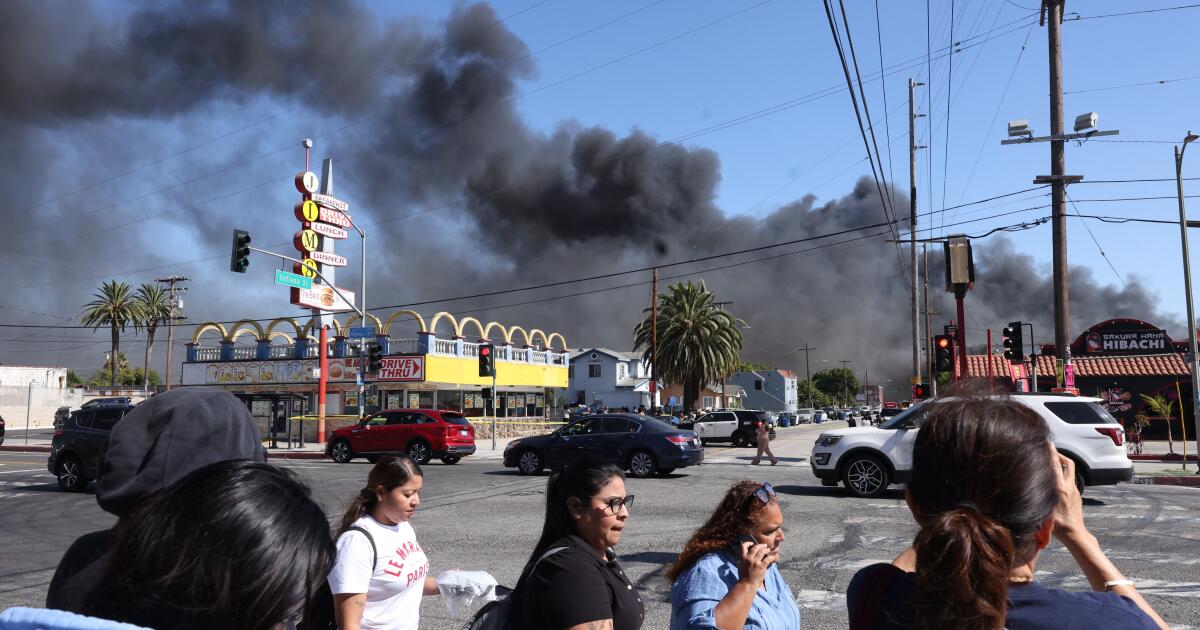
The air near the Lineage refrigerated warehouse fire in Boyle Heights carried astronomically high levels of smoke and soot, surpassing some of the worst air pollution during the Los Angeles County fires in January 2025, according to preliminary data from air officials.
The fire spewed thick black smoke for days. From downtown Los Angeles to the San Gabriel Valley, tens of thousands were enveloped in unhealthful levels of smoke, even as some local officials told residents that the air posed no danger.
As the days wore on, worst off were communities nearest the blaze. On June 19, three days after the facility ignited, a temporary air quality monitoring station at Eastman Elementary in unincorporated East Los Angeles measured an extremely hazardous 755 micrograms per cubic meter of fine particles for more than an hour, according to the South Coast Air Quality Management District.
For comparison, a Caltech air monitor in Pasadena recorded about 650 micrograms per cubic meter during the Eaton fire.
These high levels of fine particles, known as PM 2.5, probably resulted in the surge of residents into local emergency rooms during the fire, according to local health officials. But even now with the smoke gone, people still have not been told what chemicals they were breathing in during the weeklong ordeal.
Michael Jerrett, an environmental health professor at the UCLA Fielding School of Public Health, said his concern is the composition of materials emitted when the building burned.
“These contain many particularly toxic components,” Jerrett said, “and we know little about how these mixtures affect health.”
There is no completely safe level of fine particulate pollution, he noted, meaning higher concentrations are always worse.
During the 2025 L.A. County fires, local air officials announced that several monitors downwind had detected elevated levels of brain-damaging lead and cancer-causing arsenic from toxic paint and construction materials used in older homes.
The Lineage warehouse, built in 2018, is likely to contain different materials of concern. Thick insulation foam required for a massive refrigeration operation, solar panels and refrigerants were burned, leaving many residents on edge.
Even though three public agencies conducted air monitoring, the picture is still murky.
“[Public officials] are speaking with a lot of confidence but not a lot of information,” said mark! Lopez, a community organizer with East Yard Communities for Environmental Justice. “We’ve gotten in the room with folks to discuss where the gaps lie and where assumptions are being made. And I think they are realizing these agencies supposed to protect our air and our health aren’t as reliable as they thought they were.”
In response to the Boyle Heights fire, the South Coast air district deployed a mobile monitoring vehicle to screen for toxic substances in the community near the fire, according to Nahal Mogharabi, a spokesperson for the air district. It found increased levels of bromine, a chemical commonly found in fire retardant, and chlorine, often released from burning plastic. Both were below short-term health-based exposure thresholds.
Toxic metals, including lead and arsenic, were not elevated, according to air district data.
“That was the reassuring piece, that they were not picking up any of the metals,” said Dr. Nichole Quick, chief medical advisor for the Los Angeles County Department of Public Health. “But … that smoke is unhealthy. “You don’t want to be breathing it, regardless.”
The U.S. Environmental Protection Agency set up air monitors around the perimeter of the facility to test for toxic air contaminants, has the results and has not made them public. Julia Giarmoleo, an EPA spokesperson, said the monitors did not detect elevated metals, but would not provide a copy of the data without a federal records request.
The Los Angeles Fire Department’s hazardous material team also tested for ammonia, which is used in refrigeration, and hydrogen fluoride, a toxic chemical that could be released by burning lithium-ion batteries and solar panels.
Fire officials previously said they measured low levels of hydrogen fluoride on the second day of the fire. But the department would not answer questions about its air monitoring. It also told a reporter to submit a public records request.
It remains unclear whether any agency has tested for hydrogen cyanide or isocyanates, highly toxic gases that could be released from burning chemical-laden insulating foam inside the building.
“The real issue is what monitoring has not been done to protect the fence-line community from the air toxics,” said Jane Williams, executive director of California Communities Against Toxics.
Without the EPA or LAFD data, what is known of the smoke’s toxicity rests on the air district’s mobile monitoring.
Jerrett, the UCLA researcher, said that is not ideal for understanding the kind of plume released by the Boyle Heights fire, which rapidly changed direction with the wind.
“This can in some instances lead to levels that look low, but they are resulting from a mismatch between the location of the vehicle and the plume,” he said.
The Boyle Heights blaze, similar to the Eaton and Palisades fires, has revealed the region’s air monitoring can’t always tell people what they’ve been exposed to in a disaster.
“We do need a better monitoring system in place,” he said.
Local officials are now shifting their focus to the rancid odors from millions of pounds of rotting food in the ruined wing of the warehouse. Decomposing food can release hydrogen sulfide, a toxic gas synonymous with landfills and garbage. Lineage hired contractors who are measuring this noxious gas and other pollution. Their data indicate they have not detected hydrogen sulfide.
As Lineage workers haul the rotting food to local landfills, they are using deodorizing mist and have discussed using shrink wrapping to suppress the stench and minimize issues for nearby homes.
At this point, the odors are believed to be an inconvenience rather than a public health threat, according to Quick, the county medical advisor. She said running air purifiers may help to reduce odors indoors.
“It’s very important for folks to understand that the odors themselves do not indicate any dangerous levels of toxins, mold, bacteria, and so forth,” Quick said. “But the odors are a public nuisance.”
The air district is still encouraging residents to report odors to its online complaint system or by calling (800) 288-7664.
-
Delaware4 minutes ago
What Delaware’s New Probate Threshold Means for Your Estate Plan
-

 Florida6 minutes ago
South Florida’s top deals: Davie school building sells for $16M
-

 Georgia12 minutes ago
10 Best Towns In Georgia For Retirees
-

 Hawaii19 minutes ago
Paid parking lots debate continues – Hawaii Tribune-Herald
-

 Idaho21 minutes ago
ATV Crash in Pine Takes Life of Gooding Man
-

 Illinois27 minutes ago
Catholic Charities Fort Worth Expands Research-Backed Anti-Poverty Program to Illinois
-

 Indiana28 minutes ago
Indiana gov to Porter County: If you want to miss out on fun of giving $250m in tax money to Bears, your loss
-

 Iowa34 minutes ago
Iowa attorney general sues Temu, alleging deceptive sales, data theft

