This story is the first feature in a new Vox special project, Changing With Our Climate, a limited series exploring Indigenous solutions to extreme weather rooted in history — and the future.
Alaska
What 6 degrees of warming means for a community built on ice


When Priscilla Frankson thinks about home, she thinks about ice — thick sea ice stretching out toward the horizon.
Frankson, an Iñupiaq masters student in Tribal Leadership and Governance at Arizona State University, is from Point Hope (Tikiġaq), Alaska, a small city about 125 miles above the Arctic Circle and one of the northernmost communities in the United States.
“For us, the ice is a part of land, even though every single year it changes and it’s always different,” she said. “I think of the way that my boots kind of crackle over the ice, or the different sounds that it makes when there’s a very thin kind of sheet of snow on the top, and how it’s a little bit softer.”
In Point Hope, where summer temperatures rarely break 60 degrees, ice and cold are a part of life. Thick, reliable sea ice is essential for harvesting whales, a key part of the subsistence diets, a lifestyle built around harvesting wild foods for personal and community use, of Point Hope’s Iñupiaq residents.
Growing up, even when temperatures reached 40 below zero, Frankson would bundle up to go play outside in the snow or go hunting on the ice, while whales passed by. And on cold, cloudless nights, the northern lights would be spectacularly clear, flashing and dancing across the sky. It was a sight that Frankson said still seems too incredible to be real — even after years of observing it.
But climate change is threatening all of this.
Alaska is warming up to three times faster than the rest of the world, and the Arctic is warming nearly double that. Alaska’s North Slope, where Point Hope is located, saw an average annual temperature increase of 6 degrees since 1971. Since 1970, the US as a whole has warmed by 2.6 degrees.
Although the difference between, say, a day that is 0 degrees and one that is 5 degrees may seem like no big deal, the impact of these rising averages is immense.
Sea ice is forming later in the year than usual and is not as predictable as it used to be. As the permafrost thaws, siġlauqs — the traditional ice cellars carved into the land — are caving in or flooding. The animals that people rely on for food and goods — whales, fish, caribou — are also growing harder to find.
Despite the challenges, Frankson, who researches the social impact of declining caribou populations, says that Iñupiaq people are not going to change their entire way of life, but instead are making small adjustments to changing conditions. “We’re not scared enough to stop hunting, we’re not scared enough to stop going out on the ice, we’re not scared enough to do any of this,” she said. “We’re just learning how to adapt, as we always have.”
To adapt to the warming climate, Indigenous people in Alaska are relying on their deep understanding and respect for the land, a kind of humility developed over countless generations. “You can’t really change the Arctic,” Frankson said. “You can only change with the Arctic.”
Yes, daily life in Alaska — with its northern lights, its dependence on ice and the movement of caribou — may feel unrelatable. But this way of living in tune with the environment and gracefully adapting to a changing climate is becoming increasingly essential for the rest of the country. The strategies that Indigenous people in Alaska are developing show that sometimes the best forms of climate adaptation are achievable, local solutions.
Generations of extreme conditions have equipped Alaska Natives with the willingness and ability to embrace this kind of adaptation. As the impacts of climate change grow increasingly severe in the rest of the country, we could all learn from that.
Swimming may not seem like an adaptation to global warming. But in Alaska, it is.
Hundreds of miles south of Point Hope, in Bethel, Alaska, the Kuskokwim River is the heart of the community, providing food, transportation, employment, and community throughout the year.
The only way to get to Bethel is by plane, which can be very expensive, or by the river. In the winter, snow machines zip through town, heading up and down the frozen river to the dozens of villages that depend on Bethel for food, supplies, health care, and much more. In the summer, people travel by boat to spend days at their fish camps on the river, smoking salmon to eat throughout the rest of the year. In between, when the ice is forming or beginning to break up, the river can be dangerous: too frozen for boats, but too unstable for snow machines and cars.
“You can’t really change the Arctic. You can only change with the Arctic.”
Lately, those shoulder seasons have been shifting, extending, and becoming terrifyingly unpredictable.
Every year, flooding and erosion get worse, fish are dying, and the winter ice is becoming more dangerous. Kevin Whitworth, the executive director of the Kuskokwim River Inter-Tribal Fish Commission, says declining salmon populations are especially concerning. “It’s hard times,” he said. “Our people are subsistence-based people. They’re not economy-based people. They rely on the river as their grocery store. Their life is the river.”
According to the Federal Subsistence Management Program, rural Alaskans harvest 295 pounds of wild food per person, more than the 255 pounds of domestic meat, fish, and poultry that the average American consumes per year. Fifty-six percent of the statewide subsistence harvest is made up of fish. Beyond its cultural and community importance, subsistence is crucial for Alaska Natives because of the high cost of groceries. In a study of 261 urban communities across the country, the Council for Community and Economic Research found that the three most expensive places for groceries were Juneau, Fairbanks, and Anchorage. Prices in more remote communities like Bethel are often even higher.
Salmon’s drastic decline can be attributed to a number of causes, including warming waters and increased offshore trawling. Every year, ocean trawlers fishing primarily for pollock catch, kill, and discard about 141 million pounds of salmon, halibut, and other species, an extraordinarily wasteful practice that Indigenous people and other groups in Alaska have been rallying against. Meanwhile, communities upriver are severely limited in the number of salmon they can take from the river. “Right now, the salmon are crashing and we’re seeing big changes with the climate,” Whitworth says.
Bethel Vice Mayor Sophie Swope, who also sits on the Orutsararmiut Native tribal council, says that river conditions have become more dangerous for fishing and travel. “It used to be pretty dependable that you could just go drive out during the winter and it would be fine and safe,” Swope said. “Now, you have to keep an ear out for what the river conditions are.”
Whitworth, who is Athabascan from McGrath, says that because of salmon’s increasing scarcity, people are taking greater risks to get fish even though the river ice forms later in the season and is less reliable, leading to accidents and drownings.
So, facing declining salmon populations and a dangerous river, Indigenous people in the region are shifting their norms, too. While chinook and chum salmon are restricted, sockeye salmon, a less traditionally popular and available fish, has become an increasingly viable alternative.
Chinook has been a staple of Indigenous subsistence diets for generations, but people are doing what they must to use what is available now. Traditional salmon fishing techniques make it hard to separate different species of salmon, so Whitworth and the Kuskokwim River Inter-Tribal Fish Commission have been encouraging local fishers to use dip nets, large circular nets that allow people to target sockeye.
In the commission’s 2023 end-of-season report, sockeye made up about 40 percent of the estimated total salmon harvest on the lower Kuskokwim, a number that Whitworth says is much higher than it used to be.
As warming continues to impact the river, the local community has also been taking steps to protect its people.
In 2014, Yup’ik elder Beverly Hoffman and others finally succeeded in a decades-long effort to build a community pool in Bethel, which is now a resource for people throughout the region to learn how to swim, preparing them for an increasingly unpredictable river. Hoffman and others recognize that they cannot control the river, but they can help prepare the community to survive its dangers.
Swimming lessons and dip nets might sound like tiny changes in the face of global climate trends, but these are the kinds of local adaptations that will help communities thrive in a warming world. Outside of Alaska, planting trees to create more shade in urban heat islands or hiring more lifeguards for public pools could have a similar impact.
But these solutions are within reach and meaningful; they literally save lives.
Such approachable adaptations mean understanding that although we have a limited ability to change the climate, there are many more options to change our own behavior.
“This is what Indigenous knowledge is”
As temperatures continue to rise, Alaska Natives are turning to intergenerational knowledge and community observations to build a wealth of data that they hope will urge non-Indigenous decision-makers to listen to what they have to say.
In Unalaska, the largest city in the Aleutian Chain, the Qawalangin Tribe is gathering community feedback on climate change and what the people are experiencing. The tribe will then use these observations to help develop its climate resilience plans, which include culture camps with traditional dances and classes on kayak making, traditional food nights, and water quality testing programs.
Vera Metcalf is the executive director of the Eskimo Walrus Commission, which represents 19 coastal communities. Metcalf says that Indigenous walrus hunters have adapted to climate change by participating in research projects led by agencies like the US Fish and Wildlife Service. “In the past, we were largely ignored in research occurring in our homeland and waters,” she said. “When you combine the two ways of thinking, it really becomes a rich resource of information.”
Changing With Our Climate: A limited series exploring Indigenous solutions to extreme weather rooted in history — and the future
There’s no easy fix for the planet, but Indigenous people have simple solutions rooted in the depth of their knowledge. This story is the first installment of a new Vox series exploring frameworks for responding to extreme weather and the climate crisis. Every month through October, we’ll be publishing a new feature that centers an Indigenous community responding to various aspects of climate disasters, from major storms like hurricanes and typhoons, to extreme heat, rising seas, wildfires, and spreading aridity.
Roberta Tuurraq Glenn-Borade, Iñupiaq from Utqiaġvik, is the project coordinator and community liaison at the Alaska Arctic Observatory and Knowledge Hub, where she works with observers from four communities in the Alaskan Arctic.
Community observers share details like air temperature, wind speed, ice conditions, and animal observations, sometimes sending in photos of animals being harvested. Glenn-Borade and her team then take this data and share it with agencies like the US National Weather Service, which releases forecasts for the region. Glenn-Borade says that, historically, these forecasts prioritized larger ships offshore rather than Indigenous people living on the coast and hopes that using local observations will lead to better forecasts for Indigenous communities. “That kind of foresight of what the conditions will be can really make a difference between life or death,” she said.
Glenn-Borade also says this kind of local observation provides invaluable historical context about how the coast and the ice have changed over the years, what is within normal ranges, and what is unexpected.
“That’s what Indigenous knowledge is,” she said. “It is constant tracking and understanding and monitoring what’s going on and being prepared to respond on the fly.”
As the world warms, these examples from Alaska offer a warning that we can’t simply do everything the way we used to. Saudi Arabia, for example, can no longer ignore the deadly impacts heat is having on Hajj. Places like the Pacific Northwest can no longer count on mild summers and will save lives by investing in cooling infrastructure. But they also offer hope that if we can shift away from trying to change the environment to suit us, instead of the other way around, there may be a chance of finding creative, unexpected ways of changing with our climate.
When I spoke with Glenn-Borade recently, she told me she and her people are proud “that we’re still here. We’re not going to die off. Our languages aren’t going to die off. We will adapt. We’ll continue to adapt our lifestyles as the environment changes.”



The first Jesuit missionaries in Alaska sailed up the Yukon River in 1887. By the turn of the 20th century, the religious order of the Catholic Church had as many as 50 Jesuits in the state.
Now, only two remain. And by the end of June, there will be none.
The Jesuits’ nearly 140 years in the state was honored at an event at Bethel’s Immaculate Conception Church on June 16. A procession of priests wearing long white gowns with red hems walked down the aisle to open the event. The Bishop of the Diocese of Fairbanks, Stephen Maekawa, thumped the ground with a shimmering silver staff known as a clozier as he approached the altar.
“My brothers and sisters, we gather together to celebrate this wonderful and blessed occasion to acknowledge the love of God and the work of God through the 139 year mission of the Society of Jesus of the Jesuit fathers,” Maekawa said to open the event.
A traditional Catholic mass followed, with readings in both English and Yup’ik. During the sermon, Maekawa acknowledged the vastness of the Fairbanks diocese, and the tremendous amount of work done by the Jesuits to establish it.
“All of the 46 churches of the Diocese of Fairbanks that we currently have were established by either the Jesuit fathers or by direction of a Jesuit bishop,” Maekawa said. “We have a long history of the Society of Jesus’ presence and ministry here in all of Alaska.”
The Jesuits are an order within the Catholic Church, akin to the Dominicans or Franciscans. They have a reputation for taking on some of the Catholic Church’s most remote assignments.
That missionary spirit brought the Jesuits to the Yukon River in 1887, where they built churches, schools, and ministries. Without their work, Catholicism may not have taken root in huge swaths of Alaska, particularly among Alaska Native communities.

But the Jesuits leave a complicated legacy. Their methods of converting Native people to the religion, particularly in the first half of the 20th century, created generational traumas still felt to this day.
Fr. Sean Carroll is the provincial of the Jesuits West Province, which oversees Alaska and nine other states.

“Thank you for all that you have taught us about who Jesus is and how to love and serve Him wholeheartedly,” Carroll said. “I also thank you for your patience with us. For there have been times when we have sinned and when we have hurt you.”
Missionaries, including the Jesuits, forcefully converted and assimilated Alaska Native people into Western culture and religion. Students at Jesuit-run boarding schools were forced to abandon their Native languages and physically punished when caught speaking languages other than English. Native dancing and drumming were also banned.
The Jesuits West Province maintains a list of 150 Jesuits with credible claims of sexual abuse against minors or vulnerable adults. A quarter of the accused Jesuits served in Alaska at some point in time.
“I ask for your forgiveness for all that we have done that was not rooted in Christ and love for Him, and for when we did not value your culture nor recognize the presence of God in you,” Carroll said.
Carroll gave the order to withdraw from the state last spring. A big issue was the recruitment of Jesuits willing to travel and serve in remote villages. He told the congregation that the Jesuits’ work would continue, just without a permanent presence.
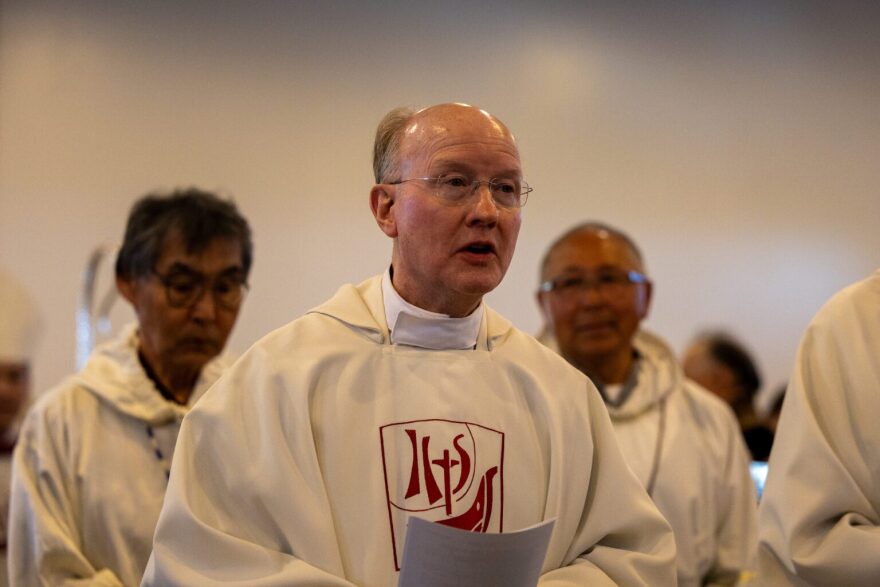
Fr. Rich Magner is one of the two remaining Jesuit priests in Alaska. His last day serving Chevak, Hooper Bay, and Scammon Bay is June 30.
“We all always knew coming in, or should have known, that we’re not going to be here forever. It’s going to be mission accomplished at some point,” Magner said. “And then we hand it off to the diocese that we’ve helped create, and so that’s a good feeling.”
Magner’s next stop is a Clinical Pastoral Education residency in Tacoma, Washington.
The other remaining priest, Fr. Tom Provinsal, first came to Alaska in 1968 to teach. A fond memory, he said, was meeting Elders that practiced traditional subsistence lifestyles.
“Some of the grandmothers, their fingers were just all bent with arthritis and stuff like that, you know, their whole lives they’ve been working out in the cold and the wet, doing food, sewing, all that kind of stuff,” Provinsal said. “I’d say I just feel very privileged to have come when I did come and to see that.”
Provinsal returned in 1975 as a priest and has served in the region ever since. After moving away, he plans to take a five month sabbatical. What happens next, he said, is in God’s hands.
Two lines formed in the aisle for communion at the end of the mass. After taking communion, Bethel’s Parish Administrator Susan Murphy gave a final thank you.
“It’s difficult to say goodbye to people who have been a part of our lives for so long,” Murphy said. “We know that you have done what was yours to do, and have taught us to do what is ours to do. We are grateful.”

Dominic Hunt, a Yup’ik deacon that flew in from Emmonak for the event, led the congregation through a final prayer.
“Bless them with your wisdom, that they may be a word of hope, a world in need. We ask this through Christ, our Lord. Amen,” Hunt said.
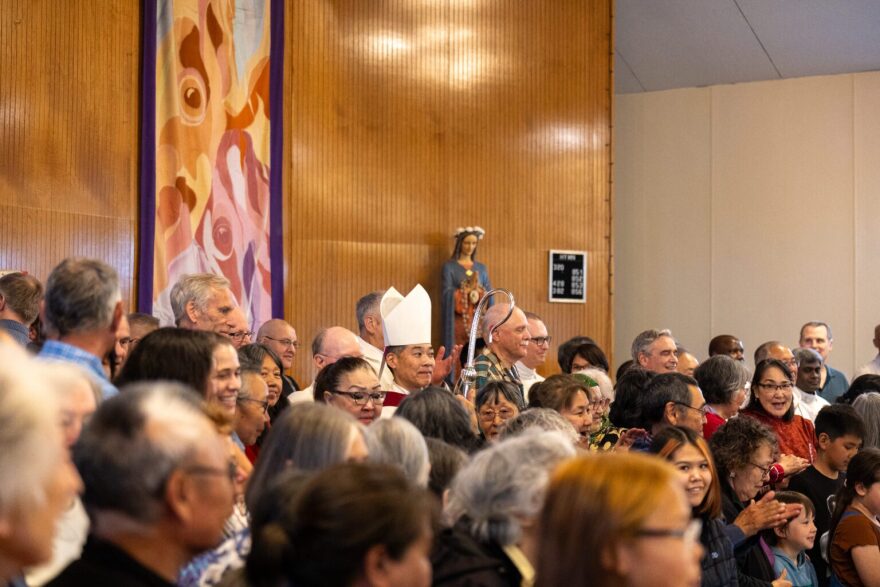
About 70 people posed for a photo on the altar – priests, deacons, parishioners, Elders and children — many of them smiling, some standing quietly.
The photo doesn’t tell the whole story. But it’s a moment when gratitude, grief, and memory all shared the same room.

JUNEAU, Alaska (KTUU) – The Supreme Court of Alaska will be taking up the case of the State of Alaska, Division of Elections v. Daniel J. Sullivan, Jr.
The oral arguments will be held Monday at 10 a.m. via Zoom, according to an order and opening notice.
The document also specifies that a decision is expected to be made before noon on Tuesday.
According to documents from the Division of Elections, the state must start printing ballots at noon on the same day.
This comes after an Anchorage Superior Court Judge ordered Dan J. Sullivan on to the ballot Friday.
See a spelling or grammar error? Report it to web@ktuu.com
Copyright 2026 KTUU. All rights reserved.

-

 New York23 minutes ago
Read the Indictment of Malik Beasley
-

 Los Angeles, Ca28 minutes ago
Stolen Sea Scouts boat found in Marina del Rey, suspect arrested
-

 Detroit, MI50 minutes ago
Michigan House passes bill to restrict big investors from amassing single-family homes
-

 San Francisco, CA58 minutes ago
San Francisco rolls out heightened security measures ahead of World Cup knockout match, 4th of July
-

 Dallas, TX1 hour ago
Klyde Warren Park reveals expansion plans, construction timeline
-

 Miami, FL1 hour ago
Person hospitalized after fire breaks out at North Miami Beach apartment building
-

 Boston, MA1 hour ago
Scottish soccer fan who died in Boston was ‘Tartan Army to his core,’ fundraising page says – The Boston Globe
-

 Denver, CO1 hour ago
Nuggets decline Jalen Pickett’s team option for 2026-27 season, sources say

