This story was produced as part of the Pulitzer Center’s StoryReach U.S. Fellowship. It was reported and edited by Northern Journal and APM Reports, with support from Alaska Public Media.
KODIAK — On an early, foggy summer morning, Nick Katelnikoff steered his boat through the treacherous waters off Kodiak Island’s Spruce Cape and chuckled.
“Trust a blind guy through the rock pile?” he asked.
Katelnikoff, 76, is a veteran fisherman — the kind of guy who, friends say, can call his catch into his boat.
Advertisement
He’s made a career chasing the bounty of the North Pacific, building up a storehouse of knowledge about his maritime backyard that allows him, even with failing eyesight, to confidently steer his 38-foot craft away from rocks that have sunk other vessels.
The MZ L motors past Kodiak Island’s Spruce Cape in July. (Photo by Nathaniel Herz/Northern Journal)
Katelnikoff describes his heritage as Aleut; he’s one of the Indigenous people who have been pulling fish out of these waters for millenia. Their catches helped sustain trading networks long before white people arrived on Kodiak and began setting up fish traps and canneries — businesses that were supplied, in part, by the harvests of Katelnikoff’s more recent ancestors.
When Katelnikoff was still beginning his career in the 1970s, he was one of a dozen or so skippers in Ouzinkie — a small Indigenous village on an island just off Kodiak’s coast.
But today, that tradition is all but dead: Katelnikoff is the last skipper running a commercial fishing boat from Ouzinkie’s harbor.
Advertisement
A similar story has played out in villages up and down the Gulf of Alaska coast. Angoon, Nondalton, Old Harbor — each of those small Native communities is home to a fraction of the commercial salmon fishermen who were once the lifeblood of their economies.
Over the last 50 years, hundreds of Alaska’s most valuable salmon permits have drained out of its Indigenous coastal villages. Now, the profits flow increasingly to those who live in Alaska’s population centers or in other states.
“We used to be people who fished,” an anonymous respondent wrote in a recent survey of thousands of Indigenous people with ties to the Gulf of Alaska. “Now, we don’t have access to our resources located in our backyard.”
Salmon dry on racks in Old Harbor in 1889. (U.S. Fish Commission photo via National Archives)
The outflow was set in motion in the early 1970s. At the time, new fishermen were flooding into the industry as salmon harvests had plummeted from historic highs, making it more difficult for each boat to turn a profit.
In response, Alaska’s government made a monumental change in the way it regulated those fisheries.
Advertisement
No longer could just any commercial fisherman set out in a boat and cast their net — even Alaska Natives whose ancestors had fished for generations. The new system, approved by voters in 1972 and put into effect three years later, placed caps on the number of permits available in each fishery.
The policy was known as “limited entry” because it restricted who could enter the industry, and it created permits that have since been valued collectively at more than $1 billion.
Scholars diverge on how effective the policy has been at preserving the salmon population, with critics arguing that limiting the number of fishermen on the water doesn’t necessarily prevent overfishing.
But one result is clear: The policy has dragged down the economies of many Indigenous villages along the Gulf of Alaska. Places that once called themselves “fishing towns” have been hollowed out, with little-used harbors and even dilapidated boats grounded on shore.
Rural local ownership in Alaska salmon purse fisheries
Alaska salmon permit values
Advertisement
Estimated earnings
Data source: Commercial Fisheries Entry Commission Zac Bentz for Northern Journal
The people who live in those Gulf communities, which are disconnected from the road system and reachable only by plane or boat, are overwhelmingly Alaska Native.
They face high prices for groceries, fuel and other supplies, which have to be flown or barged in from afar. Jobs outside of fishing are scarce, and fishing jobs are increasingly sparse, too. Residents who can’t afford permits have to leave their homes, families and cultures to find full-time jobs.
“If you’ve got young people who live in the fishing communities where the fisheries occur and they don’t see that as an opportunity, that’s bad public policy,” said Rachel Donkersloot, a researcher who grew up in the Bristol Bay region and has spent more than a decade studying obstacles to fisheries access. “Being able to provide for yourself from that fishery should be a birthright.”
When limited entry started in 1975, many Alaska Natives in coastal villages received permits without having to buy them, based on their long histories working in the industry.
Advertisement
With some exceptions, the permits were permanent — entitling holders to fish until they died or retired, then pass the permit on to an heir. But a controversial provision known as “free transferability” also meant that they could sell them to the highest bidder at any time.
Where did Nondalton’s permits go?
A total of 15 Bristol Bay salmon drift gillnet permits were issued in the Native village of Nondalton in the early years of limited entry. Today, none remain. Here’s where they went.
Data source: Commercial Fisheries Entry Commission Zac Bentz for Northern Journal
The limited supply turned those permits into valuable assets. At their peak in the 1980s and early ’90s, prices for some permits hit more than $500,000 in inflation-adjusted dollars, before the advent of farm-raised salmon began depressing their value. Still, just three years ago, some Bristol Bay permits were selling for $250,000.
Those eye-popping sums created a powerful incentive for rural fishermen to cash out. And those who sold at the top of the market likely came out ahead.
Advertisement
But the one-time windfalls severed an Indigenous tradition of commerce tied to Alaska’s ocean harvests — a trade that could now require a permit to access. And the high prices put them out of reach for many rural Alaskans who lacked a credit history or who didn’t have collateral for a loan.
“We should never have been allowed to sell them,” said Freddie Christiansen, a tribal member and longtime fisherman from the Kodiak Island village of Old Harbor. “We’re Indigenous people. We’re from here. We take care of it. Everyone else comes and goes.”
Freddie Christiansen flies in a bush plane between the city of Kodiak and the village of Old Harbor. Christiansen, an outspoken critic of the limited entry system, grew up commercial fishing in Old Harbor, where, at the time, “everybody fished,” he said. Today, the village has a fraction of the salmon permits once held there. (Photo by Nathaniel Herz/Northern Journal)
Some of the exodus can be explained by rural fishermen relocating to urban areas, bringing their permits with them. But many permits were simply bought up by city dwellers who had better access to capital — and far more experience working with western institutions like banks and government-sponsored loan programs.
At the time, many of Alaska’s Indigenous communities were just beginning to encounter those systems. And in some cases, sophisticated urban operators took advantage of that inexperience to buy their permits at low prices, according to people who witnessed the transactions.
The state has dozens of fisheries and types of fishing gear, and the losses vary across different regions and classes of permits. But they’ve tended to be more acute in fisheries where more money is at stake.
Advertisement
Each permit’s sale effectively marked the loss of a small business from the rural villages. Those businesses produced cash for captains and crew to feed families and heat homes over the winter, along with extra fish to eat and share during the off-season.
Old boats sit onshore in Angoon. The Tlingit village, 50 miles south of Juneau on Admiralty Island, used to have a fleet of small salmon fishing vessels, but many have fallen into disrepair and few permits remain in the village. (Photo by Johnny Hunter for Northern Journal)
“It’s just terminated this ability to be self-sufficient and self-determined,” said Jonathan Kreiss-Tomkins, a former state legislator from Sitka who tried and failed to reverse the permit losses before he left office in 2023. He described spending time in struggling rural villages in his district that were once “thriving, bustling communities 40 years ago that ran on commercial fishing.”
“That contrast was stark and depressing,” he said.
Kreiss-Tomkins described limited entry as “the opposite of a panacea”: Instead of a cure-all, it turned out to be the root of countless ills.
“It was an alien construct that got dropped onto all these communities. And even if they’re as good or better fishermen, or as good or harder workers, it didn’t really matter,” he said. “The structure was so foreign. And once in motion, it just got worse.”
Advertisement
Scholars have been raising alarm about the problem since the 1980s. But Alaska’s elected leaders, most of whom live in regional or urban hub communities, have largely ignored it. And many people who currently own permits are leery of change, which they fear could reduce the value of their investments.
Some larger Alaska communities like Kodiak, pictured here, and Homer have seen an increase in permits since the limited entry system was created. (Photo by Nathaniel Herz/Northern Journal)
After decades of inaction, state lawmakers are reconsidering parts of the limited entry system amid a broader effort to aid the fishing industry. Alaska’s seafood businesses and fishermen have faced major upheaval in the past two years, stemming from reduced demand and low-priced competition from Russian harvesters.
In a draft report released in January, a legislative task force noted the “large loss of permits held in rural and Alaska Native fishing communities.” And the new speaker of the state House, Bryce Edgmon, believes there’s growing interest from legislators in addressing the issue.
But he said it also faces competition from other policy problems like school funding and a shortage of the natural gas used to heat urban Alaska homes.
Most lawmakers still do not see stemming permit losses in villages “as a public policy change that’s urgently needed at this point,” said Edgmon, an independent from Dillingham, a fishing town of 2,100 in Bristol Bay.
Advertisement
‘It was what would work’
Terry Gardiner still remembers fishing outside Ketchikan in the 1960s and seeing all the other boats.
There were hundreds of them, nets stretching almost continuously a couple of miles out into the ocean from shore.“It was just, like, a wall,” he said.
Bristol Bay fishing boats sit at a dock, likely in the 1960s. (Amos Burg, Alaska Department of Fish and Game Historical Photograph Collection, 1950-1991, Alaska Resources Library and Information Services, on behalf of Alaska Department of Fish and Game)
Scores of new fishermen had entered the industry in the 1950s and 1960s amid Alaska’s postwar boom. Many were newcomers to the state, and fishing wasn’t their main occupation. Often they were teachers or out-of-staters with office jobs who could afford to take summers off to fish.
Gardiner wasn’t a full-time fisherman, either. He was still in high school, just looking for a fun way to earn a few bucks. He and a buddy made perhaps a “couple grand” in profit each summer, he said.
So, at the end of one season, Gardiner was surprised when a seafood processing company told him that his boat was one of the highest earners in the fleet.
Advertisement
“It was like, ‘Holy smokes, we’re a top boat? This is a joke,’” he said. “How would a family make a living?”
A poster advertising Terry Gardiner’s campaign for the Legislature, featuring his 36-foot fishing boat. (Photo courtesy Terry Gardiner)
Gardiner’s experience was a symptom of what he describes, more than a half-century later, as a “sickness” that was afflicting Alaska’s fishing industry.
Salmon populations had crashed in the 1950s and were starting to rebound in the 1960s just as the number of fishermen exploded.
In 1972, Gardiner ran for the state House at age 22. His campaign slogan, he said, was “too many fishermen, fishing for too few fish, at too low a price.” At the Capitol, he became one of the most vocal advocates for limiting the number of fishing boats on the water.
It was an approach supported by influential natural resource economists, who argued against what they called open access to the ocean. Fisheries in the United States at the time were “marked by obsolescence, waste, and poverty,” James Crutchfield and Giulio Pontecorvo wrote in a 1969 book about the economics of Pacific salmon harvests.
Advertisement
When fisheries are “common property,” they said, there are no ways to prevent “declining yields and the disappearance of net revenues to the industry.”
The economists said that far fewer boats and nets could catch the same amount of fish, allowing the industry to return to profitability.
Fishing boats are tied up at a dock in Juneau in a historical photo. (Alaska Department of Fish and Game Historical Photograph Collection, 1950-1991, Alaska Resources Library and Information Services, on behalf of Alaska Department of Fish and Game.)
The limited entry program was not Alaska’s first attempt to restrict the number of fishermen. Legislators had initially approved policies aimed at making it harder for people from other states to access its waters.
The courts, however, struck down those efforts, saying, in one case, that they violated the U.S. Constitution’s Equal Protection Clause.
So the final limited entry legislation prioritized permits for the fishermen who were most financially dependent on the industry for their livelihoods.
Advertisement
That meant that when the permits first rolled out, nearly half of them went to Alaska Native people, who at the time represented some 18% of the state’s population.
Ouzinkie’s harbor in the 1950s. The village had as many as 17 salmon seine permits in the 1970s, but just three remain, with only one commercial fishing boat operating out of the harbor. (Arnold Granville/Alaska and Polar Regions Collections, University of Alaska Fairbanks)
But after that, there was nothing to stop permits from leaving rural, Indigenous communities.
Gardiner said that “nobody was really a big fan” of the transferable permits.
“But it was what would work, what would be constitutional,” he said. “And everybody was tired of passing a law, getting everyone excited, spending all this effort and then boom, it fails after a year or two.”
Alaska voters approved a constitutional amendment paving the way for the limited entry system in 1972, and state lawmakers passed a bill to implement the policy the following year.
Advertisement
Lawsuits and a statewide referendum campaign both challenged the new system. But the program held up.
And in rural Alaska, the invisible hand of the market went to work.
‘They all went one way’
Jerry Liboff grew up in Southern California, and in his early 20s he signed up with Volunteers in Service to America, a program that has since become part of AmeriCorps. In 1969 the program dispatched Liboff to Koliganek, a Yup’ik village of 140 in the Bristol Bay region.
Liboff didn’t know it, but he had arrived just in time to witness an immense change to the economic and cultural fabric of his new home.
At the time of Liboff’s arrival, Koliganek, like many other Native villages, was barely connected to urban Alaska.
Advertisement
Bush planes, the only way to reach the road system, arrived in the village just once or twice a week, Liboff said. Many Koliganek residents spoke no English, only their Indigenous Yup’ik language. Most finished school after eighth grade; there were just a handful of full-time jobs.
Subsistence harvests of fish and game were essential to survival. There was, however, one strong link connecting Koliganek to the cash economy.
Each spring, about half the village’s 30 families would push their fishing boats into the water, run the 120 miles down the Nushagak River into Bristol Bay and spend the summer catching salmon that they would sell to local canneries.
Their harvests would pay for the fuel and food they needed to get through the winter. Fish canning businesses in Bristol Bay, like others across the Gulf of Alaska, formed close ties with the Native skippers and would often float them with supplies on credit if they had a bad year.
“You didn’t need a full-time job to survive,” Liboff said. “People got by. I don’t remember anybody being hungry.”
Advertisement
Liboff’s fluency in English and in navigating bureaucracy made him useful in the village, and he decided to stay, developing a passing facility with the Yup’ik language. He also drummed up a tax preparation business — working with residents of Koliganek and, eventually, more than a dozen surrounding villages.
Jerry Liboff works in his home office in the Bristol Bay hub town of Dillingham in January. (Photo by Margaret Sutherland for Northern Journal)
Many of his clients were fishermen, giving him a unique chance to observe the effects of the new permit system in the years after its approval.
In Koliganek, Liboff said, residents hadn’t been informed or consulted about the limited entry program beforehand, though at first, it seemed to work. All the village’s boat owners initially got permits, and “nobody really thought much about it,” he said. But after a few years, troubling signs began popping up.
A man with a drinking problem in a neighboring village went on a weeks-long bender after selling his permit for $1,500 in cash and a rickety snowmachine that the buyer claimed was worth $2,500, Liboff recalled.
Two brothers who had fished in an equal partnership realized that only one could pass their single permit on to their children.
Advertisement
Liboff said he witnessed teachers and pilots — non-Natives who lived in and traveled through the villages — acting like speculators. They found local fishermen in Bristol Bay who needed money and bought their permits on the cheap, then flipped them for a profit, Liboff said.
“In villages, we had a bum season, they couldn’t meet their family needs, they sold their permits,” said Robin Samuelsen, a Native leader from Bristol Bay. “It reoccurred, reoccurred, reoccurred, reoccurred. Anything of any value, like a permit, you sold — you had to feed the family. You had to buy stove oil.”
Robin Samuelsen poses for a photo at an office in Dillingham, the Bristol Bay salmon fishing hub town, in October. His father harvested Bristol Bay salmon from a sailboat — powered boats were banned in the area until 1951. Samuelsen says he initially supported limited entry as a way to limit the number of outsiders in the fishery. “But the problem with limited entry permits is, you could sell them,” he said. (Photo by Nathaniel Herz/Northern Journal)
In another village, Liboff knew a Native woman who didn’t speak English and had what he said was a common misunderstanding about the permit system. She thought that if her children needed to generate some cash by selling the permits they initially qualified for, they could simply earn new ones later.
“That was her very incorrect version of how the law worked: If you fished enough years, you’d get another permit,” Liboff said. Today, he added, “there’s one permit left in the family, out of eight.”
Liboff spent his career as a tax preparer trying to find ways to stop the outflow of permits from the villages — as did other advocates, researchers and local and regional groups.
Advertisement
But they were fighting the pervasive power of the market.
“There are a whole ton of different reasons why permits went. But the bottom line is they all went one way,” Liboff said. “Whether a guy lost it because his taxes were bad. Whether a guy lost it because he bought a boat he couldn’t afford. Whether a guy lost it because he didn’t want to give it to one of his kids and have the rest of his kids pissed at him.”
Limited entry is one of multiple ways in which 1970s-era policymakers imposed Western systems of private ownership on Alaska’s natural resources and lands — systems that fundamentally changed Native people’s relationships to their ancestral territory.
Congress also passed legislation in 1971 that terminated Indigenous land claims in Alaska. In exchange, the Alaska Native Claims Settlement Act transferred some 10% of the state to Indigenous people — but it did so through newly created, for-profit corporations. Native leaders and advocacy groups, in recent years, have increasingly questioned how well that for-profit model serves their interests and aligns with their culture.
“This Westernized model, one-size-fits-all, does not work,” said Christiansen, the tribal member and fisherman from Old Harbor, on Kodiak Island. “We’ve proven it over and over and over again.”
Advertisement
Years of warnings, little action
Rural Alaska residents weren’t the only ones to notice permits trickling out of the villages.
Within a decade of limited entry’s passage, scholars and government agencies had begun to document the phenomenon.
A 1980 paper by Anchorage anthropologist Steve Langdon described a “clear and escalating trend” of diminishing rural permit ownership.
“The outflow of permits that has occurred and that potentially can occur must be regarded as (a) significant threat to the rural Alaskan economic base and the well-being of rural Alaskans,” Langdon wrote.
Four years later, the state agency that oversees commercial fishing permits said that Indigenous ownership of Bristol Bay salmon permits had fallen 21% since the new system went into effect — a dynamic that called for “serious attention,” according to the agency’s commissioners.
Advertisement
One driving force that appeared to be behind the trend, according to Langdon: The permits were worth more money to fishermen who could catch bigger hauls with them.
Urban and out-of-state fishermen were more likely to own cutting-edge boats and gear that allowed them to catch more fish and reap bigger profits. As a result, they were willing to pay more for a permit than fishermen without those advantages.
Courtney Carothers speaks at a community meeting in Ouzinkie in July. (Photo by Nathaniel Herz/Northern Journal)[/caption]
“The economic rationale of why you want to privatize the rights to fish is all about efficiency. It’s eliminating inefficient users,” said Courtney Carothers, a University of Alaska Fairbanks anthropologist whose scholarship has focused on Native fishing communities on Kodiak Island. “The ideology is that those who don’t fish efficiently could better serve society by getting other jobs.”
Carothers said that logic may make sense in an urban environment where there are lots of employment opportunities. But, she added, it breaks down in intensely isolated rural areas like the coastal villages. “Their lives are from the sea, and if you’ve displaced people from sea-based livelihoods, there’s not a whole lot to pick up.”
A view of Old Harbor from the mountainside that looms behind the village. (Photo by Nathaniel Herz/Northern Journal)
There were a few efforts in the early years of limited entry to keep more permits in Alaska Native hands — one, started in 1980, was a short-lived loan program targeted at residents of rural communities.
But it was shut down a few years later, after a state agency said it had the unintended effect of driving up the cost of permits. Langdon’s research concluded that an earlier state loan program had actually contributed to the losses from rural areas, because it was used mainly by urban residents.
Advertisement
Langdon has suggested that the state allow tribes to own permits, so they can stay in Indigenous hands. But those and other ideas got little traction. Most legislators, Langdon said in an interview, live in more urban areas where their constituents are buying up permits — not selling them.
“They’re the ones benefiting,” he said.
Where did the Kodiak village permits go?
There were 73 Kodiak salmon purse seine permits initially issued in the island’s six Native villages. Ten remain, along with roughly a dozen more that have come into the villages from other communities. Here’s where the rest of the initial-issue permits are now.
Data source: Commercial Fisheries Entry Commission Zac Bentz for Northern Journal
Kreiss-Tomkins, the former Sitka legislator, is the only lawmaker who’s made a major push to tackle the problem in recent years.
Advertisement
He said he and his aides put thousands of hours into developing and pushing legislation that would have allowed local trusts or regional organizations to buy and own permits, then lease them to new fishermen.
But the bill never got to the House floor for a vote. Kreiss-Tomkins said he thought the proposal “bewildered” some of the legislators from urban communities who weren’t familiar with the limited entry system. There was also a wariness from fishing industry stakeholders who represented existing permit holders, he said.
“I think, to some extent, the idea was written off at the outset because of political cues from opponents in the commercial fishing world,” he said. “There was never a rich, policy-based conversation or understanding.”
Gardiner, the legislator who promoted the limited entry bill in the 1970s, put it more bluntly: “There’s not a whole lot of votes in all those small, coastal communities.”
The sale of permits isn’t the only factor driving the losses in rural Alaska. Migration — when a rural resident moves with their permit to urban Alaska or out of the state — has also been responsible for the loss of hundreds of rural permits statewide. Experts say the closure of many remote processing plants in coastal villages also makes it harder for rural fishermen to turn a profit.
Advertisement
Empty slips in the harbor in Angoon. (Photo by Johnny Hunter for Northern Journal)
But residents across coastal Alaska say that permit costs remain a significant barrier for people seeking to enter the industry. In the Kodiak island villages, there are “a bunch of young guys” who would love to be a skipper and the owner of a boat, Christiansen said. But the cost of a modern vessel, combined with a seine permit and gear, is out of reach, he added.
“They love fishing. But they don’t have the opportunity,” Christiansen said. “How are you going to be able to come up with half a million dollars to get in?”
Christiansen is one of many Alaska Native people and groups — including Kodiak’s and Southeast Alaska’s regional Native corporations — that are increasingly agitating for reforms to the limited entry system.
Those two Native corporations, working with nonprofit organizations and scholars, released the January survey of Indigenous people with ties to the Gulf of Alaska. Some 80% agreed that villages are in “crisis” because of loss of access to fisheries.
“We’re ready to go to work” on policy reforms, said Joe Nelson, interim president of Sealaska, the Southeast Alaska Native corporation. “We’re working all together.”
Advertisement
In the meantime, communities like Ouzinkie — the home of Katelnikoff, the aging skipper with the failing eyesight — face existential questions.
At a community meeting last summer, as Katelnikoff was finishing up a trip, residents described how the village is steadily shrinking. A few decades ago, there were more than 200 people there, with dozens working in commercial fishing. The population is now down to just 100.
Jimmy Skonberg is retired from commercial fishing in Ouzinkie, but he still owns a salmon seine permit there. He’s skeptical that the commercial fishing culture can be revived in the village. “It’s gone forever,” he said. “Limited entry, I have to blame that.” (Photo by Nathaniel Herz/Northern Journal)
The community, through a federal program, has purchased rights to a small halibut harvest that it wants to make available to residents to fish. But many of the young people that old-timers hope would get into fishing have moved out of Ouzinkie, making them ineligible to participate.
“Our younger generation can’t afford to buy a skiff, or the equipment, or the permits,” said Sandra Muller, who once fished commercially with her husband and young children. “It is a big crisis for our young people. I feel for them.”
The village’s sole remaining commercial fishing boat, meanwhile, motors on.
Advertisement
Katelnikoff has renewed his state permits for 2025. More than six decades after he began fishing, he says he’s still “too young” to retire. But when he does, he’ll likely pass his operation on to a daughter, who was onboard for his summer trips.
Nikolai Katelnikoff’s boat, the MZ L. (Photo by Nathaniel Herz/Northern Journal)
Other Ouzinkie old-timers say it’s too late to resurrect the village’s commercial fishing culture, that the loss of collective knowledge and experience is too great to overcome.
But Katelnikoff isn’t so sure. He pointed out that permit prices have fallen in recent years — making it, he said, a good time for aspiring fishermen to buy in.
“Things could happen where it could come back,” he said.
Brian Venua contributed reporting, and Zoë Scott contributed research and reporting.
Advertisement
Do you have a story about the loss of a permit from your family or village, or do you have feedback on this piece? Take Northern Journal’s brief survey that will inform future reporting on fisheries access in Alaska.
Nathaniel Herz welcomes tips at [email protected] or (907) 793-0312. This article was originally published in Northern Journal, a newsletter from Herz. Subscribe at this link.
The first Jesuit missionaries in Alaska sailed up the Yukon River in 1887. By the turn of the 20th century, the religious order of the Catholic Church had as many as 50 Jesuits in the state.
Now, only two remain. And by the end of June, there will be none.
The Jesuits’ nearly 140 years in the state was honored at an event at Bethel’s Immaculate Conception Church on June 16. A procession of priests wearing long white gowns with red hems walked down the aisle to open the event. The Bishop of the Diocese of Fairbanks, Stephen Maekawa, thumped the ground with a shimmering silver staff known as a clozier as he approached the altar.
Bishop of the Diocese of Fairbanks, Steven Maekawa, walks toward the altar at the Immaculate Conception Church in Bethel.
“My brothers and sisters, we gather together to celebrate this wonderful and blessed occasion to acknowledge the love of God and the work of God through the 139 year mission of the Society of Jesus of the Jesuit fathers,” Maekawa said to open the event.
Advertisement
A traditional Catholic mass followed, with readings in both English and Yup’ik. During the sermon, Maekawa acknowledged the vastness of the Fairbanks diocese, and the tremendous amount of work done by the Jesuits to establish it.
“All of the 46 churches of the Diocese of Fairbanks that we currently have were established by either the Jesuit fathers or by direction of a Jesuit bishop,” Maekawa said. “We have a long history of the Society of Jesus’ presence and ministry here in all of Alaska.”
The Jesuits are an order within the Catholic Church, akin to the Dominicans or Franciscans. They have a reputation for taking on some of the Catholic Church’s most remote assignments.
That missionary spirit brought the Jesuits to the Yukon River in 1887, where they built churches, schools, and ministries. Without their work, Catholicism may not have taken root in huge swaths of Alaska, particularly among Alaska Native communities.
The Immaculate Conception Church in Bethel.
But the Jesuits leave a complicated legacy. Their methods of converting Native people to the religion, particularly in the first half of the 20th century, created generational traumas still felt to this day.
Advertisement
Fr. Sean Carroll is the provincial of the Jesuits West Province, which oversees Alaska and nine other states.
Fr. Sean Carroll, provincial of the Jesuits West Province, speaks at an event recognizing nearly 140 years of Jesuit service in Alaska.
“Thank you for all that you have taught us about who Jesus is and how to love and serve Him wholeheartedly,” Carroll said. “I also thank you for your patience with us. For there have been times when we have sinned and when we have hurt you.”
Missionaries, including the Jesuits, forcefully converted and assimilated Alaska Native people into Western culture and religion. Students at Jesuit-run boarding schools were forced to abandon their Native languages and physically punished when caught speaking languages other than English. Native dancing and drumming were also banned.
The Jesuits West Province maintains a list of 150 Jesuits with credible claims of sexual abuse against minors or vulnerable adults. A quarter of the accused Jesuits served in Alaska at some point in time.
“I ask for your forgiveness for all that we have done that was not rooted in Christ and love for Him, and for when we did not value your culture nor recognize the presence of God in you,” Carroll said.
Advertisement
Carroll gave the order to withdraw from the state last spring. A big issue was the recruitment of Jesuits willing to travel and serve in remote villages. He told the congregation that the Jesuits’ work would continue, just without a permanent presence.
Fr. Rich Magner, one of the two remaining Jesuit priests in Alaska, attends a ceremony in Bethel.
Fr. Rich Magner is one of the two remaining Jesuit priests in Alaska. His last day serving Chevak, Hooper Bay, and Scammon Bay is June 30.
“We all always knew coming in, or should have known, that we’re not going to be here forever. It’s going to be mission accomplished at some point,” Magner said. “And then we hand it off to the diocese that we’ve helped create, and so that’s a good feeling.”
Magner’s next stop is a Clinical Pastoral Education residency in Tacoma, Washington.
The other remaining priest, Fr. Tom Provinsal, first came to Alaska in 1968 to teach. A fond memory, he said, was meeting Elders that practiced traditional subsistence lifestyles.
Advertisement
“Some of the grandmothers, their fingers were just all bent with arthritis and stuff like that, you know, their whole lives they’ve been working out in the cold and the wet, doing food, sewing, all that kind of stuff,” Provinsal said. “I’d say I just feel very privileged to have come when I did come and to see that.”
Provinsal returned in 1975 as a priest and has served in the region ever since. After moving away, he plans to take a five month sabbatical. What happens next, he said, is in God’s hands.
Two lines formed in the aisle for communion at the end of the mass. After taking communion, Bethel’s Parish Administrator Susan Murphy gave a final thank you.
“It’s difficult to say goodbye to people who have been a part of our lives for so long,” Murphy said. “We know that you have done what was yours to do, and have taught us to do what is ours to do. We are grateful.”
Jesuit priests form a row along the altar of Bethel’s Immaculate Conception Church as members of the congregation lift their arms and pray.
Dominic Hunt, a Yup’ik deacon that flew in from Emmonak for the event, led the congregation through a final prayer.
Advertisement
“Bless them with your wisdom, that they may be a word of hope, a world in need. We ask this through Christ, our Lord. Amen,” Hunt said.
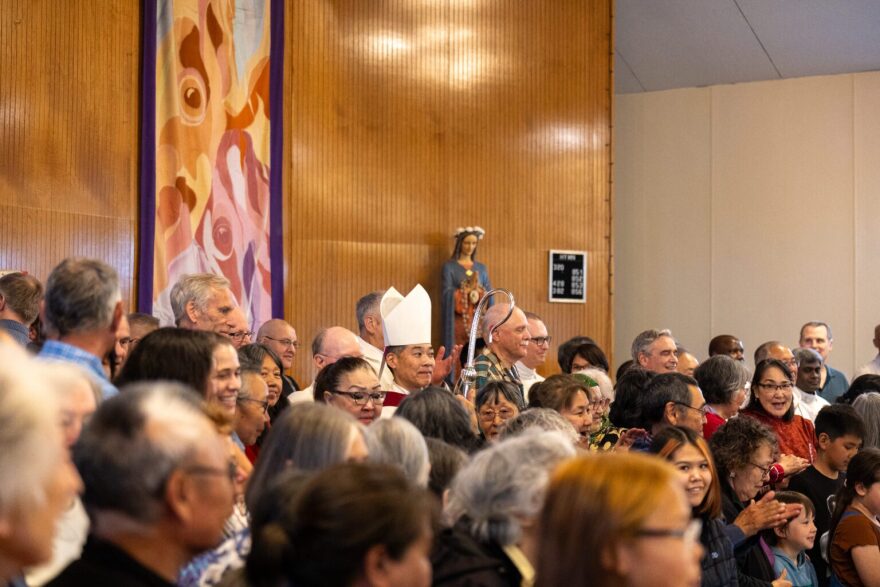
About 70 people posed for a photo on the altar – priests, deacons, parishioners, Elders and children — many of them smiling, some standing quietly.
The photo doesn’t tell the whole story. But it’s a moment when gratitude, grief, and memory all shared the same room.
Bishop of the Diocese of Fairbanks, Steven Maekawa, stands in the middle of a crowd waiting to take a photo at Bethel’s Immaculate Conception Church.
JUNEAU, Alaska (KTUU) – The Supreme Court of Alaska will be taking up the case of the State of Alaska, Division of Elections v. Daniel J. Sullivan, Jr.
The oral arguments will be held Monday at 10 a.m. via Zoom, according to an order and opening notice.
The document also specifies that a decision is expected to be made before noon on Tuesday.
According to documents from the Division of Elections, the state must start printing ballots at noon on the same day.
Advertisement
This comes after an Anchorage Superior Court Judge ordered Dan J. Sullivan on to the ballot Friday.
See a spelling or grammar error? Report it to web@ktuu.com



 Courtney Carothers speaks at a community meeting in Ouzinkie in July. (Photo by Nathaniel Herz/Northern Journal)[/caption]