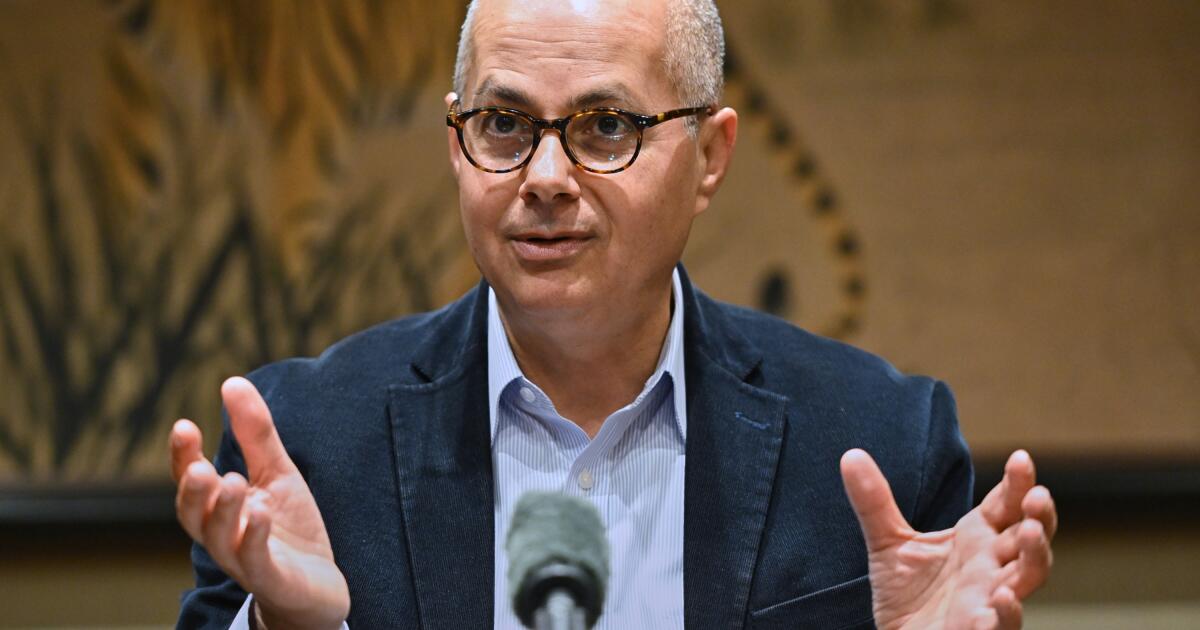
Revenue Commissioner Adam Crum gives comments to the House Finance Committee on January 23, 2025. (Marc Lester / ADN)
Former Alaska Revenue Commissioner Adam Crum says he was following state law when he committed $50 million in state funds to invest in a digital infrastructure firm shortly before he departed public office.
Crum’s decision to commit the funds from the Constitutional Budget Reserve — the state’s rainy day fund — later led Gov. Mike Dunleavy to promise a third-party independent review of the investment. It also caused alarm from House Speaker Bryce Edgmon and Senate President Gary Stevens, who in a joint statement said that the investment “raises serious concerns about accountability, transparency, and fiscal responsibility.”
But Crum, who departed the Dunleavy administration in July and days later announced he was running for governor, said Friday that members of Dunleavy’s administration, including the governor himself and top attorneys in the Department of Law, had known about his investment plan for months.
Department of Revenue spokesperson Aimee Bushnell said in an email that Crum had informed the governor’s office of his plan, but Bushnell declined to answer when she was asked when, exactly, Dunleavy was informed. The governor’s office “cautioned that any investments made needed to be in accordance with established investment policies and procedures,” Bushnell said.
Advertisement
The idea for the $50 million investment in private equity, Crum said, was to resume a practice first initiated by lawmakers more than 20 years ago, of investing some funds from Alaska’s Constitutional Budget Reserve in a subaccount with the goal of yielding “higher returns than might be feasible to obtain with other money in the budget reserve fund,” assuming that the funds would not be needed for at least five years, according to state statute.
But lawmakers liquidated the subaccount’s nearly $7 billion in 2015 amid a decline in oil revenue, and hadn’t used it since, though its existence remained prescribed in law. Since 2020, the Department of Revenue’s policy has remained to keep the funds from the Constitutional Budget Reserve — which currently stand at roughly $3 billion — in short-term investments, under the assumption that the funds might be needed in the near term. Indeed, under Dunleavy’s most recent budget proposal, the funds in that accountwould have been fully spent by 2028, far before the five-year timeline prescribed in the subaccount statute.
Because the funds in the account for years have been invested accessibly and with lower rates of return, “simply leaving all of the money in the Constitutional Budget Reserve was actually irresponsible,” Crum concluded.
Crum said he asked former Alaska Attorney General Treg Taylor if he could revive the subaccount to “invest in alternatives” that would both have a higher rate of return and “help Alaska as a whole.”
“They said, ‘yes you can, make sure that you update the investment policy statement,’ ” Crum said.
Advertisement
The Department of Law did not respond to questions from the Daily News, including whether Taylor — who himself resigned in August to run for governor — reviewed the investment proposal.
Crum said that once he decided to revive the subaccount, he chose to invest in digital infrastructure — a category that includes data centers and cellphone towers — because these are “the things that we’re actually going to need more and more of because we don’t have enough power and we don’t have enough data.” He said he chose the firm DigitalBridge after meeting with members of the firm both in New York and in Alaska.
According to Crum’s public calendar, he met with DigitalBridge executives four times in November 2024, including one meeting to which both Dunleavy and Alaska Gasline Development Corp. President Frank Richards were invited. Dunleavy spokesperson Jeff Turner did not respond Friday when asked whether Dunleavy did, in fact, attend the meeting, and whether the potential investment was discussed.
DigitalBridge, headquartered in Florida with assets estimated at around $106 billion, was founded as Colony Capital by Thomas Barrack, an adviser and fundraiser for President Donald Trump. In 2024, the U.S. Securities and Exchange Commission charged the firm with breaches of its fiduciary duty.
Crum said DigitalBridge is “interested in Alaska for a lot of things” and “they’ve come up here a lot.” However, he said the $50 million he committed to the firm was not intended for in-state investment.
Advertisement
“It was actually directly written into the documents that this is not for in-state investment,” Crum said. “The idea on that is, you want to actually invest on the merits.”
“Over time, as we look to actually develop infrastructure and have this in Alaska, having a relationship with an investment firm like this actually draws attention from other investment firms,” Crum added.
Crum said he committed $50 million to DigitalBridge with an intention of expanding the subaccount investments up to 10% of the value of the Constitutional Budget Reserve — which would amount to roughly $300 million — but that didn’t happen before he left the department.
On Sept. 30, Acting Revenue Commissioner Janelle Earls wrote to legislative auditor Kris Curtis to inform her of the investment decision, noting the letter was part of the department’s protocol for “non-routine investments.” On the same day, Dunleavy called Edgmon and Stevens to tell them about the investment.
Edgmon said in an interview that his impression from the call was that Dunleavy had not been aware of the $50 million obligation before Crum resigned.
Advertisement
Edgmon, a Dillingham independent, said he’s “confused” about Crum’s assertion that he ran the investment decision by Dunleavy and the Department of Law.
“It’s my understanding that the governor’s office is saying otherwise, and it’s troubling that we don’t know what took place,” said Edgmon.
Edgmon said that Dunleavy promised him and Stevens that an independent third-party review of the investment agreement would be conducted.
The Department of Revenue and the governor’s office did not answer questions on who is conducting that review or when its results were expected.
Crum, meanwhile, said Friday that “the whole claim that no one knew this was coming is a complete and utter lie.”
Advertisement
Crum said that Dunleavy likely reached out to lawmakers to inform them of the investment commitment “as an olive branch.” As for the independent review of the investment decision, Crum said he sees it as Dunleavy ensuring “transparency for the public.”
That’s not how the Department of Revenue portrayed it. In an email, Bushnell said that “after the former Commissioner left state service, the newly appointed Acting Commissioner (Earls) expressed concern over the process utilized for making the investment. After being advised of the acting commissioner’s concerns, the governor apprised legislative leadership of the transaction, forwarded documents to the legislative auditor for review, and directed an outside third-party review be conducted to determine whether there were in fact any violations of policy and make process recommendations as appropriate.”
Bushnell did not answer questions on the specific cause for Earls’ concern.
Edgmon said that lawmakers will review the investment when the Legislature convenes in January.
“The whole situation is eyebrow-raising,” Edgmon said, “and until reasonable answers are provided and we can all get to the bottom of this, I think it’s going to remain an issue of concern.”
I’m typically pretty wordy. But just watch the video.
Disclaimer: Matt Addington is a professional. These bears grazed toward him from 100 yards away while he held tight. Do not try this ever, under any circumstances, or you will likely spend the rest of your time on this earth as bear poop.
Matt Addington is an incredible professional photographer, and I can say that from personal experience. He’s captured images of me in rough shape and somehow made them stunnin’. The Minnesota-based photographer and filmmaker has built a career telling outdoor stories, and his latest bear video proves he knows exactly where to point a camera.
Places like Katmai National Park in Alaska (where this video was taken) can offer unusually close encounters with brown bears, thanks in part to abundant food and tightly managed visitor access. That doesn’t make encounters like this casual or safe to imitate.
Advertisement
Addington is an extremely experienced outdoorsman, and he was photographing with professional guides Scott and Jackie Stone. For people hoping to photograph bears this way, a guided wildlife photography tour is one of the safest ways to do it. Do not try this in Yellowstone or your local national forest.
The bears were grazing nearly 100 yards away when the group set up. They stayed put as the animals continued feeding and gradually moved closer, resulting in some incredible footage and a once-in-a-lifetime photo.
I can only hope he wore his brown pants under his waders.
A black bear was caught on camera seemingly running errands at a local shopping mall in Anchorage, Alaska over the weekend.
A black bear in Alaska strolled through the automatic doors of the commissary mall on the military base on Sunday. Kory Godbout
The bear entered the commissary mall at Joint Base Elmendorf-Richardson around 9 a.m. Sunday, KTUU reported, citing a JBER spokesperson.
Wild footage shows the young cub strolling through the commissary’s automatic doors and exploring all that the mall had to offer.
Advertisement
Barber shop employee, Kory Godbout, saw the black bear approach his store and ran to the break room. Joint Base Elmendorf Exchange
The hungry bear stole and ate a piece of fruit before emptying its bowels on the hallway floor on its way out of the building.
Kory Godbout, who works at the barber shop on the military base, was waiting for his first customer of the day when he spotted the furry intruder traveling through the automatic doors.
“My coworker, who is cutting hair in front of me, she yelled, ‘Bear!’” Godbout recalled.
The grizzly bear decided to “use the restroom in the hallway” of the shopping mall. Kory Godbout
“And I looked up from my phone and the bear was walking into the barber shop right in front of me,” the barber said. “And we all ran into the break room and shut the door behind us.”
After a few minutes, Godbout and his coworkers emerged from the break room and followed the out-of-place bear into the commissary, where it took a peach from the grocery store and ate it.
Advertisement
The barber recalled that a few onlookers were “going big to try and scare” the bear out of the grocery store.
The bear cub stole a peach and ate it while exploring all that the commissary had to offer. Joint Base Elmendorf Exchange
But all of a sudden, the black bear returned to the barber shop.
“By that time, we were able to run back to the shop and then lock the door,” Godbout said.
The bear cleared its bowels on the floor before leaving the shopping mall. Facebook
“And then we were watching him from the window and then that’s when he decided to, you know, use the restroom in the hallway.”
Officers from Conservation Law Enforcement attended the peculiar grizzly scene and were able to direct the wild animal towards a river and into the woods, according to the JBER spokesperson.
Advertisement
JBER’s wildlife program manager Colette Brandt said in a press release that the bear had triggered the automatic doors and that Sunday’s events were entirely incidental, KTUU reported.
While there has been a decline in bear-related calls since the military base installed bear-resistant dumpsters, seven bears have been put down at JBER for public safety over the past year.
ANCHORAGE, Alaska (KTUU) – The southbound lanes of the Glenn Highway were closed Thursday morning near the S-curves due to a fatal crash, according to the Anchorage Police Department.
Police confirmed shortly after 11 a.m. that at least one person was dead. As of 12:45 p.m., one southbound lane is now open to traffic.
The southbound lanes of the Glenn Highway were closed July 9, 2026 near the S-curves due to a fatal crash, according to the Anchorage Police Department.(Alaska’s News Source)
An Alaska’s News Source reporter on the scene said the crash took place near the Eagle River Loop Road. Video from the scene shows multiple vehicles took damage in the incident.
This is a developing story. It has been updated with new information.
Advertisement
See a spelling or grammar error? Report it to web@ktuu.com