Sports
The bold move that led Gunnar Henderson to Orioles stardom: ‘We decided to skip six grades’


On the evening of June 3, 2019, roughly 50 people gathered in the backyard of a single-family home in Valley Grande, Ala. The sun was still high on a 92-degree day that showed no signs of cooling down as the group stood around the pool, munching on chips, dip and pizza.
Kerry and Allen Henderson had been hesitant about attending the party. Hosted by a friend, it was a watch party for Major League Baseball’s annual draft, and their 17-year-old son, Gunnar, was among those hoping to be selected. They were anxious, and wondered if they should have just watched at home. But the host, Terry Waters, had thrown batting practice to Gunnar for MLB scouts who came to their small neighboring town, Selma, which has roughly 16,000 people. Waters and many others in the area felt invested in the outcome of the draft.
Gunnar was a consensus first-round pick, a powerful 6-foot-3, 195-pound shortstop at John T. Morgan Academy, who had been named Alabama’s top high school basketball player. Mock drafts had him going between picks 14 and 25. Pick No. 25 was “the floor,” per The Athletic’s draft expert Keith Law.
The party was in full swing as the first 10 picks flashed on a big flat screen showing the MLB Network’s live broadcast. Then people began to pay closer attention. The Phillies, who told Henderson they would take him at No. 14 if college shortstop Bryson Stott wasn’t available, got their top choice. Three picks later, the Nationals, who had hosted a private workout for Henderson, went with pitcher Jackson Rutledge. The Dodgers used pick No. 25 on Tulane third baseman Kody Hoese.
The names kept ticking off. The group kept waiting. The Yankees had always preferred another high school shortstop, Anthony Volpe, and took him – the eighth shortstop drafted – at No. 30. A faction of Houston’s scouting department wanted Henderson, but the Astros ultimately selected Cal catcher Korey Lee with pick No. 32.
Every team but Boston, which didn’t have a first-round pick that year, passed on Henderson. The Pirates passed on him twice, as did the Dodgers. Arizona and Tampa Bay passed on him three times each. The athleticism was enticing, as were Henderson’s raw tools, but he wasn’t a sure bet. He hadn’t fared that well on the recent summer circuit. The Astros weren’t sure he could make enough contact and stick at shortstop, and the Dodgers had concerns about his swing and lack of domination against the weaker competition Henderson faced in Selma. Team after team didn’t want to take the risk.
When the Texas Rangers took Baylor third baseman David Wendzel with pick No. 41, the broadcast of the draft ended — only the first round and nine compensatory/competitive balance picks were televised — and the TV was switched to another channel.
A pall fell over the party. Kerry fought back tears. Allen felt sick. Eventually, Gunnar and his parents tried to lighten the mood, reminding everyone of the fallback plan.
“We’re going to Auburn!” the trio announced. The group cheered.
Henderson, still just 23, has amassed more than 9 WAR in a dominant follow-up to his Rookie of the Year 2023 season. (Daniel Shirey / MLB Photos via Getty Images)
Gunnar Henderson never made it to Auburn.
The 23-year-old is one of the top five players in Major League Baseball, by FanGraphs WAR. He’s the reigning American League Rookie of the Year, an All-Star and the face of the Baltimore Orioles, a team widely regarded as being in the early phases of a potential dynasty. The O’s will begin the wild-card round of the playoffs against the Kansas City Royals on Tuesday, and their shortstop — coming off one of the best single seasons in Orioles history — will take center stage.
Henderson was drafted with the first pick in the second round and is one of the bigger scouting misses in recent memory. Most of the prospects drafted before Henderson are still in the minors, or struggling to prove they belong in the big leagues. Only No. 2 pick Bobby Witt Jr. of the Royals has been as impactful a hitter.
“Every city we go to, you talk to other coaches who are like ‘How did this guy last that long?” said Orioles manager Brandon Hyde.
Henderson’s rise highlights the imperfect nature of the draft, as teams repeatedly talked themselves out of a talented but risky high school player. It’s also a developmental success story, as the plan Baltimore crafted for Henderson, including an unorthodox approach during the pandemic, set him up to arrive and produce in the majors earlier than expected.
In 2018, when Mike Elias was the Astros’ scouting director, he began scrutinizing the following year’s draft class, circling Henderson’s name as his preferred choice with Houston’s late first-round pick. But that November, Elias was hired as Baltimore’s general manager. The rebuilding Orioles had the No. 1 pick and would take Oregon State catcher Adley Rutschman.
On Baltimore’s internal draft board, Henderson, who was also well liked by the incumbent scouting group, was somewhere between Nos. 14 and 16. But because the Orioles wouldn’t pick again until No. 42, landing him seemed like a pipe dream. So much so that Kerry told her youngest son, Cade, to change out of the pajama pants featuring his favorite team — the Orioles — before he could go to the draft party.
As the draft picks got to the low 30s, and with Henderson’s name still out there, Elias — who had scouted Henderson more than two dozen times — called Henderson’s then-agent, Larry Reynolds, to ask: Would Henderson sign if they paid him over slot value? Reynolds wasn’t sure. The family had been pretty clear it was the first round or Auburn. They patched in Allen, who was still lingering at the Waters’ home. After the Auburn announcement, Kerry had gone to try to eat something. Gunnar was out back playing cornhole. There wasn’t time to gather them and relay the message, let alone make a life-altering decision.
A few minutes later, Gunnar and Kerry found out the Orioles had selected him in the second round on a ticker scrolling across the bottom of the TV.
No one slept that night. Kerry was up crying, tossing and turning and praying. She never cared which team took Gunnar or how much money he got. Instead she had hoped and prayed for a “clear path.” For her and Allen, being a first-round pick felt like a clear enough path for their son to bypass college. But now what?
The next morning, taking a walk through the neighborhood to think, Kerry received a call from Astros scout Travis Coleman, who had coached Gunnar in travel ball. “Baltimore doesn’t have a shortstop. There’s a clear path for him there,” Coleman said.
Elias called later that day, telling the Hendersons how excited he was that the Orioles had drafted Gunnar. He also mentioned that the Orioles didn’t have long-term infielders and that the organization was rebuilding around its young players. Baltimore, Elias said, was where Gunnar was supposed to be. “There’s a clear path here,” Elias said.
There it was again. Two people using the exact phrase Kerry had used herself to describe what she wanted for her son, that sealed it. Henderson agreed to sign with the Orioles for $2.3 million, $500,000 above slot value, forgoing Auburn.
Within baseball, the COVID-19 pandemic has widely been considered a lost developmental year. The 2020 minor league season was canceled, with most players left to train on their own or not at all. The only setup allowed for Major League teams was an “alternate site” with a maximum of 30 players, which for most teams consisted of big leaguers and Triple-A players who could serve as roster depth for the big-league squad, covering injuries and underperformance.
Baltimore, fresh off a 54-108 season, sent Rutschman and Henderson to their alternate site, even though both were years away from being on a big-league roster. The thinking was simple: These were formative years, and they had just paid both guys big bonuses. What else were they going to do?
“It’s like you have a kid, and you have a choice of either he doesn’t go to school or you skip six grades,” Elias said. “We decided to skip six grades.”
Rutschman, an older, more polished college athlete who had gone through three levels his first pro season, held his own right away. Henderson, who had only 29 rookie ball games under his belt, struggled mightily. In his first at-bat, he faced Eric Hanhold, a journeyman reliever almost eight years his senior. He struck out on three pitches.
“He saw right away that Adley was having some success and he wasn’t good enough. And it drove him crazy,” said Orioles hitting coach Ryan Fuller.
Henderson had always been a tireless worker. When his parents came to visit him in rookie ball, he and Allen snuck onto a high school field after a bad game so Gunnar could swing out some of his frustration. There was no screen to shield Allen, so he held an old chain link fence in front of him with one hand and pitched with the other.
At the alternate site, Henderson “came to us right away and said, ‘I stink, let’s get to work,’” Fuller said. The focal point early on was the barrel entry on Henderson’s bat. It was too steep and he would pull his hands into the zone off plane. Even in rookie ball, Henderson had seen how exposed the natural loft in his swing left him to rising fastballs. So, for weeks, he worked in the batting cage trying to connect with little foam balls — “hoppy heaters” — that would rise as they approached the plate.
Each day, Henderson would get to the field around 10:30 a.m. and work in the cage. Then he’d take ground balls and roughly 5-10 live at-bats, totally overmatched against guys who had been in Triple A or the big leagues.
“Every single day he would take his beating,” said Matt Blood, then director of player development, “and he would go back to the cage and they would just train, train, train.”
There was nowhere to go but the hotel and the field, yet Henderson was in heaven. “It was probably one of the most fun times I’ve had playing,” he said. “It was all about development, and I took it seriously.”
There was no worrying about slash lines, or wins and losses. There were no distractions. “It was unlimited reps, and maybe we weren’t the smartest at the time, but we had young, motivated players wanting to hit,” Fuller said. “When we had downtime, we would go to the cage. And it wasn’t feel-good swings, it was always something really challenging. It was almost experimental at that point. But these guys knew that we were building for something bigger.”
Roughly three weeks in, Henderson started holding his own during the simulated games. A swing change that might have taken months or even a year under normal circumstances evolved much faster thanks to thousands of reps at the alternate site. Henderson was flattening out his swing to create a better path to the ball. The Orioles kept internal stats at the alternate site, and while Henderson’s batting average never recovered from the early shellacking, his OPS started creeping up, approaching the respectable .700s when it was through.
“This young dude is competing against these guys that he really had no business competing against,” Blood said. “And by the end of it, we’re all looking at each other like, if he keeps this rate of practice and development up, we might have an animal on our hands.”

Gunnar Henderson homered in his major-league debut. (Nick Cammett / Getty Images)
That fall, Henderson played in the Orioles instructional league. In 2021 Henderson started putting up what Elias calls “freakish exit velocity numbers,” and flew through three levels to end at Double A. By the following June, he was promoted to Triple A. There, Henderson slugged .504 with a .374 batting average on balls in play. He was promoted to the big-leagues on Aug. 31. Henderson’s first hit was a home run where he swung so hard — 107.1 mph off his bat — that his helmet fell off.
In spring training 2023, Henderson texted his now-fiancée, Katherine Lee Bishop, who is in her final year of pharmacy school at Auburn, his goal was to win AL Rookie of the Year. Before each season, he texts Bishop his big goal for the year, and then they don’t talk about it again.
In that 2023 rookie season, Henderson started slowly. Then on June 8, he hit a go-ahead, two-run, eighth-inning homer down the left-field line in Milwaukee that helped get his mojo back. Every night, he was showcasing the rapid improvements he’d made at the plate and a glove that could hold its own at shortstop. He did win Rookie of the Year, the first Oriole in 34 years to do so, and he did it in unanimous fashion.
This year, Henderson slashed .282/.366/.531 in 158 games. He had 92 RBI, 118 runs scored (sixth-most in baseball) and was voted Most Valuable Oriole for the second season in a row. Still, after some games, Henderson bemoans to Bishop that he didn’t barrel up a ball all night. It doesn’t matter if he went 3-for-4 with multiple RBIs. In Triple A, Henderson would go from a full sprint to a full-stop down the first baseline so quickly that his manager Buck Britton had to look away, he was so worried about the young star blowing out a hamstring. It was Henderson’s way of blowing off steam.
“I wish he wouldn’t be so hard on himself sometimes,” Hyde said. “He literally doesn’t think he should ever get out … He will come back (to the dugout) and there’s sort of a bewilderment, like, how did that just happen?”
On a young Baltimore team, Henderson’s intensity is mixed with youthful exuberance.
For the All-Star game, Henderson had a Scooby Doo bat made and, when coming off the field, grabbed the ESPN mic to yell the cartoon dog’s signature line, “Ruh Roh Raggy!” Henderson also lists much-maligned Star Wars character Jar-Jar Binks as another top impression and is a surprisingly confident singer, thinking nothing of cranking up the radio and serenading Bishop on their first date.
“We have a couple of karaoke days on the (Orioles) bus,” said Henderson, who used Motley Crue’s “Kickstart my Heart” as his walkup song in the minors and then switch to Gwen Stefani’s “Sweep Escape” — an idea from his older brother, Jackson — to get the fans more involved. Henderson has an old country song he plays in the batting cages on Sundays, but teammates “never wanted me to sing it in there,” he said. He usually respects that.
Henderson’s manners are impeccable, if not jarring in a big league clubhouse. He peppers every sentence with “sir” or “ma’am”, something coaches have had to tell him to stop doing. It occasionally still slips into an in-game conversation with Hyde. “We are past that now,” Fuller says, laughing. “No more ‘sir.’”
It’s a reminder of the way he was raised. When Henderson went pro, he promised his parents he’d get a college degree. Kerry and Allen have the notepad he scrawled it in for safekeeping. Henderson has completed enough online credits through Wallace Community College Selma, where Kerry works, to be a sophomore. He’s working toward a Bachelor of Science in Business Administration, a goal that’s on hold now as he deals with more pressing matters.
Baltimore, whose last World Series win was in 1983, was swept out of the AL Division Series by the Rangers last year, ending a magical 101-win season. It was a setback chalked up, in part, to the team’s youth. The O’s, many national pundits believe, are just at the beginning of what could be a long run of success. This year, the expectations are much higher.
And while the Orioles have relied on key trades (like pitcher Corbin Burnes) and feel-good stories (Ryan O’Hearn and starter Albert Suárez), the roster is built around a young position-player core that includes Henderson, Rutschman, Jackson Holliday, Colton Cowser and Jordan Westburg.
All of those guys were picked higher in their respective draft classes than Henderson, who virtually any other team could have had. Instead, he’s in Baltimore, where his face is plastered on posters and where he has already passed a guy named Cal Ripken, Jr. for most home runs (37) by a shortstop in team history.
The awkwardness of that draft party five years ago feels light years away from an already-impressive career still in its infancy.
“The Orioles weren’t on my radar,” Henderson said, “but it worked out.”
(Top image: Meech Robinson / The Athletic; Photos: Scott Taetsch / Getty Images)



NEWYou can now listen to Fox News articles!
All eyes were on Caitlin Clark on Wednesday night as she made her anticipated return from injury in a road matchup in Los Angeles.
But instead of a triumphant comeback, the Fever spent the entire night chasing the Sparks as Clark’s rough return fueled a 106-92 rout.
The superstar never found a groove, looking completely out of sync in her return from a back injury.
STEPHANIE WHITE GIVES CAITLIN CLARK STATUS UPDATE AHEAD OF FEVER-SPARKS, BUT HER NEXT MOVE RAISES QUESTIONS
Caitlin Clark huddles with teammates as the Indiana Fever battle the Sparks. (Photo by Katelyn Mulcahy/Getty Images) ((Photo by Katelyn Mulcahy/Getty Images))
Much of that disjointed performance falls squarely on head coach Stephanie White, who kept Clark on a ridiculously tight leash by limiting her to just 16 minutes. The stop-and-go approach could have sabotaged any chance for the phenom to establish a rhythm.
Clark finished with just 9 points, 4 rebounds and 3 assists. Her minus-16 plus-minus told the story.
The Los Angeles Sparks were severely shorthanded, taking the floor without stars Kelsey Plum and Cameron Brink.
MERCURY’S NOW-DELETED SOCIAL MEDIA POST MOCKING CAITLIN CLARK DRAWS SCRUTINY AFTER STAR’S INJURY
Yet while a depleted Sparks roster played to win, Indiana spent the night over-managing its biggest asset.
With Clark on a minutes restriction and Aliyah Boston out of the lineup, Kelsey Mitchell was forced to shoulder the entire offensive burden.
Mitchell did her part, pouring in 29 points while shooting 5-of-9 from beyond the arc.
Caitlin Clark orchestrates the Fever offense as Indiana battles the Los Angeles Sparks in primetime action. (Photo by Katelyn Mulcahy/Getty Images) ((Photo by Katelyn Mulcahy/Getty Images))
But one hot hand couldn’t stop an efficient LA squad.
The Sparks shot 45% from three-point range, going 9-of-20 from deep to cruise to the 106-92 victory.
White’s next move is to sit Clark against the Mercury on Thursday while Boston returns.
CLICK HERE TO DOWNLOAD THE FOX NEWS APP
After Wednesday’s loss to a shorthanded Sparks team, it’s fair to question whether Indiana’s cautious approach is working. The Fever dropped to 12-9.
Caitlin Clark and Dearica Hamby face off as Fever and Sparks battle at Crypto.com Arena in Los Angeles. (Photo by Tyler Ross/NBAE via Getty Images) ((Photo by Tyler Ross/NBAE via Getty Images))
Send us your thoughts: alejandro.avila@outkick.com / Follow along on X: @alejandroaveela
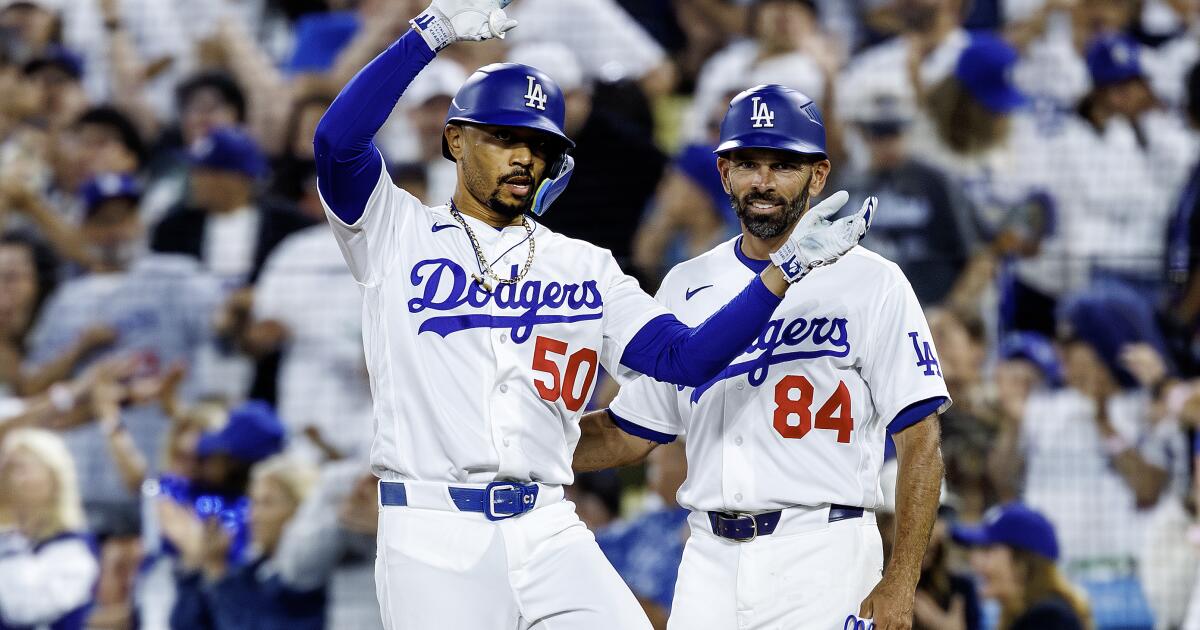
Mookie Betts’ first hit this series against the Rockies couldn’t have come at a more opportune time. With the crack of the ball against his bat, Tommy Edman scored from third, giving the Dodgers the lead.
And as Betts reached first, he pointed to Freddie Freeman, whose single put Edman in scoring position. It had taken a team effort to overcome another middling start from Roki Sasaki, and Betts, who had little to show before his game-winning hit, took the chance to highlight the joint contribution in the Dodgers’ 4-3 rubber-match win over Colorado (38-56).
“It feels great,” Betts said of his nine-pitch battle. “Helping the boys win, that’s really all it is. We play the game to win, and coming through in a big moment is kind of what, when you’re a kid, playing in the backyard, getting that hit is what you always strive to do, and fortunately, I was able to do it.”
Given a three-run lead in the first inning, brought to the Dodgers by a wild pitch and Kyle Tucker’s two-run, line-drive single to left field, Sasaki seemed set up for success.
Still, he gave away the lead as quickly as it came. In the second inning, he left a fastball too far over the plate, and third baseman Kyle Karros drove the ball over the left-center wall. The slider he dealt two batters later to second baseman Edouard Julien also crossed the zone too far over the plate, and Julien rounded the bases with another homer. In the third, a sacrifice fly by Mickey Moniak evened the scored, 3-3.
Sasaki’s troubles this season have been hard to pin down since his last win on May 23, as Sasaki tries to claw back the triple-digit velocity that’s escaped him as of late.
Against the Rockies, his fastball topped out at 99.1 miles per hour before steadily dropping to 98. He had managed five strikeouts in his six innings when manager Dave Roberts replaced him with Jack Dreyer, though the three earned runs couldn’t be ignored.
But Roberts also acknowledged the possibility that the pitcher had been tipping his pitches, possibly since he was playing in Japan, and Sasaki has tried to address it after a three-inning, six-run start last week. Even if he had fully self-corrected, his control issues remain. In the third inning, he walked the tying runner, Brett Sullivan.
“I’ve been working on a lot of things like the tipping stuff,” Sasaki said through interpreter Kensuke Okubo. “Also, I need to make quality pitches.”
Sasaki regained some of his confidence in the fourth when he worked out of a two-base jam with two strikeouts and a flyball to right, something that didn’t go unnoticed by Roberts.
“You can see the demeanor walking off the mound, the confidence,” Roberts said. “For me, it was more of let him end on a high note, feeling good about his outing, and then go from there.”
The Dodgers’ problems were compounded by Alex Call wasting the team’s two challenges in his at-bat in the first inning when the team had already taken the lead. And maybe it would’ve been excusable if Call had driven in the runners on first and second, but instead he ended the inning on a strikeout, stranding both. Roberts called the situation an “outlier” and didn’t feel as though he needed to have a conversation with Call regarding the situation.
After the three-run first, the Dodgers (61-33) remained hitless until Max Muncy laced a double down the right-field line in the sixth, though to little avail. As the innings ticked forward, Colorado’s chances seemed to increase. The Rockies hold the best league batting average (.297) in the eighth and ninth innings (the Dodgers are fourth with .268). And the Dodgers relievers, within the same constraints, have a 3.83 ERA — not bad, but not in the top 10 either.
Third baseman Max Muncy can’t get his glove on a line-drive double by Kyle Karros in the fourth inning.
(Gina Ferazzi/Los Angeles Times)
So when Alex Vesia struggled against the Rockies in the eighth inning and Muncy suffered a throwing error, Colorado seemed in position to score with the bases loaded and one out. Vesia struck out TJ Rumfield and Edgardo Henriquez (4-0), his replacement, retired Karros on a fly ball to right.
After Betts’ single allowed the Dodgers to take the lead, Tanner Scott (13) shut down the Rockies with back-to-back strikeouts, avoiding the team’s eighth series loss of the season.
“Didn’t feel great,” Roberts said. “Fortunately, we won a series, but that’s not the kind of way you want to do it.”
Sports
Justin Verlander announces he will retire after this season: ‘I’ve realized that time has come’

NEWYou can now listen to Fox News articles!
One of the greatest pitchers in the history of baseball will be hanging up his cleats after this season.
Three-time Cy Young Award winner Justin Verlander announced on Wednesday that the 2026 season will be his last.
Amid an injury-riddled season with the Detroit Tigers, Verlander decided it’s time to go.
Detroit Tigers pitcher Justin Verlander watches from the dugout during a game against the Chicago White Sox at Comerica Park in Detroit June 21, 2026. (David Rodriguez-Munoz/USA Today Network via Imagn Images)
“This season has challenged me in ways I haven’t experienced before, both physically and mentally. I’ve always believed that as long as I could compete at the level I expect of myself, I’d keep playing. I never wanted to retire because of a milestone, a number, or a date on the calendar. I wanted the game to tell me when it was time. Over the last several months, I’ve realized that time has come,” Verlander said in a social media post.
“While I’m fully committed to giving my team everything I have for the rest of this season, I’ve decided this will be my last. It’s fitting that I get to finish where it all started – with the Detroit Tigers, the organization that drafted me and gave me my first opportunity.”
Verlander inked a one-year deal with the Tigers, with whom he spent his first 12½ seasons before being traded to the Houston Astros, in the offseason. In Houston, he returned to dominance, winning both of his World Series titles and two of his Cy Young Awards.
“Baseball has given me more than I could have imagined. It taught me discipline, resilience, and the value of continuing to adapt and evolve. I’ve been fortunate to play with and against incredible players, for outstanding organizations, and compete in-front of fans who deeply appreciate the game,” Verlander added in his announcement.
Justin Verlander of the Houston Astros celebrates after the Astros defeated the Philadelphia Phillies in Game 6 of the 2022 World Series at Minute Maid Park Nov. 5, 2022, in Houston, Texas. (Mary DeCicco/MLB Photos via Getty Images)
PHILLIES STAR SAYS ‘BS RULE’ IS KEEPING HIM FROM BEING NAMED ALL-STAR IN FRONT OF HOME CROWD
“To every teammate, coach, player, clubhouse attendant, and fan who has been part of this journey – thank you. It’s been a privilege to share the field with you. To my family, especially my wife Kate, thank you for standing beside me through every season, every rehab, and every high and low. I couldn’t have done this without you. It’s time for the next chapter. But first, I’m excited to finish this season the only way I know how – with everything I’ve got.”
Verlander is the active leader with 3,554 strikeouts, which is good for eighth all-time. He needs 21 to surpass Don Sutton and 87 to pass Tom Seaver.
The 43-year-old made his MLB debut in 2005 and won the American League Rookie of the Year Award the following season in what was just a small glimpse of what was to come.
Verlander was a Cy Young Award finalist on four other occasions, consistently near the top of the leaderboard in just about every pitching stat. MLB Commissioner Rob Manfred gave Verlander a legend’s exemption to this year’s Midsummer Classic, making him a 10-time All-Star.
One could argue that Verlander should have at least one more Cy Young Award on his mantle, but he is on the fast track to Cooperstown and very much in the conversation to join Mariano Rivera as the only player unanimously elected to the Hall of Fame.
Verlander’s best season came in 2022, when he pitched to a career-best 1.75 ERA along with a 0.829 WHIP. However, that came after he missed the entire 2021 season due to Tommy John surgery for an injury he suffered after pitching just one inning in the abbreviated 2020 season.
Houston Astros starting pitcher Justin Verlander throws against the Boston Red Sox during the first inning Aug. 22, 2023, in Houston. (AP Photo/Michael Wyke)
CLICK HERE TO DOWNLOAD THE FOX NEWS APP
He won his first Cy Young Award in 2011, when he was also awarded the MVP Award, and his second in 2019. Verlander’s 11 seasons between his first and final Cy Young Awards are the second-most behind Roger Clemens, who had 18 seasons between his first and seventh.
Verlander led the majors in innings and WHIP four times while recording the most strikeouts in three seasons.
Follow Fox News Digital’s sports coverage on X, and subscribe to the Fox News Sports Huddle newsletter.
-

 Kentucky1 minute ago
Kentucky lawmakers hold town hall on AI data centers in Louisville
-

 Louisiana6 minutes ago
Norman C. Francis library naming honors Lafayette education legacy
-

 Maine13 minutes ago
Live updates: U.S. and Iran escalate attacks; jockeying starts in Maine after Graham Platner drops Senate bid
-

 Maryland16 minutes ago
How the Baltimore-style hot dog tells a uniquely Maryland story
-

 Michigan21 minutes ago
Michigan immigration advocates react after Supreme Court ruling on Temporary Protected Status
-

 Massachusetts28 minutes ago
Is new construction right for you? There are benefits to buying a brand-new home in Massachusetts.
-

 Minnesota31 minutes ago
Where to watch Cleveland Guardians vs Minnesota Twins: TV channel, start time, streaming for July 9
-

 Mississippi36 minutes ago
Where Ace Reese, Mississippi State signees appear in latest MLB mock drafts

