Sports
Thanks to the transfer portal, this March’s Cinderella stories are players, not teams


To find Cinderella stories at this men’s Final Four, you have to look at the name on the back of the jersey rather than the front.
For the second time in the history of the NCAA Tournament’s modern-day bracketing practices, all four top seeds advanced to the national semifinals. It will be No. 1 Florida vs. No. 1 Auburn and No. 1 Houston vs. No. 1 Duke on Saturday in the national semifinals, a perfect ending to a most chalky March Madness. Only one double-digit seed reached the Sweet 16, and all of the teams in the regional semifinals were from Power 4 conferences.
Where have you gone, Loyola Chicago and Sister Jean? Check the transfer portal.
Two of the very best players competing for a championship this weekend in San Antonio — Florida’s Walter Clayton Jr. and Auburn’s Johni Broome — might not be where they are today if not for this new world order of college sports, with unlimited, unrestricted transfers and name, image and likeness compensation.
Clayton is the former high school football star from Florida whose passion for basketball led him to New Rochelle, N.Y., a hidden gem uncovered by Rick Pitino during his time at Iona. You probably didn’t even notice Clayton scoring 15 points for the Gaels against eventual national champion UConn in the first round of the 2023 NCAA Tournament.
Now, he’s being compared to Steph Curry.
“He’s obviously a blessing to have in our program, have on our team,” Florida coach Todd Golden said. “He’s an incredible player, but outside of that, he’s a great leader. He’s been everything we could have asked him to be for this program since he got to campus two years ago.”
Broome, another Floridian, was the 471st-rated prospect in his recruiting class per 247Sports Composite rankings, not even good enough to get an offer from Florida Atlantic. To be fair, former FAU coach Dusty May put together a team good enough to reach a Final Four two years ago without Broome, so not being good enough for those Owls is no slight.
Instead, Broome landed at Morehead State and blossomed in two seasons in the Ohio Valley Conference before becoming the best player in the SEC in his third year at Auburn.
“Shoutout to Morehead State,” he said. “I think those two years of my college career have helped me become who I am.”
We’re not quite ready to declare the NCAA Tournament underdog dead. The trends are working against the mid-majors — specifically, relaxed transfer rules that turn every player in the country into a free agent every year.
For years, draconian transfer rules gave way too much power to schools and coaches. Not only did undergraduate basketball players have to sit out a season after transferring — a non-compete clause for non-employees — but schools could block athletes from going to certain schools, just because.
It was borderline shameful. Even Mark Emmert, the former NCAA president who was not exactly known for getting out in front of potential problems, knew change was needed.
“How complicated could this be?” Emmert said at the last Final Four in San Antonio in 2018. “It’s about students changing schools. And yet I’ve never seen anything that’s quite as intractable a problem as this one because you just can’t get agreement.”
Even back then, before the portal was a viable option for every player from superstar to walk-on, transfers were on the rise in college basketball, with instances increasing from 10 percent of Division I players in 2010 to about 13 percent in 2016.
The Villanova team that won the NCAA Tournament in 2018 started forward Eric Paschall, a transfer from Fordham. Surely, Rams fans were wondering what could have been as they watched Paschall score 24 points in the semifinal victory against Kansas.
Villanova, Kansas, Michigan and Sister Jean’s Loyola Chicago all started at least one transfer in the Final Four that season. There were a total of nine on those rosters, including players who were sitting out to comply with the NCAA rules of the time.
The Wolverines reached the title game with the help of Division III transfer Duncan Robinson.
According to the NCAA’s most recent reported figures, over 1,200 Division I men’s basketball players transferred after the 2022-23 season. Typically, there are about 4,200 scholarship athletes playing Division I men’s basketball.
This year’s Final Four teams have 20 scholarship transfers from other NCAA schools on their rosters, led by Auburn with seven. Florida has six, Duke has five and Houston has two, both from other Big 12 programs. Cougars star L.J. Cryer is in the Final Four for the second time after being part of Baylor’s 2021 title team as a freshman.
Florida, Auburn and Duke all have at least one starter who once played at a mid-major.
For Duke, that’s guard Sion James, a former three-star recruit from Sugar Hill, Ga. He played four seasons at Tulane before taking advantage of the extra year of eligibility all athletes received in the wake of the pandemic to become a glue guy for one of the most storied and prestigious programs in the country.
“I’d played a lot of college basketball games, but none in the tournament, and I knew that we’d have a chance to win a national championship,” James said. “And it’s cool being here, however many months later, just a few games away.”
The pendulum has swung hard toward player empowerment when it comes to transfer rules. It’s fair to say we might be in the too-much-ice-cream phase. Bouncing around the country and averaging about a school per season is probably not ideal for players with minimal pro prospects who would benefit from graduating from … somewhere.
Purdue coach Matt Painter made an interesting point earlier in the tournament about balancing the opportunity to get a degree with recognizing that for some players, college will be the last chance they have to make money playing basketball.
“I don’t think that’s a bad (thing) … like, why not?” he said.
Painter’s 2024-25 team, it should be noted, had no transfers, but former Boilermaker Mason Gillis is back in the Final Four with Duke.
Will Wade, who took the NC State head coaching job after leading 12th-seeded McNeese past Clemson in one of the few true upsets of this tournament, talked about selling his mid-major program as a place for players to develop into power-conference transfers. More and more mid-majors are recruiting that way, resigned to the fact that, yes, they are indeed farm teams for the big schools.
Maybe with a revenue sharing system coming to college sports, along with player contracts and something that replicates a salary cap for monied schools that opt into the system, the low-mid-major poaching will slow down. Probably not.
That’s not great news for the future of Cinderella in March Madness, but just last year Oakland, Yale, Grand Canyon, James Madison and Duquesne won first-round games as double-digit seeds. Then again, Morehead State made the tournament last year, two seasons after Broome left, and lost in the first round as a 14-seed to Illinois. Imagine what that team could have been with Broome.
We’re also only two years removed from FAU’s Final Four run. One of those players, Alijah Martin, is back in the Final Four with Florida. Others, from Michigan’s Vladislav Goldin to Arkansas’ Johnell Davis, came a win or two away from returns of their own.
Then there is Chaney Johnson, who played three seasons of Division II basketball at Alabama Huntsville before becoming a key reserve for Auburn.
Fans might lament the transient nature of college basketball, with mercenary players quickly coming and going, but this is Clayton’s second season at Florida. Broome has been at Auburn for three years, and it’s probably not a coincidence the Tigers only added three transfers this past offseason to a rotation with lots of multi-year veterans.
Thanks to NIL, Auburn fans have watched Broome and this core of players develop to be able to cut down the nets on the way to a Final Four.
“Man, words can’t even describe it,” Broome said after the regional final victory against Michigan State in Atlanta. “To stand on top of the ladder in front of all the Auburn fans still being there, traveling and witnessing it as well, and looking down and seeing my teammates, the whole Auburn family, it just means the world to me. To kind of be able to deliver for the Auburn family.”
And they all lived happily ever after.
(Illustration: Will Tullos / The Athletic; Photos: Andy Lyons, Alex Slitz / Getty Images)



Sports
Thousand Oaks native Claire Liu finally reaches Wimbledon’s third round, will face Coco Gauff

LONDON — Claire Liu packed her bags and checked out of her London hotel room on Wednesday morning before heading to the All England Club.
It was more pragmatism than pessimism — a reality of a qualifier navigating her Wimbledon journey one day at a time.
But as her boyfriend reminded her while organizing her luggage: “Just because you’re packing doesn’t mean you’re leaving,” Liu recalled with a laugh.
He was right.
The Thousand Oaks native went on to win her second-round match against 51st-ranked Zeynep Sonmez of Turkey 7-5, 6-3, advancing to the third round of a Grand Slam for the first time in her professional career. She had tried 29 previous times at majors, including qualifying rounds, since 2015.
“I was just super relieved to get through that,” said Liu, noting she had blown a set and a break lead in the French Open’s second round last month.
For Liu, who turned 26 in May, returning to the manicured lawns of SW19 brings her tennis journey full circle. Nine years ago, she captured the 2017 Wimbledon girls’ singles title — the first American to do so since Chanda Rubin in 1992 — and was the No. 1 junior in the world. She still holds fond memories of that heady achievement, including chatting with her idol, Roger Federer, at the Wimbledon Champions Ball.
Yet, the transition from teenage phenom to professional mainstay has been anything but a linear ascent. When asked if she expected to be in the third round of a major this late in her career given her junior success, Liu was candid.
“Younger me would have believed it more than now,” she said.
That shift in perspective comes after weathering some brutal setbacks.
Liu climbed as high as No. 52 in early 2023 but then endured a wrist injury and took a months-long mental health hiatus in 2024 that eventually saw her ranking plummet outside the top 400 last year.
Currently sitting at No. 146, she’s been rebuilding her standing by playing a mix of WTA 125 events and ITF tournaments before returning to the main WTA Tour, with 2026 stops in far-flung places from Bahrain to Boca Raton and plenty of places in between.
“My goals haven’t changed, but I think the stress of how I got there really took a toll on me,” said Liu.
To navigate the darkness, Liu leaned heavily into both sports psychology and traditional therapy, including EMDR, a technique that helps people process traumatic experiences. She also started a Substack newsletter called “Finding Claire-ity,” where she openly chronicles her life and struggles on the tour.
The Southern California native, who has trained at the USTA facility in Carson since she was 9 years old and resides in Redondo Beach, also split with her longtime coach last season, a difficult decision, and hired Clemens Wagner.
The switch following the U.S. Open last year is clicking.
“I saw in her someone who fought a lot of battles inside herself,” says Austrian-born Wagner, who has a background in tennis analytics.
Together, they have focused on keeping an “aggressive undertone” on the grass, emphasizing coming to the net and squeezing the most out of her game.
Wagner notes that the 5-foot-7 player’s game isn’t the flashiest, but describes her as a “silent killer” who excels at “redirecting pace, standing close to the baseline, constantly putting pressure on her opponents.”
The reboot is starting to pay significant dividends.
Liu put together her best stretch in years this spring, winning a lower-tier title in Trnava, Slovakia, her first professional title since 2024, and then qualifying for the French Open.
Having again successfully navigated three rounds of qualifying to reach the main draw here, Liu has now won five consecutive matches at Wimbledon. Not surprisingly, she currently has no sponsors, just equipment support from Head Sport and Asics Corp., making her Wimbledon run particularly lucrative. By reaching the third round, Liu achieved her highest career payday: around $250,000. A victory Friday would boost that to nearly $400,000.
First, she faces her biggest test yet: a third-round contest against two-time major champion Coco Gauff on No. 1 Court, which perhaps fittingly is the same show court where Liu won the girls’ title almost a decade ago.
Gauff, 22, noted that she and Liu haven’t crossed paths much since Liu is older, but expects a serious battle. Gauff won both of their previous meetings on hard courts.
“I feel like anytime you’re playing a qualifier, it’s always tough because they have three matches already,” the seventh-seeded American said.
Liu, who didn’t even know she was playing Gauff until a reporter told her after her match, is purposefully keeping her focus narrow.
“I will just take today to be happy for winning, and then tomorrow I’ll think about it,” Liu said. “Obviously she’s one of the best players in the world right now, so that’ll be a good experience.”
Veteran Jessica Pegula, 32, the top-ranked American who also toiled away on the sport’s lower tier before becoming a top-10 mainstay, appreciates Liu’s resolve.
“It’s always nice to see girls that are figuring it out slowly but surely,” the No. 4 seed said. “I think I can relate to that.”
Liu’s accommodations? Fortunately, her mother was able to rebook the same hotel after the match, which eased some of the logistical issues for her unexpectedly extended stay in London.
“It definitely makes me stay in the moment, like, day by day,” Liu smiled of her lodging limbo.
On Wednesday morning, Liu packed her bags expecting she might leave Wimbledon. Instead, she emptied them one more time, with the biggest match of her career still waiting.

NEWYou can now listen to Fox News articles!
Folarin Balogun’s teammates came to his defense after the USA World Cup star was given a red card during the team’s 2-0 win over Bosnia and Herzegovina on Wednesday night.
Balogun received the red card after he stepped on defender Tarik Muharemovic’s right ankle. Brazilian referee Raphael Claus only gave Balogun the card after a VAR review. The red card meant Balogun will not be able to play in the team’s Round of 16 match against Belgium.
ZERO BS. JUST DAKICH. TAKE THE DON’T @ ME PODCAST ON THE ROAD. DOWNLOAD NOW!
United States’ Folarin Balogun, right, stands by after being issued a red card by Referee Raphael Claus, of Brazil, as United States’ Weston McKennie (8) looks on during the World Cup round of 32 soccer match between the United States and Bosnia in Santa Clara, Calif., near San Francisco, Wednesday, July 1, 2026. (AP Photo/Martin Meissner)
A FIFA official told The Athletic a team cannot appeal against the red card or the suspension. The official pointed the outlet to a portion of the organization’s rules and regulations, which states, “A sending-off automatically incurs suspension from the subsequent match. The FIFA judicial bodies may impose additional match suspensions and other disciplinary measures.”
Balogun’s teammate, Weston McKennie, called the lack of an appeal process “bogus” and disagreed with the referee’s decision to issue the red card.
Bosnia’s Sead Kolasinac (5) talks to United States’ Folarin Balogun after Balogun was sent off, as Christian Pulisic (10) watches during the World Cup round of 32 match between the United States and Bosnia in Santa Clara, Calif., Wednesday, July 1, 2026. (Julio Cortez / AP)
“Obviously the ref made a decision that he made, but I think it’s questionable,” McKennie said. “I think there’s been many other plays like that throughout the tournament on other players that a card wasn’t given at all. It’s disappointing.”
U.S. coach Mauricio Pochettino said Balogun’s act “was never intentional.”
“It’s never a red card. Never. … If the intention is to damage the opponent, OK, I understand. But that never was. It was a normal action in football that you are fighting for the ball and your feet land,” he said.
Balogun is the third player to score in a World Cup knockout match and be sent off. He follows Brazil’s Ronaldinho in 2002’s quarterfinal match against England and France’s Zinedine Zidane in the 2006 World Cup final against Italy.
Referee Raphael Claus of Brazil shows a red card to United States’ Folarin Balogun, right, during the World Cup round of 32 soccer match between the United States and Bosnia in Santa Clara, Calif., near San Francisco, Wednesday, July 1, 2026. (AP Photo/Julio Cortez)
It’s the fifth red card handed to an American in the squad’s World Cup history.
CLICK HERE TO DOWNLOAD THE FOX NEWS APP
Eric Wynalda received one against Czechoslovakia in 1990, Fernando Clavijo got one against Brazil in 1994 and Pablo Mastroeni and Eddie Pope each received one against Italy in 2006.
The Associated Press contributed to this report.

While veterans jockey for new contracts during free agency, young players are getting their tryout opportunities with NBA summer league games beginning this week.
First-round draft pick Cameron Carr and second-year forward Adou Thiero highlight the Lakers summer league roster that was announced Wednesday. The 16-man team will be coached by Lakers assistant coach Ty Abbott and begin summer league play Friday against the Golden State Warriors at Chase Center.
The Lakers also face the Miami Heat (July 5, 1:30 p.m.) and San Antonio Spurs (July 6, 4:30 p.m.) in the California Classic before playing in the Las Vegas summer league from July 9-19. The Lakers play Oklahoma City (July 10), Dallas (July 11), the Clippers (July 14) and Chicago (July 16) in Las Vegas’ Thomas & Mack Center.
The Lakers traded up in the draft to get Carr, a 6-foot-5 guard out of Baylor, with the 24th overall pick. He will make his unofficial NBA debut, along with former Indiana State and Saint Louis star Robbie Avila. The 6-10 center became a bespectacled college basketball cult hero known affectionately as “Cream Abdul Jabbar” while leading Indiana State to the NIT championship game in 2024. He transferred to Saint Louis, where he was named Atlantic-10 player of the year as a senior when the Billikens won a school-record 29 wins.
Although he is entering his second season with the Lakers, Thiero will be playing his first summer league games. Persistent knee injuries hampered his rookie season. The athletic 6-7 forward averaged 1.9 points and 1.1 rebounds in 25 appearances last season. He said after the Lakers were eliminated from the playoffs that he wanted to improve on his three-point shooting during his second year. He attempted only five three-pointers during his rookie season, regular season and playoffs, making one.
Lakers summer league roster
Robbie Avila, C, 6-10, 240
Cameron Carr, G, 6-5, 190
Jon Elmore, G, 6-3, 190
Luke Goode, F, 6-7, 210
William Hickey, G, 6-4, 203
Arthur Kaluma, F, 6-7, 225
William Kyle III, C, 6-9, 230
Chris Mañon, G, 6-4, 212
Robert McCray V, G, 6-4, 188
AK Okereke, F, 6-7, 245
Chase Ross, G, 6-5, 210
Zhaire Smith, G, 6-4, 205
Peter Suder, G, 6-5, 215
Adou Thiero, F, 6-7, 234
Anton Watson, F, 6-8, 225
Jacari White, G, 6-3, 180
-
 Entertainment5 seconds ago
Argentine club queen Six Sex wants you to get free
-

 Lifestyle7 minutes ago
Why Chanel Is Acquiring Charvet
-
 Politics10 minutes ago
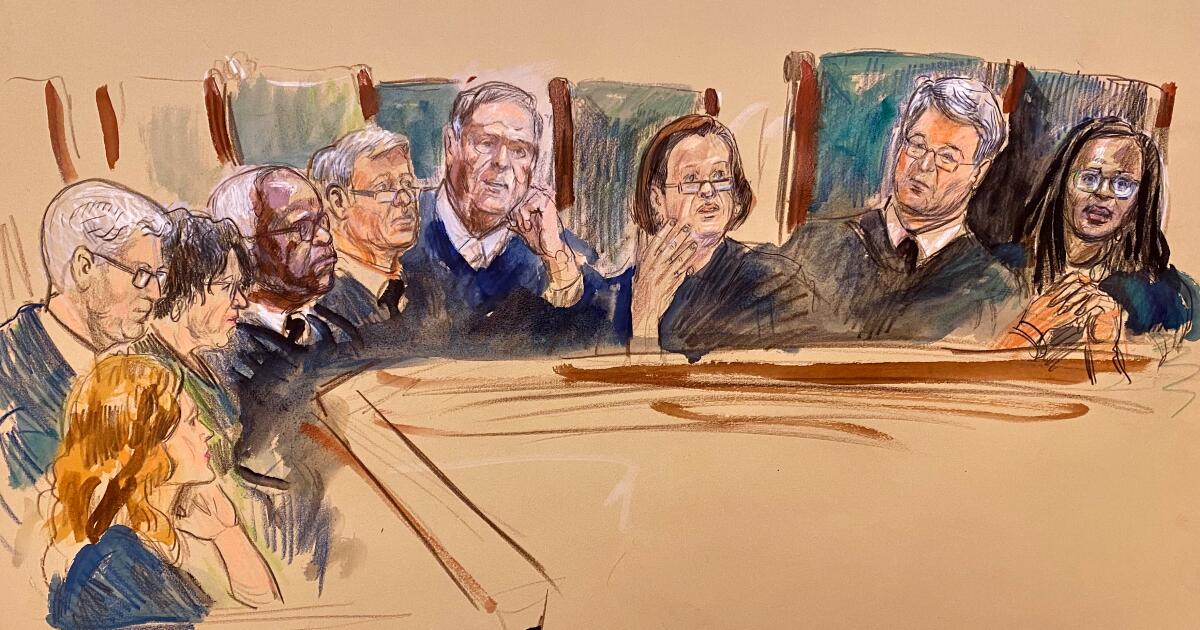
How Roberts led a fractured Supreme Court to wins for the right and defeats for Trump
-
 Science15 minutes ago
Contributor: Alcohol should be stigmatized like smoking
-
Sports22 minutes ago
Thousand Oaks native Claire Liu finally reaches Wimbledon’s third round, will face Coco Gauff
-

 World30 minutes ago
Could water become a flashpoint between Islamabad and New Delhi?
-
 News55 minutes ago
Ukraine latest / Limits of military might / Can major powers regain dominance? : Sources & Methods
-

 Los Angeles, Ca2 hours ago
Juvenile charged with murder after 4-month-old Claremont infant thrown to her death

