Sports
Exploring the Nick Saban butterfly effect, 400-plus job changes later


At approximately 3:53 p.m. CT on Jan. 10, Nick Saban sized up what had been another busy day inside the Alabama football office. He and his staff had spent much of their day interviewing three prospective assistants: two wide receivers coaches and a special teams coach. The third of the interviews, with Washington receivers coach JaMarcus Shephard, had just concluded.
“I think the guy from Washington is probably our best hire,” Saban told the Alabama coaches. “Let’s keep doing our due diligence, and then we’ll talk about it in the morning.’”
At 4 p.m., Saban and the group would reconvene for a team meeting. Within 10 minutes, he would inform everyone in the room – some 150 players and staffers – he was retiring, ending a coaching career that included seven national titles, 11 SEC championships and saw 27 assistants go on to become FBS head coaches and 10 more get NFL head coaching jobs.
“Man, it was a weird day, like ‘Twilight Zone’ weird,” said Zach Mettenberger, then an Alabama analyst. “Like two minutes into the meeting, not even, he just dropped a friggin’ nuke on all of us. He just kinda dropped the mic and walked out.”
Saban had two speeches written: one to retire and one to keep going. “I kept vacillating back and forth,” Saban later told ESPN. At 3:55, he was sitting in his chair, looking at the clock. “You have five minutes to decide which speech you’re gonna give.”
The speech he gave rocked the football world, particularly the lives of 423 coaches and staffers whose jobs would be impacted by the coaching dominoes that would begin to fall from his retirement.
Five more major college football programs needed new head coaches as a result of Alabama’s hire. The impact ultimately spread to 38 Power 5 schools, 25 Group of 5 schools, 34 lower-level programs, more than a dozen high schools and 10 NFL organizations.
The Crimson Tide’s head nutritionist since 2010, Amy Bragg won five national titles with Saban. Only head trainer Jeff Allen and Dr. Ginger Gilmore, the Tide’s director of behavioral medicine, worked with Saban longer.
Alabama had built up one of the largest coaching and support staffs in the country, with more than 75 staffers listed in its 2023 directory. Saban’s decision left each of them – even his closest allies – wondering whether they’d have a role in the powerhouse program moving forward.
“We were all probably unprepared even though we knew that day was coming when it would be over,” Bragg said. “As it sunk in, I thought a lot about Coach Saban’s quotes: Control what you can control. Play the next play.”
Clint Trickett was in Tampa at Jon Gruden’s “Fired Football Coaches of America” headquarters when he heard the Saban news. Trickett’s dad, Rick, was a colleague of Saban’s in the 1970s at West Virginia and was on Saban’s first LSU staff.
“I was like, ‘F—!’” said Trickett, who was looking for work after getting released as Marshall’s offensive coordinator. “I was disappointed because one of my career goals was to work under him as a position coach. I’d been a (graduate assistant) for him for a short period of time — for eight work days — and when I left him to go work for Lane (Kiffin), it was a big deal. I really wanted to work for Nick Saban. It was a sad, sad day.”
Kane Wommack, the head coach at South Alabama, was preparing steaks as he and assistant head coach Matt Shadeed planned spring practices. Before the steaks hit the grill, Shadeed blurted out, “Oh my gosh! Nick Saban has retired.”
Wommack immediately felt a pit in his stomach. “I remember thinking, ‘I just hope nothing changes with my program,’” he said.
The next morning, Kalen DeBoer called Wommack. The two coaches were assistants at Indiana in 2019, when the Hoosiers cracked the Top 25 for the first time in 25 years. DeBoer had just led Washington to the national championship game in his second season as head coach, a turnaround that had gotten the attention of Alabama brass.
He wanted Wommack’s insights about the Tide’s program. Would he be a good fit?
When the offer was on the table, DeBoer asked: Is this something you would want to be a part of? Wommack had led South Alabama to its first two winning seasons and bowl victory as an FBS program, but sustaining success, he felt, was much harder at the Group of 5 level than it was when he took the job in 2021 because of the evolution of NIL and the transfer portal. When you’re the defensive coordinator at Alabama, he reasoned, you can succeed every year.
“It just wasn’t an opportunity I was gonna turn down,” Wommack said. “It happened fast.”
Everything did.
After Saban left the Wednesday team meeting, Alabama athletic director Greg Byrne told the Tide that he would have a new head coach in place within 72 hours. Byrne made the hire in 49 hours, naming DeBoer as Saban’s successor. On Monday afternoon, DeBoer shook up the coaching carousel again, hiring Wommack.
Four days after it played for a national title, Washington needed a new leader.
“What a week!” Jedd Fisch said as he walked down the halls of the Arizona football office the day Saban retired.
One of his mentors, Pete Carroll, had stepped down from the Seahawks the previous day after 14 seasons. Fisch expected his former boss Bill Belichick to part ways with New England the next day. Fisch didn’t think the Saban news would impact him. When Alabama hired DeBoer on Friday, Fisch figured Washington would go with DeBoer’s longtime assistant, offensive coordinator Ryan Grubb, as his successor.
Washington athletic director Troy Dannen had only been in Seattle for three months. Locking DeBoer into a long-term extension was imperative. The Huskies were 5-0 when he arrived and just kept winning. Dannen made a strong offer the week of Thanksgiving starting at $8.5 million per year, an unprecedented figure for UW. When that was rejected, Dannen spent much of December preparing a list of candidates.
Fisch wasn’t atop that initial list despite achieving a remarkable flip in Tucson, taking over a program on a 12-game losing streak and winning 10 games by Year 3. But when the job opened in January and Dannen started making calls, he was quickly won over.
Their first conversation, a half-hour call, took place around 2:30 p.m. on Saturday. By 10 p.m., Dannen was ready to offer him the job.
The Huskies’ impending move to the Big Ten in 2024 was, for Fisch, the No. 1 factor.
Fisch said it was clear Washington was willing to make a “huge” commitment to football. Arizona’s salary pool for its football assistants was $4.3 million in 2023. Washington almost doubled that to $7.3 million. He offered jobs at Washington to 21 Arizona staffers and all 21 accepted. But he still had room for a few new faces.
Steve Belichick watched how Fisch transformed Arizona. The two coached together on his father’s staff in New England. Belichick, 37, had spent all 12 of his years in coaching with the Patriots, the last four as New England’s defensive play caller. If someone had told him a month before his father left the Patriots that he would become a college coach, he says he’d have rolled his eyes.
“I don’t think I would’ve believed it,” said Belichick, now the Huskies’ defensive coordinator, “but things happen.”
Over at South Alabama, Wommack’s sudden departure was a stunner. The Jaguars had just earned their first bowl victory in program history. Players didn’t see the change coming and needed continuity.
“They were, to use a boxing example, catching a flurry and on the ropes,” said Major Applewhite, Wommack’s offensive coordinator.
Applewhite was quickly promoted to take over at South Alabama. He has Saban to thank for that and much more. He was Saban’s first OC at Alabama in 2007 and rebooted his career in Tuscaloosa as an analyst in 2019 after his abrupt firing as Houston’s head coach.
“He’s always helped me whenever I’ve asked,” Applewhite said. “I don’t try to abuse that or be a nuisance. But there’s been times where I’ve called him since I’ve gotten this head job and asked him questions.”
He could’ve left for more high-profile OC jobs during his time with Wommack, but Applewhite and his family like Mobile, Ala., and were tired of moving. He didn’t want to ask his daughter to switch high schools.

Major Applewhite was promoted to head coach at South Alabama after Kane Wommack departed for Alabama. (Brian Bahr / Getty Images)
Applewhite had to rebuild his staff, hiring five new assistant coaches while promoting two more. After losing DC Corey Batoon to Missouri, he brought back Will Windham, who’d been fired by Wommack in December and had just accepted a job at Arkansas State.
Windham spent one week recruiting for the Red Wolves but hadn’t signed a contract. He had already put the family home on the market and had three showings. On the Friday morning that Applewhite called, his wife was en route to Arkansas to go house hunting.
“It was a crazy three-hour span of, ‘We’re moving to Jonesboro, Ark.,’” Windham said, “to, ‘Holy smokes, get the house off the market, I’m gonna be the defensive coordinator at South Alabama.’”
A coach’s fortune can change in an instant. Pete Lembo was recruiting in New Jersey when he learned Buffalo head coach Maurice Linguist was leaving after a 3-9 season to become Alabama’s co-DC. Lembo had a 112-65 career record in 15 years as a Division I coach, but the South Carolina special teams coordinator hadn’t run his own program in almost a decade. The 54-year-old was beginning to doubt he’d get another shot.
“I remember getting a call from a search firm guy,” Lembo said. “He said, ‘You would be a great candidate for this job, but you guys were 5-7 this year. If it was last year when you were 8-4, you’d probably be getting an interview right now.’ Those are things you can’t control. You say to yourself, ‘I’m the same guy I was when we were 8-4.’”
The New York native said he had an “aha moment” when Buffalo opened. He was the right man for the job, an experienced former MAC coach who could ensure a smooth transition. The process moved quickly with AD Mark Alnutt, and it needed to with the start of the semester fast approaching. In his first week on the job, Lembo held meetings with all 87 players.
“It was real important for me to come in and be very steady and even-keeled,” Lembo said, “and let everybody know this is gonna be OK.”

Applewhite hired Paul Petrino to coach South Alabama’s receivers. Central Michigan replaced him with B.T. Sherman from Morgan State, who then brought in Apollo Wright as its new offensive coordinator.
And that meant Mike Woodard needed to find a new head coach for the Fernandina Beach Pirates.
Fernandina Beach, Fla., is tucked away in northeast Florida next to the Georgia border, a tourist destination on Amelia Island. Their high school program has good support, an indoor practice facility and a renovated weight room but one playoff win in school history. Wright, a college assistant for 20-plus years, went 7-13 over his two seasons. Woodard, their AD and dean of students, knew Wright wanted to give college one more shot.
Bobby Dan McGlohorn, who had head coaching experience in North Florida and was an assistant across the state line at Camden County in Kingsland, Ga., accepted the job but backed out a few weeks later. Woodard turned to Blake Willis.
The 33-year-old has been the Pirates’ defensive coordinator and strength coach for five years while also teaching PE weight lifting classes. He grew up and went to school there. Fernandina Beach’s last consecutive winning seasons were his junior and senior year.
There was a time when Willis considered working at the college level. He interned with South Carolina’s strength and conditioning staff in the summer of 2018 and worked for UCF’s staff in 2018-19 while pursuing his master’s degree. While he learned so much from coaches now at Tennessee and other Power 5 schools, he was reluctant to go down that road.
“I didn’t know if I wanted to move around a whole lot, because that’s kind of the deal,” Willis said. “Every few years, you’re probably having to find a new job.”
Willis never thought he would become a head coach this quickly. Woodard has reservations, too, but talked him into applying. When the AD interrupted a team workout to announce the new coach, his players celebrated.
“I’m trying to build it up to where I think it should be,” Willis said. “This is where I’m from. I want this place to be the best it can be.”
The coaching moves set off by Saban’s retirement rippled out to high schools in nine other states, too. Mettenberger, the Alabama analyst and former LSU and NFL quarterback, accepted an OC role at Father Ryan High School, a private school in Nashville. The process of looking for another coaching job late in the cycle was daunting, and the 32-year-old coach didn’t have an agent.
“We planned on moving back to Nashville, because it was more conducive to my wife’s work and I was just gonna figure it out, whether it be selling insurance for the next year until the next coaching cycle,” Mettenberger said. “The coordinator at Father Ryan left for a job in Georgia, and with my prior experience there and my situation moving back, it happened organically. I was real lucky.”
Clint Trickett was fortunate, too. Three months after being let go by Marshall, he was hired to coach inside receivers and tight ends at Georgia Southern. That spot came open after DeBoer hired Georgia Southern OC Bryan Ellis as Alabama’s tight ends coach. Ryan Aplin, who had the job Trickett was taking, got promoted to replace Ellis, who got looped in at Alabama by his old buddy from his Western Kentucky days, JaMarcus Shephard, DeBoer’s receivers coach at Washington that Saban had interviewed 10 minutes before he retired. Shepherd ended up in Tuscaloosa after all, as the Tide’s wide receivers coach.
Willis and Woodard chuckled upon learning their connection to Alabama. “It’s definitely insane,” Willis said. “I would’ve never thought.” How would Woodard like to be in Byrne’s shoes, tasked with selecting Saban’s successor?
“You know, everyone has their own speed bumps and potholes,” Woodard said. “I’m perfectly fine right now just covering mine with beach sand.”

Arizona hired Brent Brennan and San Jose State hired Ken Niumatalolo to replace him. Coincidentally, he’d already met his new team four weeks earlier.
The veteran coach was back home in Hawaii in December. His good friend Joe Seumalo, San Jose State’s defensive line coach, was in town and wanted to catch up. He asked if he could watch a practice as the Spartans prepped for the Hawaii Bowl.
“Brent Brennan is a good dude and was like, ‘Ken, do you wanna speak to the team?’ I said sure,” Niumatalolo said. “I talked about how I was impressed with how close their team was. It was evident Coach had done a really good job of creating a family atmosphere. I wished them the best of luck.
“I’m a very spiritual person. Things are sometimes meant to be.”
Niumatalolo was fired in the locker room after Navy’s double overtime loss to rival Army in 2022, an abrupt end to a successful 15-year tenure. Plenty of friends offered him jobs, but could he go back to being an assistant? Niumatalolo joked that he wasn’t quite ready to grind like the countless fired coaches who became Alabama analysts under Saban.
Chip Kelly got creative and offered him a new advisory role: UCLA’s director of leadership. No coaching, no recruiting. Niumatalolo sat in on meetings, watched practice and took copious notes on how to run a Power 5 program. The 59-year-old coach shared an apartment with his son Ali’i, UCLA’s offensive line GA.
“It was a way for me to stay in the game and learn from Chip,” Niumatalolo said. “It turned out it was a perfect job for me. … I didn’t realize I needed that to decompress. It allowed me to touch every part of that program and see it for myself.”
He spent the year putting together a plan with the hopes he’d get a call at the end of the season. Niumatalolo knew he needed to move away from Navy’s option offense and studied passing attacks. He filled up his iPad with ideas for his next program. When a job didn’t emerge, he agreed to coach UCLA’s tight ends. And then Saban retired.
“The way this happened was weird, because it was so late,” Niumatalolo said. “I don’t know if that will ever happen again. None of us have ever seen that, how all these different dominoes fell.”
He’d been involved in quite a few searches in past years, so he knew how fast they were filled. When Brennan landed his dream job at Arizona, Niumatalolo got a call from his agent, then a Zoom meeting, then an in-person interview the next day. “You better be prepared,” Niumatalolo said.
He landed Texas State’s Craig Stutzmann and his “Spread and Shred” system on offense, retained DC Derrick Odum and brought Nu’u Tafisi from UCLA as his strength coach. He trusted them to fill out their staffs while he took more of a CEO approach, building relationships with donors to boost NIL funding.
“I can’t do a lot of things well, but I know how to be a head coach,” he said. “I can’t use a hammer. I suck at computers. I don’t know how to fix a tire. But I know how to lead people.”

When Lembo brought one of his former grad assistants, Brian Dougherty, to Buffalo as his safeties coach, Mike Caputo was out of a job.
The 31-year-old assistant, a three-year starter and All-American at Wisconsin, had worked at five schools in seven years. Caputo lived out of his Dodge Charger for six months after landing a GA job at LSU in 2017. He put in two years there with Dave Aranda before reuniting with Gary Andersen as safeties coach at Utah State. Caputo took a pay cut to join Aranda’s Baylor staff as a quality control coach in 2020. He accepted another off-field role at his alma mater in 2022 and watched Paul Chryst get fired at midseason.
“I tried to develop as many relationships as possible, didn’t burn any bridges and just always chased opportunity and not money,” he said.
Caputo could’ve stayed with Wisconsin but felt ready for his next step. He got on at Buffalo as safeties coach and special teams coordinator. His wife, Lauren, was pregnant with their second child but signed off on the move. Their daughter, Vera, arrived 11 days after they landed in Buffalo.
Nine months later, Caputo was in an airport bar trying to rebook a flight canceled by a snowstorm when he learned Linguist was leaving. There weren’t many jobs available by late January. He exhausted all his connections.
In April, the Caputos moved to Pittsburgh. Mike came home to join his father’s commercial insurance agency. This isn’t a hiatus. He’s decided to get out of coaching.
“I’m not sour about it,” he said. “Shoot, it’s been a blessing.”
Caputo believes he’s out for good. He was already becoming frustrated by how much assistant jobs have changed. “Now you’re only coaching 20 percent of the time,” he said. “The majority is recruiting. That’s not why I got in. I got in to coach and develop young men.” For Caputo, it was validating to hear Saban make similar observations upon retiring.
Dozens of coaches and staffers impacted by Saban’s decision found themselves in similar predicaments. These newly hired head coaches had to make difficult decisions about who to bring, who to keep and who’s out. At Alabama, DeBoer brought Washington nutritionist Ali VandenBerghe and moved on from Bragg, ending her 14-season tenure. She’s now in the consulting business, relying on her two decades of leading college football nutrition programs.
Daniel Bush, Alabama’s recruiting director since 2018, wasn’t retained and wasn’t looking to move his family across the country. He stayed in Tuscaloosa and has launched a recruiting service to help high school prospects. Bush proudly said he didn’t miss a single Little League game this spring. He won’t miss the 85-hour work weeks from August through December.
“At the end of the day, winning takes what it takes,” Bush said. “We were all willing to invest what it took to get it done.”
Just before spring break, Cisco College defensive coordinator Charlie Rizzio was on his way out of the office when he got stopped by his head coach.
Stephen Lee told Rizzio that he was about to accept an offer to coach tight ends at FCS program Tarleton State and that he would recommend Cisco hire Rizzio as his successor. It’s his first college head coaching gig.
“I guess I’ve got ole’ Nick to thank for that,” Rizzio joked when he learned of his six degrees of separation from Saban.
Rizzio, a former Division II running back at Assumption College, has spent his adult life coaching at places the average fan has never heard of.
At 30, with six years of high school coaching experience to his name, Rizzio wanted to try the college level. But his connections were sparse, so in 2014 he emailed his resume to every college he could think of. When Division II West Texas A&M responded it needed a running backs coach, Rizzio jumped in his Hyundai on a Friday and drove 1,800 miles cross-country to Canyon, Texas.
When he arrived at the football offices Monday morning, he beat all but one coach there: Lee, who was then the offensive coordinator there. Nobody there had a clue who Rizzio was. The head coach had forgotten they had spoken. But he hired Rizzio as a graduate assistant on the spot.
That kicked off a decade-long coaching journey for Rizzio at schools like Eastern New Mexico, Southern Connecticut State and Missouri Western. He has driven thousands of miles, blown two car engines, and didn’t make enough money to pay off his student loans until he was 36.
When Lee was announced last year as the new head coach at Cisco, Rizzio was one of his first calls as defensive coordinator. “He’s a problem solver,” Lee said. “He looks around to figure out what needs to be done.”
Rizzio, then substitute teaching in Connecticut, had only three requests for his next gig: health insurance, enough salary to live without a roommate and enrollment in the Texas Teacher Retirement System, a statewide pension program for school employees.
“I told him, ‘If you can check those three boxes, I don’t care where it is,’” Rizzio said.
The Wranglers went 4-4 in Lee’s and Rizzio’s first year together and were encouraged by the potential. Cisco, roughly 100 miles west of Fort Worth in a town of 4,000, doesn’t have the resources that other programs in the Southwest Junior College Football Conference have. But the coaches made it work.
In January, DeBoer hired Baylor offensive line coach Chris Kapilovic to the same job at Alabama. Baylor coach Dave Aranda recruited Mason Miller from Tarleton State to fill the void. Tarleton coach Todd Whitten made two moves to fill the vacancy left by Miller, his offensive coordinator and tight end coach: He promoted quarterbacks coach Adam Austin to OC and called Lee from Cisco to be the tight ends coach.
The funding and ambition at Tarleton was too attractive to pass up for Lee. And he knew Cisco would be in good hands with Rizzio.
The first-time head coach has plenty of work ahead of him. In junior college football, the coaching staff sizes and facilities may as well be on a different planet when compared to what Saban had at Alabama.
“You’re gonna have to wash some jock straps and you can’t be too prideful to do that,” Rizzio said. “You’re gonna have to clean the dorms, take the trash out, do grade checks, do breakfast checks, run the weight room.”
But he’s not complaining. He loves coaching and couldn’t imagine doing anything else. He knows there are coaches paid exponentially more who are “miserable.” He’s the opposite.
Rizzio appreciates the small-town community and says the people of Cisco are “amazing.” He tells his team to imagine they’re not waking up in Cisco, but in Tuscaloosa, preparing for the Iron Bowl.
“You can find happiness anywhere,” Rizzio said. “Everyone’s got problems. Even Nick Saban has problems. He’s just got Mercedes-Benz problems, and we have Hyundai problems.”
(Illustration: Eamonn Dalton / The Athletic; graphics: John Bradford, Drew Jordan / The Athletic; photo: Tim Warner / Getty Images)



Sports
London descends into disorder as Morocco fans flood streets after World Cup elimination by France

NEWYou can now listen to Fox News articles!
Public unrest began in parts of London late Thursday night, and it appears Morocco’s exit from the 2026 FIFA World Cup at the hands of France is the reason.
France took down Morocco 2-0, eliminating the African country for the second consecutive tournament, this time in a quarterfinal match.
As a result, many feared Paris would erupt into riots, especially after the chaos that followed Paris Saint-Germain’s UEFA Champions League victory over Arsenal in May.
Instead, images and videos from Edgware Road in northwest London showed police clashing with large crowds as smoke billowed through the streets and debris littered the roadway.
A police vehicle is parked in a road as people from pro-Palestinian activist groups gather near the Edgware United Synagogue during a demonstration against the “Great Israeli Real Estate Event” organized by real-estate agency My Home in Israel, which markets property in Israeli settlements in the occupied West Bank, in London, Britain, June 14, 2026. (Toby Shepheard)
Riot police, equipped with shields and body armor, tried to contain the crowds as they clashed with people launching fireworks and throwing debris. One video also appeared to show an officer down.
KYLIAN MBAPPÉ, OUSMANE DEMBÉLÉ FIRE FRANCE INTO WORLD CUP SEMIFINALS WITH WIN OVER MOROCCO
It’s unknown what happened to the officer who was down on the asphalt or how he was injured.
Fans waved Moroccan flags in the middle of the streets, which held up traffic. Some even jumped on top of vehicles trying to get through the area.
Moroccan fans in the stands before a FIFA World Cup 2026 quarterfinal match between France and Morocco at Boston Stadium July 9, 2026, in Foxborough, Mass. (Richard Sellers/SportsphotoAllstar)
Similar scenes unfolded after Egypt’s World Cup exit, when Argentina rallied for a controversial 3-2 victory that featured several disputed officiating decisions.
Paris, on the other hand, looked more like a city celebrating than one on the brink of a riot. Supporters of both France and Morocco flooded the streets, slowing traffic in several parts of the city.
One video showed horns blasting from cars with French and Moroccan flags out the windows on the L’avenue des Champs-Élysées in Paris. Supporters on the side of the road, waving their own flags, joined in on the celebration.
France’s Kylian Mbappé scored his eighth goal of this World Cup, which ties him for the most with Argentina’s Lionel Messi. Ousmane Dembélé also scored in the second half for France in the 2-0 win over Morocco.
It’s the third straight semifinal appearance for France, while Morocco still made World Cup history despite the loss. After becoming the first African country to reach the quarterfinals and semifinals in World Cup history in 2022, Morocco added to that by becoming the first-ever African nation to reach more than one quarterfinal.
Moroccan fans react while attending a watch party for the World Cup round of 8 match between France and Morocco in Boston, Massachusetts, on July 9, 2026. (Joseph Prezioso/AFP)
CLICK HERE TO DOWNLOAD THE FOX NEWS APP
Morocco’s exit means there are no more African nations alive in the World Cup. France will be taking on the winner of Spain and Belgium, while England and Norway and Argentina and Switzerland face off in the quarterfinals.
Follow Fox News Digital’s sports coverage on X and subscribe to the Fox News Sports Huddle newsletter.
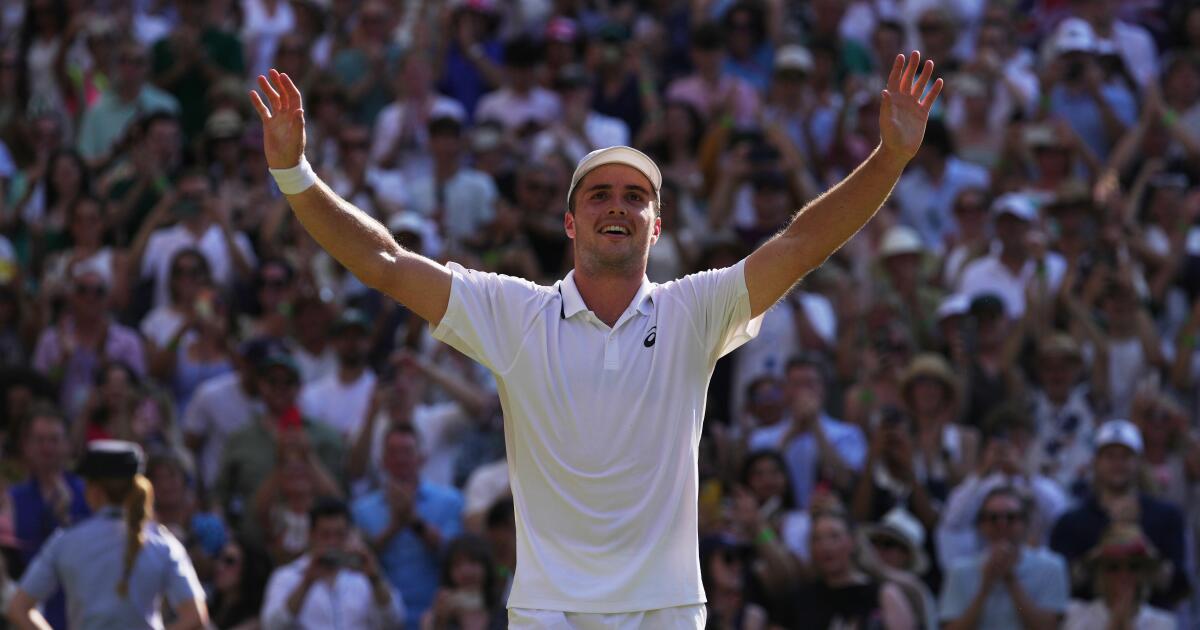
LONDON — A local boy sleeps in his own bed, plays in front of a king and queen and makes a Cinderella run to the Wimbledon semifinals. Sounds like a Hollywood script that might never see the silver screen.
But it’s no fairy tale — it’s Arthur Fery’s out-of-nowhere performance over the last 10 days.
Fery, a virtually unknown British wild card with a triple-digit ranking, has become the emotional heartbeat of Wimbledon while legitimately diverting some national attention from England’s World Cup quest.
The royal treatment at his matches across the All England Club has come in more ways than one.
Fery, who grew up five minutes from Wimbledon and is staying at home during the tournament, first played before grass-court king Roger Federer, Wimbledon’s eight-time singles champion, during Monday’s fourth-round victory. Two days later, he beat No. 9 seed and French Open runner-up Flavio Cobolli of Italy in the quarterfinals 6-4, 7-6 (4), 6-0 in front of Queen Camilla.
Ranked 114th, Fery had never reached the semifinals of an ATP Tour event, let alone a major, before his brief chat with the queen following the match.
“She just said, ‘Congratulations, keep going,’” 23-year-old Fery told reporters later. “I told her it was my birthday on Sunday, so it would be great to play the Wimbledon final on my birthday.”
That’s still a match away. To get there, Fery will have to get past one of the hottest players on tour: No. 2 seed Alexander Zverev, who is fresh off his first Grand Slam title at the French Open. Looming on the other side of the draw is a highly anticipated showdown between defending champion Jannik Sinner against 24-time major winner Novak Djokovic.
If Fery can continue his magical run to the end, he would become the first British wild card to win a Wimbledon title.
Arthur Fery reacts after defeating Flavio Cobolli in the Wimbledon quarterfinals on Wednesday.
(Maja Smiejkowska / Associated Press)
Born in France, Fery’s family moved to Wimbledon when he was an infant. His mother played professional tennis. He was a top British junior but chose to sharpen his game for three years in the U.S. collegiate system at Stanford, as many of his compatriots have done.
“I came out with a lot of hunger coming out of that, and I was ready to attack the pro circuit,” Fery said.
After struggling with bone bruising in his arm that limited him to playing mostly on the lower-tier Challenger circuit in recent years, Fery is finally healthy and playing consistently.
His path to the last four in London has been a masterclass in clutch come-from-behind performances. The Brit has stared down near-certain elimination in multiple matches, repeatedly breaking his opponents’ momentum with Houdini-like on-court acts.
At 5-foot-9, Fery possesses a skill set perfectly suited for low-bounding grass.
His compact strokes, low center of gravity, and elite movement allow him to hug the baseline, take time away from opponents, and confidently execute delicate volleys at the net, according to ESPN analyst Chris Eubanks.
“He defends well,” said Eubanks, a 2023 Wimbledon quarterfinalist. “He can scrap. He can claw. He can dig his way back into points. And when he ventures forward, he’s very, very comfortable at the net. This is a picture-perfect example of someone whose game is built for the surface.”
Still, it’s hard to fathom the multitude of milestones for Fery, who briefly reached the No. 1 ranking in college and earned 2023 Pac-12 Singles Player of the Year honors before leaving early to pursue a pro career.
He arrived at Wimbledon with just one main-draw victory at a major, a losing record as a professional, and only one previous ATP quarterfinal, at Queen’s Club last month. He’s now 11-8, won his first two five-set matches, and is the first British wild card to reach the Wimbledon men’s semifinals in the Open Era. The only other men’s wild-card semifinalist was Goran Ivanisevic, who won the title as a wild card in 2001.
Fery, who started the season ranked No. 185 and will climb to at least No. 36 after the tournament, said there were a “lot of first times” as he reflected on his unprecedented run. “First five-setter, longest match that I’ve ever played, first time breaking into the top 100, first second week in a slam, all at home, five minutes from where I grew up. It’s a great story for me,” he said.
The gap with his fellow semifinalists is understandably massive.

Entering Wimbledon, Djokovic, Sinner and Zverev’s combined records include 29 Grand Slam titles, 2,088 match wins and 155 tour-level titles. Fery was 6-8 in tour-level matches with zero titles.
But he has singlehandedly lifted the tournament for locals. With top hopes Jack Draper and Emma Raducanu withdrawing before the tournament and the rest of Britain’s singles prospects falling one by one — 18 men and women were eliminated by the third round — Fery became the nation’s last knight standing.
If his first name inevitably evokes Arthurian legend, Fery’s march through the draw gave Britain reason to believe again. No sword, no Round Table, just world-class shot-making, a lion’s heart and a Centre Court crowd thrilled to rally behind him.
“This is really quite something to see on home soil,” said Russell Fuller, the BBC’s tennis correspondent, who compared it with Raducanu’s stunning U.S. Open win in 2021 as a qualifier.
Fery earned every bit of it.
In the first round against Damir Dzumhur, Fery dropped the opening set and trailed by a break in the second before surging back. Against Zizou Bergs in the third round, he faced a 4-1 deficit with a double break in the fourth set, and again fell behind 4-1 in the fifth, before somehow surviving.
Then, stepping onto Centre Court for the first time against former top-10 stalwart Grigor Dimitrov of Bulgaria in the fourth round, Fery clawed out of a 2-sets-to-1 hole and a break down in the fourth set to clinch the victory in a fifth-set tiebreak.
“He carries himself with humility, but he’s a fierce competitor, and he’s got a ton of belief in himself,” said Stanford men’s coach and former top-60 player Paul Goldstein, who flew to England Tuesday to see his former charge compete against Cobolli.
While Fery attempts to outmaneuver Zverev on Friday, the other semifinal features a 2025 Wimbledon semifinal rematch between seven-time Wimbledon winner Djokovic and top-ranked Sinner, who defeated the Serb in straight sets on his way to the title. It’s also their second Grand Slam semifinal meeting in 2026. At January’s Australian Open on hard courts, Djokovic bested 24-year-old Sinner in five sets before falling to now-injured Carlos Alcaraz in the Melbourne final.

Arthur Fery hits a return during his Wimbledon quarterfinal win over Flavio Cobolli on Wednesday.
(Clive Brunskill / Getty Images)
Djokovic, 39, enters the match after surviving a grueling five-set, 5-hour-plus quarterfinal slugfest against No. 3 Félix Auger-Aliassime that concluded just minutes before Wimbledon’s 11 p.m. curfew. But the seventh-seeded Serb has a way of defying Father Time and he has had two days to recover on a surface where points are shorter and generally less taxing on the body.
Italy’s Sinner, who defeated Alcaraz in last year’s Wimbledon final, has been efficient if not at the level that saw him capture five consecutive titles before crashing out in the second round at the French Open. After a first-round scare here, the four-time Grand Slam champion has dominated opponents behind his improving serve, winning 80% of his first-serve points. He hasn’t dropped a set since the opening round. Sinner leads the head-to-head with Djokovic 6-5.
According to Eubanks, Djokovic must disrupt Sinner’s movement to break his rhythm, and take his chances.
“He’s got to play similar to how he played in Australia, where it was just all-out aggression,” Eubanks said.
For Sinner, he added: “His serve can be a neutralizing force for what Novak is going to try to do.”
On the other side of the ledger, Fery’s poise under pressure and deft use of the home crowd will be paramount to continue his surprise run against Germany’s Zverev, whom he called a “step up again” from his last five matches. Zverev, 29, is seeking his fifth major final and first at Wimbledon.
“I’m ready for it,” Fery said. “I have nothing to lose. I’m just going to go out there and … put my game on the court, do what I’ve done, believe in myself. We’ll see where that takes me.”
Home has never been closer to Centre Court. Nor has Arthur Fery ever been closer to tennis history.
Sports
Pirates star pitcher makes unfortunate history after being taken out in middle of perfect game bid

NEWYou can now listen to Fox News articles!
Jared Jones was flirting with Major League Baseball history on Wednesday night — he got it, but it was not what he originally envisioned.
The Pittsburgh Pirates pitcher retired the first 18 batters he faced, but he was taken out in the middle of his perfect game bid after six innings.
Now, the Pirates certainly have their reasons — the 24-year-old Jones hasn’t thrown more than 81 pitches in eight starts since returning May 20 after missing all of last season while undergoing ulnar collateral ligament internal brace surgery on May 21, 2025. He was yanked with 77 pitches and likely would have needed more than 100 pitches to record the 25th perfect game in MLB history.
Jared Jones of the Pittsburgh Pirates pitches during the first inning against the Atlanta Braves at PNC Park on July 8, 2026, in Pittsburgh, Pennsylvania. (Photo by Joe Sargent/Getty Images)
However, Jones left the game after getting zero run support, so when the Atlanta Braves tacked on three runs late for a 3-0 victory, Jones instead found himself in the wrong chapter of the history books.
According to Opta Stats, Jones became the first pitcher in the modern era (since 1920) to pitch at least six perfect innings and not record a win.
“It does suck. Something’s cool coming on, but I’m on what? My eighth start off of surgery? I completely understand it, and it is what it is,” Jones told reporters after the game.
Pittsburgh Pirates starting pitcher Jared Jones (17) makes his way to the field to warm up before pitching against the Atlanta Braves at PNC Park. (Charles LeClaire/Imagn Images)
JUSTIN VERLANDER ANNOUNCES HE WILL RETIRE AFTER THIS SEASON: ‘I’VE REALIZED THAT TIME HAS COME’
Jones said he didn’t entertain attempting to complete the perfect game.
“Not with the pitch count,” he said. “Not really ever expecting to go nine right now, so that was never in my head.”
Joey Bart, traded to the Braves from the Pirates on June 18, followed a double by Mike Yastrzemski with a 422-foot, two-run homer to left-center field off a slider from Dennis Santana. Drake Baldwin added an RBI single to center in the ninth for good measure.
It was the second time in less than a week that a pitcher was taken out of the game with a perfect bid through six innings — the Miami Marlins took Eury Perez out after seven innings in which he had 92 pitches. Perez, too, is in the midst of returning from injury and has surprisingly found himself right in the postseason mix.
He was pulled for Lake Bachar to start the eighth, and the Marlins allowed eight runs to the Athletics in the final two innings, but held on to win 9-8.
Jared Jones (17) of the Pittsburgh Pirates delivers a pitch during a MLB game against the Cincinnati Reds on June 27, 2026, at PNC Park in Pittsburgh, Pennsylvania. (Joe Robbins/Icon Sportswire via Getty Images)
CLICK HERE TO DOWNLOAD THE FOX NEWS APP
The Pirates are 4.0 games out of the final wild card spot, which is held by the Marlins.
The Associated Press contributed to this report.
Follow Fox News Digital’s sports coverage on X, and subscribe to the Fox News Sports Huddle newsletter.
-
 Denver, CO6 minutes ago
Denver mayor announces new $100 million plan to bring in 10,000 jobs
-

 San Diego, CA9 minutes ago
WEBTOON Brings Top Creators for San Diego Comic-Con Panels
-

 Seattle, WA9 minutes ago
Husband of pregnant wife killed in Seattle sues King County homeless authority
-

 Milwaukee, WI21 minutes ago
Supervisor calls for referendum on Milwaukee County courthouse revamp
-

 Atlanta, GA24 minutes ago
Critically missing: 11-year-old missing in Atlanta after running away
-

 Minneapolis, MN29 minutes ago
Marilyn Savage, St. Cloud State Educator And Media Pioneer, Remembered July 18 In Cokato
-

 Indianapolis, IN36 minutes ago
Unsettled Friday and Saturday, then summer heat returns early next week | July 10, 2026
-

 Pittsburg, PA39 minutes ago
Buying Here: Modern home with backyard pool in Lawrenceville priced at $949,900

