Politics
Commentary: For all the chatter by mayoral candidates, can anyone fix L.A.’s enduring problems?


I’m going to start this story on a quiet tree-lined street in Mar Vista, where a couple I met with on Thursday — the day after the L.A. mayoral debate — have a problem.
It’s not an unusual matter, as things go in Los Angeles. On both sides of the street, the sidewalk rises and falls, uprooted and cracked by shallow roots because over many decades, the trees were not properly maintained.
John Coanda, 61, who grew up in Los Angeles, was never bothered by torn-up sidewalks as a kid.
“In fact,” he said when he first emailed me about his predicament, “my friends and I sometimes used the ramping pavement as jumps for our bicycles.”
But his wife, Barbara, was diagnosed in 2024 with ALS, and she uses a wheelchair. When John pushes her, they can’t use the sidewalk if they want to go to the store or meet with friends, or just enjoy a nice pass through the neighborhood without getting into a vehicle.
So John pushes Barbara’s wheelchair in the street, which creates an obvious safety problem. And despite John’s best efforts to get City Hall to fix the sidewalks, he’s not expecting help anytime soon.
I’ll circle back to this story, but first, about that debate.
I recruited a half-dozen L.A. residents to watch and send me their thoughts about how the candidates tackled the important issues. And then I felt guilty for having done so, because the candidates didn’t do much tackling at all.
Candidate Spencer Pratt is shown on a television while journalists work during the 2026 Los Angeles mayoral debate at Skirball Cultural Center.
(Jason Armond / Los Angeles Times)
They hit their talking points, for sure, and Mayor Karen Bass, Councilmember Nithya Raman and TV personality Spencer Pratt each had their moments. But by the end of the debate, and two straight nights of gubernatorial debates as well, I came away thinking there were no clear winners, but there was a definite loser.
Voters.
This is the fault of the format more than of the candidates themselves. The deck is stacked against meaningful, substantive discussions, especially when moderators ask — as they did several times — for one-word answers.
“Moderator questions are so meaningless … and they make it easy for candidates to take potshots at each other,” said longtime political sage Darry Sragow. “The format is guaranteed to elicit nothing that matters.”
It’d be better to have single-issue debates, and to have candidates pressed for details by journalists who cover those issues and can push back against unrealistic promises and expose a lack of depth.
My debate watchers did some of that themselves. CSUN librarian Yi Ding had praise and criticism for each candidate, but was looking for concrete plans and didn’t get many.
Ding was also disappointed that two other mayoral candidates — Ray Huang and Adam Miller — were not invited to the debate, and I agree with her. Both have been polling low, but with so many undecided voters, and such high unfavorability ratings for Bass, they should have been in the mix.
Mike Washington, a retired pharmacist and West Adams resident, said Bass has done better than previous mayors on homelessness and he didn’t think Raman or Pratt came off as worthy of bumping her out of City Hall.
“The public would have benefited from more questions related to the challenges young people are facing,” said Juan Solorio Jr., president of the San Fernando Valley Young Democrats club. His colleague David Ramirez agreed, saying he was hoping for “more discussion about the cost of living for young adults,” but he and Solorio are both backing Bass.
West L.A. software developer Mike Eveloff asked the million-dollar question in one of his many observations during the debate:
“Why is LA spending record amounts on homelessness, fire, police, and infrastructure while results deteriorate? Streets and sidewalks crumble. Even the city emblem right in front of City Hall is deteriorated. With the World Cup and Olympics approaching, voters need to know: Do these leaders have the financial discipline and operational competence to manage a fourteen billion dollar city?”
Venice resident Dennis Hathaway, author of “An Octogenarian’s Journal,” said he thinks “these kinds of debates are pretty non-edifying.” And, as someone I wrote about two years ago regarding busted sidewalks in his neighborhood, he shared this lament about Thursday’s debate:
“No mention of broken sidewalks, potholed streets, other deteriorated infrastructure. To me, that’s a much more important subject than non-citizens voting in city elections.”
(Bass did say during the debate that there was a new infrastucture plan in place, and that’s a step in the right direction. But there was no discussion, and when you read the details, 2028 Olympics projects will be prioritized, and it’ll take years to figure out how to fund thousands of additional much-needed fixes.)
The Coandas live not far from Hathaway, and their lives have been upended first by Barbara’s diagnosis and then by John getting laid off in February from his job as a data analyst. Barbara still teaches French via Zoom, and John is tending to her needs. They started a Gofundme campaign to help pay their bills.
With Barbara in a wheelchair, John contacted the city’s Safe Sidewalks L.A. program last fall, and I think it’s fair to say that name is somewhere between a misnomer and a bad joke.
The “program” responded by email on Halloween, appropriately enough, informing him that under the City Council-approved “Sidewalk Repair Program Prioritization and Scoring System,” his request for help merits only 15 points out of a possible 45.
“Currently,” he was informed, “the estimated wait time for completion of an Access Request with a score of 15 is in excess of 10 years.”
Happy Halloween.
Over the years, responsibility for sidewalk repairs has shifted between the city and homeowners. There’s a rebate program available to people who repair their own sidewalks, but it’s capped at an amount that doesn’t always cover the costs. And ruptured pavement is keeping lots of lawyers busy with trip-and-fall lawsuits that cost the city millions each year.
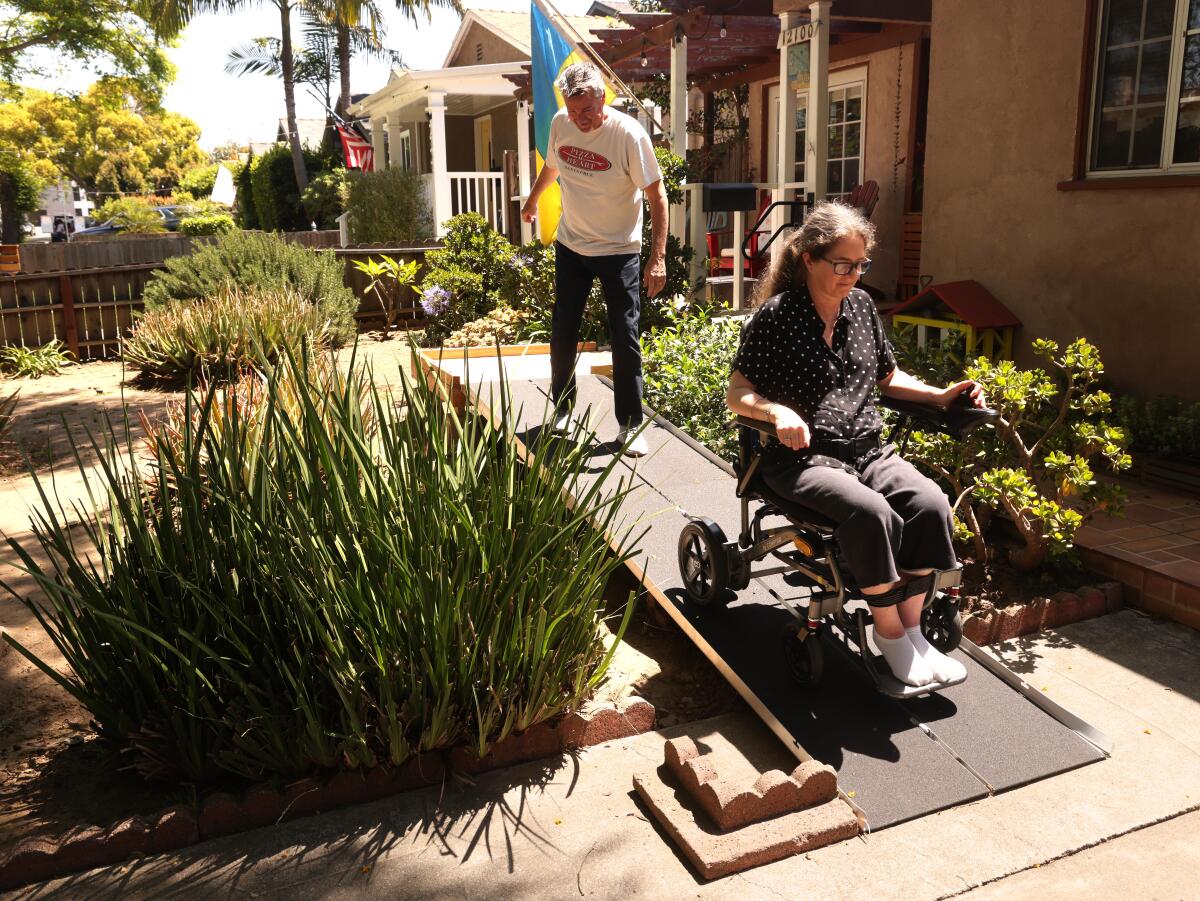
Barbara Durieux Coanda, who has ALS, and her husband, John Coanda, make their way down the ramp in front of their home in Mar Vista.
(Genaro Molina / Los Angeles Times)
Coanda told me he doesn’t have the funds at the moment to pay for repairs, and even if he did, there are several more sidewalk disaster zones on both sides of his street, so he’d still have to push his wife’s wheelchair in the street even if he fixed the cracks in front of his own house.
Barbara graciously said she thinks the city has other, higher priorities, but in November her husband contacted the office of Councilmember Traci Park, saying he was told that he would have to wait 10 years for repairs.
“Sadly,” he wrote, “I don’t think my wife will live that long.”
A Park staffer wrote back, saying, “The turnaround time does sound realistic given the budgetary crisis the city finds itself in.” But, the staffer added, maybe the council member’s office could “help move the needle on this request.”
Coanda said he’s been too busy with his wife’s issues to follow up. But Pete Brown, Park’s communications director, told me Friday afternoon that the office is exploring ways to pay for fixes that don’t take 10 years, including the use of discretionary funds.
I don’t know how that might play out, but I do know that L.A. doesn’t need another debate like the last one.
We need a mayor and council members who refuse to accept that it takes 10 years to create safe passage for a wheelchair.
In the national capital of broken sidewalks, we need concrete plans.
steve.lopez@latimes.com


new video loaded: Reflecting Pool Turns Green, Paint Peels After Renovation
transcript
transcript
Reflecting Pool Turns Green, Paint Peels After Renovation
Algae blooms have hit the Lincoln Memorial Reflecting Pool, which underwent a $14.2 million repair project. Blue paint appeared to be chipping from the bottom.
-
“The reflecting pool is greener than I have ever seen it before due to algae.” “I was expecting to see blue, but green is O.K.” “Honestly, I don’t think you can fight mother nature.”

By Julie Yoon, Jackeline Luna and Alisa Shodiyev Kaff
June 19, 2026

NEWYou can now listen to Fox News articles!
House GOP Conference Chairwoman Lisa McClain, R-Mich., rebuked a school board in Richmond, Michigan, after some of its members tried to remove a conservative colleague for missing meetings while on military deployment to the Middle East.
Ray Stier, who received an American flag and a copy of the Congressional Record from McClain on Thursday as a commendation of his work, had been on deployment, attending board meetings remotely, but eventually lost virtual access.
That’s when the board called for his removal, citing a “disservice” caused by his absence.
“One of the board members’ family was taking to social media and putting out misinformation about myself and my wife and things that were not factually accurate and then ultimately calling for my resignation and prompting others to reach out to the district to call for my recall,” Stier recounted.
PARENTS SAY THEY’RE RUNNING FOR LOCAL SCHOOL BOARDS TO FIGHT ‘POISONOUS’ CRITICAL RACE THEORY
House GOP Conference Chairwoman Lisa McClain, R-Mich., left, pictured alongside Ray Stier, a school board member in Richmond, Michigan. (Andrew Harnik/Getty Images; office of Lisa McClain)
The moment is just the most recent clash between Republicans and school boards over policies that, in their view, are gatekeeping schools against diversity of thought and accountability.
“I think education is extremely important and vital,” McClain told Fox News Digital.
“And educators and administrators need to teach children how to think, not what to think. It’s about time that administrators begin to get held accountable for their actions. Good actions and bad actions.”
McClain’s meeting with Stier comes on the heels of a congressional hearing last week where she grilled a superintendent from Virginia over student privacy policy, probing if those policies were being unevenly applied to favor transgender students.
VIRGINIA SCHOOL DISTRICT SLAPPED WITH COMPLAINT ALLEGING NEW CLAIMS IN VIRAL TRANS LOCKER ROOM FIGHT
Rep. Lisa McClain, R-Mich., leaves a House Republican Conference meeting at the Capitol Hill Club on Feb. 28, 2023. (Tom Williams/ CQ Roll Call via Getty Images)
“The victims got a 10-day suspension and the biological female that did the filming got a one-day suspension,” McClain said, referring to an incident at Stone Bridge High School in Loudoun County where students had been reprimanded for filming in a locker room.
“How does that make sense?”
In Stier’s case, McClain questioned whether the board had targeted Stier on account of just his deployment overseas. Stierhad clashed with the board after learning that some of the district’s bathroom policies would have allowed fourth-grade students to use the same bathroom as transgender eighth-grade boys.
“Prior to him filling the seat, the seat was open for two months,” McClain observed. So that logical argument doesn’t exactly make sense to me; it doesn’t really hold a lot of water.”
MICHIGAN PARENT WANTS TRUMP TO ACT AFTER DAUGHTER SHARES LOCKER ROOM WITH TRANS-ATHLETE
House GOP Conference Chairwoman Lisa McClain, R-Mich., left, pictured alongside Richmond, Michigan school board member Ray Stier right. (Office of Lisa McClain)
CLICK HERE TO DOWNLOAD THE FOX NEWS APP
For his own part, Stier believes his case will refocus attention on the importance of the school board and its membership.
“My goal is to continue being an advocate for the community. One of the good things that I think came out of this was that it got so much attention that some of the community members who were unaware of the dynamics that were not being brought to light,” Stier said.

California’s political watchdog commission on Thursday finalized a $31,500 fine against Gov. Gavin Newsom, alleging that the Democratic leader failed to report three dozen behested payments totaling $5.5 million mostly to support wildfire recovery by the deadline under state law.
The Political Reform Act requires elected officials to disclose payments of $5,000 or more that they solicit or direct others to give to a charitable, legislative or governmental purpose within 30 days.
The California Fair Political Practices Commission said 34 of the violations were for failing to report on time that Newsom and his staff directed outreach from companies and foundations that wanted to help after the Los Angeles wildfires to the California Fire Foundation. The nonprofit was started in 1987 by the California Professional Firefighters to support the families of fallen firefighters and communities impacted by fire.
The donations include $1 million from the Chuck Lorre Foundation and $500,000 apiece from Lockheed Martin, the Anthem Blue Cross Foundation and BlackRock, among others gifts.
The governor also failed in 2024 to report on time two behested payments, totaling $100,000 from the Schmidt Family Foundation and Schwab Charitable Funds to the Institute for Local Government, a nonprofit within the League of California Cities.
The commission said the governor reported all of the payments “prior to public discovery” or contact from its enforcement division, which it considered a mitigating factor. Newsom also signed the stipulation and agreed to the fine.
Tara Gallegos, a spokesperson for Newsom’s office, said the issue involved late paperwork at a time when the governor’s staff was focused on emergency response and supporting survivors. She also underscored the fact that the reports were filed before he was contact by the FPPC.
Gallegos said the fine is unrelated to an alleged investigation into the governor and his wife by the Department of Justice, which Newsom announced this week.
Newsom alleged Monday that Trump is using the government as a political weapon to target him and his wife, Jennifer Siebel Newsom. Newsom announced the investigation after he learned that the FBI and Internal Revenue Service asked his associates questions about nonprofits and businesses related to the couple.
The governor’s office characterized the investigation as a fishing expedition. The Trump administration declined to comment.
A source familiar with the matter, who requested anonymity because they were not authorized to discuss it publicly, said two federal probes have been going on for about a year, and that they originated not from Washington, D.C., but from conversations between whistleblowers and federal prosecutors based in Sacramento. The probes are linked to Newsom’s former chief-of-staff, Dana Williamson, and Siebel Newsom’s taxes, the source said.
The FPPC violations mark the second time Newsom has reported payments late, which increased his penalty for the new infractions. The commission fined Newsom in 2024 for failing to timely report 18 payments totaling $14.4 million.
-

 Mississippi2 minutes ago
Kohen Wiley: Police shooting of a 1-year-old Mississippi boy ignites tension between police and Black residents | CNN
-

 Missouri7 minutes ago
What’s closed on Juneteenth in Missouri? Check trash, libraries, banks
-

 Montana14 minutes ago
Your guide to local sports events, plus what’s on TV for June 19
-

 Nebraska17 minutes ago
Nebraska’s governor doesn’t carry a state-issued phone. Critics call it an abuse of state disclosure laws. – Flatwater Free Press
-

 Nevada23 minutes ago
Conservation groups oppose potential sale of federal lands highlighted in land mapping tool
-

 New Hampshire30 minutes ago
Portsmouth Pride 2026 is a protest and a celebration
-

 New Jersey32 minutes ago
Historical marker recognizing Lawnside, New Jersey, to be unveiled Friday
-

 New Mexico37 minutes ago
Eight Black New Mexican artists explore the concept of land through art

