Virginia
Virginia Dept. of Health plans to test small, disadvantaged communities for PFAS • Virginia Mercury


The Virginia Department of Health is continuing its forever hunt to find the amount of per- and polyfluoroalkyl substances, known as PFAS, present in the state by testing for them in water systems serving small and disadvantaged communities.
“We suspect they haven’t done PFAS monitoring yet, and so they don’t know what they’re up against,” said Robert Edlemen, director of technical services at the office of drinking water at VDH, in an interview. “And certainly we don’t either.”
PFAS are the thousands of different chemicals used in several household products ranging from winter jackets to cookware to firefighting foam because of the tight chemical bond they possess to repel water and heat.
Because of that tight bond, the chemicals are nearly impossible to break down, meaning they end up in landfills, can leak into groundwater, and then get soaked up by clouds that send them back into the environment and food sources through rainfall.
The new testing comes as part of the federal government passing final PFAS rules in April to enforce a 4 or 10 parts per trillion maximum contaminant levels, or MCL, for a limited number of types of PFAS. One part per trillion is the equivalent of 1 drop of water in 20 Olympic-sized swimming pools.
The new standards will reduce PFAS exposure for roughly 100 million people, prevent thousands of deaths, EPA Administrator Michael Regan said when announcing the new rules this spring.
The chemicals have been linked to serious health problems including cancers and reproductive and fetal development issues.
When issuing the rules, the U.S. Environmental Protection Agency created a grace-period for public water systems to monitor levels of PFAS chemicals until 2027 before needing to treat any exceedances of the MCLs in drinking water starting in 2029.
Types of systems
Nationwide and in Virginia, public water systems, or waterworks, are defined as those serving 25 people or more a day for 60 days or more a year.
In Virginia, there are 1,072 community systems that serve towns, cities and counties and about 500 non-transient, non-community systems that serve schools or an office building where people return day-after-day but don’t live.
There’s also 1,245 transient non-community systems, which serve restaurants, a campground or a highway rest-stop that sees groups of people coming and going rather than live in or repeatedly return to the same area.
The community systems and non-transient, non-community systems are subject to the new rules. The transient, non-community systems do not need to follow the rules, with the thinking that the same people aren’t exposed to the potential contaminants from the same system over and over again.
Private wells, which are unregulated in Virginia and primarily serve individuals’ homes in rural, mountainous areas, are not subject to the rules either.
Previous testing
In addition to some sampling the Virginia Department of Environmental Quality has done, the Virginia Department of Health conducted two phases of testing across Virginia’s publicly regulated water systems.
The first of those happened in 2021 with 45 of 50 systems that VDH reached out to agreeing to participate. The effort targeted larger systems serving about 5.25 million of the state’s about 7 million population, Elemen said.
Phase II, in 2022 and 2023, sampled 274 systems which were smaller community systems, and a handful of non-transient, non-community systems that were near areas that included known sources of PFAS, such as large airports that may use firefighting foam with the chemicals, and unlined landfills.
As a result of that sampling, PFAS was found to be present in the Roanoke, Newport News and Potomac River areas.
New testing
Now, in Phase III, VDH is sampling small and disadvantaged communities, which include the “vast majority” of systems in Virginia, Edelman said. These systems include those serving populations of less than 10,000 and are deemed burdened under the EPA’s Environmental Justice screening tool.
The effort is expected to collect about 400 samples in all areas of the state over the next two or three months, Edelman said.
“If you consider that we have over a thousand community water systems, 400 samples isn’t enough to get the job done,” said Edlemen. “But it’s the next step in making progress identifying the PFAS levels across the state…it’s a doable step.”
Some of the about $27 million the state received from the federal government for 2022 and 2023, and $13.5 million this year can be tapped into to offset the costs of testing, Edelman said at a recent waterworks advisory committee meeting.
More testing
The testing is all seen as a way to get a handle on understanding where PFAS are in Virginia before beginning to figure out where the substances are coming from.
Chris Pomeory, attorney for the Virginia Municipal Drinking Water Association that represents waterworks that serve about 3 in every 4 Virginians, said in a statement that the “VMDWA is pleased to know that VDH intends to assist small disadvantaged communities with PFAS testing, which will be helpful for determining where PFAS testing is needed.”
The testing of the smaller systems “absolutely needs to be done,” added Betsy Nichols, vice president of the Potomac Riverkeeper Network, a local environmental group, since those might be in rural areas that are more likely to use biosolids from wastewater treatment plants as fertilizer.
The level of exposure in private wells also needs to be understood, Nichols added. She suggested the state could set up a grant program to help users of those systems conduct the testing.
It costs her group about $90 to $100 to conduct small tests, which require strict protocols for handling and storage because of the ease of outside particles contaminating the test subjects, Nichols said.
“Maybe [the wells] are all fine, but you don’t really know until you test,” Nichols said.
Also of importance is knowing where PFAS is coming from, such as carpet manufacturers, metal finishers and pesticides that use them, in order to “shut off the tap” and begin using alternatives, Nichols said.
“If we don’t start moving more quickly, we won’t have made all the changes that are needed to be implemented when that deadline hits,” Nichols said.
This past session Republican Gov. Glenn Youngkin signed a bill setting up a process for the Department of Environmental Quality to identify “significant” sources of PFAS. The bill passed despite some advocates initially wanting a more direct report from those using the chemicals to identify how they were introduced into the environment in the first place.
VDH will also be embarking on a $500,000 study, due to the General Assembly by Dec. 1, to determine how much it may cost to have waterworks make upgrades to treat PFAS, which could cost millions.



Virginia
Virginia Heat Wave: Richmond high temperatures near or above 100°. Heat index could exceed 110°.

RICHMOND, Va. — A big ridge of high pressure will lock into place over the next few days, keeping temperatures significantly above normal, creating a dangerous combination of heat and humidity.
Highs will be near or above 100° for at least Thursday, Friday and Saturday, and the heat index could exceed 110°.
An Extreme Heat Warning is in effect for most of the region Thursday and Friday. Click here for the latest heat alerts.
The highs will challenge records on multiple days. Due to the high heat index values, and the very warm overnight lows, this will be the biggest heat wave since July 2012.
A few isolated storms are possible Friday, especially north and northwest of Richmond.
There is a better chance of a few storms over the weekend.
Rain chances will increase for Monday and Tuesday, and this should allow highs to drop to near-normal levels.
The drought continues for the Commonwealth. Since last week, the severe (level 3 out of 5) and extreme (level 4 out of 5) drought areas have dropped by a few percent, with the area of moderate drought (level 2 out of 5) expanding.
(WTVR)
Stay With CBS 6, The Weather Authority.
STORM TRACKING LINKS:
Weather Alerts
Closings & Delays
Interactive Radar
Map Center
📱 Download the new and improved CBS 6 Weather App for iPhone and Android.
WTVR 

Va. (WSET) — Adult adoptees in Virginia can now obtain copies of their original birth certificates under a new state law that took effect Wednesday, ending restrictions that had been in place for nearly 50 years.
House Bill 301 establishes a process allowing adult adoptees to request their original birth certificates from the Virginia Department of Health’s Office of Vital Records. The law also allows birth parents to file a form indicating their preferred level of contact with adoptees.
The legislation marks a significant change in Virginia adoption law. Since 1976, most adoptees have been unable to access their original birth certificates, documents that are generally available to other adults in the commonwealth.
Del. Wendell Walker, R-Lynchburg, who served as chief co-patron of the measure after language from his earlier House Bill 664 was incorporated into the final legislation, said the new law concludes several years of legislative efforts.
“This is a day that many adoptees and families have waited years to see,” Walker said in a statement. “Today, Virginia restores a simple but meaningful right: the ability for adult adoptees to obtain their own original birth certificate.”
Walker thanked Del. Katrina Callsen, D-Charlottesville, for helping carry the legislation during the 2026 General Assembly session. He also recognized advocates, adoptees and families who supported the effort, including the Virginia Adoptee Rights Alliance, a coalition that advocated for expanded access to original birth records.
Walker also reflected on someone much closer to home for us at ABC13: the late anchor Mark Spain, whom he credited with bringing the issue to his attention in 2022.
EARLIER: Why Virginia law makes it hard for adoptees to get information about their birth parents
Mark’s compassion and determination helped launch this effort,” Walker said. “While it is bittersweet that he is not here to see this day, his legacy lives on in the lives that will be impacted by this law.
Adult adoptees seeking their original birth certificates can submit requests through the Virginia Department of Health’s Office of Vital Records by clicking this link.
“Today marks the beginning of a new chapter for thousands of Virginians. For many adult adoptees, this law provides an opportunity to better understand their own story, their family history, and where they came from. I’m grateful to everyone who helped make this day possible,” Walker concluded.

A Virginia law going into effect Wednesday seals the criminal records of many convicted of low-level offenses.
The Clean Slate Law allows for the automatic sealing of certain offenses, including traffic infractions and misdemeanor convictions like shoplifting, trespassing, distribution of marijuana and disorderly conduct. Eligible misdemeanor convictions will be automatically sealed after seven years if the person has not been convicted of any other crime in Virginia, any other state, the District of Columbia or a United States territory during that time.
RELATED | Virginia sees gun sale boom as ‘assault firearms’ ban put on hold
The law also allows for petition processes to seal certain convictions or deferred dismissals.
Sex crimes, violent felonies and protective order violations are among the instances not eligible for petition sealing. The petitioner must not have been convicted of any other felony within the past 10 years in order for a circuit court to grant a petition.
BE THE FIRST TO COMMENT
Under the law, there are exceptions where sealed records may be disseminated and used, including for background checks for firearm purposes and employment screenings for law enforcement and emergency medical services agencies.
-
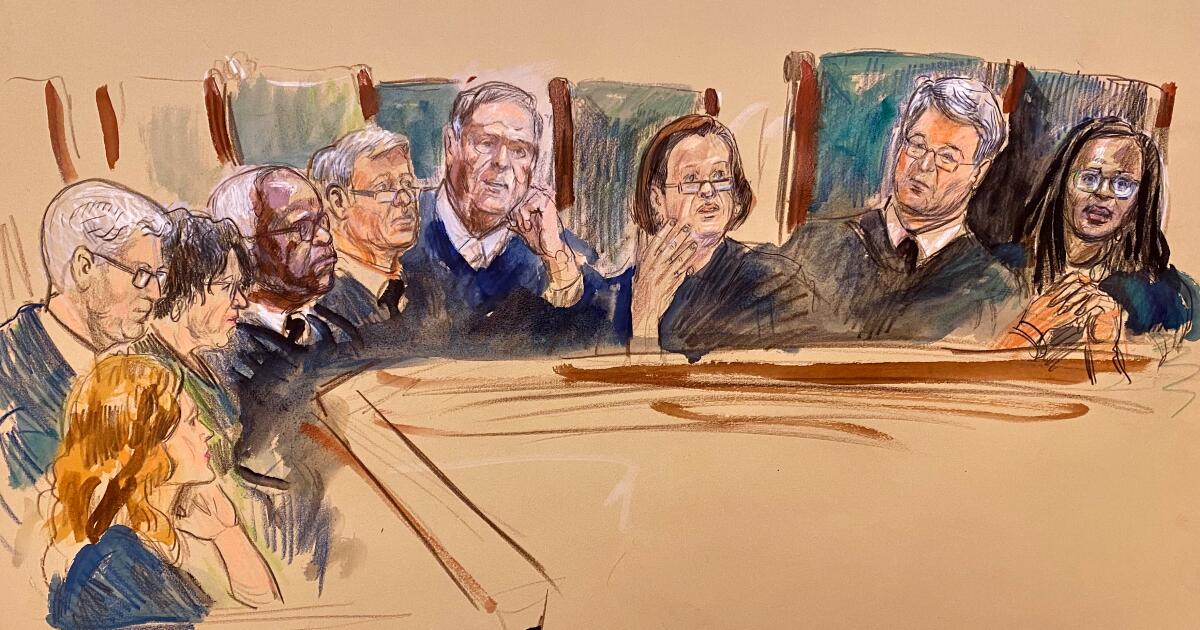 Politics2 minutes ago
How Roberts led a fractured Supreme Court to wins for the right and defeats for Trump
-
 Science7 minutes ago
Contributor: Alcohol should be stigmatized like smoking
-
 Sports14 minutes ago
Thousand Oaks native Claire Liu finally reaches Wimbledon’s third round, will face Coco Gauff
-

 World22 minutes ago
Could water become a flashpoint between Islamabad and New Delhi?
-
 News47 minutes ago
Ukraine latest / Limits of military might / Can major powers regain dominance? : Sources & Methods
-

 Los Angeles, Ca2 hours ago
Juvenile charged with murder after 4-month-old Claremont infant thrown to her death
-

 Detroit, MI2 hours ago
Silence from Jalen Duren’s camp is what the Pistons want to hear
-

 San Francisco, CA3 hours ago
Jury deadlocked on 2 counts for Golden Gate Bridge pro-Palestinian protesters

