Virginia
Slipek: Virginia Union takes on residential real estate development – Richmond BizSense


The abandoned old Richmond Community Hospital is owned by Virginia Union University. (BizSense file photo)
In Sunday night’s episode of “Abbott Elementary” on ABC-TV, the faculty and administration of the fictitious school were at odds over their building being designated a Philadelphia historic landmark. Upon researching the school’s namesake, they found that Willard R. Abbott, was no saint. The naysayers recoiled at the idea of installing an honorific plaque in the lobby.
But, hey, at least no one in Philly suggested that the schoolhouse itself be demolished.
Recently, Richmond Public Schools demolished the historically and architecturally worthy George Mason Elementary School on Church Hill at 813 N. 31st St. Its demise provided playground space for the school’s replacement, Henry L. Marsh III Elementary. An alumnus of George Mason Elementary, Marsh (1933-and retired) was a prominent civil rights lawyer, the city’s first Black mayor (elected in 1977) and a Virginia state senator. He is highly worthy of the naming honor (full disclosure: he’s a friend of mine). But did we need to lose this 100-year-plus notable African American landmark for a few plastic swing sets and slides?
A plaque or a stack of old stones or bricks, no matter how attractively configured, may attempt to memorialize a lost building, but they are no substitutes for still-standing remains of the day. When adapted to meet new and contemporary uses, fine old structures add priceless historical continuity, teach cultural and socio-economic lessons, and add rich aesthetic pleasures for young and old. Richmond is nothing if not good at the adaptive reuse of buildings.
But for a community of our size, age and aspirations, aside from many churches, Richmond has precious few historic structures that embody the African American past. Such places can be counted on a few fingers: the First Battalion Armory that houses the Black History Museum and Cultural Center of Virginia, the Winfree cottage, the Maggie L. Walker house, the former Rosa Bowser Branch of the Richmond Public Library and the Hippodrome and Bill “Bojangles” Robinson theaters.
Let’s look at some landmark losses:
The Jackson Ward offices of political firebrand John Mitchell Jr. (1863-1929) who edited the Richmond Planet newspaper for 50 years. He was also a trailblazing city council member and a gubernatorial candidate.
Great swaths of Jackson Ward and Randolph were sliced out of the cityscape with the construction of Interstates 95 and 64 and the Downtown Expressway, respectively.
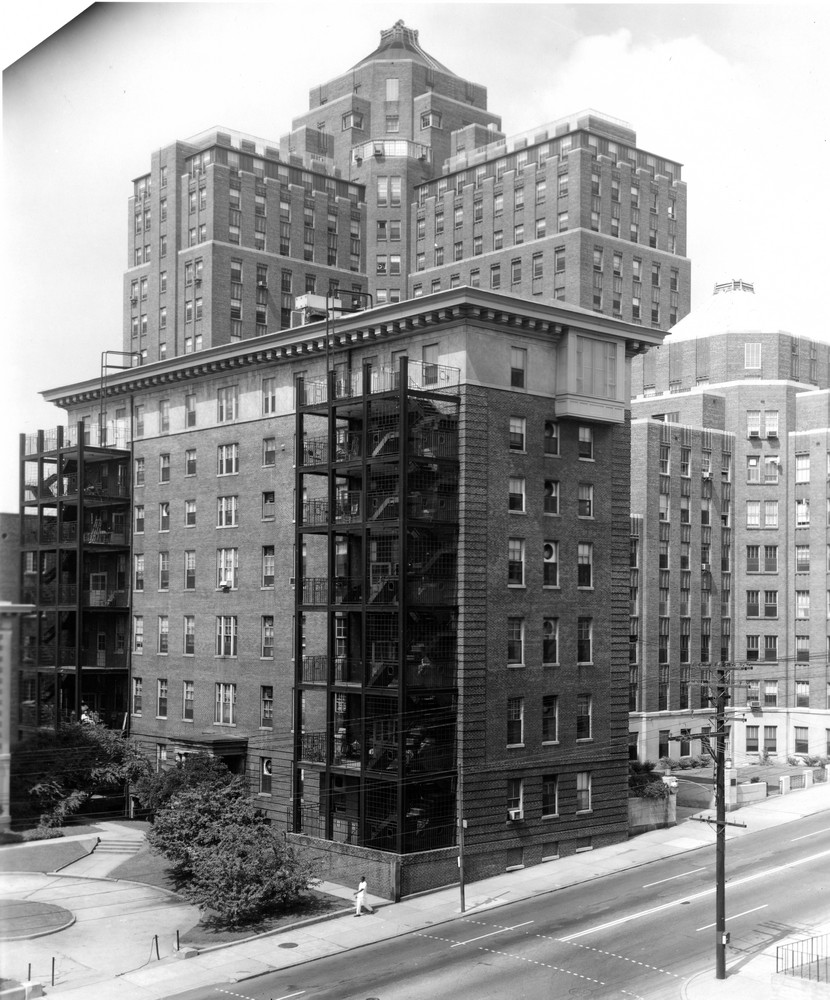
The former St. Philip Hospital in the foreground. (Image courtesy VCU Libraries Gallery)
The handsome former headquarters of Maggie L. Walker’s Consolidated Bank & Trust Company (designed by Black architect Charles T. Russell, 1875-1952) was torn down for a small parking lot when a new bank was completed across North Second Street at East Marshall Street.
On the downtown VCU Health campus, a lonely, salvaged stone door frame embedded in the Marshall Street sidewalk is all that’s left where adjacent, handsome hospitals once stood – the Dooley Hospital for children and St. Philip for Black adults.
Back in Jackson Ward, the former Eggleston Hotel once stood at 813 N. Second St. and hosted such luminaries as Mohammed Ali, Louis Armstrong, Duke Ellington, Billie Holiday and Martin Luther King Jr. The building’s rear partially collapsed in the spring of 2009 and could have been shored up and restored. But no. In the middle of an April Saturday night, the entire building was bulldozed.
But some positive developments are on the horizon. The City of Richmond is finally recognizing and acquiring all-but-forgotten Black cemeteries – a major preservation victory. And after years of discussion, an ambitious master plan was recently unveiled for Shockoe Valley, a fraught part of town. The area will tackle the stories and honor the memory of enslaved people who passed through there.
And more modestly at Virginia Union University, whose Northside grounds and buildings have composed our city’s piece de resistance of Black architectural history for 156 years, the long-forlorn granite-walled Industrial Hall is being restored and transformed into a university gallery museum.
But wait, there’s more. And it isn’t good.

The entryway of the old Richmond Community Hospital.
In early February, as a back-handed slap to Black History Month no less, Virginia Union announced plans to demolish the abandoned but sturdy former Richmond Community Hospital that sits on university-owned property adjacent to the campus. It will be cleared to open up a site for 130 housing units. They will be for rent or purchase by the general public. The university is partnering with the Steinbridge Group, a New York-based investment firm that has pledged $42 million for the project. This will be the first phase of implementing a $500 million master plan that the university announced earlier in the year. “Why should we allow our students … not to become homeowners in this great city of Richmond?’” Hakim Lucas, VUU president, asked rhetorically in a Feb. 7 post by Virginia Public Media.
Say what? Within what university department can we find that program listed?
The old Richmond Community Hospital is an overlooked Art Deco gem at 1209 Overbrook Road. It was designed by Charles T. Russell, a VUU professor of the building and industrial arts as well as prominent local architect. After a major fundraising campaign, the hospital was opened in 1932 in the midst of the Great Depression. The aging facility was much later acquired by Bon Secours, which passed it to Virginia Union.

Small trees have taken root above the old hospital’s front door.
Since the university’s announcement of the project, the Richmond Free Press has become a weekly forum for pushback to the possible – and inexplicable – destruction of a fine building and major community landmark. Finding a new use should be no problem.
Wrote Grace H. Townes to the Free Press: “[The building] holds immense historical significance as a crucial landmark of African-American legacy in our city. During an era of segregation and medical mistrust, this hospital served as a beacon of trust and safety. The doctors who practiced there were not just health care providers; they were pillars of our community who looked like us, understood our needs, and provided care with compassion and understanding. … My four children were born at Richmond Community.”
The Rev. Jabriel M. Hasan of Sandston also weighed in: “For various reasons, ranging from racial injustices to intra-communal neglect and mismanagement, hardship marks the legacy of local, Black historic preservation,” he wrote. “Now that an opportunity arises to safeguard a monument to a way Black people united for community uplift, the choice becomes to tear it down, leaving only a marker in its place.”
Removing this unique and modest building would be a loss to Richmond’s physical character, history and Virginia Union’s intellectual integrity. American college campus structures and landscapes hold deep meaning not only for students but for alumni, staff, visitors and the broader community. The record of struggles and achievements are interwoven into such buildings as this. While not a part of the original VUU campus, the former hospital is now an embedded component of the academic and residential village that grew up near the intersection of Brook and Overbrook roads.



Virginia
Con artists stole jewelry worn by women in Northern Virginia. Police are asking for help finding them – WTOP News

Several people used sleight of hand to steal jewelry worn by women in Northern Virginia, and police in Fairfax County are asking for the public’s help to find the suspects.
Several people used sleight of hand to steal jewelry worn by women in Northern Virginia, and police in Fairfax County are asking for the public’s help in finding the suspects.
The robberies began at 1:30 p.m. on March 20 and followed a similar pattern. According to police, suspects described as women in SUVs would approach other women in parking lots, start conversations and offer them jewelry.
As the suspects placed costume jewelry on the women, they would use sleight of hand to remove the women’s real jewelry, driving off before the victims knew what happened, police said.
Troopers in Delaware detained and identified those inside the Toyota, including Cristina Milhaela Paun, 21, of Baltimore. She was then let go.
Detectives in Fairfax County said they have since identified Paun as a suspect in two of the March 20 thefts and obtained warrants for felony pickpocketing and robbery. She is wanted, and police are asking the public for information regarding her whereabouts.
The exact times and locations of each theft are listed below:
- 1:30 p.m., 6900 block of Hechinger Drive in Springfield (white SUV, Paun identified as a suspect)
- 1:30 p.m., 13900 block of Metrotech Drive in Chantilly (black SUV)
- 3:30 p.m., 12900 block of Wood Crescent Circle near Herndon (white SUV, Paun identified as a suspect)
- 3:55 p.m., 6800 block of Commerce Street in Franconia (black SUV, two suspects, described as a 50-year-old woman with red hair and gold teeth and a 25-year-old woman wearing a headscarf). Video of this incident can be seen below.
Get breaking news and daily headlines delivered to your email inbox by signing up here.
© 2026 WTOP. All Rights Reserved. This website is not intended for users located within the European Economic Area.

When early voting on the proposed redistricting amendment began, the General Assembly was still in session, so one pretty March day Del. Joe McNamara walked outside the State Capitol and recorded a short video to post on social media in which he urged a “no” vote.
“This amendment will not only take power away from the local people,” the Roanoke County Republican said. “It will consolidate power in Northern Virginia.”
McNamara was being mild.
Del. Wren Williams, a fellow Republican from Patrick County, posted a social media message about what he called “Fairfaxphobia,” which he described as “A distrust or fear that political power concentrated in Fairfax County is dominating decisions for the entire Commonwealth and imposing policies on communities that they cannot afford.”
That, too, was mild compared with the video being circulated by the Freedom Caucus Fund, an offshoot of the conservative caucus in the U.S. House of Representatives. “Fairfax is a Sanctuary County with Virginia’s most insane Trans, Sex Ed and DEI policies,” the video says. “And if you don’t vote, they’ll control FIVE Virginia Congress Seats. Stop them.” The audio plays over images of protesters holding signs that say “Love Trans Kids” and, just for good measure, the proposed redistricting map is displayed in rainbow colors.
 100vw, 668px”/><figcaption class=) A screenshot from the Freedom Caucus Fund ad.
A screenshot from the Freedom Caucus Fund ad.Then there are the signs now appearing up and down the Shenandoah Valley that proclaim: “Don’t Fairfax Me.” The most prominent one is on a barn beside Interstate 81 just south of Harrisonburg where 29,000 or more drivers see it every day.
The name of Virginia’s most populous county is now being invoked as a verb in rural Virginia to argue against the proposed redistricting amendment.
 100vw, 780px”/><figcaption class=) One of the signs in Southwest Virginia. Courtesy of Mark Obenshain.
One of the signs in Southwest Virginia. Courtesy of Mark Obenshain.We’re accustomed to candidates badmouthing one another or parties doing the same. Here’s a case where one of the main arguments employed by the “no” side, at least in certain rural parts of the state, is to run against a different part of the state. Even parts of Southwest Virginia where the redistricting map would leave voters in a Republican district, eight billboards have appeared urging: “Vote No” to a “Northern Virginia Power Grab.” They’re paid for by “Friends of Dr. Todd Pillion,” the Republican state senator who represents the region.
It’s hard enough to explain to the casual voter the multiyear process by which constitutional amendments are passed in Virginia, and perhaps even harder to explain redistricting even in more normal times. But invoking the specter of consolidating “power in Northern Virginia” might be a pretty powerful trigger for some conservative rural voters who are predisposed to see Northern Virginia as the reason why there’s a Democratic majority in the legislature passing bills they don’t like.
By that measure, “Don’t Fairfax Me” might be the clearest, punchiest campaign slogan that Virginia has seen since Jim Gilmore was swept into the governor’s office in 1997 on a platform of “No Car Tax!” We’ll see April 21 how effective it is.
The factual basis for “Don’t Fairfax Me” and the general campaign against Fairfax County and Northern Virginia as the villain in this political drama is political math. Northern Virginia is the state’s largest metro area; it’s also reliably Democratic. Right now Northern Virginia has three of the state’s 11 congressional districts, while a fourth contains part of Northern Virginia. For Democrats to maximize their power under redistricting (and conversely minimize Republican power), they needed to stretch those Northern Virginia districts into the Republican strongholds of the Shenandoah Valley and the Piedmont — to essentially “bury” those Republicans into districts dominated by Northern Virginia.
That’s why the proposed map has such elongated districts snaking out of Northern Virginia.
.svg) Virginia’s current congressional districts, approved in late 2021. Courtesy of Twotwofourtysix.
Virginia’s current congressional districts, approved in late 2021. Courtesy of Twotwofourtysix. 100vw, 780px”/><figcaption class=) This is the proposed map, as amended. Courtesy of Legislative Information Services.
This is the proposed map, as amended. Courtesy of Legislative Information Services.
From three districts wholly based in Northern Virginia and a fourth partially in Northern Virginia, we would now have five districts partially in Northern Virginia. Both Fairfax and Prince William County would be split among five different districts. In four of those (the 1st, 8th, 10th and 11th), Fairfax County would be the biggest locality, although those vote shares range from 24.4% in the 1st to 49.94% in the 11th. In the fifth, the proposed 8th District, Fairfax would be the third-biggest locality, at 12.9%, with Alexandria and Prince William County being the top two.
Got question about redistricting?
If the answer’s not on our Voter Guide, let us know and we’ll see if we can get it answered.
At present, there’s just one member of the U.S. House from Fairfax County: James Walkinshaw in the 11th. The other Northern Virginia members are from Prince William County (Eugene Vindman in the 7th), Alexandria (Don Beyer in the 8th) and Loudoun County (Suhas Subramanyam in the 10th). In practice, that likely wouldn’t change much in the short term, given the power of incumbency. In theory, though, we could wind up with five House members from the same county, albeit one with a population north of 1 million. Or, conversely, we could wind up with none.
In any case, Fairfax is now a verb, and a pejorative one in the context in which it’s being used. How do people in Fairfax feel about some of their fellow Virginians using their locality’s name in such a way? I didn’t have time to interview all 1.1 million residents of Fairfax County, but I did make contact with two people who have been entrusted with the power to speak for some of them.
One of those is Jeff McKay, the chairman of the county board of supervisors and, yes, a Democrat. Here’s what he sent me:
 100vw, 417px”/><figcaption class=) Jeff McKay, chairman of Fairfax County Board of Supervisors. Courtesy of Fairfax County.
Jeff McKay, chairman of Fairfax County Board of Supervisors. Courtesy of Fairfax County.“As your reporting has noted, Fairfax County and Northern Virginia play a significant role in funding the rest of the state, from roads and schools to law enforcement. We are a major economic engine for the commonwealth, and it is unclear why that would be seen as a negative, especially for those statewide beneficiaries. Politics can unfortunately rely on pitting one part of the state against another, an old trick that does a disservice to Virginians. This is a distraction meant to make voters think this is about an in-state rivalry and to divert attention from the harmful policies of the Trump Administration. I understand why some would want to distract from that record. This is not about one part of the state versus another. It is about whether Virginians believe the Trump Administration needs to be checked and whether its policies have damaged Virginia’s economy, from sky-high gas prices and tariffs, to impacts on federal workers and contractors, to threats to the rule of law. Virginia families have been hit hard, and that issue is far more important than pitting parts of the state against each other. The stakes are simply too high at this moment in our country’s history for that to decide this vote.”
You can feel however you wish to feel about redistricting, but McKay is undeniably correct on one point: The most rural (and therefore the most Republican) parts of Virginia are financially dependent on Fairfax County and, more broadly, all of Northern Virginia.
The go-to example: school funding. Rural schools (and also some non-rural schools) get most of their funding from the state (in some places, north of 60%). Where does the state get that money? The single biggest source of tax revenue is Northern Virginia; it accounts for about 42% of the state’s general fund tax revenue. According to the state Department of Taxation, Fairfax County residents account for 22.9% of the income taxes paid in Virginia. In second place, Loudoun County, with 8.1%. If money talked (and sometimes it does), Fairfax County would have the loudest say in how Virginia spends that money.
Of course, that’s not exactly what those putting up “Don’t Fairfax Me” are talking about, but it is a useful reminder of how the state’s economy works. Rural Virginia wants Fairfax’s money, just not its politics.
 100vw, 780px”/><figcaption class=) Pat Herrity, the only Republican on the Fairfax County Board of Supervisors. Courtesy of Herrity.
Pat Herrity, the only Republican on the Fairfax County Board of Supervisors. Courtesy of Herrity.On the other side of the spectrum is Fairfax’s lone Republican supervisor, Pat Herrity, who briefly sought the GOP nomination for lieutenant governor last year until he was sidelined by heart-related health issues. During a phone call, he told me he’s now recovered (thanks to two new aortas) and is back to playing hockey in a local adult league, which is not something most heart patients do.
After we dispensed with those pleasantries, we got down to business. Fairfax as a verb? “It’s the life I live every day,” he told me. “If I were in rural Virginia, I wouldn’t want a bunch of Fairfax or Northern Virginia Democrats controlling my congressional representation or being my congressional representative. I think it’s bad from a tax standpoint, bad from a regulatory standpoint, bad from a public safety standpoint, bad from an affordability standpoint — a lot of bads.” He then proceeded to list lots of policy disagreements he had with the Democrats on the Fairfax board.
Likewise, the chair of the Fairfax County Republicans had no problem with anyone who wants to run against Fairfax County to defeat the redistricting amendment. “Totally fair,” Katie Gorka said. “I feel people have every right to be upset. I don’t have bad feelings about it. I know people love to hate us.”
We’ll find out April 21 just how much.
For more on redistricting, see our Voter Guide. For more political news and analysis, sign up for West of the Capital, our weekly political newsletter that comes out on Friday. This week I’ll have another update on the early voting numbers. Sign up here:
Related stories

Pittsburgh Riverhounds vs Virginia Dream FC
Pittsburgh Riverhounds vs Virginia Dream FC live: Pittsburgh Riverhounds vs Virginia Dream FC look to seize control of thrilling Pittsburgh Riverhounds vs Virginia Dream FC . Every team in the Pittsburgh Riverhounds vs Virginia Dream FC has two wins apiece as we go into the final two game weeks. Pittsburgh Riverhounds vs Virginia Dream FC will host Pittsburgh Riverhounds vs Virginia Dream FC at Durban’s Kings Park Stadium with the Pittsburgh Riverhounds vs Virginia Dream FC a single point ahead of Pittsburgh Riverhounds vs Virginia Dream FC in the standings and just one behind leaders Pittsburgh Riverhounds vs Virginia Dream FC .

Two Key Nuggets Players Get Injured During Jazz Game

Judge upholds Seattle’s record $30.5M verdict in Antonio Mays Jr. CHOP death case

Mother and son identified in apparent murder-suicide in San Diego

Milwaukee weekend standoff began as family dispute, search warrant says

Norfolk Southern to lease short segment of Atlanta-area trackage to new short line

Florida High School Football Rankings: Top 25 teams – Oct. 21

How old is Bo Nix? What to know about Oregon quarterback ahead of 2024 NFL Draft

Cleary's 21 help Le Moyne down Central Connecticut State 69-64 in OT

99th annual Pony Swim held in Virginia

Indiana Members Credit Union announced as new anchor tenant at Bottleworks District

GOP leaders endorse Trump’s shutdown-proof move to end DHS funding lapse

Palestinians in West Bank protest, strike against Israeli death penalty law

Judge delays Luigi Mangione’s federal trial by about a month but won’t push it to next year | CNN

Video: Trump Says U.S. to Leave Iran ‘Very Soon’

April showdowns: 4 key races to watch this month that will test Trump, GOP grip on power
-

 South-Carolina4 days ago
South Carolina vs TCU predictions for Elite Eight game in March Madness
-

 Miami, FL7 days ago
Jannik Sinner’s Girlfriend Laila Hasanovic Stuns in Ab-Revealing Post Amid Miami Open
-

 Culture1 week ago
Do You Know the Comics That Inspired These TV Adventures?
-

 Education1 week ago
Video: Trader Joe’s Dip Head-to-Head Taste Test
-

 Minneapolis, MN7 days ago
Boy who shielded classmate during school shooting receives Medal of Honor
-

 Tennessee1 week ago
Tennessee Police Investigating Alleged Assault Involving ‘Reacher’ Star Alan Ritchson
-

 Culture1 week ago
Wil Wheaton Discusses ‘Stand By Me’ and Narrating ‘The Body’ Audiobook
-

 Vermont4 days ago
Skier dies after fall at Sugarbush Resort