North Carolina
Family of 3 white deer caught on camera in rural NC


Whether albino or piebald, seeing a white deer is an uncommon and incredible sight in North Carolina – and seeing three white deer together is even more rare!
A photo of three white deer crossing a road in Person County is going viral on Facebook.
Bobbie Randleman sent the unique photo to WRAL’s Renee Chou, who found the post quickly gained thousands of likes, shares and comments on her Facebook page.
In the comments, another viewer named Lianna Slaughter provided more insight into the group of three white deer, who she believes could be the same family.
“These deer live near me and are frequently in my backyard,” she wrote. “It is a mother and her twins that were born in early July 2023. Interesting fact: The mother is also a twin. We haven’t seen her brother in the area in two years or more.”
She shared another photo of three white deer, showing them in her yard in October.
She says although they look albino, their eyes are actually blue, not pink, making them leucistic, not albino.
According to the NC Wildlife Commission, “Albino deer are deer that lack pigmentation and have a completely white hide and pink eyes, nose and hooves. Piebald deer are much more common with some studies showing the trait may show up in one in 1,000 deer. Albinism is much rarer and may only be observed in one in 30,000 deer.”
However, an article on ‘Genetics and the Making of a White Deer’ explains “the more white genes there are in a population, the higher the chance of getting white fawns.”
Plus, if there are any barriers restricting the movement of breeding adults, there’s even more of a chance of two genetically white deer breeding. Perhaps that’s how this unusual family of white deer came to be.


Coming off two impressive wins over VCU and East Carolina in the Chapel Hill Regional, the North Carolina Tar Heels head into Sunday’s matchup against Tennessee with significant momentum.
With all that being said, here is who will start on the mound for the Tar Heels on Sunday, with a lineup projection against the Volunteers in the third and final game of the regional round of the tournament.
Starting Pitcher Against Tennessee
Earlier this week, head coach Scott Forbes announced Ryan Lynch and Jason DeCaro would serve as the starters for the Tar Heels’ opening two games in the Chapel Hill Regional. With Caden Glauber contributing 4.1 innings on Saturday, compiling eight strikeouts while giving up three hits and two runs, Glauber could be less likely to start. However, I expect the true freshman to sprinkle in a few innings on Sunday against Tennessee.
- “Most of the time it becomes, ‘Okay, what do we feel like is the better matchup’ even though we feel like they match up well against anybody, and they [aren’t going to] be scared of anybody,” Forbes said. “That’s why we decided to go Lynch game one against VCU, and DeCaro will go game two against East Carolina or Tennessee.”
- “I feel like we have multiple aces,” Forbes said. “I feel like Jason DeCaro and Ryan Lynch are both Friday night guys.”
Projected Starting Lineup
Through the first two games of the regional round of the tournament, the Tar Heels are averaging 7.5 runs and 11 hits per outing. Based on what Forbes has rolled out in the opening games against VCU and East Carolina, I expect North Carolina’s batting lineup to look very similar, if not exactly the same.
While the Tar Heels coasted to victory over VCU and faced no adversity, jumping out to a 3-0 lead after the first inning en route to an 8-0 win. That was not the case on Saturday night, as the start of the game was a reciprocated experience for North Carolina, which fell behind 3-0 heading into the fourth inning.
“This team’s mature, they know we’ve played good teams all year, good midweek teams, and I’ve told them it’s about how we play, it’s not about the opponent,” Forbes said. “All of our focus has been on us, number one.”
With all that said, the Tar Heels’ projected batting lineup, in order, is Jake Schaffner, Gavin Gallaher, Owen Hull, Macon Winslow, Cooper Nicholson, Tyler Howe, Colin Hynek, Erik Paulsen, and Rom Kellis V.
 Add us as a preferred source on Google
Follow
The NC Lottery offers several draw games for those aiming to win big.
Here’s a look at Saturday, May 30, 2026 results for each game:
Winning Powerball numbers from May 30 drawing
01-27-35-44-52, Powerball: 12, Power Play: 2
Check Powerball payouts and previous drawings here.
Winning Pick 3 numbers from May 30 drawing
Day: 4-3-5, Fireball: 5
Evening: 8-3-5, Fireball: 6
Check Pick 3 payouts and previous drawings here.
Winning Pick 4 numbers from May 30 drawing
Day: 6-6-7-3, Fireball: 6
Evening: 4-1-0-7, Fireball: 3
Check Pick 4 payouts and previous drawings here.
Winning Cash 5 numbers from May 30 drawing
04-05-07-31-39
Check Cash 5 payouts and previous drawings here.
Winning Double Play numbers from May 30 drawing
02-05-28-37-42
Winning Millionaire for Life numbers from May 30 drawing
05-14-22-28-30, Bonus: 01
Check Millionaire for Life payouts and previous drawings here.
Feeling lucky? Explore the latest lottery news & results
Are you a winner? Here’s how to claim your lottery prize
All North Carolina Lottery retailers will redeem prizes up to $599.
For prizes over $599, winners can submit winning tickets through the mail or in person at North Carolina Lottery Offices. By mail, send a prize claim form, your signed lottery ticket, copies of a government-issued photo ID and social security card to: North Carolina Education Lottery, P.O. Box 41606, Raleigh, NC 27629. Prize claims less than $600 do not require copies of photo ID or a social security card.
To submit in person, sign the back of your ticket, fill out a prize claim form and deliver the form, along with your signed lottery ticket and government-issued photo ID and social security card to any of these locations:
- Asheville Regional Office & Claim Center: 16-G Regent Park Blvd., Asheville, NC 28806, 877-625-6886 press #1. Hours: 9 a.m. to 5 p.m. Monday through Friday. This office can cash prizes up to $99,999.
- Greensboro Regional Office & Claim Center: 20A Oak Branch Drive, Greensboro, NC 27407, 877-625-6886 press #2. Hours: 9 a.m. to 5 p.m. Monday through Friday. This office can cash prizes up to $99,999.
- Charlotte Regional Office & Claim Center: 5029-A West W. T. Harris Blvd., Charlotte, NC 28269-1861, 877-625-6886 press #3. Hours: 9 a.m. to 5 p.m. Monday through Friday. This office can cash prizes up to $99,999.
- NC Lottery Headquarters: Raleigh Claim Center & Regional Office, 2728 Capital Blvd., Suite 144, Raleigh, NC 27604, 877-625-6886 press #4. Hours: 9 a.m. to 5 p.m. Monday through Friday. This office can cash prizes of any amount.
- Greenville Regional Office & Claim Center: 2790 Dickinson Avenue, Suite A, Greenville, NC 27834, 877-625-6886 press #5. Hours: 9 a.m. to 5 p.m. Monday through Friday. This office can cash prizes up to $99,999.
- Wilmington Regional Office & Claim Center: 123 North Cardinal Drive Extension, Suite 140, Wilmington, NC 28405, 877-625-6886 press #6. Hours: 9 a.m. to 5 p.m. Monday through Friday. This office can cash prizes up to $99,999.
Check previous winning numbers and payouts at https://nclottery.com/.
When are the North Carolina Lottery drawings held?
- Powerball: 10:59 p.m. Monday, Wednesday, and Saturday.
- Mega Millions: 11 p.m. Tuesday and Friday.
- Lucky for Life: 10:38 p.m. daily.
- Pick 3, 4: 3:00 p.m. and 11:22 p.m. daily.
- Cash 5: 11:22 p.m. daily.
- Millionaire for Life: 11:15 p.m. daily.
This results page was generated automatically using information from TinBu and a template written and reviewed by a Carolina Connect editor. You can send feedback using this form.

North Carolina has landed what is seemingly the final major piece of its frontcourt for the 2026-27 season, multiple sources have confirmed. Alexandros Samodurov announced his commitment to the Tar Heels on Saturday by way of Jonathan Givony of Draft Express.
The 6-foot-11 Greek native will bring international experience and an advanced skillset to a UNC program that was still looking to add a starting-worthy big man to its rotation. He’ll join 18-year-old 7-footer Sayon Keita, who committed to UNC a month ago, to man most of the minutes in the middle.
Now 21 years old, Samodurov plays for Panathinaikos in Greece’s top pro league, and also in EuroLeague. This is the same professional club as fellow Greece national team standout and UNC transfer commitment Neoklis Avdalas.
Samodurov earned All-Star honors with the Greece U20 National Team last summer, averaging 17.6 points, 5.7 rebounds, 1.4 blocks at the FIBA U20 Eurobasket. He also averaged 4.9 points and 4.6 rebounds playing for the Greece Senior National Team last year.
>>> Expert Analysis: Samodurov Addition All About Stretch Big Skill Set for UNC
“The Panathinaikos forward has always been an intriguing prospect with his combination of elite size, ball-handling ability and flashes of passing, shooting and defensive playmaking,” said a FIBA report from the Eurobasket event.
Samodurov declared for the NBA Draft but the league announced on May 28 that he had withdrawn his name. He was ranked the No. 41 draft prospect in The Athletic’s Mock Draft and is No. 72 on ESPN’s Big Board.
New coach Michael Malone has been tasked over the past two months with overhauling the roster. Samodurov marks the seventh program acquisition, joining two previously committed high schoolers, and three returning players to form the 2026-27 roster.
Whether Samodurov or Keita start at center remains to be seen, but the other members of the starting lineup when UNC’s season opens in six months on Nov. 2 are expected to be Utah transfer Terrence Brown, NC State transfer Matt Able, Virginia Tech transfer Avdalas and returning forward Jarin Stevenson.
-

 Health5 minutes ago
Quitting smoking could offer a major benefit beyond heart and lung health, study finds
-

 Sports8 minutes ago
Roman Reigns domesticates Jacob Fatu to retain World Heavyweight Championship at WWE Clash in Italy
-

 Technology13 minutes ago
QR code email scam targets employee reviews
-
 Business20 minutes ago
Move over, Grogu. Internet culture soars as ‘Backrooms’ and ‘Obsession’ top the box office
-
 Entertainment23 minutes ago
Reality star Matt Brown of ‘Alaskan Bush People’ is found dead, family confirms
-
 Politics38 minutes ago
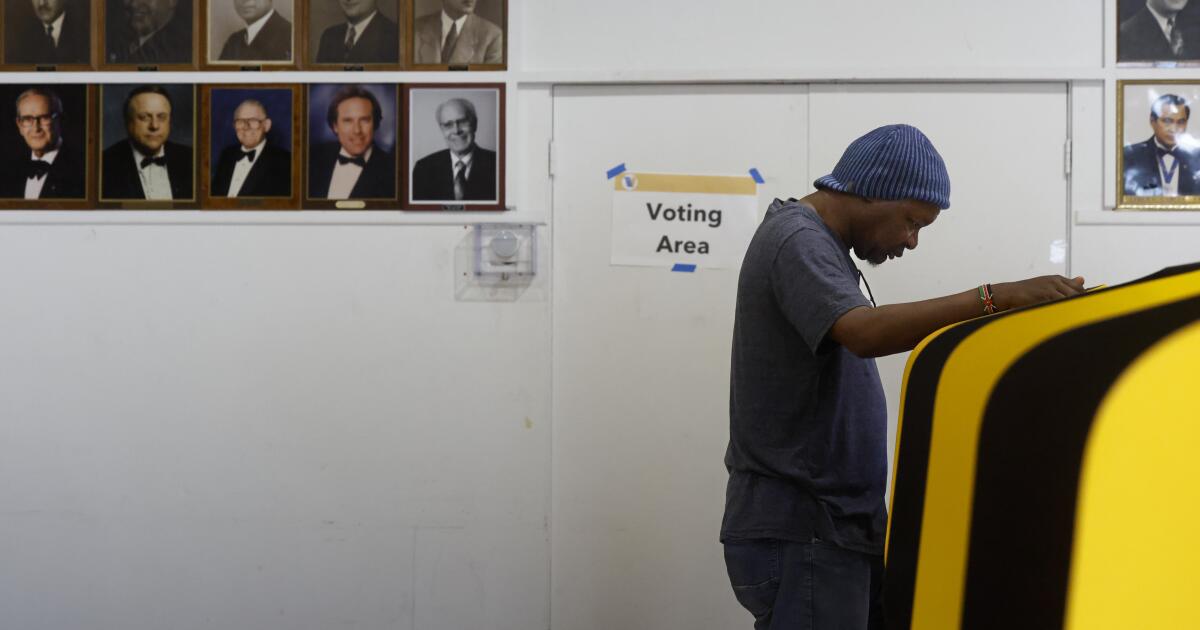
Despite Trump’s recent insistence, in-person voting does exist in Los Angeles
-
 Sports50 minutes ago
Yoshinobu Yamamoto helps Dodgers deliver a birthday win for Dave Roberts
-

 World58 minutes ago
“Crime hotspots”: Why violence at German stations

