Austin, TX
Elijah Wood, Michelle Rodriguez, and more celebrate Texas Film Awards
With South by Southwest (SXSW) in full swing, Austinites are keeping an eye out for celebrity sightings around the city. Last week’s Texas Film Awards offered an opportunity to see several celebs gathered in one place. Honoring legends of the Texas film industry, the annual fundraising event inducted new members into the Texas Film Hall of Fame, which is celebrating its 25th anniversary this year.
Coinciding with the 40th anniversary of the Austin Film Society (AFS), the milestone year for the Texas Film Hall of Fame welcomed new members Michelle Rodriguez, Tim and Karrie League, and Noah Hawley. Before the event, CultureMap caught up with AFS founder and film director Richard Linklater about the anniversary.
Richard LinklaterPhoto by David Brendan Hall
“It’s very cool,” he said, “Forty years is wild. You can’t help but reflect back to year one. We grew with Austin: as Austin has grown, so have we.”
Sharing the impact of AFS grants on stage during the event, Linklater elaborated further on this symbiotic growth.
“The rising tide of Austin lifted our boat, and we grew when we needed to [without] losing our fundamental film freakiness,” Linklater said. “Forty years in, I know two things to be true: community is everything. Watching movies together connects us and builds that community. And, the love and appreciation of cinema knows no bounds: if you nurture it, it feeds you back ten fold.”Linklater is on a recent awards streak, having been honored with a Texas Medal of Arts Award in late February.
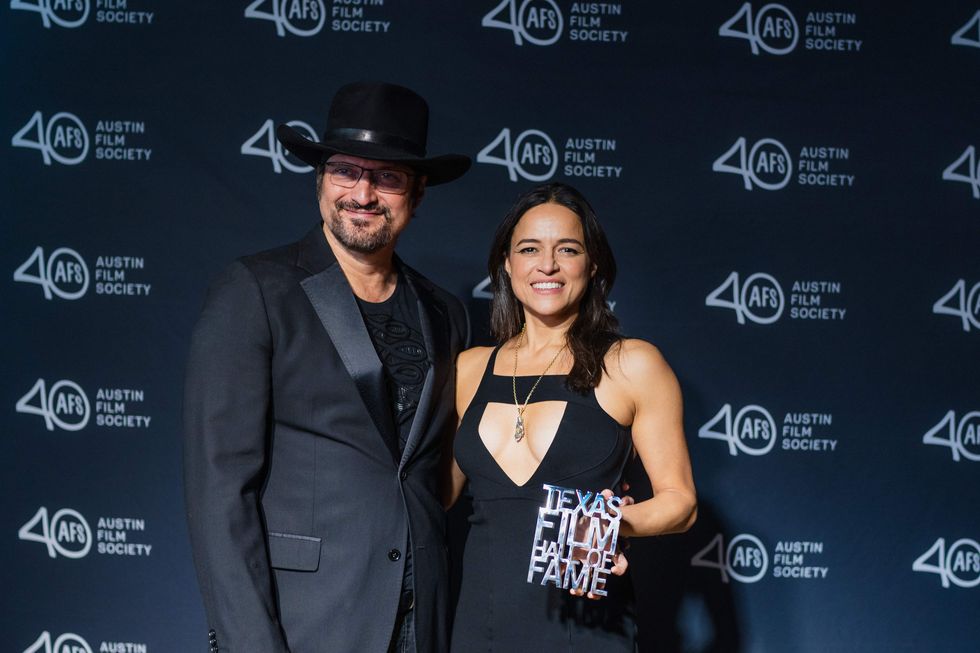
Presenting to Killeen-born and San Antonio-raised Michelle Rodriguez, director Robert Rodriguez spoke about the actress’s “unshakeable swagger” and how he wrote the character of Luz with her in mind after seeing Girl Fight.
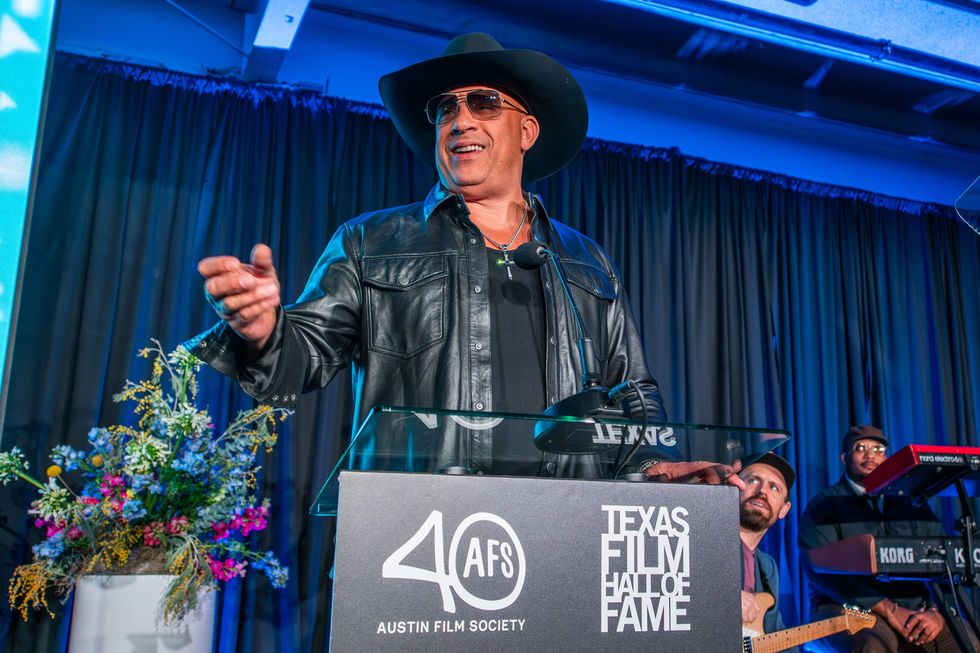
He also introduced a surprise guest to the event, Vin Diesel, who co-starred with Rodriguez in the Fast and Furious franchise. Sauntering onto the stage in a black cowboy hat, Diesel shared that he recently discovered his Texan roots and that their Texan identity was one of many things that bind him to Rodriguez as his ride-or-die.
Actor and one-time Austinite Elijah Wood presented the award to Tim and Karrie League, founders of the Alamo Drafthouse and Fantastic Fest.
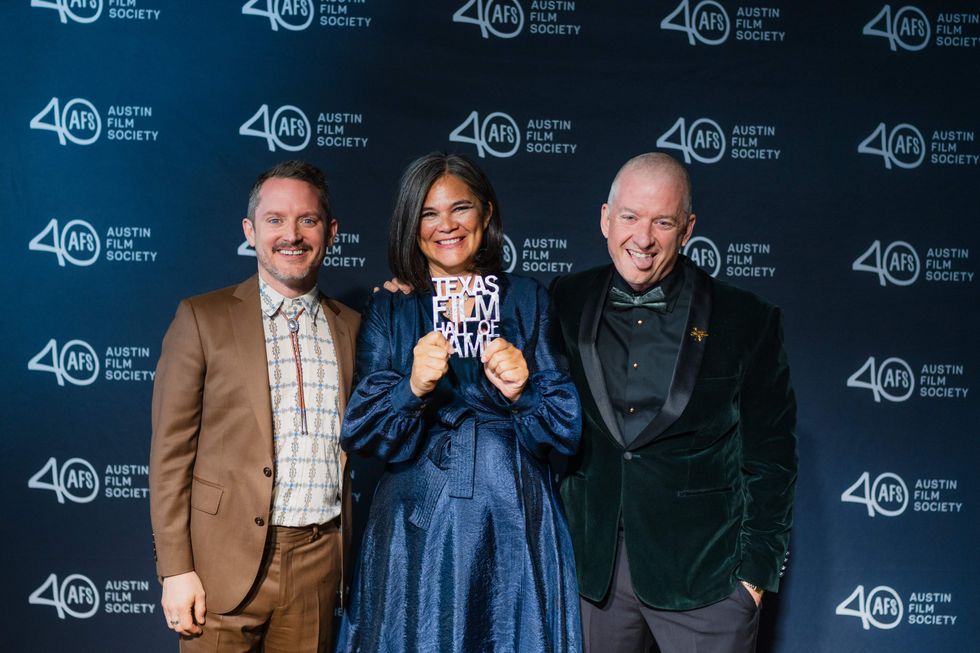
Wood praised the Leagues for their impact not just on the Austin film industry but the wider film community by redefining what a theater could be, “a place that embraces both first-run studio films, independent and international gems, and the most obscure oddities dug from the archives; a place where you can pair dinner with a movie; where themed screenings create memories beyond the film itself.”
On the red carpet before the event, Wood told CultureMap what he most misses about Austin:
“I don’t live here anymore, but it still feels like home,” he shared. “I miss the food, tons of restaurants I love like Emmer & Rye, Loro, pizza from Via 313, Olamaie, Clark’s, Fresa’s.”
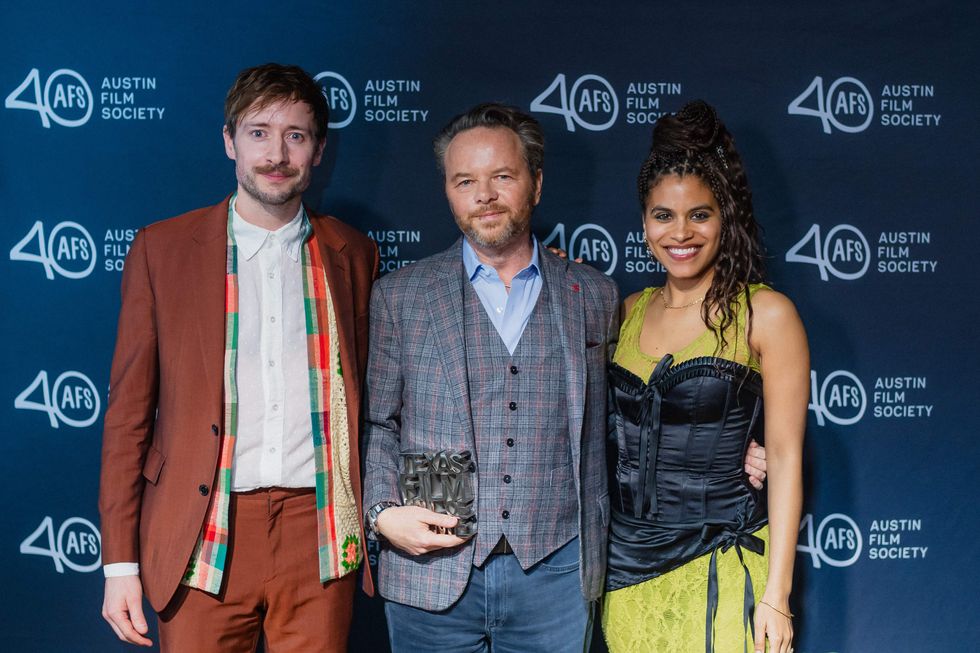
For the final award of the night, Atlanta actress Zazie Beetz and Fargo actor David Rysdahl presented the award to writer and producer Noah Hawley, who is currently working on Fargo and Alien: Earth.
Austin, TX
Was Austin’s Barton Springs sacred to Indigenous people before Europeans showed up?
This story was originally part of KUT’s ATXplained Live show at Bass Concert Hall on October 29, 2025. Get tickets to our next show on May 21 here.
Anyone who knows me, knows I love Barton Springs. It feels like the water has magical properties. Even sacred properties.
So when Brendan Cavanagh asked about the it, I knew I needed to look into it.
“Why were the springs sacred before Uncle Billy showed up?” he asked. “And what was the Indigenous population’s relationship with them?”
By Uncle Billy, he means William Barton, the man who laid claim to the springs in 1837 when he settled there with his family and the people he enslaved.
I assumed Brendan’s question came from a place of love for the springs and general curiosity. But when I talked to him about his question, he mentioned the White Shaman mural, a piece of rock art that sits in the desert about 220 miles west of Austin. Archaeologists say the White Shaman was painted around 400 B.C. It’s really big — 26 feet long and 13 feet high.
Chester Leeds
/
Witte Museum, San Antonio Texas
“I learned that the springs are actually part of that mural,” Cavanagh said. “Which was astonishing to me.”
Archeologists think the mural shows a creation story. But some people think it’s even more than that.
Gary Perez is the chief of the Coahuiltecan/Pakahua Nation. He has come to believe that it not only tells a creation story, but that it’s also an ancient map of Central Texas.
A pictograph on the mural shows a curved line with four matching symbols that look like knives with gray handles and white blades coming off of it at regular intervals.
Chester Leeds
/
Witte Museum, San Antonio, Texas
Perez says that this pictograph represents four sacred springs: San Antonio Springs, San Marcos Springs, Comal Springs and Barton Springs. All of these springs are connected to the Edwards Aquifer, an underground network of caves and porous limestone.
Perez overlaid this part of the White Shaman mural out on a modern map with the help of a mapping expert.
“Then they did. And that was it,” Perez said. “Then we knew we were looking at a map for sure.”
Perez doesn’t think the White Shaman mural just a map, but also a calendar. He said it’s like the Mayan calendar, but for hunter-gatherers.
“These calendars exist everywhere, but this particular one is specific to Central Texas,” he said.
Perez sees the mural as a scientific tool.
There are people who agree with that interpretation of the White Shaman mural. But there are people who disagree, including Harry Shafer, a former curator of archeology at the Witte Museum, which manages the White Shaman site.
“We have a really good handle on the archeology of the Lower Pecos region and Central Texas,” Shafer said. “There’s no tie in Lower Pecos to Central Texas.”
So does the White Shaman mural depict four springs in Central Texas — including Barton Springs? Depends on whose science you believe.
Ancient history
What we do know for sure is that people have lived around Barton Springs for millennia. The archaeological record at Barton Springs goes back 13,000 years.
People were drawn to the area for its abundant water and the plant and animal life. But the people who lived around the springs back then weren’t the same people who lived at the springs when William Barton arrived.
We don’t even know the names of these ancient peoples. Did they have a sacred relationship with the springs? Maybe. We may never know the exact details.
But we do know something about the Indigenous people who came later.
In 1837, we know there were the Comanche, Tonkawa, Caddo, Lipan Apache and Coahuiltecan people in the area, among others. We know some of those people had a sacred relationship with the springs, but the accounts we have are from colonists.
These were all very different cultures who spoke different languages and believed different things.
By the time William Barton showed up, Europeans had already been in the area for 100 years. The Spanish had missions near Barton Springs in the 1700s. Their arrival brought sickness and death to the Indigenous population.
Barton lived in Austin during the Texas Republic, when many of the tribes that lived here were killed or forcibly removed.
Then, there were other ways that Native Americans were erased. At one point, a law was passed legally redesignating Native people as Mexican.
This campaign to erase Indigenous people in Texas worked, at least in our collective imagination as a state.
“In Texas there’s this sort of as assumption there’s no more Indians here,” said Craig Campbell, an anthropology professor at the University of Texas at Austin. “When, in fact, we have this absolutely huge population of Indigenous people that rarely gets recognized.”
Texas has the fifth-largest population of Indigenous people in the country. According to the U.S. Census, there are over 700,000 people in Texas who identity, at least in part, as Indigenous.
Barton Springs are still sacred
Some modern-day Indigenous Texans have their own sacred relationship with Barton Springs. Every August, a group of mostly women makes a pilgrimage to the four sacred springs, led by Gary Perez’s wife, Matilde Torres.
At each site, they commune with the water and offer prayers. They start at San Antonio Springs at dawn and end up at Barton Springs in the afternoon.
Diana Dos Santos has gone on the pilgrimage for the last three years.
She said it’s a long day, but it doesn’t really feel long.
“The whole day feels like it just merges into a short moment,” she said. “It’s like the whole world — the past, the present, everything — just merges into one moment. And when you’re present there — with your prayer, with your medicine, with the other sisters — it’s incredible. It’s magical.”
Support for ATXplained comes from H-E-B. Sponsors do not influence KUT’s editorial decisions.
Austin, TX
$767 million bond could be coming to Austin voters in November
AUSTIN (KXAN) — After roughly a year and a half of work, the task force that’s been tapped to recommend a 2026 bond package to Austin City Council is out with its recommendations.
The task force has identified a package that would cost the city roughly $767 million and would tackle major projects in affordable housing, parks, transportation and flood mitigation.
It’s one of three options city council is expected to consider later this month. Another comes from a group of city council members who pitched a more than $400 million option that largely funds parks and recreation.
The third, a final proposal from city staff, is expected to be released later this month. Staff have already produced a draft proposal worth roughly $700 million.
How much would these cost you? City staff previously said that for every $100 million in additional debt the city takes on, the average Austin homeowner will see their bill go up by $14.34 annually.
‘The needs … outstrip our debt capacity’
The city has identified far more needs than it can fund — with estimates ranging into the billions — while its bond capacity is only around $700 to $750 million.
The Bond Election Advisory Task Force (BEATF) set out to identify the most pressing of those unmet needs.
“The needs in our community outstrip our debt capacity. We have more needs, very deeply felt, than we can afford to do,” a member of the BEATF said during a Monday meeting.
In the end, the BEATF landed on a $766.5 million pitch with the following funding buckets:
- $200 million: Affordable housing
- $175 million: Parks and open space
- $106 million: Facilities (libraries, museums, the Austin animal center)
- $25 million: Homeless Strategy Office (helping fund a new 1,200 bed shelter)
- $147 million: Transportation
- $113 million: Storm and flood mitigation infrastructure
You can find the full list of recommended projects here.
Council members pitch second option
Last month, Austin city council members asked the BEATF to consider an alternate option that would include a smaller bond in 2026 and potentially going back to voters in 2028.
In a message board post those council members pitched the following for a 2026 bond:
• $250-$260 million for parks projects, not including any maintenance facilities
• $50-$60 million for community facilities, such as libraries and cultural arts
• $75-$80 million for active transportation projects
“Should this option ultimately be pursued, we would then use the work of the BEATF and staff for the non-parks categories as the starting point for a 2028 bond discussion,” the council members said.
In the end the BEATF put together a second option — which is not their preferred option, but satisfies the ask from some council members — that would come in at $436 million.
The breakdown is:
- $225 million: Parks and open space
- $106 million: Facilities
- $25 million: Homeless Strategy Office
- $80 million: Transportation
You can find the breakdown of that option here.
Austin, TX
SAFE Alliance cuts forensic testing service for victims
AUSTIN, Texas – One of the nation’s largest support networks for survivors of domestic and sexual violence is facing a crossroads.
In the last year alone, the SAFE Alliance has lost roughly $4 million in philanthropic and government funding. That massive gap is forcing the organization to end a critical service.
The backstory:
“The part that is going away for Eloise House is the forensic examinations specifically,” said Dr. Pierre Berastain, CEO of SAFE Alliance.
According to SAFE Alliance, it provides 95% of all forensic examinations for sexual assault victims in the city of Austin, amounting to roughly 600 tests annually. Now, hospitals will be taking on that responsibility.
“Response times for forensic exams, whenever they happen at SAFE, are within an hour, an hour and a half max,” Berastain said.
And that’s only the wait time for the test. It often takes much longer at hospitals. On top of that, the exam itself can take anywhere from three to six hours to perform.
“When survivors go to the hospital, they’re having to tell about a dozen people what happened to them, before they’re talking to someone who can actually take their story. They’re waiting hours, sometimes up to eight hours in a room before they are with a nurse or an advocate who can help them. After that, they’re getting a bill for thousands of dollars. The actual exam is free, but the hospital charges you for everything else. We do not do any of that here,” said Holly Bowles, director of the Sexual Assault Victim Advocacy Program at SAFE.
While the assessment is free by law, survivors often get hit with “facility fees” or charges for other medical treatments at hospitals.
“Victims have received no bills from SAFE Alliance whenever they receive forensic examinations. What I can tell you from national data is that victims sometimes receive hospital bills that amount to two, three, $4,000 for services,” Berastain said.
SAFE’s CEO said that while the organization will no longer be able to provide this key service, it is still committed to supporting survivors and hopes to partner with the hospitals in this transition moving forward.
“We’re not going anywhere. And so, my reaction is one of taking in the news, accepting, and then determining what it is that we need to do to ensure that services don’t go away,” Berastain said.
What’s next:
Mayor Kirk Watson announced Tuesday that Ascension Seton, Baylor Scott & White, and St. David’s will conduct the exams.
The three major hospital systems issued a joint statement about their commitment to a “seamless transition,” promising high-quality, trauma-informed care.
The Source: Information from interviews conducted by FOX 7 Austin’s Katie Pratt
-
Politics3 minutes agoGovernor’s debate spawns another raucous clash: 5 explosive moments
-
Science9 minutes agoTrees that survived L.A.’s wildfires are dying at alarming rate. Can they be saved?
-
Sports15 minutes ago
Prep talk: Servite, Notre Dame to qualify athletes at Division 3 track and field prelims
-
World27 minutes agoUkrainian negotiator in US in bid to revive talks with Russia
-
News57 minutes agoTed Turner remembered fondly for hosting wet T-shirt college nights after Braves games, like a true hero
-
New York2 hours agoMamdani Wants Free Buses for All. The City Council Has Different Ideas.
-
Detroit, MI3 hours ago
Breaking down the Detroit Lions roster: Defense
-
San Francisco, CA3 hours agoMissing man, 85, last seen in South San Francisco

