South
Amtrak boasts free baggage for passengers after Southwest Airlines announces end to popular perk

Check out what’s clicking on FoxBusiness.com.
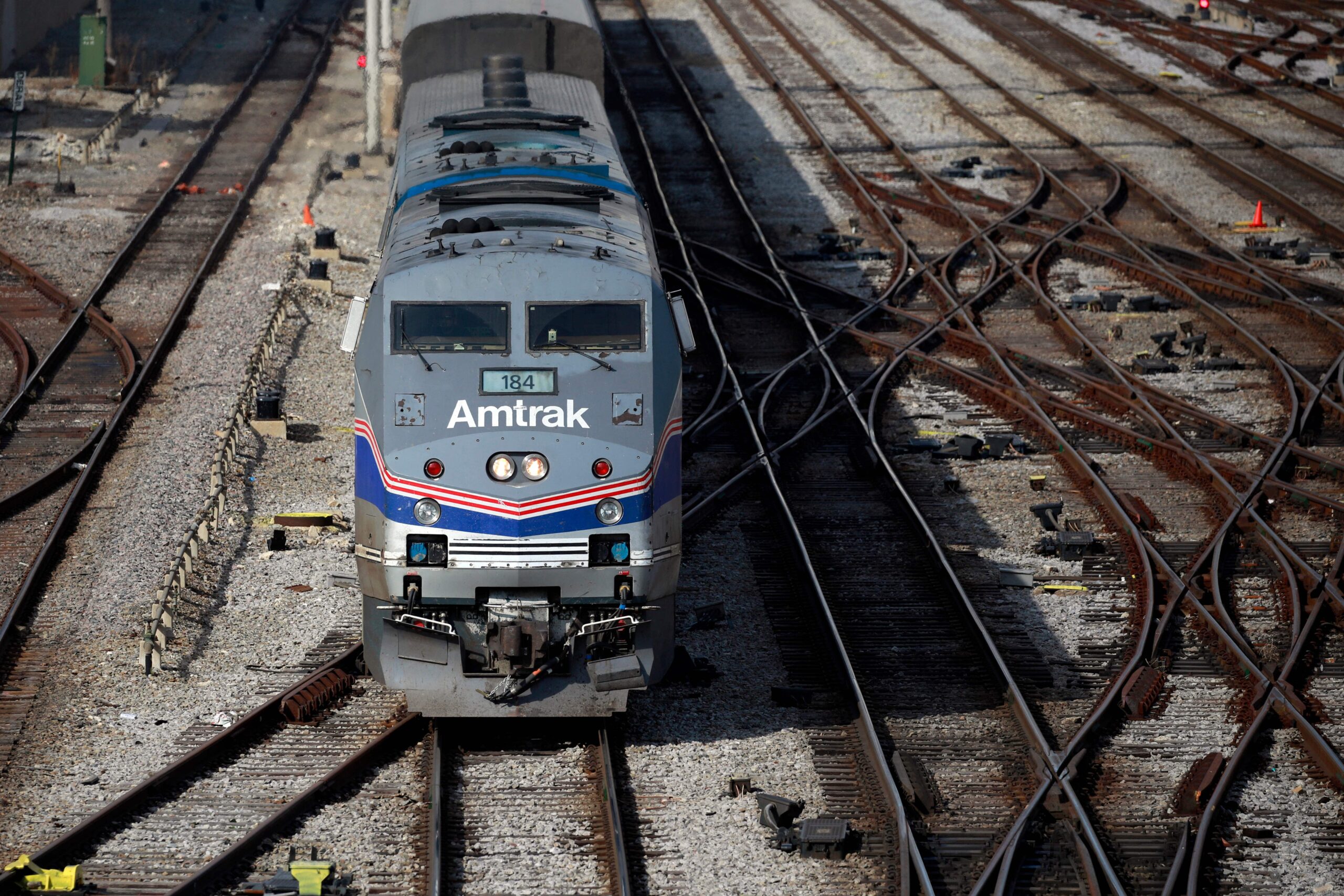
Amtrak, America’s national passenger railroad company, is taking advantage of airlines announcing changes to coveted passenger perks.
A few hours after Southwest announced it would no longer be offering two free checked bags to most passengers starting in May, Amtrak boasted its luggage policy in a post on X.
“Guess we’re the only ones doing free baggage now,” the train corporation wrote.
SOUTHWEST AIRLINES ANNOUNCES MAJOR CHANGE TO LONG-STANDING PASSENGER PERK
Amtrak is reminding travelers that train passengers can bring one personal item and two carry-on items for free after Southwest Airlines announced a change to its free baggage policy. (LUKE SHARRETT/AFP via Getty Images / Getty Images)
Amtrak then responded to the post with a link to its policy for carry-on luggage, which states each passenger may bring one personal item and two carry-on items for free as long as they are not over the weight limit.
Personal items must be lighter than 25 lbs. while carry-on items must be under 50 lbs. each. Bags must be repacked if they weigh more than the designated amounts – unlike most airlines, where passengers will be charged a fee to travel with an overweight bag.
Customers are only charged an excess baggage fee of $20 if the bags are larger than the required dimensions or if passengers are traveling with more than the three allowed items. Only two excess bags are allowed per passenger.
SOME AIRLINES INCREASED CHECKED BAGGAGE FEES: WHAT WILL IT COST CUSTOMERS?
Amtrak’s subtle brag earned the company hundreds of comments in response to the post on X, around 40,000 likes and more than 3 million views.
Southwest, the only airline to offer free checked bags to all passengers, announced the policy change on Tuesday, crediting it to a need to drive revenue growth and return to a level of profitability expected by shareholders.
Southwest was the only airline that allowed all passengers to travel with two checked bags for free. (Southwest Airlines / Fox News)
Passengers will be charged for their first and second checked bags for all flights booked on or after May 28, the carrier said in a statement. In hopes of encouraging more people to join its loyalty program, Rapid Rewards A-List Preferred members and customers traveling on Business Select fares will still receive two free checked bags. A-List Members and “other select customers” will get one free checked bag.
While the carrier’s website does not state how much baggage fees will cost once the new policy takes effect, a third checked bag will currently cost a Southwest passenger around $150 and overweight bags can cost as much as $200.
Southwest has not yet announced how much passengers will pay for their bags once the new policy takes effect on May 28. (Gary Hershorn/Getty Images / Getty Images)
GET FOX BUSINESS ON THE GO BY CLICKING HERE
Though travel times are quite different between trains and planes, Amtrak does offer more than 30 routes to all major cities and many smaller areas within the U.S.
Railroad passengers can travel to and from around 500 destinations within 46 states on Amtrak.
FOX Business’ Daniella Genovese contributed to this report.



An 87-year-old businessman in Columbia, South Carolina says he has no plans to retire.
Leonard Fabrizio works as a retailer at Brittons of Columbia, a locally-owned men’s clothing store.
“I’m not the type of person who can sit around by myself,” said Fabrizio. “I just enjoy the interaction and that’s the big thing, is the interaction with people. It’s always been the drive in this business for me, said Fabrizio.
Fabrizio’s retail career began as a college student when he worked at J.C. Penney. He has watched Columbia grow and has owned a store and managed several others.
His advice is to “Be patient. It takes time to build a business. It doesn’t happen overnight, but it’s rewarding. It’s fun. But you have to have compassion for the business.”
Fabrizio recently celebrated another birthday alongside those who have supported his career.

Tennessee director of track and field Duane Ross gauged the hunger of the men’s 4×100-meter relay team to pull off the upset.
“They said, ‘Coach, we’re going to win,’ ” Ross said. “When they bring you that much confidence, you can grab your popcorn and enjoy the meet.”
No popcorn was consumed, but the appetite was there from the start.
Traunard Folson, Davonte Howell, T’Mars McCallum and Elijah Clark finished in a school record time of 37.98 seconds at the NCAA Outdoor Championships on June 12 in Eugene, Oregon. It was the the program’s first national title in the 4×100 since 1983 and the fourth-fastest in NCAA history.
Four other relay teams never crossed the line. Auburn, the two-time defending champion, had run an NCAA-record 37.75 in the semifinal, but had a botched handoff on the last exchange. Arkansas, the reigning SEC champion, also dropped its baton, along with Oregon and Houston.
McCallum said staying clean through a race of chaos starts with a focus on winning, even in practice.
“In the moment we can’t really worry about anything else, just what we can control,” McCallum said on June 18. “We came to practice every time with the idea of, ‘OK, we’ve got to make sure this is fixed, because we know if we run that time, we can win.’ “
It was the final event of McCallum’s college career. It didn’t fully hit until the long flight home to Knoxville.
“I was like, we really did it,” he said. “Now we have a school record, the first team to ever go under 38 seconds here.”
Whether belief had anything to do with what went wrong in those four other lanes isn’t something Tennessee’s runners can answer. It’s exactly what they point to for why theirs didn’t.
Clark, a freshman who ran the anchor leg, said winning was just a matter of starting the race.
“We knew we had it the whole time,” he said. “No matter who did what, what happened, we knew what the outcome would come to.”
Ross said the victory wasn’t a surprise inside the program either.
“I wouldn’t say unsung,” Ross said. “I’ve watched this team all year long, and we were expecting to come out of there with the championship. It was a tight competition down to the last event.”
Tennessee finished third in the men’s team standings with 46 points, its best total since 2002.
Howell, a junior who ran the second leg, said the belief behind the relay team’s confidence was built long before the race.
“Three of the four of us already ran under 10 seconds,” he said. “Last year we all trained together during the summer, all lived together. We already had the bond, and adding the freshman on anchor was just a cherry on top. He figured it out at SECs, ran a 10.1, season’s best, and we trusted him to bring it home.”
Clark said the title is already part of something bigger to him.
“The goal is to always make history,” said Clark, who was hired by Tennessee four years ago after a successful run at North Carolina A&T. “It’s been one of my dreams. To be able to be on the wall, especially at a school like this, I couldn’t ask for anything more.”

More than 150 troops at Lackland Air Force Base in Texas have been infected with influenza over the past three weeks — a major outbreak less than two months after Defense Secretary Pete Hegseth said American troops would no longer be required to be vaccinated against the flu.
-

 Rhode Island5 minutes ago
Rhode Island Pride turns 50 this weekend: ‘Queer joy is resistance’ – The Boston Globe
-
South-Carolina8 minutes ago
87-year-old South Carolina businessman says he has no plans to retire
-

 South Dakota13 minutes ago
South Dakota sends poetry to the America250 time capsule
-

 Tennessee20 minutes ago
Inside Tennessee 4×100 relay’s NCAA title, outlasting four botched exchanges
-

 Texas22 minutes ago
Flu sickens some 160 troops at Lackland Air Force Base in Texas
-

 Utah28 minutes ago
San Juan County assessor resigns after allegations of being ‘unfit’ for office
-

 Vermont35 minutes ago
Norman Rockwell finally gets his day in new Shelburne Museum exhibit
-

 Virginia38 minutes ago
Motorcoach failed to slow for traffic in Virginia work zone before crash that killed 5 from Western Mass., NTSB says – The Boston Globe

