Science
NFL and UFC athletes try 'game-changing' psychedelic to treat brain injury


As awareness grows around the dangers of head trauma in sports, a small number of professional fighters and football players are turning to a psychedelic called ibogaine for treatment.
Ibogaine, which is derived from a West African shrub, is a Schedule 1 drug in America with no legal medical uses, and experts urge caution because of the need for further studies. But the results, several athletes say, are “game-changing.”
“It saved my life,” said former NFL offensive guard Robert Gallery, who traveled to Mexico in 2023 to try ibogaine.
“I’m not anxious all the time, I’m not depressed,” he continued, “I can go for a run and be thankful that I’m alive, rather than having a thought that I should step in front of a semi-truck coming down the road.”
The psychedelic substance is derived from the iboga plant, and proponents tout its ability to treat addiction, post-traumatic stress disorder and traumatic brain injury, or TBI.
-
Share via
An observational study of 30 special forces veterans by researchers at Stanford University suggests that ibogaine can be highly effective at reducing anxiety, depression and cognitive challenges associated with TBI.
“This is a miraculous thing,” said retired MMA fighter Tait Fletcher, who credits the treatment with freeing him from suicidal ideation.
NFL Hall of Fame quarterback Brett Favre even tried ibogaine to see if it could help his Parkinson’s, a neurodegenerative disease linked to TBI.
Although athletes are just discovering ibogaine, the drug is well known within the veteran community, which experiences high rates of brain injury and PTSD.
In Stanford’s study on the effects of ibogaine on special forces veterans, participants saw average reductions of 88% in PTSD symptoms, 87% in depression symptoms and 81% in anxiety symptoms. They also exhibited improvements in concentration, information processing and memory.
“No other drug has ever been able to alleviate the functional and neuropsychiatric symptoms of traumatic brain injury,” Dr. Nolan Williams, a professor of psychiatry and behavioral sciences, said in a statement on the results. “The results are dramatic, and we intend to study this compound further.”

A capsule containing a therapeutic dose of ibogaine, a psychedelic used to help treat traumatic brain injury, PTSD and addiction. (Magda Stuglik)

A team member at Ambio Life Sciences in Tijuana prepares a dose of the drug. (Magda Stuglik)
To receive federal approval, ibogaine would need to pass through multiple phases of clinical trials at the Food and Drug Administration and be moved by the Drug Enforcement Administration to a less restrictive drug category.
Schedule 1 drugs are considered to have no federally accepted medical use, a high potential for abuse and a lack of accepted safety. They also include psilocybin, MDMA, LSD and marijuana.
States can work faster than the federal government by carving out exemptions for supervised ibogaine therapy programs, similar to what Oregon has done with psilocybin therapy. Many states have also opted to legalize marijuana for medicinal or recreational use.
Study co-author Dr. Ian Kratter said researchers have reported that ibogaine may stimulate brain healing by causing an increase in certain neurotrophic factors.
“These factors signal for enhanced brain cell survival and synaptic plasticity, which is the ability for brain cells to modify the strength of their connections or even form new connections,” said Kratter, a professor of psychiatry and behavioral sciences. “This might facilitate a healing and recovery process after an injury.”

Ambio Life Sciences has administered ibogaine to hundreds of veterans since opening in 2021.
(Magda Stuglik)
Dr. Kevin Bickart, a UCLA neurology professor who specializes in brain injury in athletes, said that the Stanford study is “remarkably promising” and that it is reasonable to believe professional athletes could experience similar results.
“This group [veterans] is a strong analogue for retired professional athletes from high-contact sports like football or hockey who are now dealing with persistent cognitive and emotional difficulties,” he said.
Dr. Ramon Diaz-Arrastia, director of Penn Medicine’s TBI research center, said that ibogaine is “one of the more promising compounds” for treatment of TBI.
However, Bickart, Diaz-Arrastia and the Stanford researchers all emphasized the need for larger, randomized controlled trials demonstrating a strong therapeutic benefit and safety profile prior to the treatment being used in America.
They also highlighted the fact that ibogaine can cause heart problems such as cardiac arrhythmia and needs to be administered under strict medical supervision. In the Stanford study, cardiac monitoring and magnesium were used to mitigate this danger, and researchers reported that no participants experienced adverse cardiac effects.
Gallery heard about ibogaine when listening to a podcast about veterans whose struggles resonated with his own. He was at the end of his rope and willing to try anything to free himself from dark thoughts and the ringing noise inside his head.
“It was kind of a last-ditch hope for me,” he said. “I was just at that place of needing the noise and the thoughts to stop.”
Gallery’s doctor believes he likely developed CTE (chronic traumatic encephalopathy) as a result of repeated brain injuries during his eight seasons in the NFL. CTE, which can only be diagnosed after death, is a severe neurodegenerative disease that can cause dementia, violent mood swings, loss of motor control and depression.
Many famous athletes who committed suicide were later determined to have CTE, including New England Patriots tight end Aaron Hernandez, Hall of Fame linebacker Junior Seau and Chicago Bears safety Dave Duerson.

Former NFL offensive guard Robert Gallery, who played for the Raiders, credits ibogaine therapy with saving his life and relationship with his family.
(Robert Gallery)
Fletcher, the former MMA fighter who is also an actor and stunt artist, heard about ibogaine through his Navy SEAL friends.
He had experienced many concussions during his fighting career, but it was head trauma during a stunt gone wrong in 2019 that pushed him over the edge and into an extremely dark place.
The following morning he woke up in a state of terror. He didn’t know how to pack his bags or get out of the hotel room he had been staying in for the shoot.
Fletcher spent the next year in near-total seclusion, largely unable to leave his house due to light and sound sensitivity. Like Gallery, he tried many conventional and experimental therapies, but nothing compared with the relief that ibogaine brought him in 2023.
“We’re putting Band-Aids on problems through pharmacology,” he said. “This [ibogaine] is a thing that I watched just set people free. Nothing short of that.”
Keith Jardine, a former UFC fighter, was inspired by Fletcher’s story and traveled to Mexico to receive treatment himself. Retired hockey player Ales Hemsky credits ibogaine with helping free him of the substance use and alcohol dependency that he struggled with after his 16-year career in the NHL.
“It’s been seven months now I haven’t had a sip of alcohol,” he said. “It’s life-changing. It really restarts your brain. It gives you a new path.”
Fletcher has seen the darkness brain injury brings to athletes and the light ibogaine provides. He wants both to be part of a bigger conversation in the professional sports world.

Tait Fletcher, stuntman and former MMA fighter, suffered traumatic brain injury as a result of multiple concussive events during his career.
(Paul Mobley)
“I wish that these big organizations were looking into these things differently, because you could elongate careers and elongate lives,” he said. “And ibogaine is certainly a part of that conversation.”
Favre also wants to see more attention brought to speeding up medical trials of new treatments for brain injury and related conditions. After taking ibogaine, his Parkinson’s symptoms disappeared for three days before gradually returning, he said.
“I’m not disappointed by anything. I’m more excited about the opportunity knowing that I could do it again,” he said. “I’m hoping that this [conversation] helps open the door for not just ibogaine or psychedelic drugs, but just medication or treatments in general that can help people.”
Bickart said there is a major gap in effective, approved treatments for the persistent symptoms of brain injury.
“This leaves many, including veterans and potentially former athletes, without reliable solutions for ongoing disability, cognitive difficulties, and psychiatric conditions like PTSD, depression, and anxiety that can stem from head injuries,” he said.
Inspired by his own experience with ibogaine, Gallery co-founded a nonprofit called Athletes for Care to educate athletes with TBI on treatment options and advocate for research into psychedelic-assisted therapies.
“The sports community is not very good about talking about mental health,” he said. “Seeing the veterans take charge and take care of their community, I want to do that for the sports community and for my friends that I know that are out there suffering.”
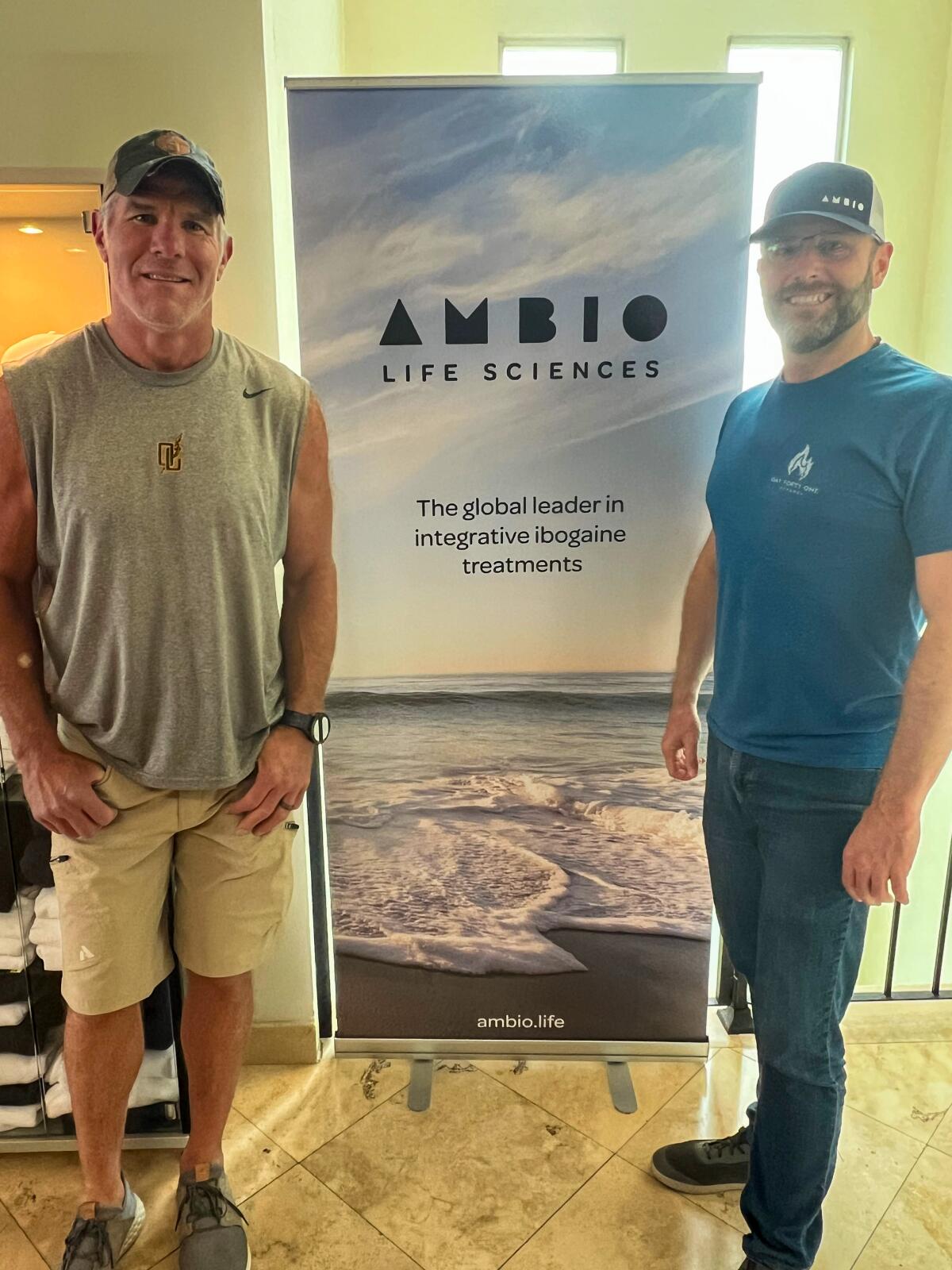
NFL Hall of Fame quarterback Brett Favre, at left with Ambio’s Trevor Millar, visited the clinic in Mexico to seek treatment for Parkinson’s disease.
(Trevor Millar)
Gallery, Favre, Hemsky, Fletcher and Jardine are among around a dozen retired contact-sports athletes who have received treatment at the Ambio Life Sciences clinic in Tijuana, which is a popular destination for ibogaine therapy.
Since opening in 2021, Ambio reports administering ibogaine to more than 3,000 patients, including 1,000 military veterans.
Diaz-Arrastia, the Penn Medicine professor, said he would not advise that Americans order ibogaine online or travel outside the country for treatment, as it remains unregulated, with limited research. Bickart, the UCLA professor, echoed these concerns, noting that the most critical caution is safety.
“People should be wary of any unregulated treatments, as the purity dosage and presence of contaminants are often unknown,” Bickart said. “The placebo effect can also be very powerful, especially for treatments that require significant effort and cost.”
Ambio, the clinic that Stanford researchers worked with for their observational study on ibogaine, stressed its safety protocols during treatment, including close monitoring of dosage and patients’ cardiac health.
There is growing political and scientific momentum in America for more clinical research of ibogaine.
In June, Texas approved a historic $50-million investment in state funding to support drug development trials for ibogaine, inspired by the results seen by veterans.
Arizona legislators approved $5 million in state funding for a clinical study on ibogaine in March, and California legislators are pushing to fast-track the study of ibogaine and other psychedelics.
“Honestly, I’m amazed to see how much interest there is in ibogaine now,” said Ambio co-founder Jonathan Dickinson. “We’re starting to see things that we would have thought were unimaginable several years ago.”


The air near the Lineage refrigerated warehouse fire in Boyle Heights carried astronomically high levels of smoke and soot, surpassing some of the worst air pollution during the Los Angeles County fires in January 2025, according to preliminary data from air officials.
The fire spewed thick black smoke for days. From downtown Los Angeles to the San Gabriel Valley, tens of thousands were enveloped in unhealthful levels of smoke, even as some local officials told residents that the air posed no danger.
As the days wore on, worst off were communities nearest the blaze. On June 19, three days after the facility ignited, a temporary air quality monitoring station at Eastman Elementary in unincorporated East Los Angeles measured an extremely hazardous 755 micrograms per cubic meter of fine particles for more than an hour, according to the South Coast Air Quality Management District.
For comparison, a Caltech air monitor in Pasadena recorded about 650 micrograms per cubic meter during the Eaton fire.
These high levels of fine particles, known as PM 2.5, probably resulted in the surge of residents into local emergency rooms during the fire, according to local health officials. But even now with the smoke gone, people still have not been told what chemicals they were breathing in during the weeklong ordeal.
Michael Jerrett, an environmental health professor at the UCLA Fielding School of Public Health, said his concern is the composition of materials emitted when the building burned.
“These contain many particularly toxic components,” Jerrett said, “and we know little about how these mixtures affect health.”
There is no completely safe level of fine particulate pollution, he noted, meaning higher concentrations are always worse.
During the 2025 L.A. County fires, local air officials announced that several monitors downwind had detected elevated levels of brain-damaging lead and cancer-causing arsenic from toxic paint and construction materials used in older homes.
The Lineage warehouse, built in 2018, is likely to contain different materials of concern. Thick insulation foam required for a massive refrigeration operation, solar panels and refrigerants were burned, leaving many residents on edge.
Even though three public agencies conducted air monitoring, the picture is still murky.
“[Public officials] are speaking with a lot of confidence but not a lot of information,” said mark! Lopez, a community organizer with East Yard Communities for Environmental Justice. “We’ve gotten in the room with folks to discuss where the gaps lie and where assumptions are being made. And I think they are realizing these agencies supposed to protect our air and our health aren’t as reliable as they thought they were.”
In response to the Boyle Heights fire, the South Coast air district deployed a mobile monitoring vehicle to screen for toxic substances in the community near the fire, according to Nahal Mogharabi, a spokesperson for the air district. It found increased levels of bromine, a chemical commonly found in fire retardant, and chlorine, often released from burning plastic. Both were below short-term health-based exposure thresholds.
Toxic metals, including lead and arsenic, were not elevated, according to air district data.
“That was the reassuring piece, that they were not picking up any of the metals,” said Dr. Nichole Quick, chief medical advisor for the Los Angeles County Department of Public Health. “But … that smoke is unhealthy. “You don’t want to be breathing it, regardless.”
The U.S. Environmental Protection Agency set up air monitors around the perimeter of the facility to test for toxic air contaminants, has the results and has not made them public. Julia Giarmoleo, an EPA spokesperson, said the monitors did not detect elevated metals, but would not provide a copy of the data without a federal records request.
The Los Angeles Fire Department’s hazardous material team also tested for ammonia, which is used in refrigeration, and hydrogen fluoride, a toxic chemical that could be released by burning lithium-ion batteries and solar panels.
Fire officials previously said they measured low levels of hydrogen fluoride on the second day of the fire. But the department would not answer questions about its air monitoring. It also told a reporter to submit a public records request.
It remains unclear whether any agency has tested for hydrogen cyanide or isocyanates, highly toxic gases that could be released from burning chemical-laden insulating foam inside the building.
“The real issue is what monitoring has not been done to protect the fence-line community from the air toxics,” said Jane Williams, executive director of California Communities Against Toxics.
Without the EPA or LAFD data, what is known of the smoke’s toxicity rests on the air district’s mobile monitoring.
Jerrett, the UCLA researcher, said that is not ideal for understanding the kind of plume released by the Boyle Heights fire, which rapidly changed direction with the wind.
“This can in some instances lead to levels that look low, but they are resulting from a mismatch between the location of the vehicle and the plume,” he said.
The Boyle Heights blaze, similar to the Eaton and Palisades fires, has revealed the region’s air monitoring can’t always tell people what they’ve been exposed to in a disaster.
“We do need a better monitoring system in place,” he said.
Local officials are now shifting their focus to the rancid odors from millions of pounds of rotting food in the ruined wing of the warehouse. Decomposing food can release hydrogen sulfide, a toxic gas synonymous with landfills and garbage. Lineage hired contractors who are measuring this noxious gas and other pollution. Their data indicate they have not detected hydrogen sulfide.
As Lineage workers haul the rotting food to local landfills, they are using deodorizing mist and have discussed using shrink wrapping to suppress the stench and minimize issues for nearby homes.
At this point, the odors are believed to be an inconvenience rather than a public health threat, according to Quick, the county medical advisor. She said running air purifiers may help to reduce odors indoors.
“It’s very important for folks to understand that the odors themselves do not indicate any dangerous levels of toxins, mold, bacteria, and so forth,” Quick said. “But the odors are a public nuisance.”
The air district is still encouraging residents to report odors to its online complaint system or by calling (800) 288-7664.

Federal employees who were axed during waves of cuts by the Trump administration have fought back against the dismantling of a key climate science website, Climate.gov, and put up a new site, Climate.us, that can now do everything the original did.
The site, with millions of users each year, was known for colorful charts that anyone could freely download and that simplified giant sets of data, such as temperature readings. Now it refers to another page and is no longer being updated.
Daniel Swain, a UC Agriculture & Natural Resources climate scientist, called the resources available at Climate.gov “the most efficacious dollars spent by NOAA on public-facing science, possibly ever.” He has used graphics from the former website on his popular weather blog.
“I am a terrible artist or illustrator. It would be very bad if I had to create those on my own.” Swain said. The website didn’t just make graphics that were beautiful, he said, they were accurate and reliable because of the network of researchers who fact-checked them.
Rebecca Lindsey was the editorial lead and program manager for Climate.gov until February 2025, when her position at the National Oceanic and Atmospheric Administration was eliminated by the Elon Musk-led Department of Government Efficiency, or DOGE. She explained that the online resource was “a bridge between scientists, data and the public.”
Lindsey and her team have now rebuilt the bridge piece by piece, if just a bit further downstream.
The team is made of the same editorial and technical staff that ran Climate.gov. It’s paid for through a crowdfunding campaign and one large, anonymous donation.
The group has raised some $380,000, about $100,000 of which came in the last week. They also have recruited 80 scientists who are willing to volunteer as subject matter experts and fact checkers. It’s enough to keep the work going through February while they seek more long-term funding.
The first iteration of Climate.us went online in 2025 to keep the last 15 years of work from the government website available. The newest version restores the full function of the previous website.
For Californians, the timing could be important.
“We’re headed for a very strong El Niño event that will have significant implications for Southern California,” Swain said. “Climate.gov and the scientists behind it did a great job walking people through the last one, and I would expect that’s the case this time as well.”
Climate.gov excelled at tapping into a pool of academic experts to explain what was happening in nearly real time. This allowed the public to see how events such as wildfire, drought or large weather patterns such as El Niño were shaping their lives when they needed the information most. Research from academic institutions, by contrast, can take years to publish results from major natural disasters.
Swain emphasized that cuts to resources that give context to hard-to-interpret data is not just a loss for the research community.
“It’s getting more and more difficult for the American public to access the science and the scientists that their tax dollars have supported for over half a century,” he said.
With the revival of Climate.us, Swain said he plans to directly use the site and its graphics to keep Californians connected to the world of climate science.

Scientists have long dreamed of discovering the alchemy by which chemicals can be turned into life. On Wednesday, a team at the University of Minnesota announced that it had taken a major step toward that vision.
Blending together dozens of ingredients, the researchers have synthesized simple cells that feed, grow, reproduce and compete with one another for food. If these cells are not yet fully alive, they have most of the hallmarks of life.
“Life is not binary,” said Kate Adamala, a synthetic biologist who led the research. “That’s why I’m hesitant to call this ‘alive.’ There’s no clear line, as much as we would love it to be.”
Until now, scientists had never mastered the recipe for a cell that can perform so many functions, said John Glass, a synthetic biologist at the J. Craig Venter Institute in La Jolla, Calif., who was not involved in the study.
“It is dazzling that she has put these things all together,” he said.
Drew Endy, a synthetic biologist at Stanford University, said, “It’s a cell that was built, not born. It’s constructed, but it does what cells do.”
Dr. Adamala named her creation SpudCell, after its potato-like appearance. Rather than patent it, she and Dr. Endy are organizing a community of scientists to focus on making SpudCells more fully alive and adapting them to new kinds of experiments.
They and their colleagues have founded a nonprofit research organization that Dr. Endy estimates will spend hundreds of millions of dollars on the effort in the next decade. Hundreds of scientists are expected to join.
“We’re going to remember this moment,” said Roseanna Zia, a computational biologist at the University of Missouri who was not involved in the project.
Dr. Adamala and her colleagues posted a 190-page account of their work online. The research is under review for publication in a scientific journal.
Scientists hope synthetic cells can tell them things about life that natural cells cannot, including such basic questions as how many genes are necessary for a minimal form of life.
But synthetic cells also might someday be engineered to do things that natural cells can’t, like making new kinds of medicine or drawing large amounts of carbon dioxide from the atmosphere. In theory, engineered SpudCells might produce a vast range of proteins that natural cells cannot be coaxed to make, or even toxic chemicals like rocket fuel.
Now, “we can think about doing chemistry that we’re barely getting our heads around,” Dr. Glass said.
The trouble with life as we know it: mysterious, messy complexity. Our own DNA contains tens of thousands of genes, as well as millions of molecular switches turning those genes on and off. Scientists barely have a clue as to what many of those pieces of DNA are doing. Often a gene that they think they understand turns out to be performing other jobs than scientists expected.
One way to sidestep this intricacy is to simplify.
In the 1990s, a team led by the late biologist Craig Venter began studying a microbe that had fewer than 1,000 genes. The team, now led by Dr. Glass, went on to strip the microbe’s genome down to 525 essential genes.
In a 2016 paper, the team reported it didn’t know what a third of those genes were doing. Dr. Glass and his colleagues have spent the last decade trying to solve the puzzle, and they still can’t say what 56 of them do.
“There are still significant tasks that every cell has to do that we don’t know,” Dr. Glass said.
Other researchers tackled the problem from the opposite direction. Instead of working from the top down, they moved from the bottom up, seeking to combine lifeless molecules to produce a living cell.
Since the 1990s, several labs have bitten off small pieces of this problem. Some of them have perfected recipes to make hollow bubbles from oily molecules. Others have found ways to encapsulate simple genetic molecules inside those bubbles.
But scientists struggled to put these pieces together into more complex systems, let alone something that could be called a cell.
In recent years, Dr. Adamala took on one of the fundamental challenges: cell division. A natural cell divides with the help of proteins that lock together into a ring anchored to its inner wall. The ring winds itself tighter, pinching the cell in two.
Other proteins act like winches, moving DNA and other molecules into the forming cells, so that they have the ingredients necessary to keep living.
At first, Dr. Adamala tried building a simpler version of the natural system. But then she decided not to mimic real cells at all.
Biophysicists had found that if they stuck proteins on a membrane, they created pressure that made the membrane bend. Dr. Adamala and her team created bubbles that could snag proteins floating around them. When a bubble collected enough proteins, its surface began bending inward until it popped in two.
While the idea was simple, getting it to work in the lab required a year of experiments. “But once it works, it works,” Dr. Adamala said.
That success prompted the team to try to build a synthetic cell in its entirety.
The first step was to create a broth of the molecules necessary for a cell to operate. The recipe ultimately included about a hundred kinds of proteins and simple molecules required for crucial chemical reactions, such as making new proteins from genes.
The researchers also provided their synthetic cell with genes borrowed from a virus and the ubiquitous microbe Escherichia coli. They picked 36 genes for basic jobs like copying DNA.
After mixing these ingredients together into a soup, the scientists added the building blocks of membranes. They spontaneously joined together into bubbles, each engulfing some of the soup.
Many of these bubbles ended up encasing the right mix of genes, proteins and other molecules, and they started carrying out the chemical reactions seen in real cells.
As the new cells floated in flasks, Dr. Adamala and her colleagues added food. The cells slurped up small molecules through channels on their surfaces.
The scientists also put in small bubbles loaded with proteins and other molecules that were too big to fit through the channels. By bumping and fusing into one of these bubbles, the cell could feed on the treats inside.
As the cells fed, they grew. And in just a few hours, they were big enough to divide.
The scientists added a special protein to the flasks, which latched onto the surface of the cells and forced them to bend inward. Once the cells split in two, the pair of new cells kept growing.
Now the SpudCells grew, fed and reproduced. As it turned out, the cells even had a rudimentary ability to evolve.
Dr. Adamala and her colleagues created a mutant version that bound more tightly to the snack-filled bubbles floating around it. To test it, they created a 50-50 mixture of original and mutant SpudCells.
The cells competed for five generations for food. Eventually the mutants outnumbered the originals, suggesting that they were outcompeting the originals for food.
“That’s the shake-the-ground accomplishment here,” said Dr. Zia. Scientists will be able to put various synthetic cells in competition with one another and rapidly develop more sophisticated ones.
For all this evidence of life, SpudCell still has some major shortcomings. For starters, it can’t make the molecular factory that produces new proteins, called a ribosome. The cells can carry all the genes they need to build ribosomes, but for some reason the parts don’t come together.
For now, Dr. Adamala and her colleagues have to feed ready-made ribosomes to SpudCells. This solution has an expiration date, though: SpudCells can keep making proteins through five to 10 generations before they fail as their ribosomes become defective.
“I don’t want to say it dies, but it stops working,” Dr. Adamala said.
When Dr. Adamala showed SpudCell to Dr. Endy last year, he was so awestruck that he decided to help her found Biotic, the nonprofit organization intended to create a community of SpudCell researchers.
“I’m pouring my life’s work into this,” Dr. Endy said. One of the first tasks for Biotic will be to make it easier for other scientists to create SpudCells.
Dr. Adamala can create a fresh batch of them in her own lab in about a day. But that’s only because she has freezers full of purified proteins and an intimate understanding of each step of her recipe. Biotic expects to offer scientists easier recipes and provide the required ingredients.
Dr. Endy hopes that the open-source tools will encourage scientists to collaborate on building new kinds of SpudCells with more of the defining features of life, such as the ability to make their own ribosomes and to divide indefinitely.
“It’s completely doable,” said Dr. Glass.
Biotic researchers are already planning their first meeting, in September in Philadelphia. High on their list of priorities will be formalizing plans to safeguard this area of research.
For now, the synthetic cell can only survive a few generations on a special lab diet. But future versions may be more robust, raising the possibility that someone might someday use SpudCells unethically, perhaps even to make a weapon.
Dr. Endy argues that an open-source research community will be better prepared to prevent that from happening. “We can have these conversations now, as opposed to waiting for somebody else to do it, and then we’re just all reacting,” he said.
Dr. Endy likens SpudCells to a biological version of the Wright flyer, the crude plane that the Wright Brothers used to make the first sustained controlled flight in 1903, ushering in the age of airplanes.
“The Wright flyer flying for 12 seconds doesn’t get you a 737,” Dr. Endy said. “This is just the beginning.”
-

 Colorado3 minutes ago
MAP: Where Colorado wildfires are burning
-

 Connecticut6 minutes ago
Local priest dies after crashing car into tree in West Hartford, police say
-

 Delaware11 minutes ago
County councilman says Newark data center plan paused after deal
-

 Florida18 minutes ago
Outrage over ‘cruel’ Florida move to ban undocumented students from college
-

 Georgia21 minutes ago
Georgia officials urge drivers to add emergency contact to license record
-

 Hawaii26 minutes ago
Concert in the Sky anchors Kauai’s July Fourth mix of celebration and care | Honolulu Star-Advertiser
-

 Illinois36 minutes ago
Prevent plant claims likely in soaked southeastern Illinois – Brownfield Ag News
-

 Indiana41 minutes ago
Indiana BMV, ISP dispel rumours about Blackout license plates

