Science
Majestic wild horses are trampling Mono Lake’s otherworldly landscape. The feds plan a roundup


Several dozen horses calmly graze along the shores of Mono Lake, a sparkling saline expanse spread out before the jagged Sierra Nevada. The September sun is blazing. A pair of brown horses come up side by side and stare intensely at an approaching visitor.
These wild equines soon may disappear from beside the ancient lake. The prospect is stirring emotional disagreement over the future of the herd, which has surged to more than three times what federal officials say the land can support.
-
Share via
“These horses deserve a place to roam and be free, but around Mono Lake is not the place,” said Bartshe Miller of the Mono Lake Committee, an environmental nonprofit.
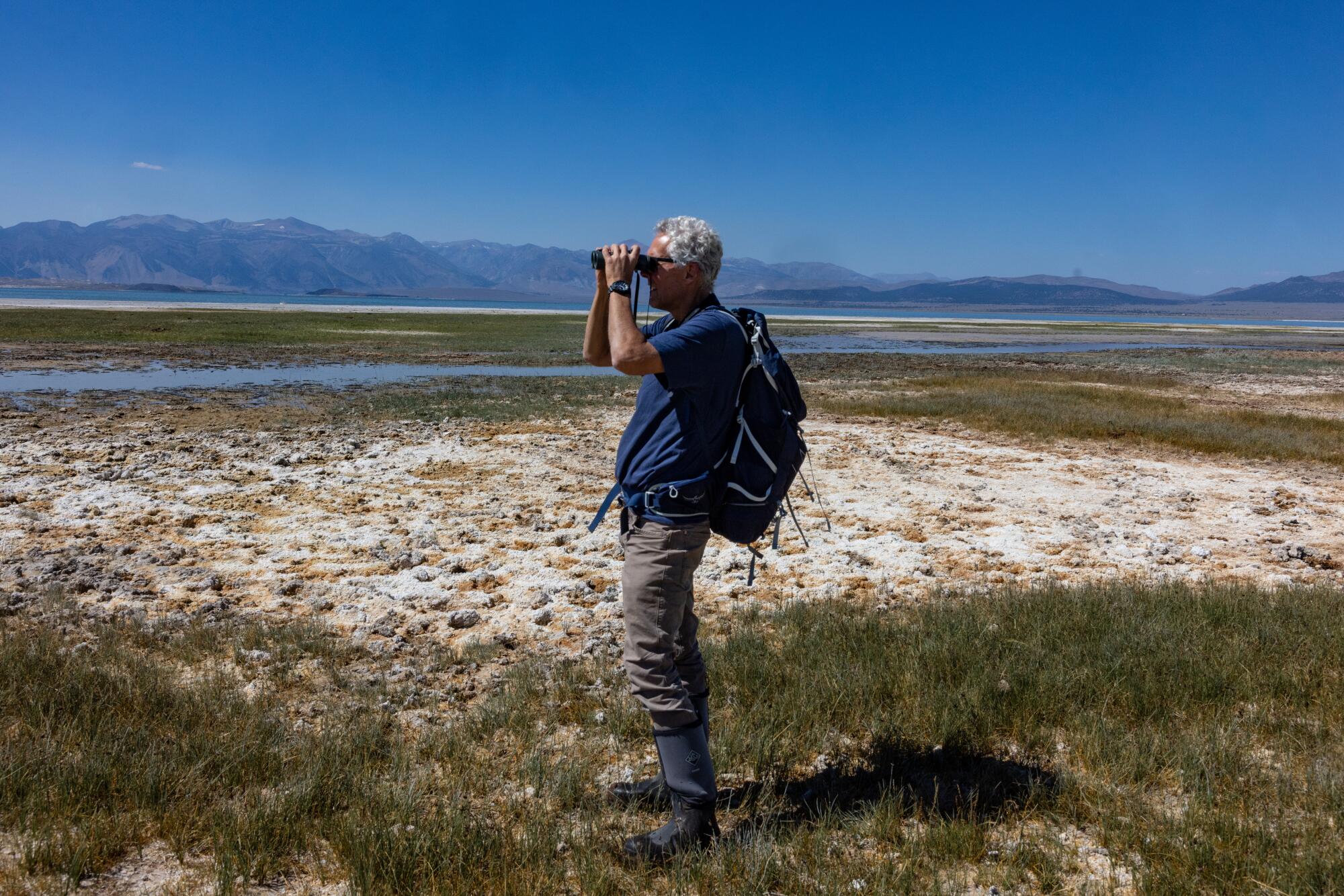
Bartshe Miller, Eastern Sierra policy director for the Mono Lake Committee, looks out onto the landscape at Warm Springs, a remote area on the east side of Mono Lake.
This year, the U.S. Forest Service and Bureau of Land Management approved a plan to round up and remove hundreds of wild horses roaming beyond the roughly 200,000 acres designated for them along the California and Nevada border. No date has been set, but it could be as soon as this fall.
It would be a relief for some. Environmentalists say the horses are degrading the otherworldly landscape at Mono Lake, including bird habitat and its famed tufa — textured rock columns that would look at home on Mars. Ranchers say the animals are gobbling down plants needed to sustain their cattle. Federal officials highlight the safety hazard posed by horses that have wandered onto highways.
Others see the move as a travesty. One method to oust the horses would use helicopters to drive them into a trap, which animal welfare groups say creates dangerous, even deadly, situations for horses. A pending federal bill would ban the practice.
Local tribes and nonprofits have partnered to fight the roundup plan, arguing that the Indigenous community should be tapped to manage the animals that roam their ancestral lands. A separate group of plaintiffs has sued the government, claiming it’s reneging on its duty to protect the horses.
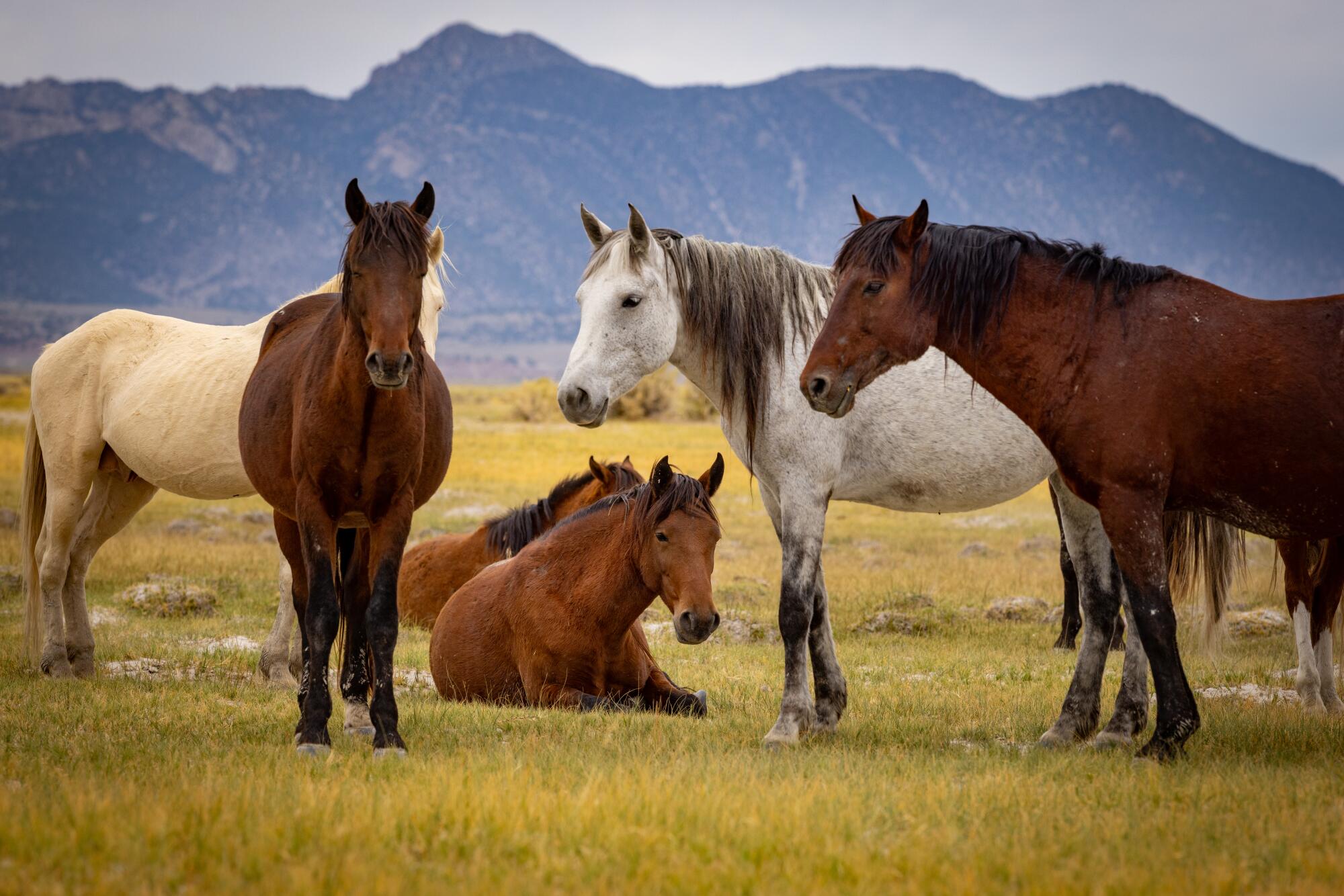
A group of horses roams near the community of Benton, Calif., not far from the Nevada border.
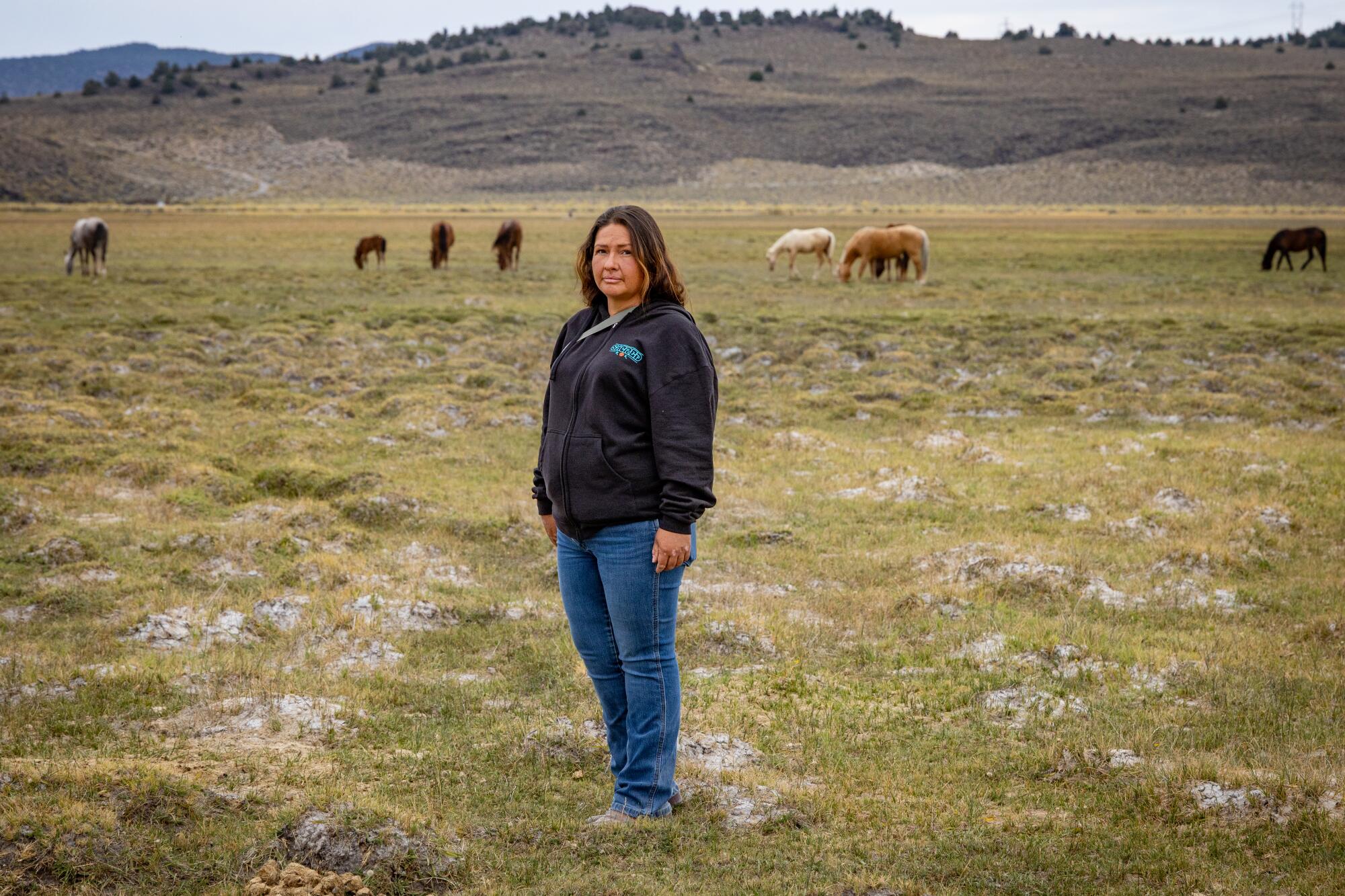
Ronda Kauk, of the Mono Lake Kootzaduka’a tribe, stands near wild horses.
“We’re all living spirits,” said Ronda Kauk, a member of the Mono Lake Kootzaduka’a tribe. “And it’s sad that people just don’t care about another living thing because they think it doesn’t belong there.”
Unseen evolution
For 36 years, Dave Marquart was part of a small team that monitored wetlands rimming Mono Lake, places so inaccessible even four-wheel drives can get stuck. Flung out far on the landscape, only wildlife could enjoy them. The area was a major nesting site for yellow-headed black birds, red-winged black birds, marsh wrens, soras and Virginia rails.
“There weren’t a lot of people that saw the transition that I saw, from healthy wetlands to completely trampled and devastated wetlands,” said Marquart, who was an interpretive naturalist for the Mono Lake Tufa State Natural Reserve until he retired in 2019. “It was quite a drastic change.”
Marquart recalled a time when he’d encounter fewer than 50 horses. They’d bolt when they saw his vehicle coming. That fear faded and their ranks grew. Over time, he said, they stamped ponds and urinated and defecated in the water. The birds stopped showing up.

Bartshe Miller holds grass he said was pulled up by the roots by wild horses roaming near Mono Lake. According to Miller, horses started arriving near the lake around 2015.
Before retiring, Marquart said, he helped organize a field trip involving the Forest Service, BLM and State Parks to showcase the impacts.
“Everybody saw that it was an issue and felt that something needed to be done,” he said.
Today, sizable mounds of horse manure dot Warm Springs, a remote area along the eastern edge of Mono Lake that Marquart had raised the alarm about during his tenure. White bones of fallen equines rest in the alkaline meadows. Chestnut fur gleamed on a hoof attached to a leg bone.
Miller, the Mono Lake Committee’s Eastern Sierra policy director, and Geoff McQuilkin, its executive director, led the way to a burbling spring rimmed by innumerable hoof prints. Surrounding vegetation was nibbled to nubs. Wildlife compete for the limited water here.

The bleached bones of a wild horse lie in vegetation near the shores of Mono Lake.
“The birds that would have a safe haven in that spring or be hidden away from raptors and predators overhead don’t have that opportunity anymore,” McQuilkin said.
The pair first remembered the horses showing up in remote areas around the lake in 2015, as the state was gripped by drought. By 2021, as they pushed west, they landed at South Tufa, where tourists congregate to gaze at the limestone columns. In the spring of 2023, horse carcasses emerged along the shores of South Tufa and nearby Navy Beach as the snow from a winter of biblical proportions melted.
“The recent deaths of these horses provide further evidence that the size of this herd cannot be supported by the landscape which they are expanding onto,” Lisa Cox, a spokesperson for the Inyo National Forest, said at the time.
‘They’re medicine’

Rana Saulque, vice chairwoman of the Utu Utu Gwaitu Paiute tribe, walks near a natural spring in an area where wild horses gather near the community of Benton, Calif.
On a pleasantly cool day in September, Rana Saulque stared transfixed at a group of roughly 50 wild horses in the River Spring Lakes Ecological Reserve, not far from her tribe’s reservation near the town of Benton.
Saulque, vice chairwoman for the Utu Utu Gwaitu Paiute tribe, draws a parallel between ousting the horses and the historical persecution of her people by the government.
“They’re going to run them down with helicopters and genocide them, just like they ran down us,” she said through tears.
A striking cremello horse stood out from the rest — a beloved subject for photographers who sojourn here. A brown foal with a white stripe on its muzzle teetered on toothpick legs. Several babies hugged close to their moms.
Mostly, the horses peacefully graze, but two rear up momentarily. “That’s horsing around,” Saulque said. Then they begin galloping and suddenly they look powerful and sleek. Epic, like a poster for a classic western film.

Dozens of wild horses graze on the River Spring Lakes Ecological Reserve.
“They’re so magical,” the vice chairwoman said. “They’re medicine for people.”
Federal officials stress that they have precautions in place to ensure safety during helicopter roundups. That includes avoiding peak foaling periods and hot weather that would stress the horses.
The Utu Utu Gwaitu Paiute are among a coalition that wants to pause the planned roundups for two years and ultimately secure land back to set aside a sanctuary for the horses to roam. As envisioned, local tribes would help manage the herd, including darting horses with a birth control vaccine to limit population growth. Horses could be put to work at pack stations, equine therapy and rodeo schools for kids, the group says.
The proposal could also help revive horse culture that runs deep in the tribal communities, Saulque said. Jim Walker, her great-great-grandfather and a respected medicine man, rode mustangs all the way to Florida, visiting tribes along the way to exchange medicine and horses.
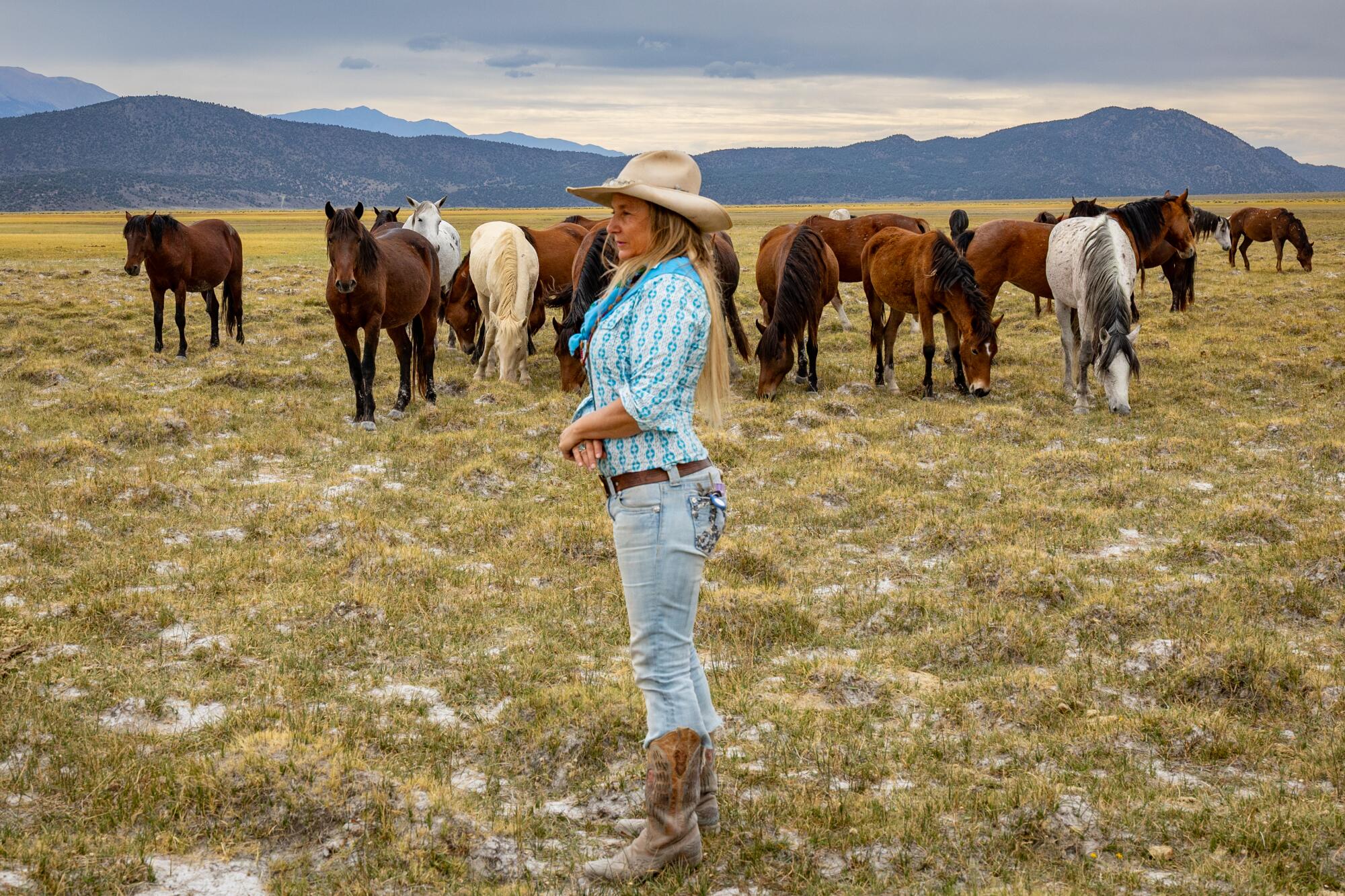
Maya Jamal Kasberg, founder of nonprofit Made by Mother Earth, is part of the coalition that wants to scrap the current plan to round up Montgomery Pass horses.
Kauk’s tribe historically rode the horses from Lee Vining into Yosemite to gather basket-making materials, among other activities. Mustangs were tapped for Native American rodeos and relay races, she added.
According to the coalition that includes the nonprofit American Wild Horse Conservation, federal officials and groups like the Mono Lake Committee have the science all wrong. The herbivores chomp down invasive cheatgrass that poses wildfire risk, and their poop — maligned by many — actually spreads native seeds, they say.
Wild and free — for now
At the heart of the emotional battle playing out in the Eastern Sierra is the Montgomery Pass wild horse herd. According to the U.S. Forest Service, its origin is unknown. But there’s speculation that it’s linked to mustang drives between the Owens Valley and Nevada.
A 1971 law declared wild horses and burros “living symbols of the historic and pioneer spirit of the West,” and made it illegal to harass, capture or kill them on public lands. But the Forest Service and BLM, which became responsible for managing them, can remove “excess animals” to preserve the health of the range.
The way this often plays out is that horses are rounded up and offered for adoption or sale. Those that aren’t taken in by a private owner are shipped to pastures where they often live out their remaining days.
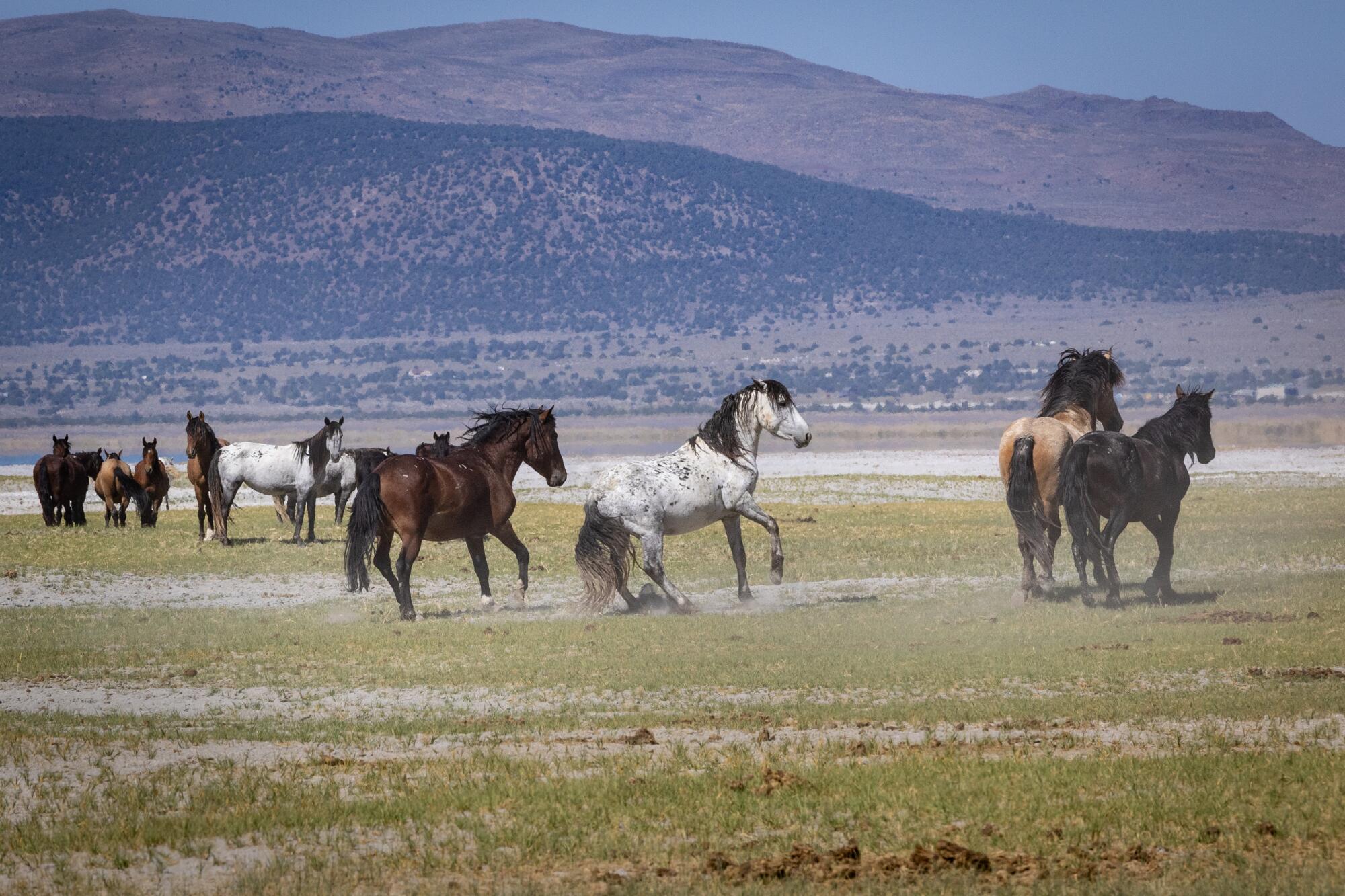
A census last year found that there are now about 700 horses in the Montgomery Pass herd.
Federal officials designated the Montgomery Pass Wild Horse Territory, a remote area spanning sagebrush steppe and pinyon pine forest east of Mono Lake. They say the land can sustainably support 138 to 230 horses.
As of last year, nearly 700 were documented in an aerial survey, with most ranging outside the territory, according to the agencies.
Now under a plan approved in March, up to 500 horses could be ousted, with the Forest Service leading the effort and BLM assisting.
Both agencies declined requests for interviews for this article, citing pending litigation. In August, a documentary filmmaker, primary care physician and wildlife ecologist sued the government authorities overseeing the agencies, claiming the roundups will decimate the herd to the point where long-term survival is unlikely.
“This case represents yet another attempt by the agencies to evade their statutory duties to protect, preserve and manage the herd,” the suit reads.
The government has agreed not to round up horses before Oct. 20, according to court documents.
When multiple uses collide
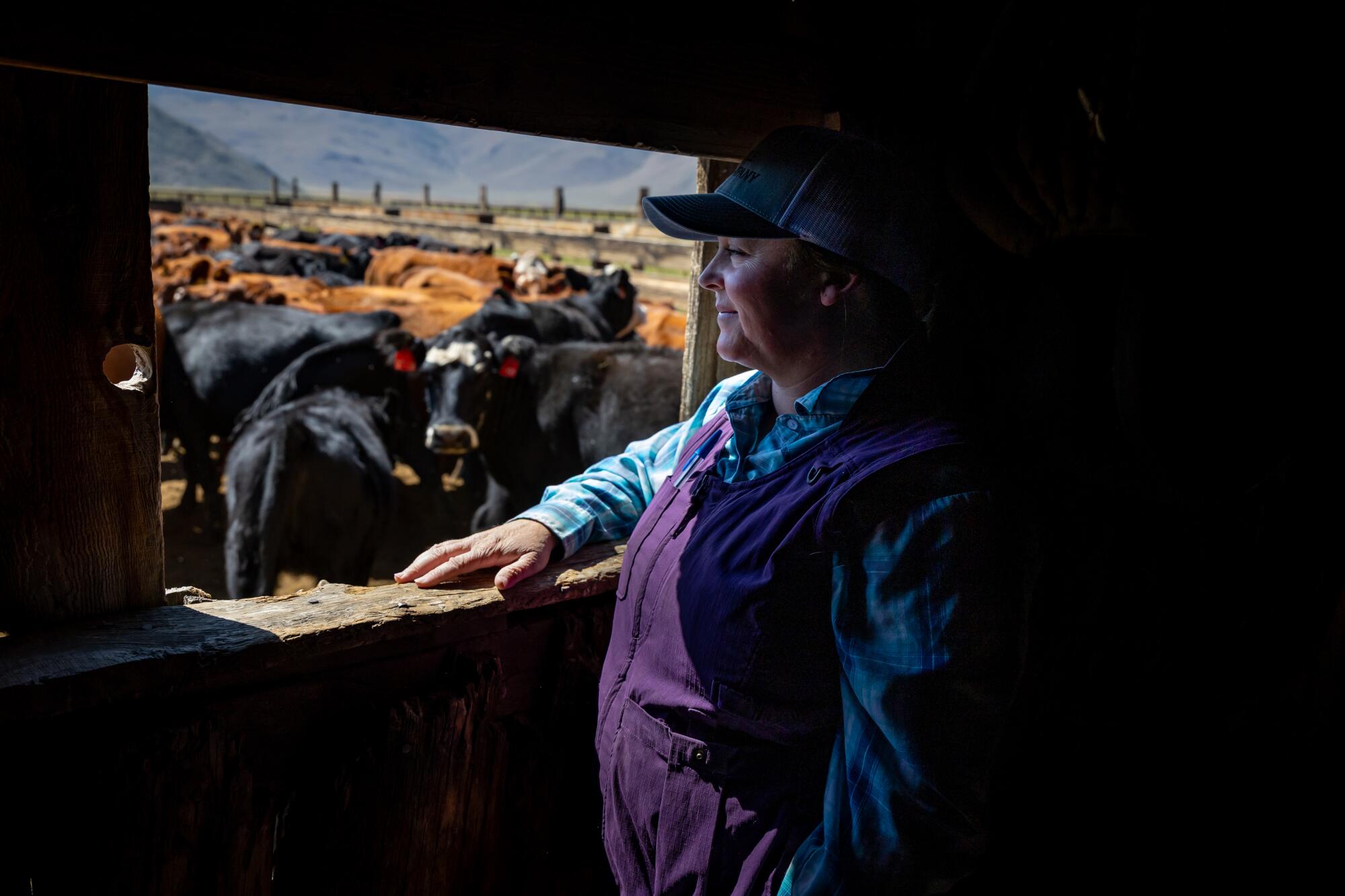
Rancher Leslie Hunewill looks at calves and their moms at her family’s historic ranch in Bridgeport.
Leslie Hunewill’s cattle ranching family sees quite a bit of “horse activity” on grazing lands in an area called the Mono Sand Flats, to the east and north of the lake. Since purchasing the right to use the public land, her outfit has been able to graze there for only about five weeks in the last two years — and not consecutively. The culprit? “A huge number of horses,” she said.
“Our cattle have not been out there,” she said. “There’s nothing for them to eat.”
Cows aren’t allowed on the roughly 50,000-acre expanse during the growing season. But the horses, facing no fences, go for what’s green and pushing up, she said.
“It doesn’t make sense for us to overuse or overgraze the land when we need to come back to it,” she said. “So when we are doing our part to manage the portion of it that we can, which is, say, our use of the cattle on that land, that’s all well and good. But who is taking charge of the horses and saying, this is too heavy use?”

The Hunewills, who have deep roots in the Eastern Sierra, operate a guest ranch in Bridgeport.
The law directs agencies to manage horse populations to maintain a “thriving natural ecological balance.” BLM and the Forest Service have to consider mustangs alongside grazing, wildlife and what’s good for the land. Some say the agencies have kicked the can down the road on management of the Montgomery Pass herd.
Hunewill’s family has deep roots in the Eastern Sierra. Her great-great-great-grandfather came to California in the 1860s as a gold miner. He struck it rich and got into the lumber business. When that stopped paying out, he used his oxen to feed the town of Bodie.
Her family is still in the beef business, with the meat generally staying on the West Coast.
They employ quite a few mustangs at their guest ranch operation in the town of Bridgeport, including Jethro, a friendly brown fella with a splash of white on his forehead. They’re hardy horses and can be enlisted as pack animals high up in the mountains. Some don’t need shoes because of their “great feet.”
But their robustness means “everybody’s already got their mustang,” she said, stymieing the prospect of mass adoptions.
Shifting dynamics
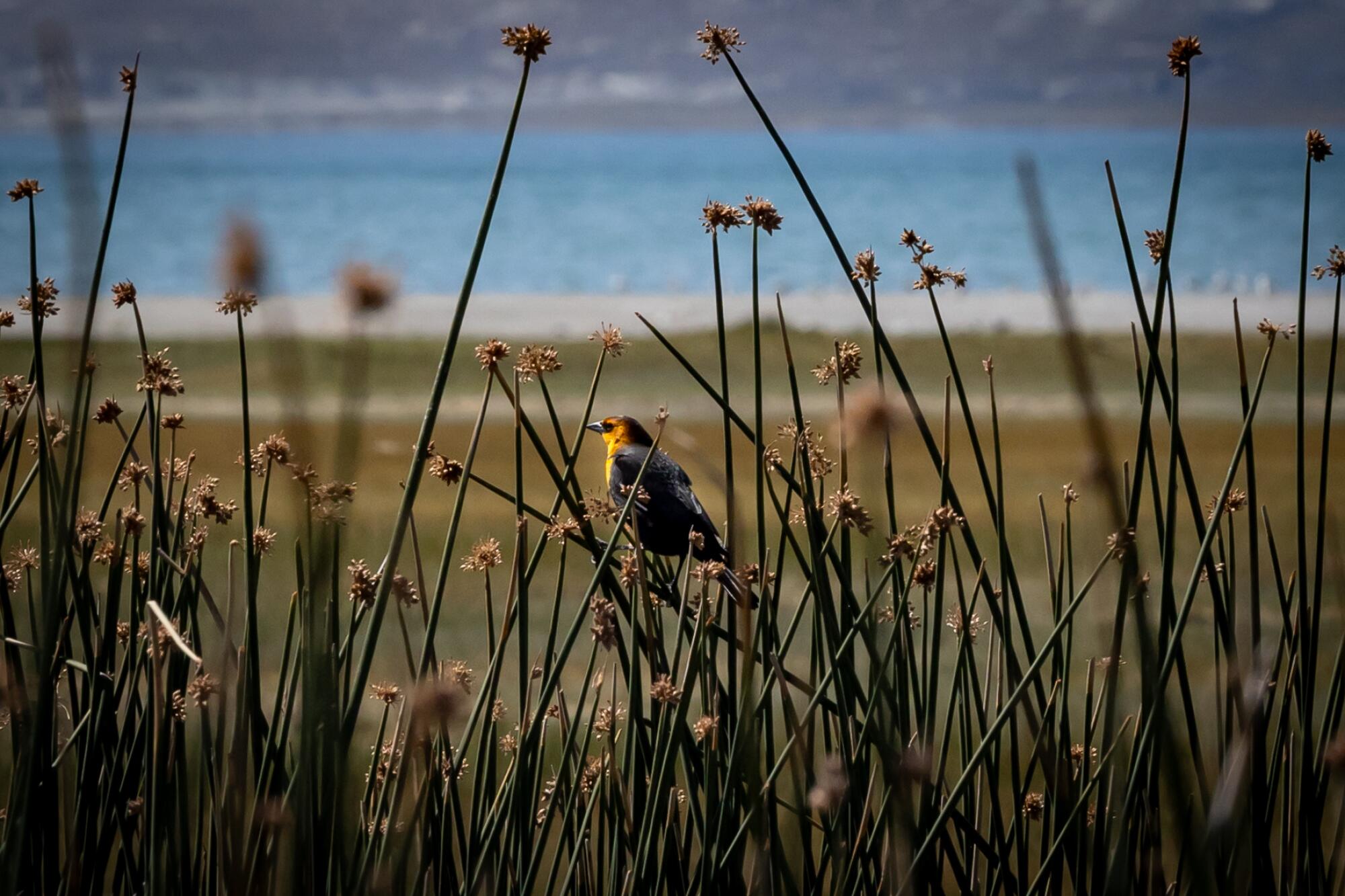
A bird perches in vegetation near Mono Lake.
Wild horse populations can increase as much as 20% a year. Montgomery Pass horses used to summer in the high country and were once kept in check by mountain lions that preyed on foals, according to John Turner, a professor at the University of Toledo College of Medicine, who studied the herd for decades.
That changed around 2008 or 2009, when the horses began lingering at lower elevations, where the open country makes it difficult for lions to hunt.
The herd’s population surged.
Turner sees the government’s current system of rounding up horses and holding them as unsustainable. And costly.
“The gathers are successful at that time, but the reproductive rate of the animals is greater than the capacity to remove them,” he said.


The number of Angelenos who went to the hospital with throat pain and concerns about smoke inhalation spiked as a fire burned through the massive Lineage cold storage warehouse in Boyle Heights this month, The Times has learned.
The blaze burned for eight days beginning June 17 and involved solar panels, insulation foam and other industrial materials.
During that time, more than three times as many people went to emergency departments within 10 miles of the warehouse mentioning the fire or smoke inhalation compared with the two weeks prior, according to data from the Los Angeles County Department of Public Health obtained through a public records request.
The agency also noted a near doubling of patients mentioning throat pain within five miles of the fire June 21 — 1.9 times the baseline levels.
Usually, fewer than 50 people go to the emergency room each day for throat pain, and fewer than 20 people for smoke inhalation, the department said.
The hospitalization data was tracked through the department’s syndromic surveillance project, which monitors trends in what people report when they come to emergency departments in L.A. County, as well as diagnosis codes noted by providers. The system is not as comprehensive as full patient health records, and clinicians may not always include key words about “fire,” “smoke” or other circumstantial information in their diagnoses, the public health department said.
As such, it “cannot capture the true number of [emergency department] visits related to symptoms from the fire and likely underestimates the true burden of fire related symptoms,” the department said.
Perhaps unexpectedly, the department said it did not note a substantial increase in asthma, acute respiratory symptoms or chronic obstructive pulmonary disease-related emergency department visits during the fire.
But even these preliminary findings are concerning, experts said. The fire is believed to have started on the solar array on the roof of the 500,000 square-foot building, which housed 85 million pounds of frozen food. It then reached an ammonia line, prompting two brief shelter-in-place orders for nearby residents.
Over the next week, the fire continued to burn through dense insulation foam within the building’s walls and other unknown industrial materials, blanketing much of L.A. in acrid smoke. Residents in downtown L.A., northeast L.A., Burbank, the San Gabriel Valley and many other parts of the city and county reported seeing and smelling the fumes.
The South Coast Air Quality Management District issued multiple warnings about unhealthy levels of PM 2.5, or fine particulate matter. The city and county opened two smoke respite shelters in the immediate area so that people could breath cleaner air.
It is still unclear what exactly was in the smoke that people breathed in. Industrial fires release far more materials than the burned wood smoke that is emitted during wildfires.
“The makeup of the smoke can include toxic chemicals, fine particles and other serious risks to lung health depending on fire conditions and what is burned,” Will Barrett, assistant vice president for nationwide clean air policy at the American Lung Assn., said as the fire was burning. Children and elderly people are particularly at risk.
David Eisenman, director of the UCLA Center for Public Health and Disasters, said urban industrial fires also can represent a hazard that standard PM 2.5 warnings don’t always address. Those advisories are “blunt instruments” that don’t adequately capture emissions from burning man-made goods — or convey that the source of pollution may include burning batteries or toxic refrigerants, he said.
The fact that initial numbers don’t show a spike in asthma attacks is “somewhat reassuring,” Eisenman said. But “people may have gone to their primary care doctors, which this would not capture. This data deserves follow up.”
The air district and the U.S. Environmental Protection Agency deployed air monitors to assess particulate matter, airborne toxic metals and other harmful compounds during the early days of the blaze. The air district said it didn’t find significant levels of air toxics during the first two days of the fire, although it did record significantly elevated concentrations of particulate matter within the plume downwind.
Some of the measurements it took with mobile monitors, which are five-minute snapshots, also showed increased bromine and chlorine, which often are found when buildings burn and were at levels “below short-term health-based exposure thresholds,” the air district said. It began continuous PM 2.5. monitoring at two nearby elementary schools on the third day.
The L.A. Fire Department said it detected low-levels of toxic hydrogen fluoride on the second day of the fire, which can be a byproduct of burning lithium-ion batteries.
Lineage, the tenant-operator of the warehouse, said no concentrations of ammonia were detected in the air at any time.
“There’s no doubt this fire has had a huge impact on the local community, and we are committed to showing up in every way we can,” company officials wrote in a statement last week. They said Lineage worked closely with the Fire Department during the blaze and delivered masks, air purifiers and other supplies to the community, and will work to ensure the fastest cleanup possible.
The long-term health effects of the fire and its smoke probably won’t be known unless researchers conduct a follow-up study, said Eisenman of UCLA.
For example, there may have been delayed pulmonary effects from the hydrogen fluoride and burning insulation foam that — when combined with the elevated PM 2.5 levels in a dense urban environment — produced health effects that didn’t show up in the emergency room data.
“They will show up in increased primary care office visits and exacerbations of chronic disease over the next few weeks,” he said. “So from a public health standpoint, this fire is not over.”

LOS ANGELES — All the water unleashed onto the warehouse fire in Boyle Heights — some of it 480 gallons at a time by helicopter — had to end up somewhere.
That somewhere is the Los Angeles River.
Los Angeles Fire Department crews ripped through 50-foot walls filled with foam insulation to get to the building’s steel skeleton and its storage racks.
Charred chunks of foam have been floating from the burn site, partially blocking storm drains. Now organizers from East Yard Communities for Environmental Justice are teaming up with scientists from UCLA and Columbia University to find out more about what’s in the runoff.
“The community here is really interested in knowing, ‘Are there any contaminants that are potentially making their way down to the L.A. River?’” said Yoshira “Yoshi” Ornelas Van Horne, UCLA assistant professor in environmental health sciences. “We really can’t answer that unless we actually have measures and samples analyzed.”
Water samples collected directly from the warehouse fire runoff have been shipped to Columbia‘s Multi-Element Trace Analysis Laboratory in New York, which has a spectrometer that can identify trace levels of elements. The lab also has relationships with researchers in Southern California.
2

1. Emmanuel Carrera Ruedas, left, and Casey Cooper prep containers to take water samples from the L.A. River. 2. Casey Cooper holds a water sample. (Christina House / Los Angeles Times)
The data will then come back to UCLA for analysis. For now, the scientists and community advocates only have the money to test for copper, lead and arsenic, Ornelas Van Horne said. Residents have expressed interest in testing for more contaminants.
As the water from the firefighting efforts trickles through the warehouse in rivulets, it forms a stream at the corner of S. Indiana and Noakes streets, that gushed into the storm drain. On a recent visit, the water traversed a smoky 10-foot canyon of charred foam and twisted wall panels on its way to the drain.
From there, the water flows to the L.A. River. Despite the fact that its concrete design is intended to whisk water out of the city as fast as possible, life stubbornly persists in the river and nearby. Recreational swimming is not permitted, yet anglers fishing for tilapia, largemouth bass and carp are a common sight along the rocky sides of the soft-bottom areas.
The L.A. River, and all it carries with it, meets the ocean in Long Beach.
The L.A. County Public Works Department said it has deployed three containment booms — floating barriers — on the L.A. River, and is continuing to monitor the water as it makes its way to the ocean.

Emmanuel Carrera Ruedas takes a water sample.
(Christina House / Los Angeles Times)
Before it gets there, the river passes through the Dominguez wetlands, where Public Works is removing some number of dead fish. The wetland has absorbed toxic runoff from a warehouse fire before, resulting in a fish die-off.
“For so long, the L.A. River has been used as a dumping ground for all kinds of chemicals,” said Emmanuel Carrera Ruedas, a community scientist and member of East Yard Communities for Environmental Justice.
Pollution has plagued the L.A. River, but it does have allies. In the 1980s, the Friends of the LA River pushed to address street runoff and trash that had made the water body infamous. Significant progress from advocacy and government initiatives improved water conditions, but these efforts have not been equally distributed.
Carrera said the samples represent “proof of what’s actually going on, and accountability, too, for the city, of not just what’s happening in our air, but what’s actually happening in our waterways.”
The first samples for the project were taken last Friday, the second day of the fire.
They were the first of 20 samples the research groups have agreed to test at no cost to see if any exceed regulatory standards and could pose a risk to people nearby.
The warehouse fire represents the latest environmental disaster for people in Boyle Heights and East L.A. Just four weeks ago, a telecommunications crew accidentally struck one of the many oil pipelines beneath the L.A. area, spilling 25,000 gallons of crude oil near Eastern and Cesar Chavez avenues — including into storm drains feeding to the L.A. River.
“I think it really is difficult to see disaster after disaster hit the communities here, with not a lot of talk about how we can move through these disasters together,” said Casey Cooper, a volunteer community scientist involved in the sampling. They were inspired, they said, by the response of neighbors, and how people were supporting one another.
Results from the laboratory analysis could be back to Ornelas Van Horne within a month.

The U.S. Environmental Protection Agency is ramping up its enforcement of illegal pesticides smuggled through the ports of Long Beach and Los Angeles, officials said during a visit to L.A. on Thursday.
Since President Trump began his second term in January 2025, EPA has blocked more than 2.4 million pounds of illegal pesticides from entering the country, said Lee Zeldin, the agency’s administrator. Much of it comes from China, but some comes from Mexico and, on the East Coast, from Africa.
“We’re very alarmed by any chemical that anyone would seek to bring into this country that our own government hasn’t had the opportunity to vet, to research to fully understand,” Zeldin said. “That’s why it’s so important that these products get stopped at the border.”
The announcement came just hours after the Supreme Court handed a major victory to the makers of the weedkiller Roundup, shielding it from thousands of lawsuits from states alleging the company failed to warn people the product could cause cancer.
Speaking from a U.S. Customs and Border Protection warehouse in Carson, Zeldin pointed to a white bottle with a yellow label reading “SNIPER” — an illegal pesticide product commonly imported from abroad and sold online — that was recently intercepted at the Port of L.A. complex. Sniper contains dichlorvos, or DDVP, a highly toxic insecticide that is not registered or approved for use in the U.S. It is known to cause neurological problems, convulsions and comas, with children particularly at risk.
Illegal pesticides are cause for concern in California, where they are often associated with illegal cannabis operations. Last year, Siskiyou County declared a local emergency in response to the “escalating threat” posed by illegal pesticides, often fumigants, in illicit cannabis operations.
“These chemicals, when burned, create thick, poisonous smoke that presents serious risks to public health, the environment, waterways, and first responder safety,” the county said.
A 2024 Los Angeles Times investigation found that contraband Chinese pesticides used on cannabis farms is a growing problem in the state.
Customs and Border Protection seized containers of an illegal pesticide from China that were packed with legitimate items.
(Myung J. Chun/Los Angeles Times)
Much of the illegal product comes through the ports of L.A. and Long Beach, which together handle more than 30% of the nation’s container traffic, officials said. EPA works closely with Border Patrol officials, who flag suspicious cargo containers at the port for further inspection.
CBP spokesman Jaime Ruiz said the agency is using artificial intelligence tools to help scan incoming cargo manifests for potentially illegal items. Thousands of containers are flagged for inspection each year, although that number also includes drugs, counterfeit goods and other contraband in addition to pesticides, he said. He could not immediately say what percentage were illegal pesticides.
Illegal pesticides have at times been found in California agriculture and the California Department of Pesticide Regulation has taken enforcement action against violators. The DPR operates one of the nation’s largest pesticide residue testing programs, analyzing some 3,500 produce samples each year from wholesale and retail stores and other outlets. The state produces about half of the nation’s fruits and vegetables.
Jeff Hall, assistant administrator of EPA’s Office of Enforcement and Compliance, said the issue should be bipartisan.
“We cannot allow foreign actors to profit by sending toxic and poisonous products into the United States and poisoning American communities,” he said. “This is a message that we should all be able to agree on, especially for pesticides.”
However, the agency’s visit to L.A. arrived at a fractured moment for U.S. pesticide regulation and for the Trump-aligned Make America Healthy Again movement.
On Thursday, the Supreme Court ruled 7-2 in favor of Bayer’s Monsanto, the maker of the powerful weedkiller Roundup, shielding it from thousands of state lawsuits that allege the company failed to warn people the product could cause cancer.
Roundup contains glyphosate, which was classified by the World Health Organization as “probably carcinogenic” in 2015. But the Supreme Court found that the company can’t be sued in state courts because federal agencies — including the EPA — have determined that it’s not likely to cause cancer in humans when used as directed. The EPA has repeatedly approved a label for the product without a cancer warning.
“When people are exposed to pesticides, they deserve honest warnings about the risks,” said Bill Jordan, former deputy director of EPA’s Office of Pesticide Programs, in a statement. “The Court’s decision leaves families, workers, and communities with fewer tools to protect themselves and to recover damages when they are injured by a pesticide.”
-

 Illinois10 minutes ago
U.S. Supreme Court rejects effort to end birthright citizenship; Illinois advocates relieved
-

 Indiana12 minutes ago
Officials urge water safety amid ‘alarming’ number of drownings
-

 Iowa18 minutes ago
Iowa judges take ICE to task over ‘astonishing conduct’ and violations of court orders
-

 Kansas25 minutes ago
Kansas man sentenced to 18 years for child exploitation and pornography production
-
 Kentucky28 minutes ago
Cumberland Falls’ renowned moonbow draws visitors from across the country to Kentucky
-

 Louisiana33 minutes ago
Louisiana summers are getting hotter and more humid, researchers say
-

 Maine40 minutes ago
Cooling centers to open in Maine as heat, air quality advisories take effect Wednesday
-

 Maryland42 minutes ago
Teen allegedly hits off-duty officer, crashes into Maryland home

